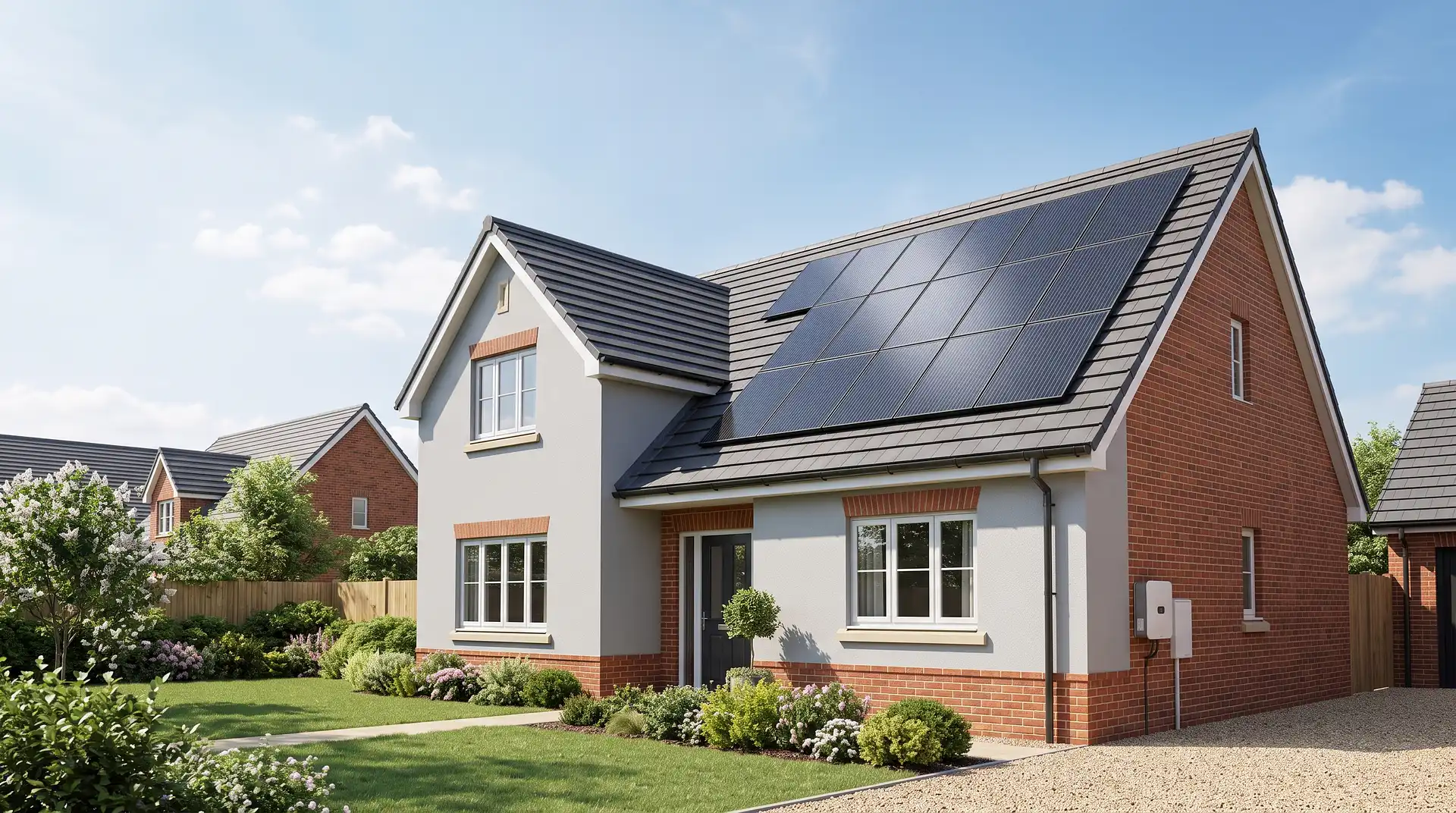
How Do Solar Panels Work
15 August 2026
How Do Solar Panels Work? (And What They Actually Cost)
Solar panels convert light into electricity through the photovoltaic effect, but the part that actually determines whether they're worth installing isn't the physics, it's what happens to that electricity once it's generated. A panel producing power at 1pm when nobody's home is worth considerably less than the same power produced at 6pm when the oven, kettle, and television are all running. Understanding that distinction explains almost everything about solar economics, including why batteries exist and why payback periods vary so much between otherwise identical households.
The Physical Mechanism
Solar panels are made up of photovoltaic cells, typically silicon-based. When photons of light strike the cell, they knock electrons loose from the silicon atoms. The cell is constructed with two layers treated to have opposite electrical charges, which creates an electric field across the junction between them. That field pushes the freed electrons in one direction rather than letting them drift randomly, and that directional flow of electrons is an electric current.
Critically, this is a light-driven process rather than a heat-driven one. Solar panels work on overcast UK days, just less efficiently than in direct sun. They also lose a small amount of efficiency at very high temperatures, which is why exceptionally hot days aren't necessarily the highest-output days.
From Panel to Plug Socket
The current produced by the panels is direct current, DC, while everything in your home runs on alternating current, AC, at 230V. This is where the inverter comes in, converting DC to AC so the electricity can be used by your appliances or exported to the grid.
The inverter is genuinely a significant component rather than an accessory. According to InstantCost.co.uk's 2026 UK cost breakdown, on a typical installation the inverter accounts for roughly £588 to £865 of the total, against £2,059 to £3,028 for the panels themselves. It's also usually the first component to need replacing, since inverters typically have shorter warranties than panels, which are commonly warranted for 25 years.
What Happens to the Electricity
Once converted to AC, generated electricity follows a simple priority order. It powers whatever your home is using at that moment. Any surplus either charges a battery, if you have one, or is exported to the grid. If you're generating less than you're using, the shortfall is drawn from the grid as normal.
This is where self-consumption becomes the central economic question. Electricity you use yourself saves you the full import rate, currently around 27p per kWh. Electricity you export earns the Smart Export Guarantee rate, around 15p per kWh. Every unit you use rather than export is worth roughly 12p more to you.
Why Batteries Change the Maths
A battery stores surplus daytime generation for evening use, converting export-rate electricity into import-rate savings. According to InstantCost's data, this raises self-consumption from roughly 50% without a battery to around 75% with one.
The effect on annual savings is meaningful: a 4kW system generating roughly 3,400 kWh a year saves around £550 to £750 annually without a battery, rising to £850 to £1,100 with one. But the battery itself costs £2,500 to £4,000 for a 5kWh unit or £4,500 to £7,000 for 10kWh, which is why payback stretches from 9 to 12 years for panels alone to 11 to 14 years with a battery.
The honest guidance here is that a battery makes sense if you're home in the evenings or on a time-of-use tariff, and drags the payback if you're out all day and use little electricity after dark.
Roof Direction Matters More Than People Expect
South-facing roofs are the benchmark. East or west-facing roofs lose roughly 15% of generation compared to south, which is a real but not disqualifying reduction. North-facing roofs rarely pay, since the generation shortfall is severe enough that the economics generally don't work regardless of system size.
Roof material affects cost rather than output, slate and flat roofs cost more to work on than plain tile, and two-storey homes almost always need scaffolding, adding £500 to £1,000.
System Sizes and What They Suit
System | Panels | Typical Cost | Suits |
|---|---|---|---|
3kW | 8 panels | £4,500 to £6,000 | 1 to 2 bed home |
4kW | 10 panels | £5,500 to £7,500 | Most common UK size |
5 to 6kW | 12 to 15 panels | £7,000 to £10,000 | Larger family homes, high usage |
The 4kW system is the most common UK installation, and its roughly 3,400 kWh annual output is the figure most savings estimates are built around.
Funding and Grants
There's no VAT on domestic solar installations in the UK, which is a meaningful saving already built into quoted prices. Beyond that, some low-income households qualify for funded solar under ECO4, which runs to 31 December 2026.
ECO4 is one of several UK schemes aimed at reducing household energy costs, and it's worth knowing how it sits alongside the others before assuming you don't qualify for anything. Our related guide covers the Warm Home Discount Scheme and how it differs from the Warm Homes Plan , which is genuinely useful context since these schemes are frequently confused with each other and have quite different eligibility criteria and application routes.
Planning Permission
Roof-mounted panels are permitted development on most UK homes, meaning no planning permission is needed. The main exceptions are listed buildings and properties in conservation areas, where you should check with your local authority before committing to an installation.
Common Misconceptions
"Solar panels don't work in the UK climate." They work on overcast days, just at reduced output. A 4kW system generating 3,400 kWh a year is a UK figure, not a Mediterranean one.
"You need direct sunlight." Panels respond to light, including diffuse light through cloud. Direct sun maximises output but isn't a requirement for generation.
"Hotter is better." Panels lose a small amount of efficiency at high temperatures. It's light intensity and daylight hours that drive output, not heat.
"A battery is essential." It genuinely isn't, and for households out all day using little evening electricity, it can extend payback rather than improve returns.
"Panels need constant maintenance." They have no moving parts. Occasional cleaning and periodic inverter checks are the main requirements, with panels typically warranted for 25 years.
Common Mistakes and What to Do Instead
Mistake: sizing the system on roof space rather than electricity usage. A larger system generates more, but if you can't use or store it, the surplus earns only the export rate. Match system size to consumption patterns.
Mistake: adding a battery by default. It's the single biggest add-on cost and only improves returns if your usage is genuinely evening-weighted or you're on a time-of-use tariff.
Mistake: ignoring the inverter's replacement lifespan. Panels are warranted around 25 years, but inverters typically need replacing sooner. Factor that into long-term cost projections rather than assuming a one-off spend.
Mistake: not checking scaffolding is included in a quote. At £500 to £1,000 on most two-storey homes, this is a substantial line item that can be quoted separately.
Mistake: assuming the headline savings figure applies to you. Published estimates assume a south-facing unshaded roof and a particular self-consumption rate. Change those and the numbers move considerably.
What It Costs in the UK
Item | Typical UK Cost (2026) |
|---|---|
3kW system (8 panels) | £4,500 to £6,000 |
4kW system (10 panels) | £5,500 to £7,500 |
5 to 6kW system | £7,000 to £10,000 |
5kWh battery | £2,500 to £4,000 |
10kWh battery | £4,500 to £7,000 |
Scaffolding | £500 to £1,000 |
Annual savings, panels only | £550 to £750 |
Annual savings, with battery | £850 to £1,100 |
Payback, panels only | 9 to 12 years |
Payback, with battery | 11 to 14 years |
All figures based on InstantCost.co.uk's 2026 UK solar pricing data. Savings assume 27p per kWh import, 15p per kWh export under SEG, a south-facing unshaded roof, and 50% self-consumption without a battery or 75% with one. Always get three quotes before booking.
Getting a Fair Quote
Confirm whether scaffolding is included or extra, since it's a substantial cost on two-storey properties. Ask what inverter is being fitted and what its warranty period is, given it's the component most likely to need replacing within the panels' lifetime. Check the self-consumption assumption behind any savings projection you're given, since a quote assuming 75% self-consumption on a household that's out all day is not a realistic forecast. Get three quotes, and be wary of any projection that doesn't state its import and export rate assumptions.
Staying Safe
Solar installation involves both working at height and electrical work connecting to your consumer unit, which is why it's a job for MCS-certified installers rather than general builders. Certification also matters practically, since Smart Export Guarantee payments generally require an MCS-certified installation.
Never attempt to clean roof-mounted panels yourself from a ladder. Panels are typically low-maintenance and any cleaning that's genuinely needed should be done from the ground with appropriate equipment or by a professional.
Grant scheme eligibility and export tariff rates change periodically, so confirm current ECO4 criteria and SEG rates directly before building them into your financial calculations.
FAQ
How do solar panels actually generate electricity? Photons of light knock electrons loose in silicon photovoltaic cells, and an electric field within the cell forces those electrons to flow in one direction, creating a current. An inverter then converts that DC current to the AC electricity your home uses.
Do solar panels work on cloudy days in the UK? Yes, they respond to light rather than heat, so they generate on overcast days at reduced output. A typical 4kW UK system produces around 3,400 kWh annually in real British conditions.
What does the inverter do? It converts the direct current produced by the panels into the alternating current your home and the grid use. It typically costs £588 to £865 of a system's total and usually needs replacing before the panels do.
Is a battery worth adding? It raises self-consumption from around 50% to 75% and annual savings from £550 to £750 up to £850 to £1,100, but costs £2,500 to £7,000 and extends payback from 9 to 12 years out to 11 to 14. Worth it if you're home evenings or on a time-of-use tariff.
Do I need planning permission for solar panels? Usually not, roof-mounted panels are permitted development on most UK homes. Listed buildings and conservation areas are the main exceptions worth checking.
How much do solar panels cost in the UK? A 4kW system, the most common size, costs £5,500 to £7,500 fitted in 2026, with 3kW at £4,500 to £6,000 and 5 to 6kW at £7,000 to £10,000. Scaffolding adds £500 to £1,000 where needed.