How Do You Charge an Electric Car
16 August 2026
How Do You Charge an Electric Car? (A Complete Beginner's Guide)
Charging an electric car is mechanically simpler than filling up with petrol, plug in, walk away, unplug when you're done, but the surrounding decisions genuinely aren't obvious the first time. Which connector fits your car. Which speed of charger you actually need. Whether you need an app, a card, or nothing at all. None of this is complicated once explained, but almost none of it is explained anywhere you'd naturally look before you already own the car.
The Connector You'll Actually Use
Nearly every electric car sold in the UK uses a Type 2 connector for regular AC charging, this is what you'll plug into at home and at the vast majority of public destination and fast chargers. It's a standardised shape across manufacturers, so a Type 2 cable works with essentially any modern EV regardless of brand.
For rapid DC charging, the connector is different, most non-Tesla cars use CCS (Combined Charging System), which adds two extra pins below the Type 2 shape specifically for high-power DC charging. Tesla vehicles in the UK now also use CCS as standard on newer models. You won't need to think about this distinction for home charging, it only matters at rapid and ultra-rapid public chargers.
Charging at Home
This is where most EV owners do the vast majority of their charging, and it's genuinely the simplest option once installed.
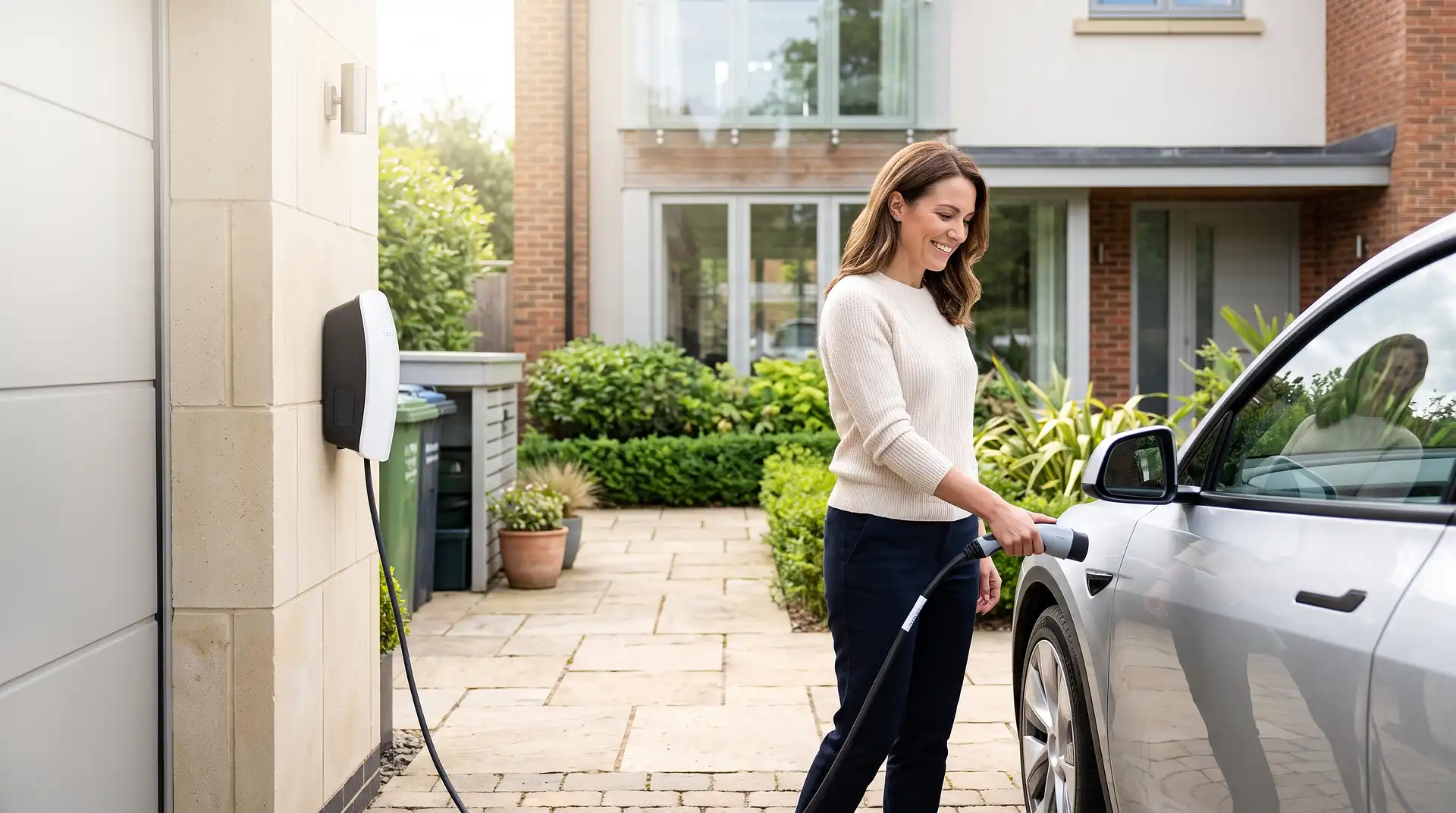
Plug in when you arrive. Connect the cable to your car and to the wallbox. Most home chargers start automatically, though some need a tap of an RFID card or an app confirmation depending on the model.
Let it charge overnight. A 7kW home charger adds roughly 30 miles of range per hour, so an 8 to 9 hour overnight session comfortably takes a typical battery from low to full.
Use smart scheduling if you're on an off-peak tariff. Many home chargers and EVs let you schedule charging to start automatically once cheap overnight rates begin, rather than charging the moment you plug in at a more expensive daytime rate. This is worth setting up specifically, since it's the difference between paying the standard rate and the considerably cheaper overnight one for exactly the same electricity.
Tethered or untethered. A tethered charger has the cable permanently attached, which is more convenient day to day since there's nothing to carry or store. An untethered charger has a socket you plug your own cable into, costs slightly less, keeps the wall tidier, and works with any cable type if you ever need a different one.
Charging Away From Home
Slower public chargers (up to 49kW, AC) are common at supermarkets, car parks, and leisure venues. These use the same Type 2 connector as home charging and suit situations where you're parked for a couple of hours anyway, shopping, at the gym, at work.
Rapid and ultra-rapid chargers (50kW and above, DC) use the CCS connector and are found at motorway services and dedicated charging hubs. These are built for speed rather than cost, a 150kW+ ultra-rapid unit can add around 100 miles of range in roughly 10 minutes, which is genuinely useful on a long journey and not something you'd use for routine daily charging given the higher cost per kWh.
How to Actually Start a Public Charging Session
This is the part that catches new EV owners out, since it varies by network. Most public chargers work one of three ways: a dedicated app for that specific network, which you download, register a payment method with, and use to start and stop sessions, contactless payment directly at the charger, increasingly common and required by regulation on newer rapid chargers, or an RFID card or fob issued by the network or through a roaming service that works across multiple networks.
With dozens of networks operating across the UK, it's genuinely worth having two or three network apps installed before you need them on a long journey, plus a contactless card as a fallback, rather than discovering at a motorway services that the charger you've pulled up to needs an app you don't have.
Reading a Charging Session
Once connected, most chargers or their app show current charging speed in kW, energy delivered so far in kWh, and either a percentage or estimated time to your target charge level. Rapid chargers taper their speed as the battery fills, charging quickly up to around 80% and considerably more slowly beyond that, which is why many drivers on longer journeys aim for 80% at a rapid charger rather than waiting for a full 100%, since the last 20% can take nearly as long as the first 80%.
What You Need at Home First
To charge properly and access the cheapest rates, you need a dedicated home charger rather than relying on a standard three-pin socket, which isn't designed for the sustained high load of regular EV charging. According to InstantCost.co.uk's 2026 UK pricing data, a standard 7kW installation costs £900 to £1,400, rising to £1,200 to £1,800 for a longer cable run, or £1,400 to £2,200 for a 22kW unit, which needs a three-phase supply most homes don't have. Around one in four installations also needs a consumer unit upgrade, adding £450 to £900. Installation must be carried out by an approved installer and is notified under Part P of the Building Regulations as standard.
Getting the charger installed is really only step one though, since how much each session actually costs you depends heavily on your electricity tariff and when you plug in, not just having a charger fitted. Our related guide covers how much it actually costs to charge an electric car , including the roughly tenfold difference between an off-peak home tariff and a public rapid charger, worth reading once you've got the physical charging process sorted and want to minimise what you're paying for it.
Common Mistakes and What to Do Instead
Mistake: relying on a standard three-pin socket for regular charging. These aren't designed for sustained high-load charging. A properly installed wallbox is the correct solution for routine home charging, not an occasional workaround.
Mistake: not setting up off-peak scheduling. Plugging in and charging immediately on arrival, rather than scheduling for the cheap overnight window, means paying the standard rate for electricity that could cost a fraction as much an hour or two later.
Mistake: arriving at a rapid charger without the right app or payment method installed. Download two or three major network apps before a long journey, and carry a contactless card as backup, rather than discovering the gap when you're already low on charge.
Mistake: routinely charging to 100% at rapid chargers. Charging slows considerably above 80%, so waiting for a full charge on a rapid unit wastes time for comparatively little extra range. Charge to 80% and continue your journey unless you specifically need the last portion.
Mistake: assuming any public charger uses the same connector. Slower public chargers use Type 2, the same as home charging. Rapid and ultra-rapid chargers use CCS. Check before you arrive if you're unfamiliar with a specific charger.
What It Costs in the UK
Item | Typical UK Cost (2026) |
|---|---|
7kW charger, standard install (under 10m cable) | £900 to £1,400 |
7kW charger, long cable run (over 15m) | £1,200 to £1,800 |
22kW charger (needs three-phase supply) | £1,400 to £2,200 |
Consumer unit upgrade, if needed | £450 to £900 |
Installation with no off-street parking | £1,500 to £2,500 |
EV chargepoint grant (renters, flat owners) | Up to £350 |
Figures based on InstantCost.co.uk's 2026 UK pricing data. Around one in four installations needs a consumer unit upgrade. Always get three quotes before booking.
Staying Safe
Only use a charger and cable appropriate for your car's maximum charging rate, and never use a damaged cable or connector, visible wear, cracking, or exposed wiring means the cable should be replaced rather than used. Home charger installation must be carried out by a qualified, approved installer, this is both a safety requirement and a Part P notification obligation your installer handles as part of the job.
At public chargers, park considerately and don't leave a fully charged car occupying a charging bay longer than necessary, both a courtesy and, on some networks, subject to an idle fee once your session completes.
Charging standards and connector types are broadly consistent across the UK, but always check your specific vehicle's manual for its maximum charging rate and compatible connector types.
FAQ
What connector do I need to charge my electric car in the UK? Type 2 for home and slower public charging, which fits nearly all modern EVs regardless of brand. Rapid and ultra-rapid public chargers use CCS instead, a different connector for high-power DC charging.
How long does it take to charge an electric car at home? A 7kW home charger adds roughly 30 miles of range per hour, so an overnight session of 8 to 9 hours comfortably takes a typical battery from low to full.
Do I need an app to use public chargers? Often yes, though contactless payment is increasingly standard on newer rapid chargers. It's worth having two or three network apps installed before a long journey, plus a contactless card as backup.
Why does rapid charging slow down near the end? Charging speed tapers above roughly 80% to protect battery health. Many drivers aim for 80% on a rapid charger rather than waiting for 100%, since the final portion takes disproportionately longer.
Can I charge my electric car from a normal wall socket? Only occasionally as a backup. Standard three-pin sockets aren't designed for sustained high-load EV charging. A dedicated home charger, properly installed, is the correct solution for regular use.
How much does it cost to install a home EV charger? A standard 7kW installation typically costs £900 to £1,400 according to 2026 UK data, rising for longer cable runs, a 22kW unit, or if a consumer unit upgrade is needed.