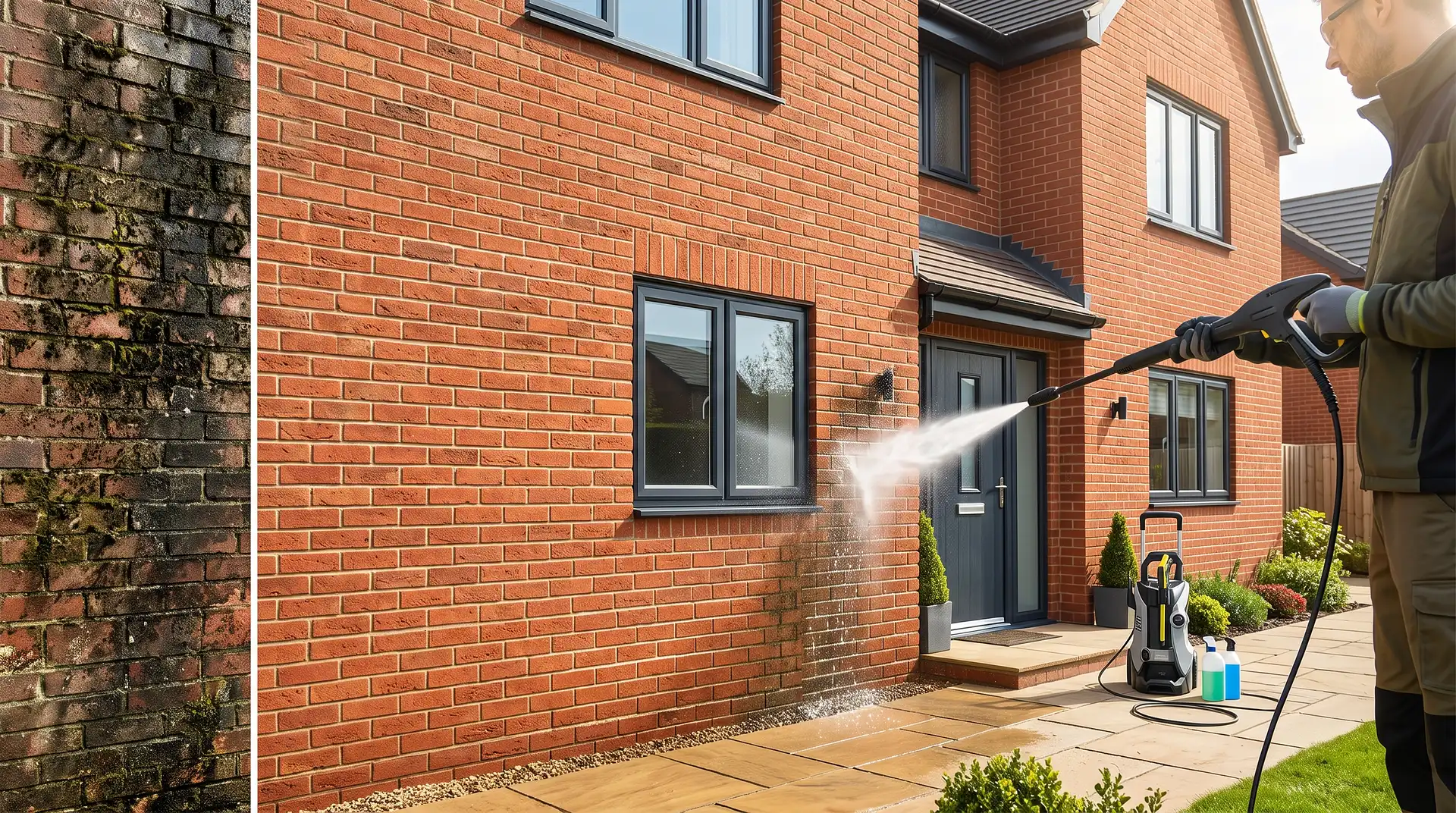
How Do You Clean a Brick House
27 July 2026
How Do You Clean a Brick House? (Without Damaging It)
Cleaning a brick house sounds like a job where more force gets better results, but it's the opposite — the biggest risk isn't leaving it dirty, it's cleaning it too aggressively and forcing water into brick that was never built to handle that pressure. Older or softer brick can be permanently damaged by the same pressure washer setting that's perfectly fine on a modern, hard-fired brick house, which is why matching the method to your specific brick matters more than any product or equipment choice.
Work Out What Kind of Brick You Have First
Newer, hard-fired brick — most builds from roughly the 1950s onward — generally tolerates moderate pressure washing without issue. Older, softer, or handmade brick, common in Victorian, Edwardian, and other pre-war properties, is more porous and can be genuinely damaged by high pressure, since the force erodes the surface and lets water penetrate rather than shed off it. If you're not certain which category your house falls into, treat that uncertainty as useful information: it's the signal to start with the gentlest method and work up only if genuinely needed, rather than reaching for a pressure washer on full power as the default first step.
What's Actually Causing the Dirt
General grime and traffic film — a dull, greyish buildup, often worse on street-facing walls — is typically just accumulated airborne dust and pollution and responds well to a straightforward wash.
Algae, moss, and lichen — greenish or black patches, usually worse on shaded or north-facing walls — need a fungicidal treatment, not just washing, since rinsing off visible growth without treating it leaves spores behind that regrow within months.
Efflorescence — a white, powdery salt deposit on the brick surface — comes from mineral salts migrating out of the brick or mortar as moisture evaporates, and it's more of a symptom to investigate than a straightforward cleaning job, since it often points to an ongoing moisture source.
Staining from old paint, carbon deposits, or previous repairs is the most stubborn category and typically needs a specific chemical or steam-based treatment beyond a general wash.
The Standard Cleaning Method
Dry brush first. A stiff, non-wire brush removes loose dirt, cobwebs, and surface moss before any water touches the wall, preventing you from scrubbing mud into the brick.
Wet the wall from the bottom up. This stops dirty water streaking down and drying onto sections you haven't cleaned yet.
Apply a fungicidal wash to any algae, moss, or lichen and leave it to dwell for the time stated on the product, commonly 15–30 minutes, before general washing.
Wash with a mild detergent solution and a soft-to-medium brush, working in manageable sections rather than the whole wall at once.
Rinse from the top down — the opposite direction to the wetting step — so dirty runoff doesn't dry onto brick you've already cleaned.
Let it dry fully before judging the result. Brick often looks patchy while damp and evens out considerably once fully dry.
If using a pressure washer on brick confirmed suitable for it, keep the nozzle at a wide fan angle and a sensible distance from the wall, using the lowest pressure that shifts the dirt. Professional brick cleaners often favour soft washing — low pressure combined with a mild chemical solution — over high pressure specifically because it cleans just as effectively with far less risk to the brick face and mortar joints.
Common Mistakes and What to Do Instead
Mistake: pressure washing without checking brick age or condition first. This is the single most common cause of DIY brick-cleaning damage. When in doubt, soft wash or hand scrub rather than defaulting to high pressure.
Mistake: using a wire brush. Wire bristles scratch the brick face and can embed metal fragments that later rust and stain the wall. Stick to stiff nylon or natural-bristle brushes.
Mistake: treating mortar the same as brick. Mortar is generally softer than brick and erodes faster under high pressure or acidic cleaning products, which can weaken the wall structurally over time even while the brick itself looks fine.
Mistake: using bleach or acid-based products without testing first. Some chemicals react with specific brick or mortar compositions and cause permanent discolouration. Always test on a small, hidden section and wait 24–48 hours before treating the whole house.
Mistake: cleaning off efflorescence without investigating the cause. The white salt deposit often signals an ongoing moisture issue — a leaking gutter, poor drainage, or a bridged damp-proof course. Cleaning it away without addressing the source usually means it returns.
Mistake: cleaning in direct sun or freezing weather. Cleaning solution dries too fast in hot sun for an even result, and cleaning in frost risks water freezing in the brick's pores, causing exactly the kind of damage you're trying to prevent.
When to Hire a Professional Instead
DIY cleaning is reasonable for a single-storey wall, general grime, or light algae on brick you're confident is modern and in good condition. It's worth hiring a professional for an older property or uncertain brick age, heavy staining (old paint, carbon deposits, efflorescence needing specific treatment), any work requiring height access via ladder or scaffold, or brick accompanied by render, stonework, or other more delicate surfaces needing a different approach nearby. A professional will typically run a test patch and assess porosity before choosing a pressure level and chemical mix suited to your specific brick, which is where much of the value in hiring out genuinely sits.
What It Costs in the UK
Brick cleaning is generally priced per square metre, and current UK data puts the typical range at £10–£25 per m² for a standard clean, though this stretches wider — £5–£55 per m² — depending on method, brick condition, and how heavily soiled the property is. Pressure washing on suitable brick sits toward the lower-to-mid part of this range, while gentler, specialist methods for older or heritage brick, and any job requiring chemical treatment for heavy staining, sit toward the upper end.
For a full house exterior, the average cost across the UK is commonly cited around £500–£695, though this varies significantly by property size and condition — a typical 3-bedroom semi-detached or terraced house generally lands between £600 and £1,500, and larger or more heavily soiled properties, or those needing specialist chemical treatment, can reach £800–£2,200 or more. Scaffolding or working-at-height access, if needed for a two- or three-storey property, adds a meaningful amount on top of the basic per-m² cost, so it's worth confirming whether a quote already includes this.
Job | Typical UK Cost (2026) |
|---|---|
Standard brick clean (per m²) | £10–£25 |
Heavy staining/specialist treatment (per m²) | Up to £55 |
Average whole-house clean (UK-wide) | £500–£695 |
Typical 3-bed semi/terrace | £600–£1,500 |
Larger/heavily soiled property | £800–£2,200 |
Brick cleaning and repointing (per m²) | £45–£55 |
These are UK market estimates and vary by region, brick condition, and access — London and larger cities typically run around £100 higher on labour than the North of England or suburban areas. Get a few quotes, and confirm whether scaffolding, sealant, or repair work is included or charged separately.
Is It Worth It?
Beyond appearance, keeping brick clean has a genuine preservation benefit — dirt and biological growth trap moisture against porous brick, and on older or softer brick specifically, that retained moisture can contribute to frost damage, cracking, or spalling over time. A clean exterior is also commonly cited by estate agents as a meaningful factor in first impressions when selling, though it's worth being realistic that cleaning brick alone won't add thousands to a valuation — it contributes to perceived condition and can support a faster sale rather than directly increasing price.
Staying Safe
Fungicidal washes and any chemical cleaning products used on brick are generally stronger than household cleaners, so wear gloves and eye protection, and avoid application in direct sun where the product might dry before it's had time to work. If working at height on an upper storey, the same caution applies as any exterior task — never overreach from a ladder, and treat anything beyond safe, stable reach as a job needing proper access equipment rather than a taller ladder.
Runoff from cleaning chemicals can affect nearby plants and, in some cases, local drainage — check the product label for guidance on this, and keep children and pets away from the area while cleaning solution is being applied and left to dwell.
Product-specific safety data and application guidance vary by manufacturer, so it's worth checking the label for ventilation, dwell time, and runoff guidance before use, particularly near planting or in a household with children or pets.
FAQ
Can I pressure wash a brick house myself? Only if the brick is modern and in good condition. Older, softer, or handmade brick can be damaged by pressure that forces water behind the surface, leading to frost damage or damp problems later.
How do I know if my brick is too old for pressure washing? As a rough guide, handmade or pre-1950s brick is more likely to be porous and unsuitable for high pressure. If you're unsure, start with manual scrubbing or a gentle soft wash instead.
Why does my brick have white powdery patches? This is efflorescence — salt deposits migrating out of the brick or mortar as moisture evaporates. It often points to an ongoing moisture source, so it's worth investigating the cause rather than just cleaning it away.
How much does it cost to clean a brick house in the UK? The UK average for a full house exterior is commonly cited around £500–£695, though a typical 3-bed semi or terrace generally costs £600–£1,500, and larger or more heavily soiled properties can reach £800–£2,200 or more.
Does cleaning brick actually protect the house, or is it just cosmetic? Both. Dirt and algae trap moisture against porous brick, which can contribute to frost damage or spalling over time on older brick specifically, alongside the cosmetic and kerb-appeal benefit.
What's the difference between pressure washing and soft washing? Pressure washing uses high-force water alone. Soft washing combines low pressure with a mild cleaning solution and is generally the safer, professional-preferred method for older brick and anything render-adjacent.