How Do You Get Rid of Mould in the Bathroom
22 July 2026
How Do You Get Rid of Mould in the Bathroom (For Good)?
Bathroom mould keeps coming back for most people not because the cleaning was wrong, but because the cause was never addressed. Wiping mould away removes what's visible, but mould needs moisture to grow, and a bathroom with poor ventilation or persistent humidity will simply regrow the same patch within weeks — sometimes in exactly the same spot — no matter how thoroughly it was cleaned. Genuinely getting rid of it means treating the mould itself and fixing the moisture problem behind it, not just repeating the same clean every time it reappears.
Why Mould Keeps Coming Back
Mould spores are present in almost all air, indoors and out, and they only need moisture and a suitable surface to establish and spread. Bathrooms are the most common room for mould specifically because they combine high humidity from showers and baths with, in many homes, inadequate ventilation to clear that moisture quickly. Wiping visible mould away deals with the surface growth but not the spores already embedded in porous surfaces like grout and sealant, nor the ongoing humidity that let it grow in the first place — which is why a bathroom that's "cleaned" repeatedly without a change in ventilation or humidity control often sees mould return in the same place every few weeks.
Step 1: Identify the Type and Extent
Most bathroom mould is a surface-level issue on grout, sealant, or paintwork, and is safe to treat yourself with standard products. If you're seeing mould that's spreading rapidly, covering a large area, appearing on multiple surfaces beyond the immediately wet areas, or is accompanied by a musty smell that persists even when no visible mould is present, that points to a bigger moisture problem — potentially within the wall cavity or beneath tiling — that needs professional investigation rather than surface treatment alone.
Step 2: Ventilate While You Work
Open a window and turn on the extractor fan before starting, and keep the room ventilated throughout the treatment. This matters both for safety, since mould treatments release fumes worth not breathing in concentrated form, and for effectiveness, since good airflow helps the treated area dry properly afterward rather than staying damp and inviting the mould straight back.
Step 3: Apply a Fungicidal Mould Treatment
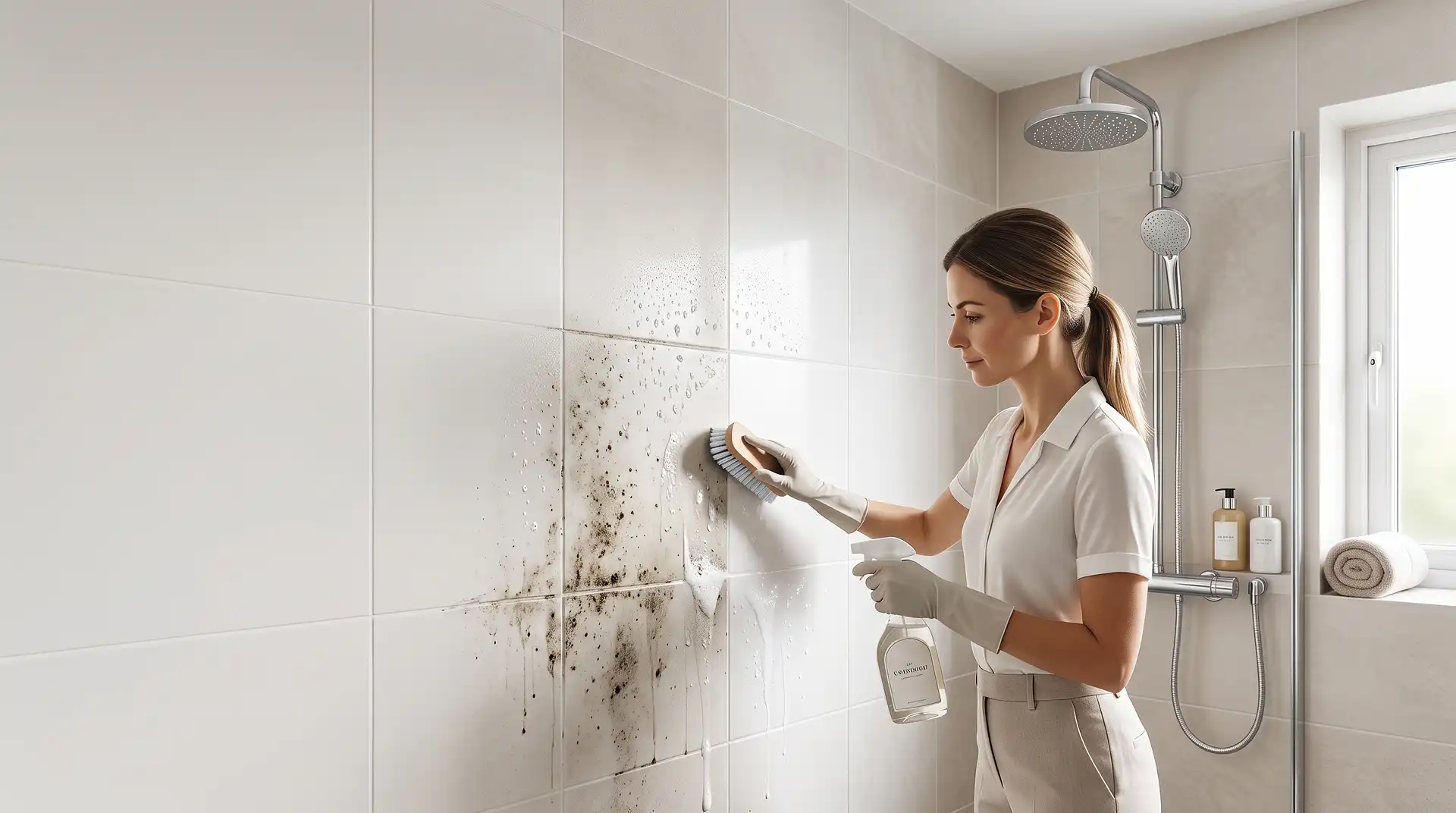
Use a product specifically labelled as a mould and mildew treatment, rather than a general bathroom cleaner, since these are formulated to kill mould at the root rather than just lift the visible staining. Apply generously to the affected area — grout lines, sealant, tile surface, or paintwork — and leave it to dwell for the time stated on the product label, commonly 10–15 minutes for light growth, longer for established or heavier mould.
Step 4: Scrub Gently and Rinse
Once the product has dwelled, scrub the area with a soft-to-medium brush — a grout brush or old toothbrush for grout lines specifically — then rinse thoroughly with clean water. Avoid excessive scrubbing pressure on sealant, which can damage or tear it, making it more likely to trap moisture and mould again in future.
Step 5: Dry the Area Fully
Wipe the treated area dry with a clean cloth and leave the extractor fan running or a window open for at least 20–30 minutes afterward. A damp surface left to air dry slowly is exactly the environment mould needs to re-establish, so actively drying the area is as important as the treatment itself.
Step 6: Address What's Actually Causing the Mould
This is the step that determines whether the mould stays gone. Run the extractor fan during every shower or bath and for 15–20 minutes afterward, rather than switching it off the moment you're done — this single habit change resolves a significant proportion of recurring bathroom mould cases on its own. If there's no working extractor fan, or ventilation is genuinely inadequate for the room's humidity, that's worth addressing directly — through fan installation, repair, or simply opening a window consistently — rather than repeating mould treatment on a cycle that will keep recurring.
When Sealant or Grout Needs Replacing, Not Just Treating
If mould has discoloured sealant or grout so persistently that treatment no longer restores it to a clean appearance, or if you can see mould reappearing specifically along the same sealant line every few weeks despite proper treatment, the sealant itself has likely become porous enough to hold mould beneath the surface, where cleaning products can't reach it. At that point, replacing the sealant (a straightforward if fiddly DIY job, or a small professional one) resolves what repeated treatment alone won't.
Common Mistakes and What to Do Instead
Mistake: wiping mould with a dry or barely damp cloth instead of a fungicidal treatment. This removes visible staining but leaves the spores that caused it, letting it regrow quickly. Always use a product specifically formulated to kill mould, with proper dwell time.
Mistake: not addressing ventilation after treating the mould. Removing mould without fixing the humidity that let it grow means it's very likely to return. Running the extractor fan during and after every shower is one of the simplest, most effective long-term fixes.
Mistake: mixing bleach with other cleaning products. Combining bleach with acidic products like limescale remover can release toxic gas. Use one product at a time and rinse thoroughly before switching to another.
Mistake: scrubbing sealant aggressively. This can tear or damage it, creating more places for moisture and mould to collect than before. Gentle scrubbing, or replacing badly affected sealant entirely, is the better approach.
Mistake: assuming all bathroom mould is a simple surface fix. Rapidly spreading mould, a persistent musty smell, or mould appearing on surfaces beyond the immediately wet areas can indicate a moisture problem within the wall or floor structure that surface treatment won't resolve, and continuing to treat only the surface delays addressing the real cause.
Mistake: painting over mould instead of treating it first. Painting over mould without properly treating and drying the surface first traps it beneath the new paint, where it typically continues growing and can show through again within weeks or months.
When to Call a Professional Instead
DIY treatment is reasonable for surface-level mould on grout, sealant, and tiles that responds to standard fungicidal products. It's worth calling a professional if mould keeps recurring in the same spot despite properly treating it and improving ventilation, if mould is spreading across multiple surfaces or rooms, if there's a musty smell without an obvious visible source, if mould appears alongside other signs of damp (peeling paint, damaged plaster, discoloured walls), or if anyone in the household has respiratory sensitivities that make even minor exposure worth avoiding. A professional mould survey can identify hidden growth and the underlying moisture source — condensation, a leak, or rising damp — that DIY treatment can't diagnose on its own.
What It Costs in the UK
DIY mould treatment is inexpensive — a fungicidal mould and mildew spray typically costs £5–£12 per bottle, and a grout brush or old toothbrush for scrubbing costs next to nothing if you don't already have one. This is sufficient for most surface-level bathroom mould, particularly if combined with improved ventilation afterward.
Professional mould removal in the UK varies significantly by severity. Small, surface-level problems — a single bathroom patch, essentially — typically cost £200–£450, covering localised treatment and application of a product designed to prevent regrowth. Medium contamination, spreading across a bathroom or into an adjoining room, typically costs £500–£2,000, and may include limited removal of affected materials like sealant or damaged plasterboard. Extensive or structural mould, linked to a genuine underlying moisture problem such as a leak or rising damp, can run £1,500–£5,000 or more, since this level of work typically requires investigating and fixing the moisture source alongside the mould itself. Hourly rates for a specialist mould removal service typically run £25–£50, though some general remediation work is quoted lower, around £12–£17 per hour, depending on the provider and scope. A professional mould and damp survey, useful for diagnosing a recurring or unclear problem, typically costs £150–£300.
Left entirely unaddressed, mould linked to a genuine structural moisture problem can contribute to damage — deteriorated plaster, damaged flooring, failed tiling — serious enough to require a broader bathroom renovation rather than a mould treatment or repair. According to InstantCost.co.uk's 2026 UK pricing data, even a basic like-for-like bathroom refit typically costs £3,500–£5,500, rising to £5,500–£8,500 for a mid-range renovation, which puts the relatively small cost of early mould treatment and a working extractor fan into useful perspective against what prolonged neglect can eventually require.
Option | Typical UK Cost (2026) |
|---|---|
DIY fungicidal spray | £5–£12/bottle |
Professional: small, surface-level treatment | £200–£450 |
Professional: medium contamination | £500–£2,000 |
Professional: extensive/structural mould | £1,500–£5,000+ |
Professional mould/damp survey | £150–£300 |
Bathroom renovation (if neglect causes structural damage) | £3,500–£8,500+ |
These are UK market estimates and vary by severity, provider, and region — a professional survey is worth the relatively small cost if mould keeps recurring despite proper treatment, since it can identify a moisture source that DIY methods can't diagnose.
Staying Safe
Mould treatment products are stronger than general surface cleaners and release fumes worth avoiding in concentrated, unventilated form — always open a window or run the extractor fan while treating mould, and never combine a mould spray with bleach or any other cleaning product. The NHS notes that damp and mould exposure can worsen respiratory problems, particularly for children, the elderly, or anyone with asthma or a weakened immune system, so it's worth treating even a small patch promptly rather than leaving it, and being especially thorough about drying and ventilation in a household with vulnerable members.
Store all mould treatment products in their original labelled containers, out of reach of children, and keep children and pets out of the bathroom while a treatment is dwelling and until the area is fully rinsed and dry.
Product-specific safety guidance and dwell times vary by manufacturer, so it's worth checking the label before use, and consulting a professional if mould in your home is extensive or you're at all uncertain about the underlying cause.
FAQ
Why does mould keep coming back in my bathroom after I clean it? Wiping mould away removes the visible growth but not the spores embedded in porous grout or sealant, nor the humidity that let it grow. Without improved ventilation, it typically regrows in the same spot within weeks.
What's the best product to remove bathroom mould? A fungicidal mould and mildew spray, left to dwell for the time stated on the label (commonly 10–15 minutes), works far better than a general bathroom cleaner, which isn't formulated to kill mould at the root.
How do I stop bathroom mould from coming back permanently? Run the extractor fan during every shower and for 15–20 minutes afterward. This single change resolves a significant proportion of recurring bathroom mould, since it addresses the humidity mould needs to grow.
When should I call a professional for bathroom mould? If it keeps recurring despite proper treatment and improved ventilation, spreads across multiple surfaces, or is accompanied by a persistent musty smell without an obvious source — these can indicate a moisture problem professional treatment alone can diagnose.
How much does professional mould removal cost in the UK? Small, surface-level treatment typically costs £200–£450. Medium contamination runs £500–£2,000, and extensive or structural mould linked to an underlying moisture problem can cost £1,500–£5,000 or more.
Can bathroom mould lead to needing a full renovation? In serious, prolonged cases linked to an underlying leak or damp problem, yes — untreated moisture damage to plaster, flooring, or tiling can require a full refit, which according to 2026 UK data typically costs £3,500–£8,500, making early treatment a comparatively small cost.