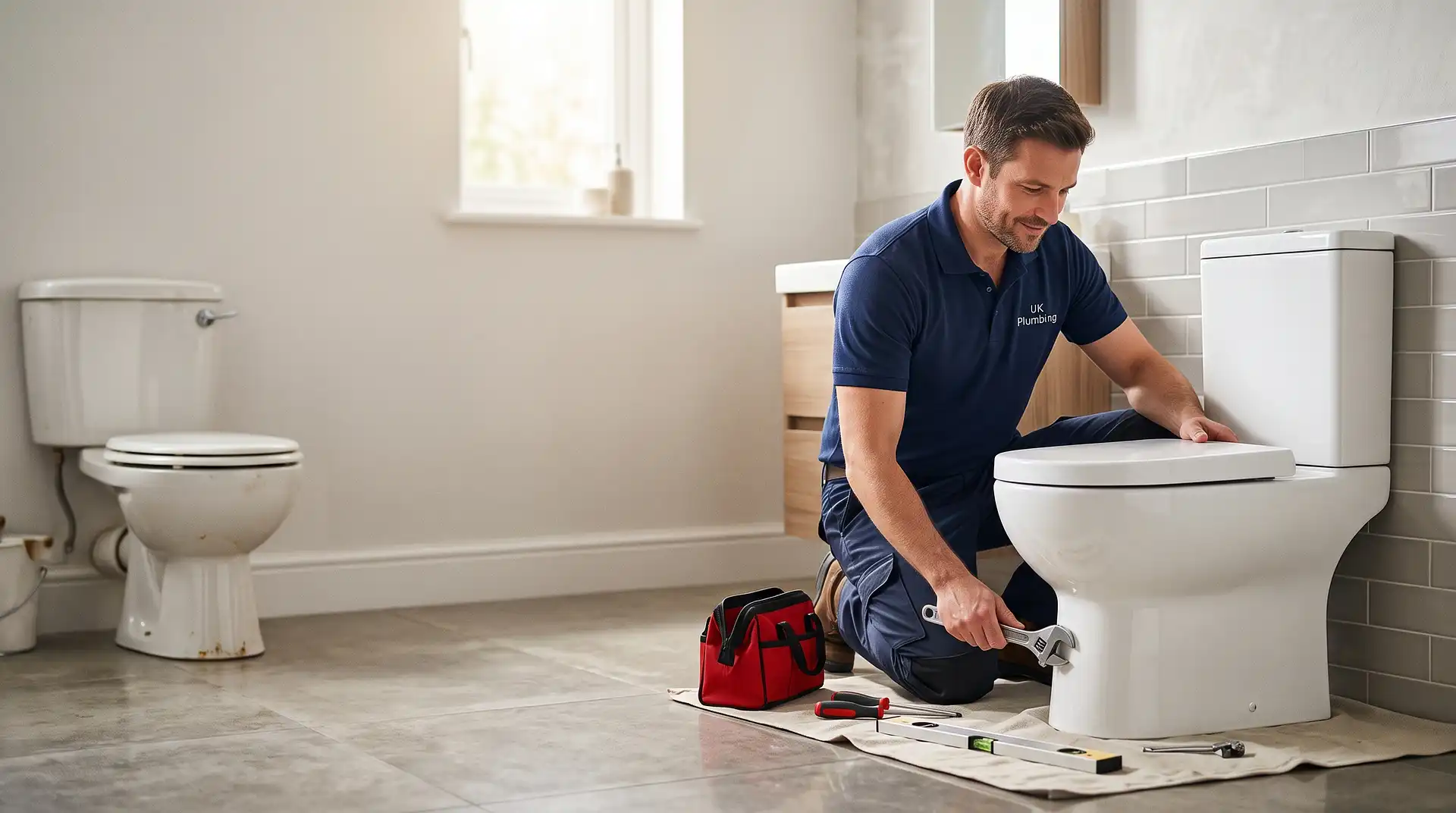
How Much Does a Plumber Charge to Replace a Toilet
25 August 2026
How Much Does a Plumber Charge to Replace a Toilet?
A plumber charges £180 to £350 to replace a toilet like-for-like in the UK in 2026. That figure covers a standard close-coupled toilet where the pan connector position matches the existing one, the supply and waste connections are in good condition, and the old toilet is removed and disposed of as part of the job.
Three things push the price above that range: a concealed cistern or wall-hung toilet, a pan connector that does not align with the new toilet position, and disposal not being included in the initial quote. Understanding what the quoted price does and does not include before agreeing is the most useful thing you can do before a plumber arrives.
What Affects the Cost
Toilet type is the biggest variable. A standard close-coupled toilet, where the cistern sits directly on the pan, is the simplest installation. A back-to-wall toilet with a concealed cistern inside a furniture unit or a duct is more complex because the cistern requires access for servicing and the pipework is hidden behind a finished surface. A wall-hung toilet requires a steel frame (carrier frame) bolted to the wall to carry the pan weight, which adds significant labour and materials. Labour for a wall-hung installation runs £300 to £600 rather than the like-for-like close-coupled rate.
Pan connector compatibility. The pan connector is the plastic fitting that joins the toilet pan outlet to the soil pipe. Standard UK pan connectors come in straight, angled, and flexible versions to accommodate different outlet positions. If the new toilet's outlet position does not match the existing pan connector, a new connector is needed. These cost £5 to £20 in parts but require the plumber to assess and fit correctly during the installation. A non-standard soil pipe entry angle occasionally requires additional pipework adjustment at extra labour cost.
Supply valve condition. The isolation valve on the water supply to the cistern should be checked and operated as part of the installation. A seized or weeping isolation valve found during the job adds £20 to £50 in parts and a small amount of additional labour. It is worth asking the plumber to replace it as a matter of course if the toilet is more than 10 years old.
Disposal. Old toilet removal and disposal is included in most professional quotes but worth confirming explicitly. A toilet and cistern is awkward to transport and heavy. Some plumbers include it in the day rate; others charge separately. Confirm before the job, since a toilet left in the garden for you to arrange disposal of is an unexpected outcome.
Location. London and the South East run 20 to 30% above the national average for plumber day rates. A toilet replacement quoted at £250 in Manchester or Leeds is typically £300 to £325 in London.
What the Quote Should Include
A properly scoped toilet replacement quote should state: labour for removal of the old toilet and installation of the new one, the pan connector (or confirmation the existing one is reused), the flexible supply hose from the isolation valve to the cistern, testing and adjustment of the flush mechanism, and disposal of the old unit. Fixings, silicone sealant at the pan base, and the cistern fill and flush valves should be included in the toilet supply price if the toilet is being supplied by the plumber, or confirmed as part of the scope if the toilet is customer-supplied.
Asking the plumber whether the quote assumes a standard like-for-like position or includes any adjustment for connector variation is worth doing before work starts, since a quote that assumes a perfect connection match can become a higher bill when the connection does not align precisely.
Types of Toilet and Their Replacement Costs
Toilet type | Typical replacement cost (2026) |
|---|---|
Close-coupled, like-for-like | £180 to £350 |
Back-to-wall with concealed cistern | £250 to £450 |
Wall-hung with carrier frame | £400 to £700 |
Combined bidet toilet or smart toilet | £300 to £600 (labour only) |
Toilet with non-standard soil pipe connection | Add £50 to £150 |
Disposal of old toilet (if not included) | £30 to £60 |
Labour only -- does not include the cost of the toilet unit itself.
The Cost of the Toilet Unit
The toilet itself is a separate cost from the plumber's labour. A basic close-coupled toilet from B&Q, Wickes, or similar costs £80 to £150. A mid-range toilet from Ideal Standard, Roca, or equivalent runs £150 to £350. A premium or designer toilet from Villeroy and Boch, Duravit, or similar runs £350 to £1,000 and above.
The plumber's labour cost does not change significantly based on which of these you choose for a like-for-like close-coupled installation. Where the toilet choice does affect cost is in the connection complexity -- a premium wall-hung toilet on a carrier frame is more expensive to install than a budget close-coupled, regardless of what the unit itself costs.
Some plumbers supply the toilet as part of a fully managed job. Trade prices are typically 20 to 30% below retail, so a plumber-supplied toilet can be competitive with a consumer retail purchase, and it places responsibility for the unit warranty and compatibility with the plumber rather than the homeowner. Ask for the model and specification being supplied and compare before agreeing.
Can I Replace a Toilet Myself?
Toilet replacement is a DIY-achievable job for a confident homeowner, and it does not require Gas Safe registration or Part P notification since it involves no gas or electrical work. The Water Supply (Water Fittings) Regulations 1999 do apply -- the installation must use approved fittings and must not create a cross-contamination or backflow risk -- but a standard like-for-like replacement using manufacturer-supplied components meets this requirement without formal notification.
The practical challenges are physical rather than technical: a toilet and cistern is heavy and awkward to manoeuvre in a small bathroom, the old pan is often sealed to the floor with silicone that requires cutting, and connecting to the soil pipe correctly requires the right pan connector for the outlet position. None of these are beyond a careful DIYer with the right tools and a second pair of hands.
DIY saves the labour cost of £180 to £350. The risks are a misaligned pan connector causing a slow leak to the subfloor, inadequate sealing at the pan base, and incorrect cistern fill valve adjustment causing continuous running. All of these are fixable, but each one involves a follow-up visit with tools or a plumber call-out.
The sensible position is: DIY for a straightforward like-for-like close-coupled replacement where the soil pipe position is clearly visible and the pan connector fits without modification. Call a plumber for anything involving a wall-hung toilet, a concealed cistern, or a non-standard soil pipe arrangement.
When the Job Costs More Than Expected
Three situations consistently produce bills above the initial estimate.
The subfloor is damaged. Old toilets that have been leaking slowly at the pan seal for months or years often sit on a damaged subfloor. Soft or rotten floorboards under the pan are discovered during removal and need replacing before the new pan can be fixed securely. This is a separate trade cost, typically £150 to £400 depending on extent.
The soil pipe is in the wrong position. A new toilet pan with a different outlet height or horizontal offset to the old one may require pipework adjustment to connect to the soil pipe correctly. On a ground-floor WC where the soil pipe is accessible under the floor, this is a plumbing job of one to two additional hours. On an upper-floor bathroom above a finished ceiling, it becomes a more complex access job.
The cistern fill or flush valve is incompatible. Some toilets are supplied without internal cistern fittings, or with fittings that require adjustment for the local water pressure. This is usually a 20-minute job but is occasionally flagged as an unexpected extra.
When to Call a Plumber Rather Than DIY
Call a plumber rather than attempting it yourself if the existing toilet is a wall-hung unit on a carrier frame, if the soil pipe connection requires modification, if the bathroom floor shows any sign of softness or water damage around the existing pan, or if the toilet is in a location with limited access for manoeuvring a heavy unit.
For renters, any plumbing work in a rented property is the landlord's responsibility to arrange and pay for. If the existing toilet is cracked, leaking, or no longer functioning correctly, notify the landlord in writing. A landlord who does not arrange a repair within a reasonable timeframe may be in breach of the statutory duty of repair under the Landlord and Tenant Act 1985.
Understanding what a toilet replacement costs as a standalone job also helps when deciding whether it fits within a broader bathroom update. A new toilet alongside new taps, fresh tiling, and a reseal changes the bathroom visually and functionally for considerably less than a full refit. For a 2026 UK breakdown of what partial and full bathroom renovations cost at different spec levels, the InstantCost plumbing cost guide has a calculator you can filter by job type and region to check whether a quote you have received falls within the expected range before agreeing.
If the toilet replacement is part of a broader bathroom renovation decision, our related guide on how much it costs to remodel a bathroom covers the full scope from a cloakroom refresh to a luxury refit, with the sequencing logic for which trades work in which order and what to do when the subfloor or plasterwork reveals unexpected problems during strip-out.
Common Mistakes and What to Do Instead
Mistake: not confirming disposal is included in the quote. A toilet is heavy and awkward to remove. Confirm in writing that the old unit is being taken away as part of the job.
Mistake: buying the toilet before confirming the pan connector position. A toilet with a horizontal outlet will not connect to a soil pipe designed for a vertical outlet without an adaptor. Confirm the existing outlet configuration before purchasing.
Mistake: not checking the subfloor before the plumber arrives. Press the existing pan gently side to side. Any movement indicates the floor fixing is loose or the subfloor is compromised. Flagging this before the job avoids a mid-job surprise and gives the plumber time to assess materials needed.
Mistake: choosing a wall-hung toilet and budgeting at close-coupled rates. Wall-hung installation includes a carrier frame, hidden pipework, and a duct or furniture unit to conceal the cistern. The labour is two to three times that of a close-coupled swap. Budget accordingly from the start.
Mistake: not asking whether the plumber supplies the toilet or expects it to be on site. If the plumber arrives and the toilet is the wrong model, has missing parts, or does not fit the available space, the visit is wasted and the rescheduling adds cost.
Mistake: ignoring a running cistern after installation. A continuously running cistern wastes significant water and adds to the water bill. It is almost always a fill valve or flap valve adjustment that takes five minutes to fix. Ask the plumber to demonstrate the flush and fill cycle before leaving.
What It Costs in the UK
Item or service | Typical UK cost (2026) |
|---|---|
Plumber hourly rate | £40 to £80 |
Like-for-like close-coupled toilet replacement | £180 to £350 (labour) |
Back-to-wall with concealed cistern | £250 to £450 (labour) |
Wall-hung toilet with carrier frame | £400 to £700 (labour) |
Basic close-coupled toilet unit | £80 to £150 |
Mid-range toilet unit | £150 to £350 |
Premium or designer toilet unit | £350 to £1,000+ |
Pan connector | £5 to £20 |
Isolation valve replacement | £20 to £50 |
Disposal of old toilet (if separate) | £30 to £60 |
Subfloor repair if damaged | £150 to £400 |
Figures based on InstantCost.co.uk's 2026 UK plumbing pricing data and vary by region and access. London and South East typically run 20 to 30% above the national average.
Staying Safe
Toilet replacement is low-risk plumbing work with no gas or high-voltage electrical involvement. The main practical risks are water damage from an incorrectly sealed pan base or a misaligned pan connector, and physical injury from handling a heavy, awkward ceramic unit in a confined space.
Turn off the isolation valve before disconnecting anything and confirm the supply has stopped by flushing the cistern fully. Mop out any remaining cistern water before lifting the unit, since the combined weight of a ceramic toilet and cistern can be 25 to 40 kg, and water adds significantly to that.
Use two people for the lift and removal. A toilet dropped in a small bathroom breaks both itself and frequently the floor tile beneath it, and the sharp ceramic edges are a laceration hazard.
Silicone sealant applied at the base of the pan should be a sanitary-grade product. Do not seal the entire perimeter completely -- leave a small gap at the back to allow any leak from the pan connection to show at floor level rather than tracking silently under the pan for months.
Keep children and pets out of the room during the job. The work involves disconnecting a waste pipe with residual contents, which is a contamination hazard until the connection is sealed.
The Water Supply (Water Fittings) Regulations 1999 require that all plumbing installations, including toilet replacements, use approved fittings and do not create backflow or contamination risks. A like-for-like replacement using manufacturer-approved components meets this requirement without formal notification. Any modification to the soil pipe or waste arrangement that changes the drainage configuration may require building regulations notification in some circumstances. Check with the local authority if uncertain.
FAQ
How much does a plumber charge to replace a toilet in the UK? A like-for-like close-coupled toilet replacement costs £180 to £350 in labour in 2026. This covers removal of the old toilet, installation of the new one, connection to existing supply and waste pipes, and testing. Wall-hung and concealed cistern installations cost more.
How long does it take a plumber to replace a toilet? A standard close-coupled like-for-like replacement typically takes one to two hours. A wall-hung toilet with a carrier frame takes two to four hours. Add time if the pan connector needs adjustment or if the subfloor has damage.
Is replacing a toilet a DIY job? For a straightforward like-for-like close-coupled replacement, yes, if the soil pipe position is visible and the pan connector fits without modification. Wall-hung toilets, concealed cisterns, and non-standard soil pipe arrangements are best left to a plumber.
Does a plumber charge to take away the old toilet? Most professional quotes include disposal, but confirm explicitly before the job. Some plumbers charge £30 to £60 separately for collection and disposal of the old unit.
Why is my toilet replacement quote higher than £350? Common reasons are a wall-hung or back-to-wall toilet requiring a carrier frame, a pan connector that does not align with the new toilet, a damaged subfloor discovered during removal, London or South East regional rates, or disposal being priced separately.
Can I supply my own toilet and just pay for the plumber's labour? Yes, and this is common practice. Confirm the toilet model and outlet configuration with the plumber before purchasing to ensure it is compatible with the existing waste connection. Some plumbers apply a small surcharge for customer-supplied units since they cannot control the product quality or warranty.