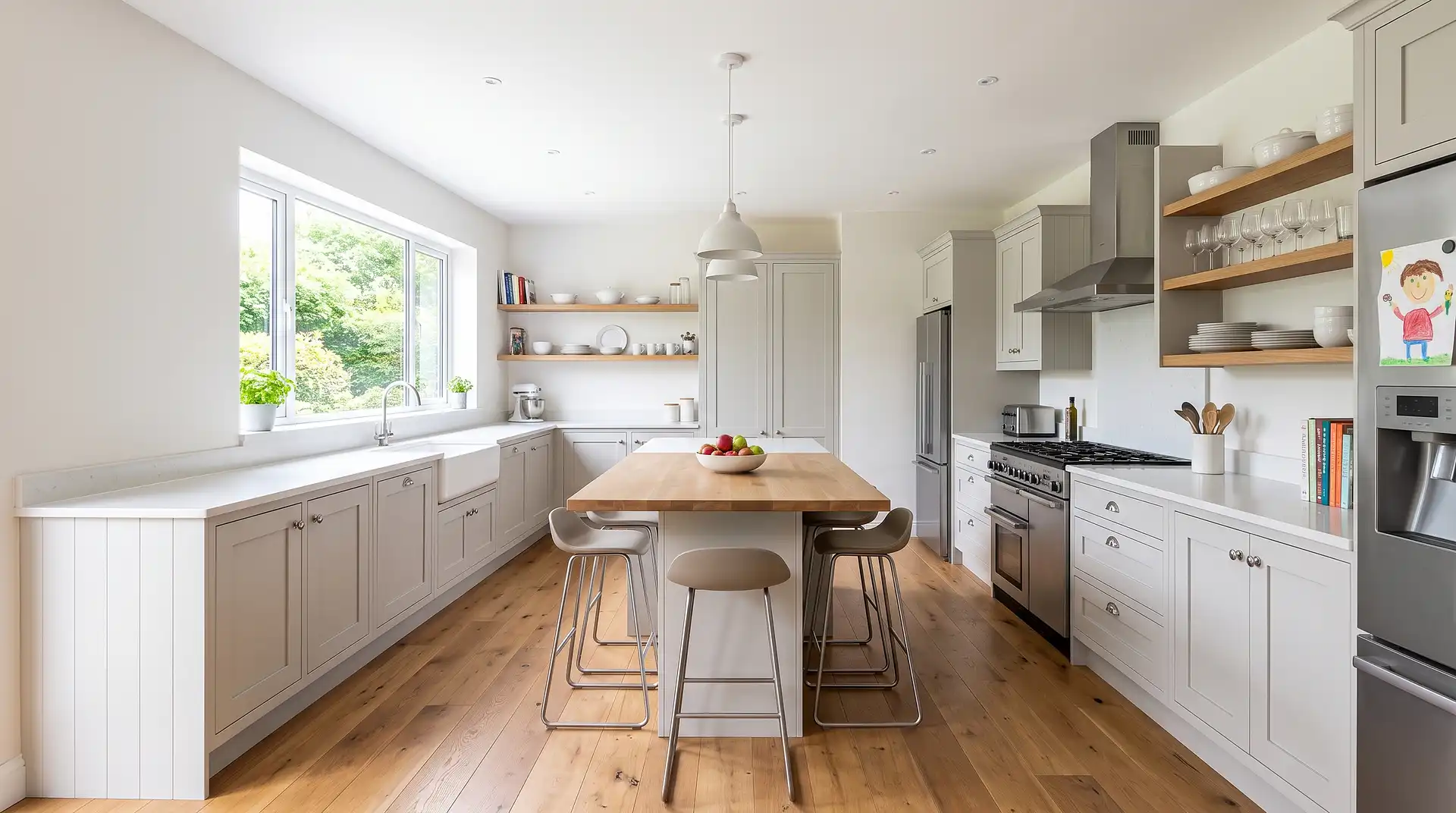
How Much Is a New Kitchen
19 August 2026
How Much Is a New Kitchen UK?
A new kitchen in the UK costs £5,000 to £15,000 for most homes in 2026, with the most common mid-range fully fitted project landing at £8,000 to £15,000. Budget flat-pack installations start around £5,000 fully fitted. High-end kitchens with stone worktops and premium appliances run £15,000 to £25,000, and bespoke handmade kitchens can exceed £60,000.
Those numbers cover a wide range because a kitchen is not one product. It is a collection of separate decisions, each of which moves the total in a different direction. The cabinet range, the worktop material, the appliances, and the labour split together account for nearly everything in the budget, and understanding how each one works is what stops you from getting halfway through a project and discovering the original quote did not include what you assumed it did.
What Drives the Price
The budget splits roughly as follows on a typical mid-range UK kitchen project:
Units and worktops: 35 to 45%
Appliances: 15 to 25%
Labour (fitting, plumbing, electrics, decorating): 25 to 35%
Finishing trades and contingency: 5 to 10%
The single biggest cost lever is not the brand of cabinet you choose. It is whether you are keeping the existing layout. Moving plumbing, gas or electrical runs adds £600 to £1,500 or more to a project depending on how far things need to move, because trades have to work behind walls and under floors rather than connecting to what is already there. Every quote should state explicitly whether it assumes like-for-like positioning or includes relocation costs.
Cost by Kitchen Type
Kitchen type | Typical UK cost (2026) | Notes |
|---|---|---|
Cosmetic refresh | £1,500 to £3,500 | New paint, handles, worktop refinish only |
Small flat-pack kitchen | £5,000 to £8,000 | IKEA or Wickes-style carcasses, fully fitted |
Mid-range standard kitchen | £8,000 to £15,000 | Rigid units, integrated appliances |
High-end kitchen | £15,000 to £25,000 | Premium brands, stone worktops |
Bespoke handmade kitchen | £25,000 to £60,000+ | Designer cabinetmakers, made to measure |
Open-plan extension kitchen | £20,000 to £45,000+ | Excludes cost of the structural extension itself |
Figures based on InstantCost.co.uk's 2026 UK kitchen renovation pricing data. London projects typically run 20 to 30% above the national average. Always get three itemised quotes before committing.
Cabinets: Where Most of the Budget Goes
Cabinets dominate kitchen budgets, and there are three genuinely different tiers available in the UK market.
Flat-pack carcasses from IKEA, Wickes, or B&Q are the entry point. The carcasses themselves are inexpensive, and the doors are what determine the look. Fitted cost runs roughly £150 to £350 per unit depending on the fitter and the complexity of the layout. The drawback is not quality, since IKEA's Sektion system is well-engineered, it is the fitting time. Flat-pack takes longer to assemble and fit than rigid units, so labour costs per unit can be higher than people expect.
Rigid mid-range units from Howdens, Magnet, or Wren are the most common choice for UK homeowners doing a full refit. These come pre-assembled and drop into place considerably faster, which reduces fitting time and risk of error. Fitted cost runs £300 to £600 per unit. A typical UK kitchen of 8 to 12 units at this tier accounts for £2,400 to £7,200 in cabinets alone before worktops, appliances, or any labour beyond the fitting.
Bespoke handmade cabinets from independent cabinetmakers are a different product category. These are made to the exact dimensions of your kitchen rather than to standard unit sizes, which matters in awkward rooms with alcoves, sloping ceilings, or non-standard dimensions. Start at roughly £900 per unit and rise sharply with timber choice, finish, and drawer mechanism specification.
One option that sits between rigid mid-range and bespoke is a rigid unit range with replacement doors. Buying a standard Howdens or similar carcass and fitting bespoke or premium aftermarket doors gives a high-end appearance at a meaningful saving over full bespoke. This is particularly worth considering if the kitchen layout is standard enough that made-to-measure sizes are not needed.
Worktops: The Widest Price Range of Any Single Decision
Worktop material is where a budget kitchen and a premium one diverge most visibly, and the price range is wider than most people expect before they start looking.
Laminate worktops are the entry point at £150 to £400 fitted for a typical kitchen run. The quality range within laminate is significant: thin, hollow-sounding boards from a budget supplier and a 38 mm solid-core laminate from a reputable manufacturer look similar in a photograph and perform very differently over a decade of use. The latter is worth the extra spend.
Solid wood runs £300 to £700 fitted. It needs oiling regularly, reacts to moisture and heat, and shows knocks and marks over time, all of which some owners appreciate as character and others find frustrating. It is not suitable immediately next to a sink without careful maintenance.
Quartz is the most popular mid-to-premium worktop choice in the UK at present. Engineered from stone particles and resin, it is non-porous, heat-resistant to a point, and consistent in appearance. Fitted cost runs £1,800 to £3,500 for a typical kitchen, which is a significant jump from laminate but a surface that will likely outlast the cabinets themselves.
Granite runs similarly at £1,500 to £3,000 fitted, is harder than quartz, requires sealing periodically, and varies naturally in pattern and colour. Porcelain slab worktops are the premium end at £2,500 to £4,500 fitted, extremely durable, and capable of covering seamlessly from worktop to upstand to splash panel.
Appliances: A Separate Budget to Plan For
Appliances usually account for £1,500 to £5,000 in a mid-range kitchen fit, but they are often treated as an afterthought in the initial budget conversations. That is a mistake, because integrated appliances, which are concealed behind matching cabinet doors, cost 15 to 25% more than freestanding equivalents, need to be specified before the cabinet order is placed, and require specific cabinet carcasses to fit correctly.
Premium integrated appliance brands such as Bosch Series 8, Neff, Siemens, and Miele typically cost £1,000 to £2,500 more than budget-tier alternatives for a full set. They generally last 50 to 100% longer in practice, which changes the value calculation considerably over a fifteen-year kitchen life.
One specific thing to confirm early: the hob type determines the extraction spec and, if you are switching from gas to induction, potentially requires an electrical supply upgrade. A 13-amp socket feeds a standard induction hob. A double or range-size induction hob may need a dedicated 32 or 40-amp circuit, which is an electrical job that needs to be certified under Part P of the Building Regulations. Budget for it separately if you are changing hob type.
Labour: What the Quote Should Include
Labour on a mid-range UK kitchen project typically runs 25 to 35% of the total, but the variation in what different contractors include under "labour" is one of the most common sources of disputed final bills.
A complete labour quote should include: strip-out and disposal of the old kitchen, first and second fix plumbing, electrical work and certification, cabinet fitting, worktop templating and fitting, tiling, decorating, and snagging. Any of these supplied separately means a separate quote, a separate contractor relationship, and a gap in the programme where one trade is waiting for another.
Kitchen fitters in the UK charge £150 to £250 per day. A small kitchen takes two to three days to fit. A mid-range full refit with all trades typically takes two to three weeks from strip-out to snagging. Bespoke kitchens have longer lead times: 8 to 14 weeks from order to installation, because the cabinets are manufactured after measuring.
What the Quote Often Leaves Out
Three cost lines that regularly appear on final bills but are absent from initial quotes:
Waste disposal. Stripping out an old kitchen generates a significant volume of material. Some fitters include skip hire, others do not. A 6-yard skip for a kitchen strip-out runs £200 to £350 in most UK regions.
Making good. When old units come off, they leave marks, holes, and uneven wall surfaces. Plastering and painting behind the new units before fitting is standard practice on a proper job. Not every quote includes it.
VAT. Standard 20% VAT applies on most domestic kitchen renovations in the UK. A quote that arrives excluding VAT is a meaningful difference on a £12,000 project. Ask whether the figure is inclusive or exclusive before comparing quotes.
Getting the Most From Your Budget
Keep the existing layout. That single decision is worth more to the budget than any choice between cabinet brands.
Buy appliances separately in January or summer sales, where reductions of 15 to 30% on premium brands are common. Ex-display kitchens from UK showrooms offer 40 to 60% savings versus new bespoke and are worth checking if your timeline is flexible, since you are buying a known, measured kitchen rather than specifying from scratch.
Choose a rigid mid-range unit range with upgraded doors rather than paying for full bespoke. The structural component of a handmade kitchen is the carcass, and an IKEA or Howdens carcass behind a solid timber shaker door produces a result that most visitors cannot distinguish from a fully bespoke kitchen at a fraction of the price.
Get three written, itemised quotes. Not estimates: itemised quotes with line-by-line costs for units, worktops, appliances, each trade, and waste disposal. Quotes that arrive as a single total figure are not comparable to each other and cannot be checked for what they include.
If you are budgeting for a full refit and want to understand exactly what a project of your kitchen size and spec would cost in your region before committing to anything, the InstantCost kitchen renovation cost guide has a 2026 UK price calculator you can filter by kitchen size, cabinet tier, appliance level, and region to generate a tailored estimate before any contractor conversation.
When Does a New Kitchen Add Value?
A new kitchen is consistently cited by UK estate agents as one of the highest-returning home improvements for resale, but the return is not uniform across price points. A mid-range kitchen in a mid-range property recovers most of its cost in added value. A £40,000 bespoke kitchen in a house where the ceiling price is £250,000 does not.
The calculation also depends on condition rather than age. A ten-year-old kitchen in good condition with solid units and functioning appliances adds more perceived value than a poorly fitted new kitchen with budget carcasses and visible gaps. Buyers notice quality, and they notice shortcuts.
For properties where the kitchen is one of several things that need addressing, sequencing matters. Kitchens are disruptive, so doing the kitchen before any decoration or flooring work that runs through the rest of the ground floor avoids damaging finished work. Our related guide covers <a href="">how to repaint kitchen units</a>, which is the most cost-effective option when the layout and structure of the existing kitchen are sound but the visual finish has dated.
Common Mistakes and What to Do Instead
Mistake: budgeting for the kitchen without budgeting for the trades. Units and worktops are only half the cost. Labour, plumbing, electrics, tiling and decorating together typically equal or exceed the cabinet and worktop cost on a full refit. Build the full project budget before ordering anything.
Mistake: changing the layout to improve the design. Moving the sink, hob, or dishwasher position involves rerouting plumbing and potentially gas and electrical runs. That adds £600 to £1,500 before any visible kitchen work begins. The original positions usually exist for practical reasons and the design can often be solved without moving them.
Mistake: ordering cabinets before confirming appliance specs. Integrated appliances need specific carcass sizes. Ordering cabinets and then choosing appliances frequently results in units that do not fit the appliance, or appliances that need to be returned.
Mistake: switching from gas to induction without checking the electrical supply. A standard kitchen ring circuit does not support a large induction hob. A dedicated circuit certified under Part P is a separate cost that needs planning before strip-out, not after.
Mistake: comparing quotes that include different scopes. A £9,000 quote that includes all trades and waste disposal is not directly comparable to an £8,000 quote that excludes the electrician, the tiler, and the skip. Ask each contractor to confirm what is and is not included in writing.
Mistake: treating the cosmetic refresh as a stopgap when the structure is sound. New doors, handles, a worktop refinish, and fresh paint can transform a kitchen for £1,500 to £3,500 when the carcasses are solid. If the unit boxes are structurally sound, this is genuinely worth considering before committing to a full strip-out.
What It Costs in the UK
Kitchen type | Typical UK cost (2026) |
|---|---|
Cosmetic refresh only | £1,500 to £3,500 |
Small flat-pack fit (IKEA / Wickes style) | £5,000 to £8,000 |
Mid-range rigid unit kitchen | £8,000 to £15,000 |
High-end kitchen (premium units, stone worktops) | £15,000 to £25,000 |
Bespoke handmade kitchen | £25,000 to £60,000+ |
Per unit cost: flat-pack, fitted | £150 to £350 |
Per unit cost: rigid mid-range, fitted | £300 to £600 |
Per unit cost: bespoke handmade | From £900 |
Laminate worktop, fitted | £150 to £400 |
Solid wood worktop, fitted | £300 to £700 |
Quartz worktop, fitted | £1,800 to £3,500 |
Granite worktop, fitted | £1,500 to £3,000 |
Porcelain slab worktop, fitted | £2,500 to £4,500 |
Appliances, mid-range set | £1,500 to £5,000 |
Skip hire for strip-out | £200 to £350 |
Kitchen fitter day rate | £150 to £250 |
Figures based on InstantCost.co.uk's 2026 UK kitchen renovation pricing data and vary by region, layout complexity, and provider. London typically runs 20 to 30% above the national average. All figures are estimates: get three itemised quotes before committing.
Staying Safe
A kitchen renovation involves multiple trades working in sequence, and two of them carry specific compliance requirements in the UK.
Gas work must be carried out by a Gas Safe registered engineer. This covers any work on a gas hob, gas oven, or gas supply to the kitchen. Fitting a new kitchen around an existing gas appliance without touching the supply does not require Gas Safe registration, but repositioning or reconnecting a gas supply does. Check the Gas Safe Register at gassaferegister.co.uk before allowing any gas work to proceed.
Electrical work, including new sockets, circuit additions, and dedicated appliance circuits, must be certified under Part P of the Building Regulations. Work carried out by a NICEIC or NAPIT-registered electrician is self-certifying. Work carried out by an unregistered person requires a building control inspection and certificate. Uncertified electrical work is a problem at remortgage and at sale, when solicitors routinely ask for certificates.
Keep children and pets out of the work area throughout the project. Strip-out generates sharp debris, adhesives, and dust, and a working kitchen site has open electrical cabling and disconnected gas and water supplies at various points. Treat it as a site, not a room.
VAT at 20% applies to most domestic kitchen renovation work in the UK. Confirm whether all quotes are VAT inclusive before comparing them. Some contractors quote exclusive of VAT, which adds a meaningful sum to the final figure on a mid-range project.
FAQ
How much does an average new kitchen cost in the UK? The most common UK kitchen renovation in 2026, a mid-range fully fitted kitchen with rigid units and integrated appliances, costs £8,000 to £15,000. Budget flat-pack kitchens start around £5,000 fully fitted. High-end kitchens with stone worktops and premium appliances run £15,000 to £25,000.
How long does a new kitchen take to fit? A standard mid-range refit takes two to three weeks from strip-out to snagging when all trades are coordinated. Bespoke kitchens have manufacturing lead times of 8 to 14 weeks before fitting begins.
What adds most to the cost of a kitchen? Changing the layout by moving plumbing, gas, or electrical runs is the single biggest hidden cost, adding £600 to £1,500 or more before any visible work begins. After that, worktop material is the widest single variable in the budget.
Is a new kitchen worth it for resale? A mid-range kitchen in a mid-range property typically recovers most of its cost in added value. A premium kitchen in a property with a limited ceiling price does not. Condition matters more than age: a well-maintained ten-year-old kitchen adds more value than a poorly fitted new one.
Can I supply my own appliances to save money? Yes, but confirm this with your fitter or kitchen company first. Some contractors will not warranty integrated appliances they did not supply, and some kitchen packages include appliance discounts that make their supply competitive. Get both options costed.
What does a kitchen fitter charge per day in the UK? UK kitchen fitters typically charge £150 to £250 per day in 2026. A small kitchen takes two to three days to fit. A full mid-range refit with multiple trades runs two to three weeks total.