How to Adjust Kitchen Cabinet Doors
2 August 2026
How to Adjust Kitchen Cabinet Doors (Fix Gaps, Sag, and Slam in Minutes)
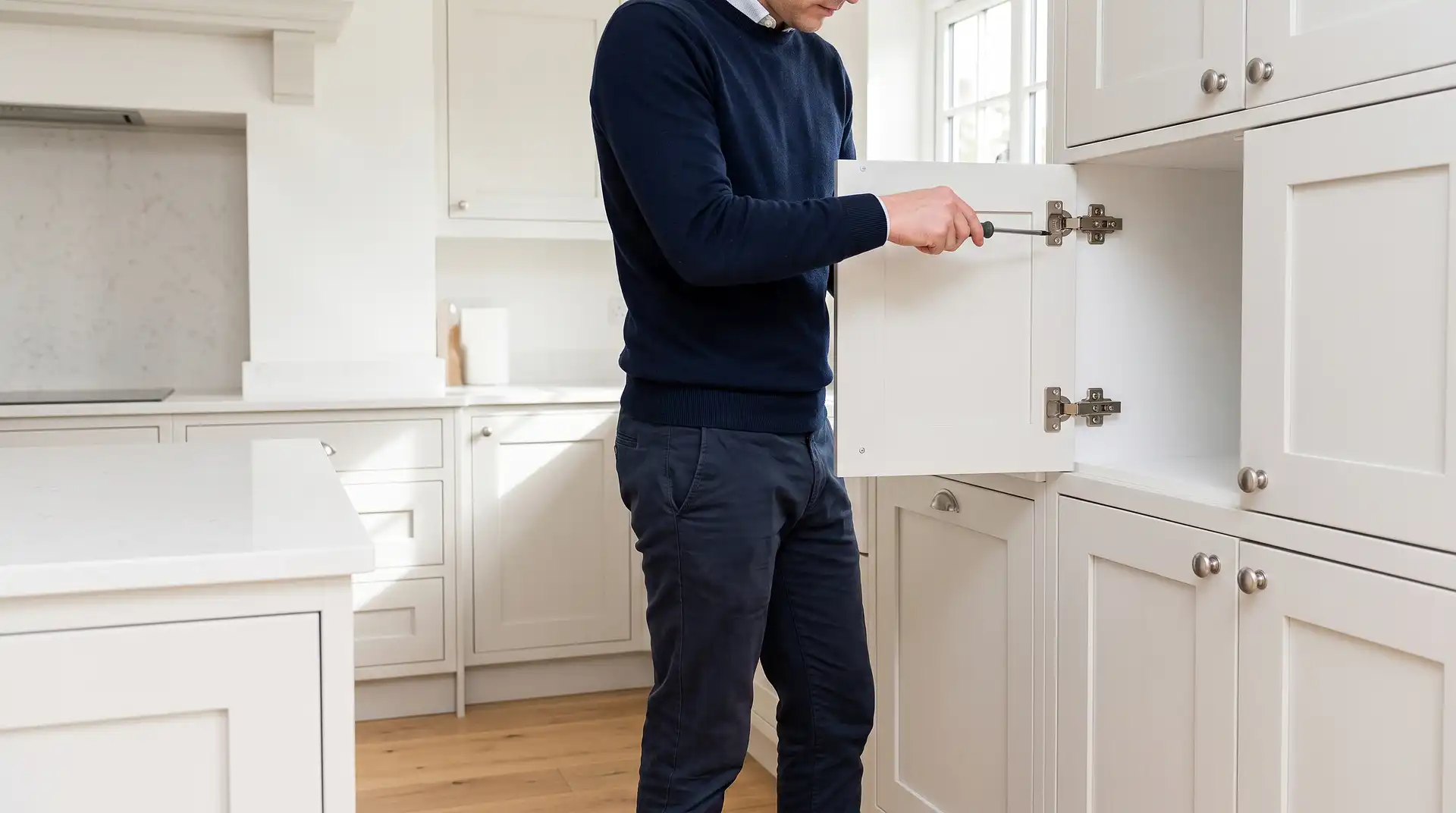
A kitchen that looks tired or slightly off often has nothing wrong with the cabinets themselves. The actual problem is usually just the doors, out of alignment by a few millimetres, sagging slightly, or catching unevenly against the frame, and it's an adjustment job, not a replacement one. Most modern UK kitchens use Euro-style concealed hinges, which are specifically designed with built-in screws for exactly this kind of fine-tuning, meaning a wonky door is very often a five-minute fix with a screwdriver rather than a call to a carpenter.
Get the Right Tools First
Using the wrong screwdriver is genuinely the most common cause of stripped screw heads on UK kitchen cabinets, since most are made from chipboard or MDF that doesn't tolerate a slipping screwdriver well. Check the hinge screws closely, most take a Pozidriv (marked with a small cross plus four extra lines) rather than a standard Phillips head, and using the wrong type is a fast way to round off the screw head and turn a simple adjustment into a bigger repair. A small Pozidriv screwdriver, ideally in a couple of sizes, is worth having before you start.
Understand the Three Adjustment Screws
Every standard Euro-style concealed hinge has three separate adjustment points, and each one moves the door in a different direction. Learning which screw does what is really the whole skill here, once you know this, adjusting a door is just a case of identifying which direction it's currently wrong in and turning the matching screw.
Side-to-side adjustment controls the horizontal gap between the door and its neighbour. This is usually the screw closest to the door itself on the hinge arm. Turning it shifts the door left or right relative to the cabinet frame, which is what you need if a door is sitting unevenly close to or far from the cabinet beside it.
Up-down adjustment controls the door's height relative to the cabinet and any door above or below it. This is typically a screw on the mounting plate, the part fixed to the inside of the cabinet carcass itself, and adjusting it raises or lowers the whole door slightly, useful for lining up a row of doors that don't currently sit level with each other.
Depth adjustment controls how far the door sits forward from or back against the cabinet frame. This is usually the rear-most screw on the hinge arm, furthest from the door. Loosening it lets you slide the door closer to or further from the cabinet carcass before retightening, which is the fix for a door that doesn't sit flush or closes with an uneven gap all the way round.
Step-by-Step: Making an Adjustment
Open the door fully so you can see the hinge arm and mounting plate clearly.
Identify which problem you're actually looking at, uneven side gap, uneven height compared to neighbouring doors, or a door that doesn't sit flush, since this tells you which of the three screws to use.
Loosen the relevant screw slightly, just enough to let the door move rather than fully removing it.
Gently move the door in the direction needed while the screw is loose, checking the gap or alignment as you go.
Once it looks right, tighten the screw firmly, then close the door and check the result from a normal viewing distance, small adjustments often look more dramatic up close than they do once the door's closed.
Repeat on the second hinge if the door has one, and adjust in small increments across both hinges together rather than making one large adjustment on a single hinge, which can leave the door twisted slightly.
What a Well-Adjusted Door Should Look Like
Aim for a gap of roughly 1mm to 2mm between the door and the cabinet carcass, enough to allow the soft-close buffer, where fitted, to do its job properly without the door binding or catching. Doors in the same row should line up level with each other, and gaps between neighbouring doors should look visually even rather than wider on one side than the other.
Fixing a Door That Slams or Closes Too Slowly
If a door is slamming shut or closing unusually slowly, check the small dial or cam on the hinge itself, often located near the hinge cup, the round part fitted into the door. Many soft-close and standard hinges include a small adjustable damper here, and turning it slightly changes how much resistance the door meets as it closes, worth checking before assuming the whole hinge needs replacing.
Dealing With a Stripped Screw Hole
Over time, the constant weight of a door pulling on its hinge screws can cause the screw hole in chipboard or MDF to strip, meaning the screw simply spins without gripping anymore. This is a genuinely common problem in UK kitchens rather than a sign anything's fundamentally wrong, and it has a reliable, cheap fix. Remove the hinge and the loose screw, dip two or three wooden matchsticks or a wall plug into wood glue, and tap them into the stripped hole until snug. Trim any excess so it sits flush with the cabinet surface, let the glue cure for around 30 minutes, then re-fit the screw, which now has fresh wood to bite into rather than the worn-out original hole.
Once the Doors Are Aligned, Consider the Finish
Getting doors properly adjusted is often the first step people take before deciding a kitchen actually needs a cosmetic refresh rather than a full replacement, since perfectly aligned but dated-looking doors are a different problem than misaligned ones. If your cabinets are structurally sound and well-adjusted but simply looking tired in colour or finish, our guide on how to paint kitchen cupboards covers the full prep and painting process for exactly this situation, a straightforward, budget-friendly way to update the look of a kitchen once the doors themselves are hanging correctly.
Common Mistakes and What to Do Instead
Mistake: using a standard Phillips screwdriver on a Pozidriv screw. This is the leading cause of stripped screw heads on UK kitchen cabinets. Check the screw head shape closely and use a proper Pozidriv driver, which looks similar but has additional small lines between the main cross.
Mistake: adjusting only one hinge when a door has two or three. This can leave a door slightly twisted or under uneven tension. Make smaller adjustments across all of a door's hinges together rather than one large adjustment on a single hinge.
Mistake: overtightening a hinge screw to try to stop a door sagging. If a screw won't hold and the hole has stripped, tightening harder just strips it further or snaps the screw. Fix the actual stripped hole with the matchstick and glue method rather than fighting a screw that's lost its grip.
Mistake: assuming a door needs replacing when it just needs adjusting. Wonky, sagging, or unevenly gapped doors are very often a straightforward hinge adjustment, not a sign the door or cabinet itself has failed. Try the three-way adjustment first before assuming anything needs replacing.
Mistake: ignoring a slamming door as just "how it is." A door slamming shut usually means the soft-close damper on the hinge needs adjusting, or has failed, not that the door is somehow faulty in a way that can't be fixed.
When to Call a Professional Instead
Straightforward hinge adjustment is genuinely DIY territory for most people, and it's worth trying before assuming you need a tradesperson. It's worth calling a carpenter or kitchen fitter if a hinge itself is physically broken rather than just misaligned, if multiple stripped holes have left the cabinet frame genuinely too damaged for the matchstick fix to hold, if you're planning to replace doors entirely rather than adjust the existing ones, or if a wider kitchen problem, sagging cabinet carcasses, a fundamentally uneven kitchen run, suggests the issue goes beyond the doors themselves.
What It Costs in the UK
DIY adjustment costs nothing beyond the right screwdriver, typically £5 to £15 for a decent Pozidriv driver if you don't already own one. Replacement hinges, if a hinge itself is actually broken rather than just needing adjustment, typically cost £2 to £5 each for standard hardware.
If you'd rather hire a tradesperson for adjustment or minor repair work, hinge replacement or adjustment typically costs £20 to £40 per hour in the UK, and given how quick this kind of job usually is, most call-outs for a handful of doors fall well within a single hour's labour. If doors need replacing entirely rather than adjusting, replacement kitchen cabinet doors typically cost £131 to £259 per door depending on material and finish, or as a full kitchen's worth of doors, £1,300 to £2,250 on average, plus a kitchen fitter's day rate of £250 to £350 if you're not fitting them yourself.
For context on where this sits within a broader kitchen refresh budget, according to InstantCost.co.uk's 2026 UK kitchen renovation pricing data, a cosmetic kitchen refresh, covering repainting or updating cabinets alongside new handles and worktop refinishing, typically costs £1,500 to £3,500. Simple hinge adjustment sits well below even that entry-level refresh tier, making it consistently the cheapest and quickest way to noticeably improve how a kitchen looks before considering any larger-scale update.
Item or Service | Typical UK Cost (2026) |
|---|---|
Pozidriv screwdriver (if needed) | £5 to £15 |
Replacement hinge (each) | £2 to £5 |
Professional adjustment/repair, hourly | £20 to £40 |
Replacement door (each) | £131 to £259 |
Full kitchen's worth of replacement doors | £1,300 to £2,250 |
Kitchen fitter day rate | £250 to £350 |
Cosmetic kitchen refresh (for context) | £1,500 to £3,500 |
These are UK market estimates and vary by hardware brand, cabinet material, and region. Try adjusting doors yourself first, it costs nothing and resolves the great majority of alignment issues, before assuming a bigger repair or replacement is needed.
Staying Safe
Cabinet doors are lighter than most home repair tasks but still worth handling carefully, particularly larger or heavier doors, since a door coming loose from its hinges unexpectedly can catch fingers or drop suddenly if a screw gives way mid-adjustment. Support the door with one hand while adjusting screws with the other, rather than letting it hang entirely on a hinge that's only partially tightened.
Keep small hardware, screws, and any tools used well out of reach of children while you're working, particularly if you're removing a hinge fully rather than just adjusting it in place.
Hinge types and adjustment mechanisms can vary slightly between manufacturers, so it's worth checking your specific cabinet hardware if the screws don't match the standard three-way layout described here.
FAQ
Why is my kitchen cabinet door not sitting flush? This is usually a depth adjustment issue, the rear-most screw on the hinge arm. Loosening it lets you slide the door closer to or further from the cabinet carcass until it sits flush, then retighten once it looks right.
What screwdriver do I need to adjust kitchen cabinet hinges? Most UK kitchen hinges use Pozidriv screws, not standard Phillips, despite looking similar. Using the wrong type is the most common cause of stripped screw heads, so check closely and use a proper Pozidriv driver.
How do I fix a kitchen cabinet door that keeps sagging? Check whether the screw hole has stripped, a common issue in chipboard or MDF cabinets. Remove the hinge, fill the hole with glue-dipped matchsticks or a wall plug, let it cure, then re-fit the screw into the fresh wood.
Can I adjust cabinet doors myself, or do I need a carpenter? Straightforward alignment issues, uneven gaps, sagging, doors not sitting flush, are genuinely DIY-friendly using the hinge's built-in three-way adjustment screws. A carpenter is more useful for broken hinges or full door replacement.
How much does it cost to have kitchen cabinet doors professionally adjusted? Typically £20 to £40 per hour, and most adjustment jobs for a handful of doors take well under an hour, making this one of the cheapest kitchen repair call-outs available.
Why does my cabinet door slam shut? Check the small adjustable damper on the hinge, usually near the hinge cup on the door itself. Turning it slightly changes the closing resistance and often resolves slamming without needing to replace the hinge.