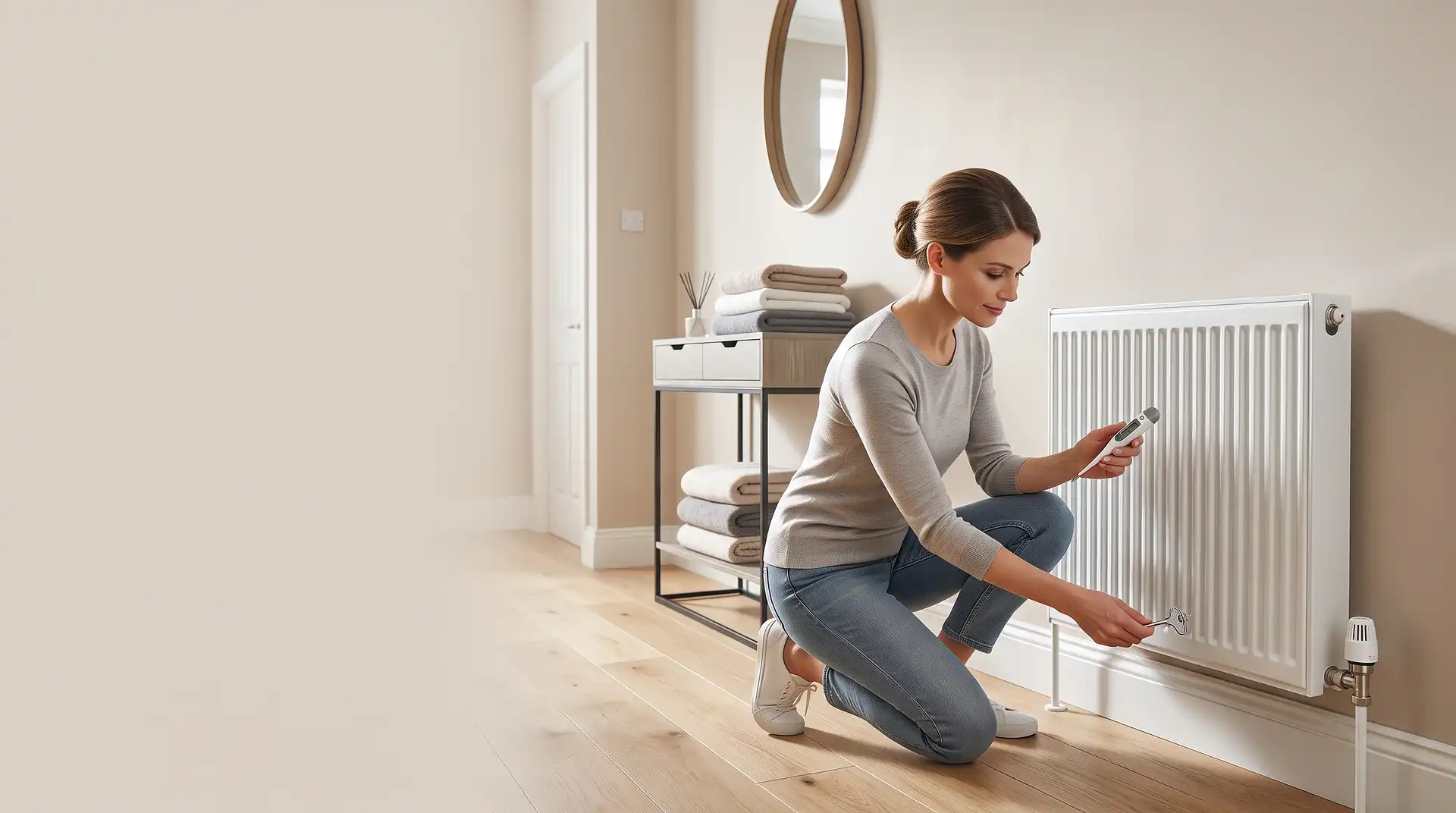
How to Balance Radiators
17 July 2026
How to Balance Radiators (So Every Room Heats Evenly)
If one radiator in the house scalds to the touch while another barely warms up, that's not usually a fault — it's an unbalanced system, where water is taking the path of least resistance to the radiators closest to the boiler or pump, leaving the furthest ones starved of flow. Balancing fixes this by deliberately restricting flow to the radiators that are getting too much, forcing water to distribute more evenly across the whole system. It's a genuinely fiddly, patience-heavy task — the actual method involves comparing temperatures between radiators in sequence, not just guessing and adjusting.
What Balancing Actually Means
Every radiator has two valves: the ordinary control valve (or thermostatic valve/TRV) you adjust day to day to turn a radiator up or down, and the lockshield valve, usually on the other end, hidden under a plastic cap and not meant for everyday adjustment. Balancing means setting each lockshield valve to control how much water flows through that specific radiator relative to the others, so radiators nearer the boiler don't hog flow and starve those further down the circuit. It's a one-time (or occasional) system-wide adjustment, not something you touch when you just want a room warmer or cooler day to day.
What You Need
A radiator key or a flat-head screwdriver — for adjusting the lockshield valve, which is often protected by a removable plastic cap.
A thermometer, ideally two — a clip-on pipe thermometer or an infrared thermometer works well; having two lets you compare the flow and return pipe temperatures on the same radiator without moving one back and forth.
A notepad or phone — to record each radiator's readings and adjustment as you go, since balancing an entire house means working through every radiator in sequence and it's easy to lose track without notes.
Step 1: Number the Radiators by Distance from the Boiler
Work out which radiator is closest to the boiler (or the circulation pump) and which is furthest, and number them in that order. This matters because you'll be balancing them in sequence, starting with the radiator nearest the boiler and working outward — balancing out of order is one of the more common reasons a DIY attempt doesn't actually even out.
Step 2: Open Everything Fully First
With the heating off, open every radiator's lockshield valve and control valve (or TRV) fully. This resets the system to a known starting point before you begin restricting flow to specific radiators, rather than trying to adjust valves that are already partially closed from a previous attempt.
Step 3: Turn the Heating On and Let It Settle
Switch the heating on and let the whole system run for 10–15 minutes so water is circulating and radiators have had time to heat up before you start taking readings.
Step 4: Measure Flow and Return Temperature at Radiator 1
At the radiator closest to the boiler, measure the temperature of the pipe going into the radiator (the flow) and the pipe coming out (the return) using your thermometer. The target is a difference of around 10–12°C between flow and return — a smaller difference means too much water is flowing through relative to what the radiator needs to heat that specific room, and the lockshield valve should be closed slightly to restrict it.
Step 5: Adjust and Recheck
Using the radiator key, close the lockshield valve slightly — a small turn, not a large one — and wait a few minutes for the temperatures to settle before measuring again. Repeat this small-adjustment-then-recheck cycle until the flow-return difference on that radiator is close to the 10–12°C target.
Step 6: Move to the Next Radiator in Sequence
Once radiator 1 is set, move to radiator 2 (the next closest to the boiler) and repeat the same measure-adjust-recheck process. Continue through every radiator in order, from nearest to furthest. Because each adjustment affects flow throughout the whole system slightly, working in sequence from nearest to furthest is what makes the process converge properly rather than chasing a moving target.
Step 7: Do a Final Pass
Once every radiator has been through the process once, it's worth doing a second, lighter pass through all of them, since adjustments made later in the sequence can shift the balance achieved earlier. This second pass is usually much quicker, since most radiators will only need minor fine-tuning rather than the larger adjustments made the first time through.
Common Mistakes and What to Do Instead
Mistake: adjusting the lockshield valve by feel instead of measuring. Balancing based on how warm a radiator feels to the hand is imprecise and inconsistent between rooms of different sizes. Use an actual thermometer and the flow-return temperature difference as the real target.
Mistake: balancing radiators in a random order rather than by distance from the boiler. This is one of the most common reasons a DIY balance doesn't hold — working from nearest to furthest is what allows the adjustments to converge rather than each one throwing off the last.
Mistake: closing the lockshield valve too far in one go. Large adjustments overshoot the target and require repeated correction. Small, incremental turns with a recheck in between get to the right setting faster overall, even though each individual step feels slower.
Mistake: confusing the lockshield valve with the TRV or control valve. Adjusting the wrong valve won't balance the system and can instead just turn the radiator up or down for everyday use. Confirm which valve is the lockshield — usually the one without a numbered dial, often under a plastic cap — before making any adjustment.
Mistake: balancing once and never revisiting it. Adding or removing a radiator, replacing a boiler, or significant pipework changes can all throw off a previous balance. It's worth rebalancing after any changes to the heating system, not assuming a balance done years ago still holds.
When to Call a Professional Instead
Balancing an entire house is a genuinely time-consuming, precision task, and it's reasonable to hire a heating engineer rather than DIY it, particularly for larger properties with many radiators, systems that have never been balanced and show significant temperature differences throughout the house, or after a new boiler or radiator installation, where balancing is typically included as the final step of the job. A professional will also have more precise equipment and experience recognising when an uneven radiator isn't actually a balancing issue at all, but sludge buildup or a different fault that balancing won't fix.
What It Costs in the UK
Professional radiator balancing, booked as a standalone service, typically costs £80–£180 in the UK, and can pay for itself over time — a properly balanced system commonly saves £80–£180 a year on heating bills, since an unbalanced system forces the boiler to work harder to compensate for radiators that aren't heating efficiently. If balancing is done as part of a new boiler or central heating installation, it's usually included in the overall job price rather than charged separately, since engineers balance the system as standard once installation is complete. DIY balancing, using a radiator key and a basic clip-on or infrared thermometer, typically costs under £20 in total for the tools, if you don't already have them.
Option | Typical UK Cost (2026) |
|---|---|
DIY balancing (tools only) | Under £20 |
Professional standalone balancing | £80–£180 |
Balancing as part of new boiler/radiator install | Usually included in job price |
Potential annual saving from a balanced system | £80–£180/year on heating bills |
These are UK market estimates and vary by property size, number of radiators, and provider — for a system that's never been balanced, the potential annual saving alone often justifies the one-off professional cost.
Staying Safe
Balancing involves working with a system that's actively running hot water, so handle pipework and valves carefully to avoid burns, particularly on the flow pipe closest to the boiler. If a lockshield valve feels stuck or seized rather than turning with reasonable resistance, don't force it — a damaged valve is a bigger and more expensive fix than the balancing issue you started with. If you're not confident distinguishing the lockshield valve from the TRV, or a valve looks different from a standard setup, it's worth checking with a heating engineer rather than adjusting the wrong one.
If children are in the home, keep them away from radiators and exposed pipework while measuring temperatures, since some sections of pipe near the boiler can get genuinely hot during this process.
Valve types and balancing procedures can vary slightly between heating systems, so it's worth checking your system's documentation or asking a heating engineer if anything about your setup looks non-standard.
FAQ
How do I know if my radiators need balancing? If some radiators heat up quickly and get very hot while others stay lukewarm or take a long time to warm, especially those furthest from the boiler, that's a strong sign the system is unbalanced.
What's the difference between the lockshield valve and the TRV? The TRV (or standard control valve) is for everyday adjustment of a room's temperature. The lockshield valve, usually under a plastic cap, is for system-wide balancing and isn't meant to be adjusted for day-to-day use.
What temperature difference should I aim for when balancing? A difference of around 10–12°C between the flow (inlet) and return (outlet) pipe temperatures on each radiator is the general target most balancing guidance uses.
How long does it take to balance a whole house of radiators? For a typical home, DIY balancing can take a few hours, since each radiator needs incremental adjustment and rechecking, done in sequence from nearest to furthest from the boiler.
Is radiator balancing worth doing? Yes, generally. A balanced system heats more evenly and can save £80–£180 a year on heating bills, since the boiler doesn't have to work as hard to compensate for radiators that aren't distributing heat efficiently.
How much does professional radiator balancing cost in the UK? A standalone professional balancing service typically costs £80–£180, though it's often included at no extra charge as the final step of a new boiler or radiator installation.