How to Change a Spotlight Bulb
12 August 2026
How to Change a Spotlight Bulb (And When You Can't)
Before anything else, there's a question worth answering that most guides skip entirely: does your spotlight actually have a replaceable bulb. A growing number of modern downlights are sealed integrated LED units, where the LED is built permanently into the fitting itself, and no amount of twisting, pulling, or prying will get a bulb out because there isn't one. If yours is integrated, the entire fitting needs replacing rather than the bulb, and that's electrician work rather than a two-minute job. Working this out first saves a genuinely frustrating half hour on a ladder.
How to Tell If Yours Is Integrated
Look at the fitting from below. If you can see a distinct glass or plastic bulb face sitting inside a separate housing, usually with a visible rim or trim around it, you almost certainly have a replaceable bulb. If the light surface is completely flush and continuous with the fitting, with no visible seam between bulb and housing, and no obvious way to access anything behind it, it's likely an integrated LED unit. The other clue is age and type, integrated fittings are common in newer installations and are often marketed on their long lifespan, typically rated for tens of thousands of hours rather than being treated as a consumable.
Identify Your Bulb Type
Assuming you do have a replaceable bulb, there are two common types in UK homes.
GU10 is by far the most common. It has two small pins with slightly bulbous ends, and it works on a twist-and-lock mechanism, push in and twist rather than screwing in. It runs on mains voltage, 230V.
MR16 has two thin straight pins with no lock mechanism, and simply pushes straight in. It typically runs on low voltage through a transformer, which is worth knowing since MR16 fittings sometimes have a separate transformer that can fail independently of the bulb.
The two are not interchangeable, so take the old bulb with you or photograph the base clearly before buying a replacement.
Step 1: Turn the Power Off Properly
Switch off at the wall switch, and ideally at the consumer unit for that lighting circuit too. This matters more than it might seem for recessed spotlights specifically, since your hands go up into a ceiling void where you can't see what you're touching.
Step 2: Let It Cool
Halogen spotlights in particular get genuinely hot, and even LEDs warm up. Give it a few minutes at minimum before touching anything.
Step 3: Release the Retaining Mechanism
This is where fittings differ most, and where people most often get stuck.
Spring clip. Look at the inside edge of the fitting where it meets the bulb face. You'll see a thin wire clip with two ends bent into small loops or prongs. Squeeze the two ends toward each other with thumb and finger, which compresses the spring and releases its tension, then manoeuvre it out of the small grooves holding it. The clip is designed to stay attached to the fitting, so let it hang rather than trying to remove it completely.
Rotating front trim. Some fittings have a trim ring that unscrews. Turn it until it's loose enough to remove by hand, then lift it away to expose the bulb.
Pinch clip on the holder. Squeeze the two ends of the clip together to release it from the GU10 holder.
If the bezel appears fixed and won't move at all, check for small screws at roughly the three and nine o'clock positions on the rim, some designs secure the bezel this way. Occasionally a bezel is stuck because it's been painted over during decorating, in which case carefully scoring the paint seal around the rim with a blade lets it come free.
Step 4: Remove the Bulb
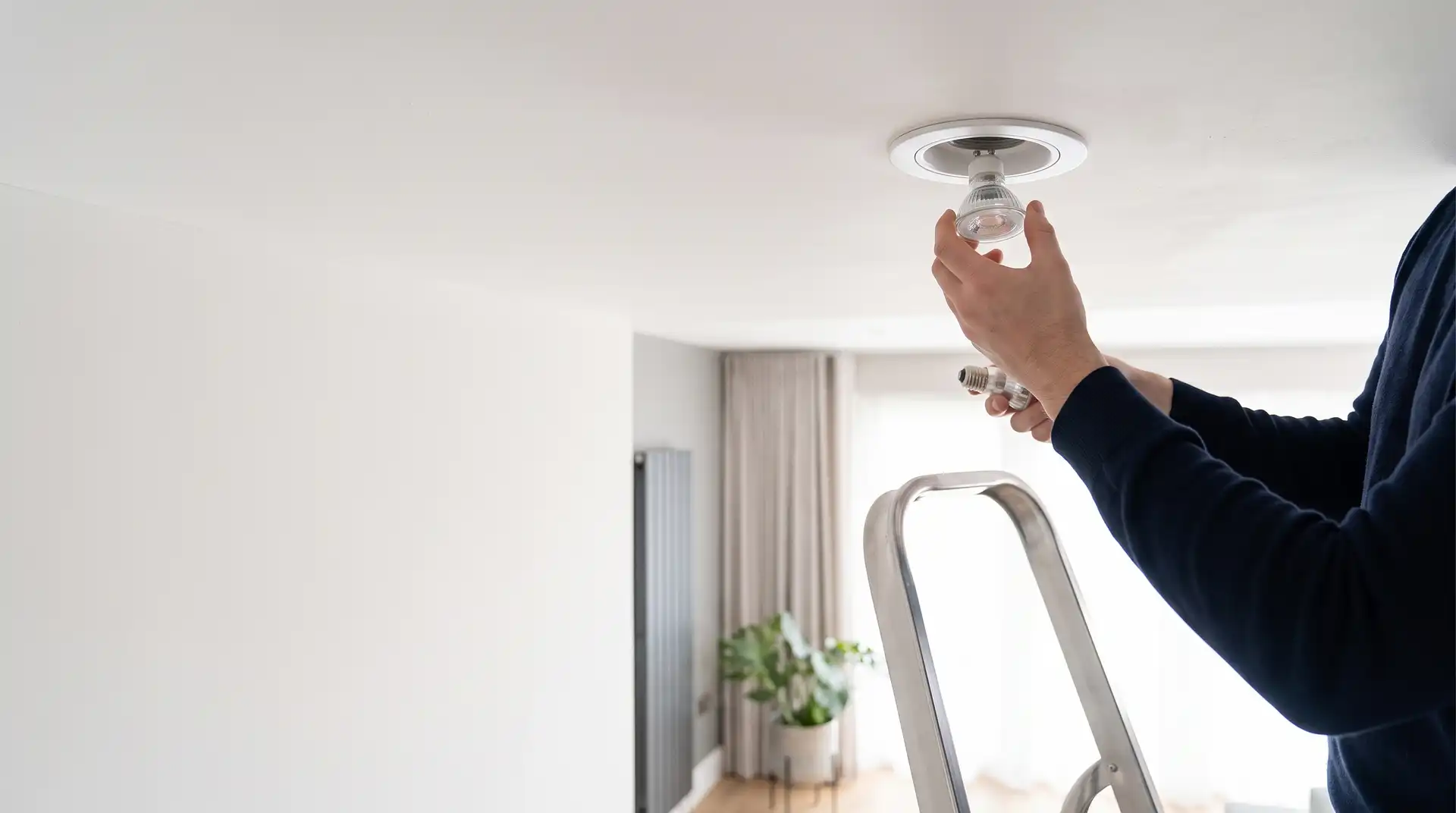
For GU10, push the bulb gently inward and twist anticlockwise about a quarter turn, then pull it straight out. It's a small twist, so avoid applying enough force to break the glass.
For MR16, there's no twist, just pull it straight out of the socket.
If the bulb sits flush with the trim and there's nothing to grip, a small suction cup tool, sold cheaply for exactly this purpose, gives you enough purchase to twist it without scratching or dropping it. A flattened plastic straw wedged into the gap alongside the bulb is a workable improvised alternative if you don't have one.
Step 5: Fit the New Bulb
Handle LED bulbs with a cloth or gloves rather than bare fingers, since skin oils can affect performance and lifespan. For GU10, align the two pins with the two larger openings in the socket, push gently, and twist clockwise about a quarter turn until you feel a distinct stop or click. Give it a very gentle tug to confirm it's seated. For MR16, line the pins up and push straight in until fully seated.
Step 6: Reassemble and Test
Squeeze the retaining clip ends together again and guide it back into its grooves inside the housing, releasing once both sides are seated so it springs back against the new bulb's face. Refit any trim ring. Restore power and test.
If the New Bulb Doesn't Work
Check it's fully seated first, an incompletely engaged GU10 is the most common cause. If it's definitely seated and still not lighting, and other spotlights on the same circuit work, the fitting's socket or, on MR16 systems, the transformer may have failed rather than the bulb.
If several spotlights are flickering rather than failing outright, that's often a different problem entirely, LED bulbs on a dimmer switch that was designed for halogen commonly flicker because the dimmer isn't LED-compatible, which no amount of bulb replacement will fix. Our related guide covers how to diagnose and fix flickering lights, worth reading before buying replacement bulbs if flickering rather than failure is the actual symptom you're dealing with.
Common Mistakes and What to Do Instead
Mistake: assuming every spotlight has a replaceable bulb. Integrated LED units are sealed, and the whole fitting needs replacing instead. Check for a visible bulb face and seam before spending time trying to extract something that isn't there.
Mistake: trying to unscrew a GU10 bulb. It's a twist-and-lock fitting, not a screw thread. Push in first, then twist a quarter turn anticlockwise.
Mistake: buying a replacement without checking the base type. GU10 and MR16 look broadly similar from a distance but aren't interchangeable. Take the old bulb with you or photograph the pins clearly.
Mistake: touching LED bulbs with bare fingers. Skin oils can affect performance and shorten lifespan. Use a cloth or gloves when handling.
Mistake: forcing a bezel that won't move. Check for retaining screws at the three and nine o'clock positions, or a paint seal from previous decorating, before applying more force and cracking the trim.
Mistake: not checking dimmer compatibility when fitting LEDs. An LED bulb on a dimmer built for halogen commonly flickers or buzzes, which is a compatibility issue rather than a faulty bulb.
When to Call an Electrician
Call a qualified electrician if your fittings are integrated LED units needing full replacement, if the socket or transformer has failed rather than the bulb, if you're dealing with a fitting you can't safely reach from a stable ladder, or if multiple spotlights on a circuit have failed simultaneously, which points to something beyond individual bulbs.
What It Costs in the UK
Replacement bulbs are inexpensive, a GU10 LED typically costs £3 to £10 depending on brand, brightness, and colour temperature, and a suction cup removal tool typically costs £3 to £8 if you need one.
If the fitting itself needs replacing rather than the bulb, according to InstantCost.co.uk's 2026 UK electrician pricing data, light fitting and spotlight installation typically costs £120 to £280 per room supplied and fitted. Electrician hourly rates run £40 to £75, with London and the South East at £55 to £75 and the Midlands, North and Wales closer to £40 to £55, and most electricians charge a one-hour minimum plus a call-out fee of £40 to £80 for short jobs, which is worth factoring in for a single fitting replacement. If replacing spotlights prompts a wider look at the property's electrics, an EICR safety inspection typically costs £150 to £350 depending on property size.
Item or Service | Typical UK Cost (2026) |
|---|---|
GU10 LED replacement bulb | £3 to £10 |
Suction cup removal tool | £3 to £8 |
Electrician hourly rate | £40 to £75 |
Call-out fee (short jobs) | £40 to £80 |
Light fitting or spotlights, per room, supplied and fitted | £120 to £280 |
EICR safety inspection | £150 to £350 |
Electrician figures are based on InstantCost.co.uk's 2026 UK pricing data and vary by region and provider. Bulb prices are general UK market estimates.
Staying Safe
Turn the power off at both the wall switch and, ideally, the consumer unit before reaching into any recessed fitting, since your hands enter a space you can't see into. Use a stable stepladder rather than a chair or worktop, and have someone steady it if the ceiling is high. Let halogen bulbs cool fully before handling, they retain genuine heat well after being switched off.
If a bulb breaks while you're removing it, switch the circuit off at the consumer unit before attempting to remove the remaining base, and wear gloves when handling broken glass.
Fitting designs vary considerably between manufacturers, so if your spotlight looks different from the types described here, check the manufacturer's guidance rather than forcing any component.
FAQ
How do I know if my spotlight has a replaceable bulb? Look for a visible seam between the bulb face and the housing. If the light surface is completely flush and continuous with no accessible bulb behind it, you likely have a sealed integrated LED unit where the whole fitting needs replacing instead.
How do I remove a GU10 spotlight bulb? Push it gently inward and twist anticlockwise about a quarter turn, then pull straight out. It's a twist-and-lock fitting, not a screw thread, so don't try to unscrew it.
What's the difference between GU10 and MR16 bulbs? GU10 has two pins with bulbous ends and twists to lock, running on mains voltage. MR16 has thin straight pins and pushes straight in, typically running on low voltage through a transformer.
What do I do if the bulb is stuck or flush with the ceiling? A small suction cup tool, typically £3 to £8, gives enough grip to twist it out without scratching or dropping it. A flattened plastic straw wedged alongside the bulb works as an improvised alternative.
Why won't my new spotlight bulb work? Most commonly it isn't fully seated. If it's definitely engaged and other lights on the circuit work, the fitting's socket or, on MR16 systems, the transformer may have failed rather than the bulb.
How much does it cost to replace a spotlight fitting rather than the bulb? Light fitting and spotlight installation typically costs £120 to £280 per room supplied and fitted, according to 2026 UK data, plus a call-out fee of £40 to £80 for a smaller single-fitting job.