How to Clean Exterior Brick Walls
11 July 2026
How to Clean an Exterior Brick Wall Without Damaging It
The biggest risk in cleaning exterior brick isn't leaving it dirty — it's cleaning it the wrong way and doing damage that costs far more to fix than the original staining ever cost to look at. High-pressure water forced into old or soft brick can drive moisture behind the surface, which shows up months later as frost damage, spalling, or damp inside the wall. The method has to match the brick, not the other way around, and that single decision matters more than any product you choose.
Work Out What You're Actually Cleaning First
Brick condition and age determine everything downstream. Newer, harder-fired bricks (most builds from roughly the 1950s onward) can generally tolerate moderate pressure washing. Older, softer, or handmade bricks — common in Victorian and pre-war properties — are more porous and can be damaged by the same pressure that's fine on modern brick, because the surface erodes and lets water penetrate rather than shed it. Painted brick, rendered surfaces, and anything with organic growth (moss, algae, lichen) each need a different approach again — pressure washing render specifically is widely discouraged, since the force can strip the finish and push water behind it rather than clean the surface.
If you're not sure which category your wall falls into, that uncertainty is itself useful information: it's the signal to start with the gentlest method available and go up in intensity only if needed, rather than reaching for the highest-pressure option first.
The Right Method for Ordinary Dirt and Grime
For general soiling — traffic film, dust, light algae — on standard modern brick, this order works without specialist equipment:
Dry brush first. A stiff (not wire) brush removes loose dirt, cobwebs, and moss before any water touches the wall, which stops you scrubbing mud into the surface.
Wet the wall from the bottom up. This prevents dirty water streaking down and drying into already-clean sections above.
Apply a mild detergent solution and scrub gently with a soft-to-medium brush, working in small sections rather than the whole wall at once.
Rinse from the top down, the opposite direction to the wetting step, so dirty runoff doesn't dry on clean brick.
Let it dry fully before judging the result — brick often looks patchy while damp and evens out once dry.
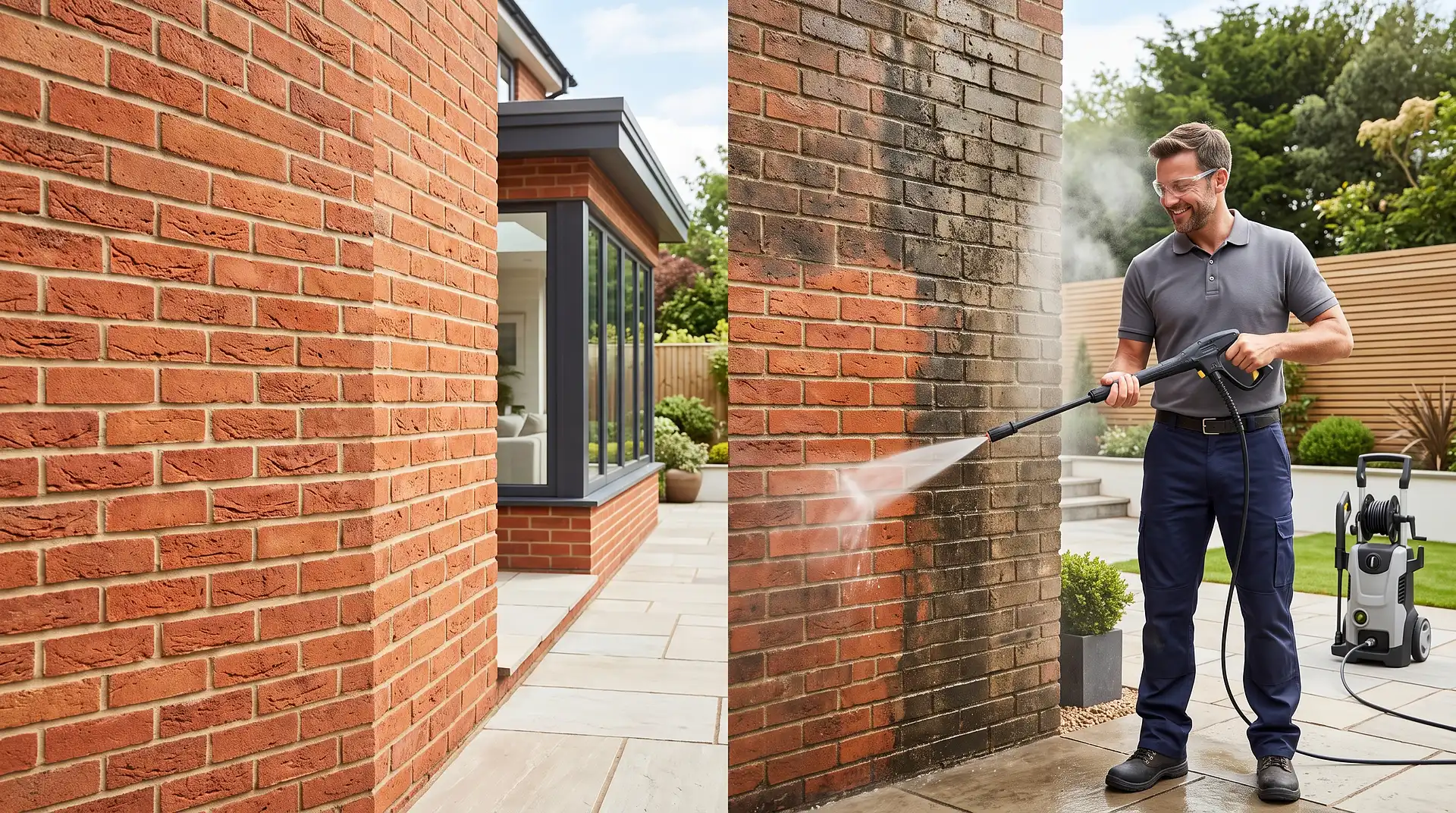
If you use a pressure washer on brick confirmed suitable for it, keep the nozzle at a wide fan angle, maintain distance from the surface, and use the lowest pressure that shifts the dirt — professionals typically favour soft washing (low pressure plus a mild chemical solution) over high pressure specifically because it cleans as effectively with far less risk to the mortar and brick face.
Common Mistakes and What to Do Instead
Mistake: pressure washing without checking brick age or condition. This is the single most common cause of DIY brick-cleaning damage — forcing water into porous or old brick that was never designed to take that pressure. When in doubt, soft wash or hand scrub instead.
Mistake: using a wire brush. Wire bristles scratch the brick face and can embed metal fragments that rust and stain the wall later. Stick to stiff nylon or natural-bristle brushes.
Mistake: cleaning brick and mortar the same way. Mortar is generally softer than brick and erodes faster under pressure or acid-based cleaners. Aggressive treatments can wear out the mortar joints long before the brick itself shows any wear, weakening the wall structurally over time.
Mistake: using bleach or acid-based products without testing. Some cleaning chemicals react with specific brick types or mortar composition and cause discolouration that's permanent. Always test any chemical product on a small, hidden section first and leave it 24–48 hours before treating the whole wall.
Mistake: cleaning in direct sun or freezing conditions. Solution dries too fast in hot sun, leaving patchy results, while cleaning in frost risks water freezing in the brick's pores and causing exactly the damage you were trying to prevent. Overcast, mild days are best.
Mistake: ignoring the cause of staining. Green or black staining often indicates a damp source — a leaking gutter, poor drainage, or a bridged damp-proof course — rather than just surface dirt. Cleaning it off without fixing the cause means it returns within a year or two.
When to Call a Professional Instead
Brick cleaning moves from a reasonable DIY project to a specialist job in a few specific situations: the property is older or the brick type is uncertain, there's heavy staining like carbon deposits, old paint, or efflorescence (the white salty residue that needs specific treatment, not just washing), the work requires height access via ladder or scaffold, or you're dealing with render rather than brick — professionals almost universally recommend against DIY pressure washing render because of how easily it's damaged.
A professional will typically run a test patch, check the brick's porosity, and select a pressure and chemical mix suited to the specific wall, rather than applying one method across the whole property. That judgment call is where most of the value in hiring out actually sits — not the equipment itself.
What It Costs in the UK (2026)
Pricing varies significantly by method and property type, more than almost any other exterior cleaning job. Standard residential brick cleaning using manual scrubbing typically runs £8–£15 per m², while pressure washing (on brick confirmed suitable for it) runs closer to £10–£18 per m². Specialist methods cost more: gentle low-pressure cleaning suited to heritage or older brick typically runs £25–£40 per m², and deep chemical treatment for heavy carbon deposits or old paint can reach £30–£55 per m².
For a full house exterior, most companies set a minimum call-out of roughly £150–£250, and a typical 3-bedroom semi-detached or terraced property tends to land between £600 and £1,500 depending on wall area, staining severity, and access. Render cleaning is priced separately and differently — since soft washing rather than pressure washing is the standard approach, a terraced or semi-detached property typically costs £300–£600, and a detached property averages around £850.
Scaffolding, where needed for upper-storey access, adds a substantial amount on top — often 20–30% of the total project cost for a two- or three-storey property — so getting a like-for-like quote on whether scaffolding is included matters as much as comparing the headline per-m² rate.
Method | Typical UK Price (2026) | Best For |
|---|---|---|
Manual scrub (brush + water) | £8–£15/m² | Light dirt, general upkeep |
Standard pressure washing | £10–£18/m² | Modern, hard-fired brick only |
Gentle low-pressure/soft wash | £25–£40/m² | Older or heritage brick, render |
Chemical/deep treatment | £30–£55/m² | Carbon deposits, old paint, efflorescence |
Full house exterior, 3-bed | £600–£1,500 | Whole-property clean, typical semi/terrace |
Render cleaning (soft wash), terrace/semi | £300–£600 | Modern render, algae/staining |
These are UK market estimates and vary by region, brick condition, and access — get at least three quotes, and confirm whether the price includes scaffolding, mortar repair, or a protective sealant, since these are commonly quoted as separate extras.
Staying Safe
Anyone hiring a professional should check for public liability insurance and, ideally, accreditation such as Water Jetting Association safety certification, since pressure equipment and working at height both carry real risk if handled without training. If you're doing this yourself, the same working-at-height caution applies as with any exterior job — don't overreach from a ladder, and treat any wall taller than you can safely reach from the ground as a professional job rather than a taller-ladder problem.
On the chemical side, UK contractors are expected to follow COSHH (Control of Substances Hazardous to Health) requirements when using cleaning chemicals or biocides, which is worth asking about even for a domestic quote. If you're using any chemical treatment yourself — including shop-bought brick or algae cleaners — keep it off skin and eyes, never mix products together, and check local wastewater rules before letting runoff go into a drain, since some cleaning solutions aren't meant to enter the water system untreated. Store any products used in a locked or high shelf out of reach of children, in their original labelled containers, exactly as you would indoors.
Building-specific safety guidance, COSHH requirements, and local wastewater rules can be updated, so it's worth checking current advice (e.g. HSE.gov.uk) before undertaking chemical brick cleaning yourself, especially near drains or on a shared boundary wall.
FAQ
Can I pressure wash my brick wall myself? Only if the brick is modern and in good condition. Older, softer, or porous brick can be damaged by pressure that forces water behind the surface, leading to frost damage or damp later on.
How do I know if my brick is too old for pressure washing? As a rough guide, handmade or pre-1950s brick is more likely to be porous and unsuitable for high pressure. If you're unsure, start with manual scrubbing or a soft wash instead.
What's the difference between pressure washing and soft washing? Pressure washing uses high-force water alone. Soft washing uses low pressure combined with a mild cleaning solution, and is the safer, industry-preferred method for older brick and all render.
How much does professional brick cleaning cost in the UK? A full 3-bedroom house exterior typically costs £600–£1,500 in 2026, depending on method, staining severity, and whether scaffolding is needed for access.
Why does green or black staining keep coming back after cleaning? It usually indicates an ongoing damp source — a leaking gutter, poor drainage, or a bridged damp-proof course — rather than just surface dirt. Fixing the source stops it returning.
Should I seal brick after cleaning it? It's optional. Sealing can slow moss and algae regrowth and make future cleaning easier, but some older or heritage brick needs to "breathe" and shouldn't be sealed — check with a professional before applying anything.