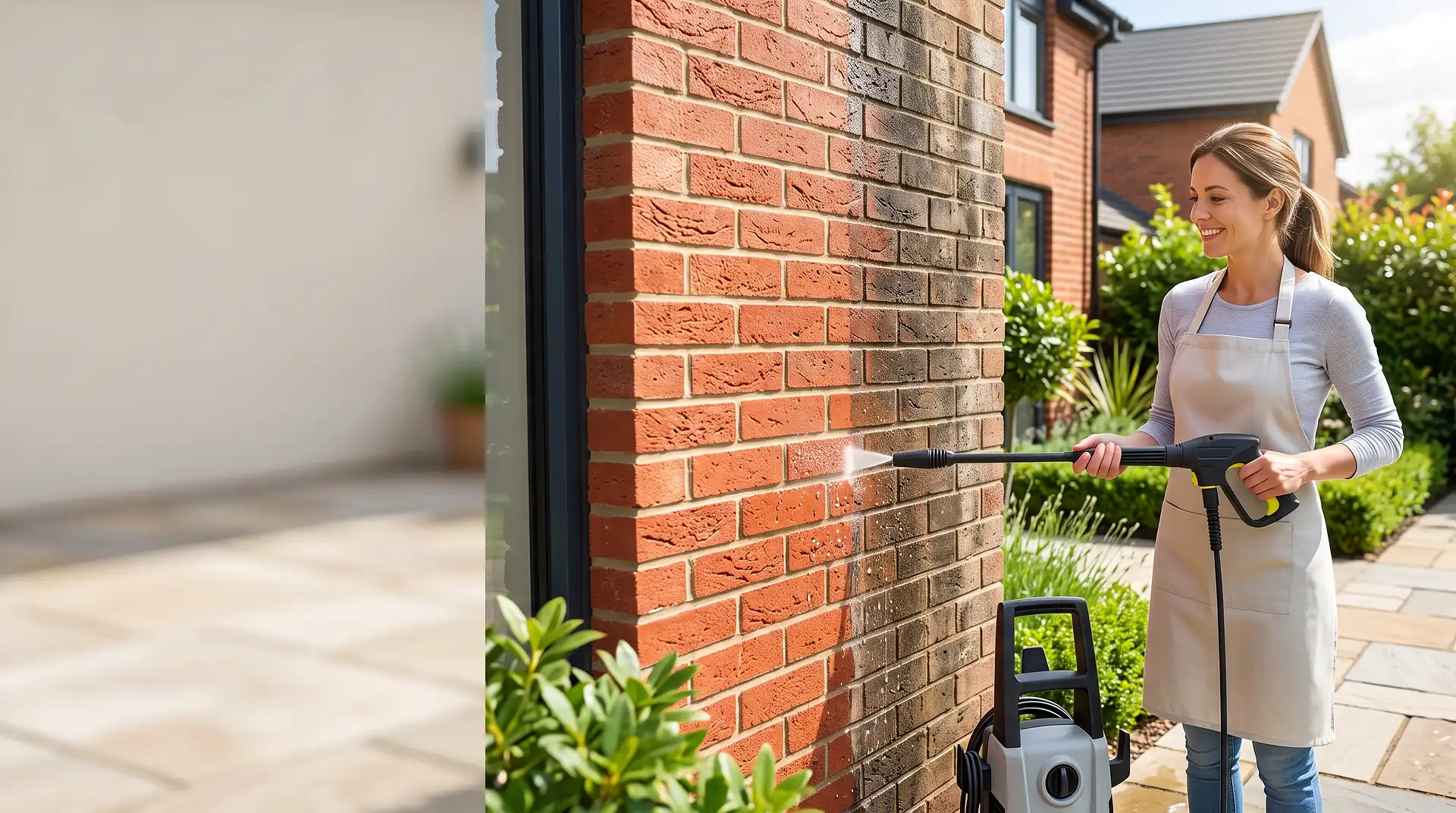
How to Clean Exterior House Bricks
13 August 2026
How to Clean Exterior House Bricks (Diagnose First, Then Treat)
Most brick cleaning advice starts with method, pressure washing, soft washing, chemical treatment, when the more useful starting point is working out what's actually on the wall. Green algae, white efflorescence, general grey soiling, and dark staining below a gutter are four genuinely different problems with four different correct responses, and treating one as though it's another is how people end up scrubbing repeatedly at something that was never going to shift, or worse, driving a problem deeper into the brick.
First, Identify What You're Looking At
Green, black, or grey patches, worse on shaded and north-facing walls. This is biological growth, algae, moss, or lichen. It thrives on damp, sheltered surfaces and returns from spores if you simply rinse it off.
White, powdery, crystalline deposits. This is efflorescence, mineral salts migrating out of the brick or mortar as moisture evaporates through it. It's a symptom of moisture movement rather than dirt sitting on the surface.
Even grey or brown dulling across the whole elevation. General atmospheric soiling, accumulated dust, pollution, and traffic film. This is the most straightforward category to deal with.
Dark streaking below a gutter, downpipe, or windowsill. This is usually a water path problem rather than a cleaning problem. Something above is discharging water down the face of the brick.
Treating Biological Growth
Rinsing off visible algae doesn't work long-term, because the spores remain and regrow within months. Apply a fungicidal or biocidal wash formulated for masonry, and leave it to dwell for the time stated on the product, commonly 15 to 30 minutes, before washing down. Some products are designed to be applied and left without rinsing, working over subsequent weeks as weather washes the treated growth away, which genuinely gives longer-lasting results than immediate rinsing.
Address the underlying cause too, if practical. Growth thrives where brickwork stays damp, so overhanging vegetation blocking sun and airflow, or a persistent water source, will bring it straight back regardless of how well you treat the surface.
Treating Efflorescence
This is the one where cleaning alone genuinely isn't the answer. The white deposits are salts being carried to the surface by moisture moving through the masonry, so scrubbing them away treats the symptom while the process continues underneath. Light efflorescence often weathers away naturally over time, and dry brushing with a stiff, non-wire brush removes surface deposits without adding water that would dissolve the salts and carry them back in.
More importantly, ask where the moisture is coming from. A leaking gutter, failed pointing, a bridged damp proof course, or rising damp are all common sources, and until that's addressed, efflorescence will keep reappearing. Persistent or heavy efflorescence is worth having assessed rather than repeatedly cleaned.
Treating General Soiling
This is the most straightforward category. Dry brush first to remove loose material, wet the wall from the bottom upward so dirty runoff doesn't streak down onto uncleaned brick, apply a mild detergent or masonry cleaner, work in manageable sections with a soft to medium brush, then rinse from the top down. Let it dry fully before judging the result, since brick often looks patchy while damp and evens out considerably once dry.
Treating Streaking Below Gutters
Cleaning this only ever produces a temporary result, because the staining will return with the next heavy rain if the cause isn't fixed. A blocked or overflowing gutter, a cracked downpipe joint, or a missing drip edge sends water down the brick face rather than away from it, and that repeated wetting both stains the brick and feeds algae growth. Clear the gutters and check the downpipe before cleaning the wall beneath, otherwise you're doing the same job again next season. Our related guide covers how to clean gutters without a ladder, using ground-based vacuum systems and telescopic tools, which is worth reading if streaking below the guttering is what prompted you to look at the brickwork in the first place.
Common Mistakes and What to Do Instead
Mistake: treating every type of soiling with the same method. Algae needs a biocide with dwell time, efflorescence needs the moisture source addressed, general soiling needs a straightforward wash, and gutter streaking needs the gutter fixed. Identify first.
Mistake: rinsing algae off without a fungicidal treatment. The spores remain and regrow within months. A proper biocidal wash with adequate dwell time is what actually delays return.
Mistake: scrubbing efflorescence repeatedly without investigating why it's appearing. It's a moisture symptom, not surface dirt. Cleaning it away while the underlying moisture movement continues means it simply comes back.
Mistake: washing efflorescence with water. Water dissolves the salts and carries them back into the brick, where they resurface later. Dry brushing is the better first approach.
Mistake: cleaning below a gutter without fixing the gutter. The staining returns with the next heavy rain. Deal with the water path before the wall beneath it.
Mistake: starting at full pressure. Older or softer brick, and mortar of almost any age, can be damaged by pressure that's fine on modern hard-fired brick. Start gentle and escalate only if genuinely necessary.
When to Call a Professional
Worth doing for older properties or where you can't confidently identify the brick type, for heavy staining that a standard wash hasn't shifted, for any work needing height access beyond a stable ground-floor ladder position, for persistent efflorescence suggesting an underlying damp issue that needs diagnosing rather than cleaning, or where brickwork sits alongside render or stonework needing a different approach on the same elevation.
What It Costs in the UK
According to InstantCost.co.uk's 2026 UK exterior cleaning data, exterior wall cleaning for render or brick typically costs £200 to £600 per elevation, depending on the size of the wall, the level of soiling, and access. For context on a broader exterior clean, standard exterior window cleaning for a typical 3-bed semi costs £40 to £80.
There's a genuinely useful efficiency here worth knowing: bundling services on the same visit typically saves 10 to 20% compared with booking each separately, since setup time is shared across the whole job. If your brickwork needs cleaning and the gutters or windows are due attention as well, arranging them together is meaningfully cheaper than three separate visits, and it also means the gutter work happens before the wall beneath it is cleaned rather than after.
DIY materials are considerably less, a biocidal masonry wash typically costs £15 to £40 depending on coverage, and a stiff non-wire brush £10 to £20.
Item or Service | Typical UK Cost (2026) |
|---|---|
Biocidal masonry wash (DIY) | £15 to £40 |
Stiff non-wire brush | £10 to £20 |
Exterior wall cleaning, per elevation | £200 to £600 |
Exterior window cleaning, 3-bed semi | £40 to £80 |
Saving when bundling services on one visit | 10 to 20% |
Exterior cleaning figures are based on InstantCost.co.uk's 2026 UK pricing data and vary by property size, access, and region. DIY material costs are general UK market estimates.
Staying Safe
Fungicidal and biocidal washes are stronger than household cleaning products, so wear gloves and eye protection, and avoid applying them in direct sun where the product dries before it can work. Check the label regarding runoff, since some products shouldn't drain untreated onto planting or into drains.
For work above ground floor, never overreach from a ladder. Anything beyond safe, stable reach warrants proper access equipment or a professional, and this is the point where the cost of hiring out compares favourably against the risk.
Keep children and pets away from treated areas while any chemical wash is dwelling.
Product-specific guidance varies by manufacturer, so check the label for dwell time, dilution, and runoff advice before use, particularly near planting.
FAQ
How do I know what's actually on my brickwork? Green, black or grey patches on shaded walls are biological growth. White powdery deposits are efflorescence, a moisture symptom. Even grey dulling is general soiling. Dark streaks below gutters indicate a water path problem rather than dirt.
Why does algae keep coming back after I clean it? Rinsing removes visible growth but leaves spores behind. A fungicidal wash with proper dwell time is needed, and any persistent damp source or overhanging vegetation keeping the wall shaded and wet will bring it back regardless.
What causes the white powdery deposits on my bricks? Efflorescence, mineral salts carried to the surface as moisture evaporates through the masonry. It indicates moisture movement, so the source, a leaking gutter, failed pointing, or damp, is what actually needs addressing.
Can I pressure wash my house bricks? Only if the brick is modern and in good condition. Older, softer, handmade brick can be damaged by pressure forcing water behind the surface, and mortar erodes faster than brick under pressure regardless of age.
How much does professional brick cleaning cost in the UK? Exterior wall cleaning typically costs £200 to £600 per elevation according to 2026 UK data, varying by wall size, soiling level, and access.
Is it cheaper to clean brickwork and gutters at the same time? Yes, bundling services on a single visit typically saves 10 to 20% compared with separate bookings, and it also means gutter issues get resolved before the wall beneath them is cleaned.