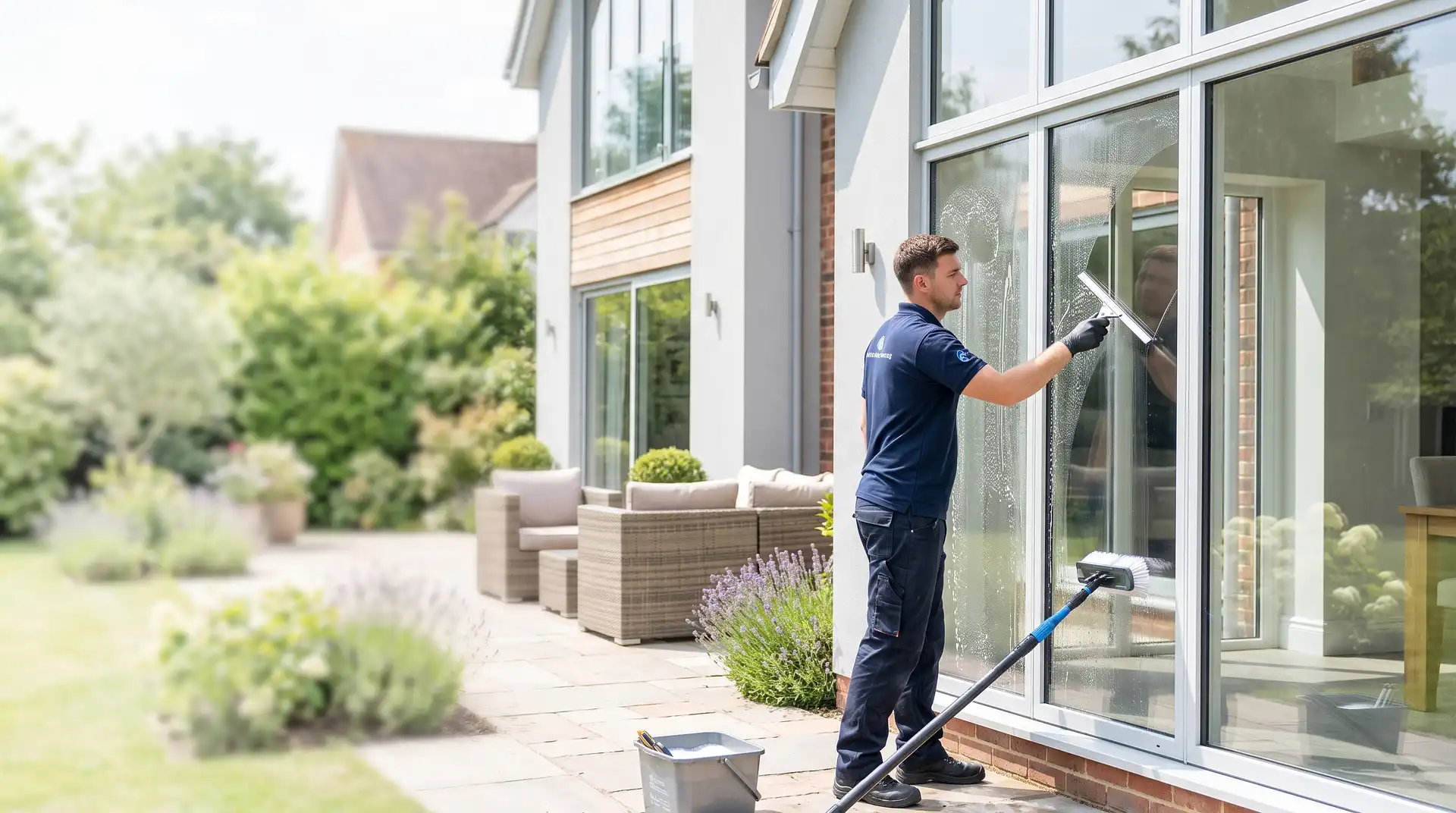
How to Clean Exterior Windows
11 July 2026
How to Clean Exterior Windows Without Streaks (or a Fall)
Exterior windows fail for a different reason than interior ones — it's not dust, it's mineral residue from rain and hard water, plus whatever's airborne (traffic film, pollen, salt near the coast). That means the standard spray-and-wipe approach that works indoors often just smears exterior grime around rather than lifting it. The fix is a specific method — pure or deionised water where possible, the right tool, and a technique that pulls dirt off rather than pushing it — combined with knowing when the job genuinely needs a professional instead of a ladder.
What You Actually Need
A bucket of warm water with a small amount of washing-up liquid, or better, deionised/pure water — pure water leaves no mineral residue behind, which is why professional cleaners use it and why it dries streak-free without buffing.
A squeegee — this is the actual tool that removes streaks; cloths alone tend to redistribute water rather than remove it cleanly.
A soft-bristled window brush or scrubber — for loosening dirt on the glass before the squeegee pass.
A water-fed pole — for upper floors, this lets you clean from ground level using pure water and a soft brush head, avoiding a ladder entirely.
A lint-free cloth or micro-fibre towel — for wiping the squeegee blade between passes and cleaning sills and frames.
A separate cloth for frames and sills — reusing the glass cloth on frames transfers grit back onto the glass on the next window.
You don't need branded glass cleaner. Most streaking on DIY window cleans comes from using too much soap, not too little, or from cleaning in direct sunlight where the solution dries before it's wiped off.
The Method That Actually Works
Wet the glass fully with your soap solution or pure water and scrub with the soft brush to lift dirt, working from the top of the pane down. Then use the squeegee in a single continuous stroke where possible — start at a top corner, pull across horizontally, and overlap each stroke slightly with the one before it so you're not leaving a dry, un-squeegeed strip. Wipe the blade dry with your cloth after every stroke; a wet blade just redeposits dirty water instead of removing it.
Finish by running the squeegee or a dry cloth around the frame and sill edge to catch drips before they run back down the glass and undo the pane you just finished — this single step is what separates a genuinely streak-free finish from one that looks fine wet and streaky once it dries.
Work on a dry, overcast day if you can choose. Direct sun dries the cleaning solution before you can squeegee it off, which is one of the most common causes of streaking and has nothing to do with technique.
Common Mistakes and What to Do Instead
Mistake: cleaning in direct sunlight. The solution flash-dries and leaves mineral streaks before the squeegee reaches it. Clean in shade or on an overcast day.
Mistake: using too much washing-up liquid. Excess soap leaves a film that attracts dust faster than dirty glass did. Use a small amount — a capful in a bucket of water is enough.
Mistake: skipping the frame and sill. Dirt sitting on the sill washes straight back onto the glass with the next rain, undoing the clean within days. Always clean frame and sill in the same pass as the glass.
Mistake: using a ladder for upper-floor windows without checking ground stability and reach. Most DIY ladder falls happen from overreaching sideways rather than from the ladder itself failing. If a window needs you to lean, a water-fed pole or a professional is the safer option, not a taller ladder.
Mistake: cleaning windows but ignoring gutters above them. Overflowing or blocked gutters run dirty water straight down the glass during rain, which is why windows below a blocked gutter get dirty again within a week or two of a clean.
When to Hire a Professional Instead
Ground-floor and single-storey windows are reasonable to do yourself with the method above. Anything above that changes the calculation — not because the cleaning itself is harder, but because the access is. A professional using a water-fed pole system can safely clean second- and third-storey windows from the ground; doing the same from a ladder leaning against the house carries real fall risk, and it's the single most common reason window-cleaning DIY goes wrong.
It's also worth hiring out a first clean if windows haven't been done in months or years — heavy algae, bird mess, or built-up traffic film takes significantly longer to remove and often needs a stronger initial treatment before a normal maintenance clean can keep it looking streak-free.
What It Costs in the UK (2026)
Current UK pricing for exterior window cleaning centres on the size of the property and how the windows are accessed, more than anything else. For a standard 3-bedroom house on a regular schedule, most quotes fall between roughly £15 and £40 per visit, with £20–£30 being typical for straightforward ground-and-first-floor access using a water-fed pole. Smaller terraced properties tend to sit toward the lower end of that range, while larger detached homes or properties with harder access (bay windows, conservatories, upper storeys with limited rear access) push toward £40–£60 or more.
A first clean or a one-off deep clean — where windows haven't been done in months and have heavy build-up — typically costs 50–100% more than a regular scheduled clean, since it takes noticeably longer to remove. Regular customers on a 4–8 week schedule generally pay less per visit than one-off bookings, both because the glass stays easier to clean and because many cleaners offer a discount for standing work.
Location shifts prices meaningfully: London and the South East typically run 15–35% above the national average, while the Midlands, North of England, Wales, and Scotland tend to sit at or below it. Commercial properties requiring cherry pickers, scaffolding, or abseiling access are priced separately and can range from £100 to £500+ depending on scale.
Job | Typical UK Price (2026) | Notes |
|---|---|---|
Regular clean, 3-bed house | £15–£40/visit | Ground/first floor, water-fed pole |
One-off/first clean (neglected windows) | £40–£90 | 50–100% above regular rate |
Small terraced house | £12–£20/visit | Fewer, more accessible windows |
Large detached/hard access | £40–£60+ | Bay windows, conservatories, upper storeys |
Commercial (cherry picker/scaffold) | £100–£500+ | Priced per job, not per visit |
These are UK market estimates and vary by region, property access, and provider — get at least three quotes before booking, and be clear upfront on whether frames and sills are included, since some cleaners charge these separately.
Staying Safe While You Clean
Working at height is the main real risk in exterior window cleaning, and it's worth treating seriously rather than as an inconvenience. Never lean sideways from a ladder to reach further — reposition the ladder instead, even if it means climbing down and moving it repeatedly. If a window genuinely can't be reached safely from the ground or a stable single-storey ladder position, that's the signal to use a water-fed pole or book a professional, not to extend the ladder further.
On the chemical side, if you use anything stronger than washing-up liquid — a limescale remover for stubborn mineral staining, for instance — keep it off skin and eyes, don't mix it with anything else, and rinse thoroughly, since runoff can affect nearby plants and surfaces as well as skin. Store any cleaning products used outdoors the same way you would indoors: in original labelled containers, out of reach of children, especially since outdoor cleaning often means a bucket left temporarily accessible in a garden or driveway while you work.
Ladder safety guidance and product-specific safety data can change, so it's worth checking current advice (e.g. HSE.gov.uk for working-at-height guidance) before taking on upper-storey window cleaning yourself.
FAQ
What's the best way to clean exterior windows without streaks? Use pure or deionised water with a soft brush to loosen dirt, then a squeegee in overlapping strokes, wiping the blade dry between each pass. Avoid direct sunlight, which dries the solution before it can be removed cleanly.
Can I use vinegar or washing-up liquid to clean exterior windows? Yes, a small amount of washing-up liquid in warm water works fine, but too much leaves a residue film. A squeegee is what actually prevents streaking, not the specific cleaning solution used.
Is it safe to clean upstairs windows myself? It can be risky with a ladder due to overreaching. A water-fed pole lets you clean upper-storey windows safely from the ground, and is the method most professionals use for exactly this reason.
How much does professional window cleaning cost in the UK? A regular exterior clean for a 3-bed house typically costs £15–£40 per visit in 2026, with London and the South East running 15–35% above the national average.
How often should exterior windows be cleaned? Most UK homes do well on a 4–8 week schedule. Properties near busy roads, trees, or the coast usually need more frequent cleaning due to faster dirt build-up.
Why do my windows get dirty again so quickly after cleaning? Usually a blocked or overflowing gutter above the window, which runs dirty water straight down the glass during rain. Cleaning the gutters fixes this faster than cleaning the windows more often.