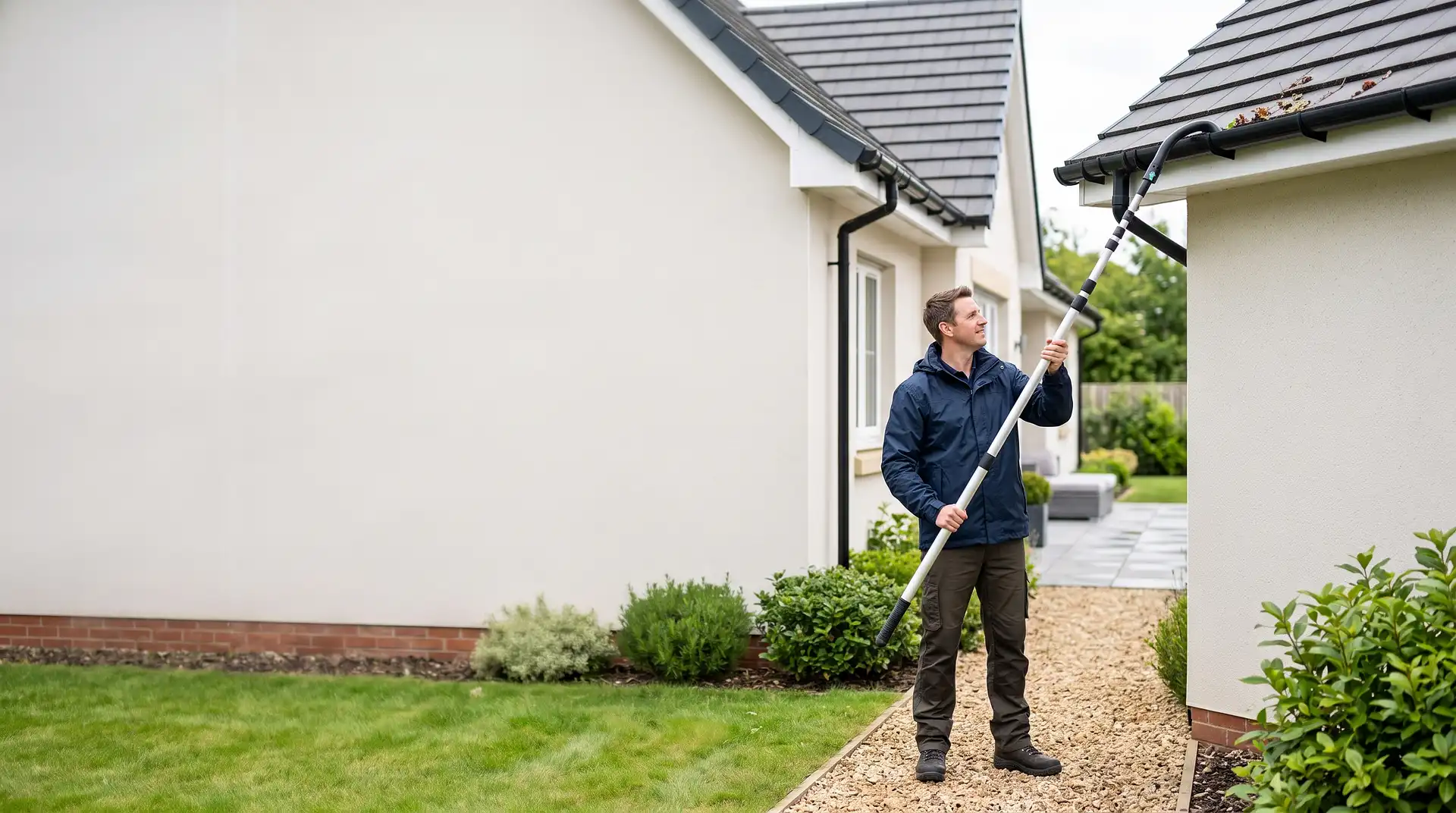
How to Clean House Gutters Without a Ladder
27 July 2026
How to Clean House Gutters Without a Ladder
Ladder falls are one of the most common causes of serious DIY injury in the UK, and gutter cleaning is consistently one of the jobs most associated with them reaching, overbalancing, or the ladder itself slipping on uneven ground near a building's edge. The good news is that gutters genuinely can be cleaned thoroughly from the ground now, using tools built specifically for this a gutter vacuum system with a camera being the standout option, but not the only one.
Why Ground-Based Cleaning Works Now
Gutter vacuum systems essentially a powerful wet/dry vacuum connected to a long, lightweight extension pole, often with a small camera fitted near the tip let you see inside the gutter on a screen or viewfinder while removing debris, all from ground level. This is the same core technology many professional gutter cleaning companies now use specifically because it avoids ladder risk for their own staff, and the consumer version works on the same principle at a smaller scale. It's a genuine shift in how gutter cleaning is done, not just a workaround.
Method 1: Gutter Vacuum System
This is the most thorough ground-based option. A vacuum unit (many households already own a wet/dry shop vac suitable for this, or a dedicated gutter vacuum kit can be bought or hired) connects to a series of lightweight extension poles, often reaching 6–12 metres, ending in a curved nozzle designed to sit inside the gutter channel. Some kits include a small camera near the tip, feeding a live image to a handheld screen or your phone, so you can see exactly what you're clearing without climbing anything.
Work along the length of the gutter in manageable sections, moving the nozzle steadily to draw out leaves, moss, and debris. Periodically check the vacuum's collection canister, since a full canister loses suction efficiency and needs emptying to keep working properly.
Method 2: Telescopic Gutter Cleaning Wand (Hose Attachment)
A more basic and less expensive option is a telescopic wand that attaches to a garden hose, with a curved nozzle designed to flush debris out of the gutter channel using water pressure alone rather than suction. This works well for lighter debris and general seasonal buildup, though it's less effective than a vacuum system for compacted, wet, or heavier debris like waterlogged leaves or moss, since it relies on pushing material along rather than lifting it out.
Method 3: A Gutter Cleaning Scoop or Brush on an Extension Pole
For a lower-cost, no-power option, a purpose-made gutter scoop or brush head that attaches to a standard extension pole lets you physically pull debris out while standing at ground level, working along the gutter in sections. This is more physically effortful and slower than a vacuum system, and offers less visibility into what you're actually clearing, but it's a genuinely workable option for lighter, more occasional debris on a single-storey or easily reached gutter run.
Method 4: A Pressure Washer with a Gutter Cleaning Attachment
Some pressure washers accept a specific gutter-cleaning attachment — an extended, curved lance designed to flush gutters from the ground using the pressure washer's water pressure. This can be effective for clearing built-up grime and lighter debris, though it's worth checking the attachment's rated reach against your actual gutter height before assuming it'll cover a two-storey property comfortably.
Common Mistakes and What to Do Instead
Mistake: assuming a hose attachment alone handles a heavily blocked gutter. Water pressure pushes lighter debris along but struggles with compacted leaves, moss, or anything waterlogged and heavy. A vacuum system, which lifts and removes debris rather than just pushing it, handles heavier blockages far more reliably.
Mistake: not checking your extension pole's actual safe working reach. Poles are rated for a maximum comfortable and stable reach, and pushing beyond that — particularly on an upper-storey gutter — makes the tool harder to control and less effective, even if it technically reaches. Check the manufacturer's guidance for your specific property height before assuming a longer pole solves everything.
Mistake: skipping downpipe checks. Clearing the gutter channel itself doesn't guarantee the downpipe is clear too. A gutter that looks clean but still overflows during rain often has a blocked downpipe that needs separate attention, sometimes with a plumber's snake or a specific downpipe clearing tool.
Mistake: not checking gutter joints and brackets while you're at it. Since you're already working along the gutter run, it's worth a visual check (via camera, if your vacuum system has one, or binoculars from the ground) for sagging sections, damaged joints, or loose brackets, which are much easier to address alongside a clean than as a separate job later.
Mistake: cleaning gutters during or immediately after heavy rain. Waterlogged debris is heavier and harder to remove, and visibility for spotting blockages is generally worse. A dry or lightly damp day gives a more effective clean.
Mistake: using a household vacuum not rated for wet or heavy debris. A standard vacuum cleaner isn't designed for damp leaves, moss, or grit and can be damaged or clogged quickly. Use a wet/dry shop vac or a dedicated gutter vacuum kit built for this kind of debris.
When to Call a Professional Instead
Ground-based DIY methods work well for most standard single- and two-storey properties. It's worth hiring a professional gutter cleaning service for three-storey or taller properties, gutters with significant structural issues (sagging, detached sections, or damage beyond simple cleaning), properties with genuinely difficult access (steep or uneven ground, limited space to manoeuvre an extension pole safely), or if you've tried ground-based methods and still can't reach or clear a specific section effectively. Many professional services now use the same vacuum-and-camera approach as the consumer version, just with more powerful equipment and taller reach, and can also show you a before-and-after view of the gutter without anyone climbing anything.
What It Costs in the UK
DIY equipment costs vary by method. A wet/dry shop vac, if you don't already own a suitable one, typically costs £60–£150, with dedicated gutter vacuum extension kits (poles, curved nozzle, sometimes a camera attachment) adding £40–£150 depending on reach and features. A basic telescopic hose attachment wand is the cheapest option, typically £15–£40. A gutter scoop or brush on an extension pole typically costs £20–£50 for the pole and attachment together.
Professional gutter cleaning, using either traditional ladder access or the now-common vacuum-and-camera system, typically costs £70–£130 for a standard two-storey semi-detached property in most of the UK, rising to £85–£155 in London and the South East, where labour and access costs run higher. Smaller single-storey properties are generally cheaper, sometimes £55–£100, while larger, taller, or harder-to-access properties can run £140–£300 or more, particularly if scaffolding or specialist equipment is needed. Pricing per linear metre of guttering typically runs £4–£5, useful for cross-checking a fixed quote against your property's approximate gutter length, and some companies charge an hourly rate instead, typically £20–£70 depending on the provider. Most UK homeowners are advised to have gutters cleaned once or twice a year — typically spring and autumn — with properties near trees or heavy moss growth sometimes needing a third clean.
Option | Typical UK Cost (2026) |
|---|---|
Telescopic hose attachment wand | £15–£40 |
Gutter scoop/brush on extension pole | £20–£50 |
Wet/dry shop vac (if needed) | £60–£150 |
Dedicated gutter vacuum kit (poles, nozzle, camera) | £40–£150 |
Professional clean, standard 2-storey semi | £70–£130 (London: £85–£155) |
Professional clean, single-storey | £55–£100 |
Professional clean, larger/harder access | £140–£300+ |
These are UK market estimates and vary by property size, access, region, and provider — always confirm whether a quote includes downpipe flushing and debris removal, since some companies charge these as separate extras.
Staying Safe
Even with ground-based tools, stand on stable, level ground and keep the extension pole within a comfortable, controlled reach rather than stretching or overextending to cover a section slightly out of range — losing control of a fully extended pole is still a real risk, both to you and to anything below. Be aware of nearby power lines when using any metal or electrically conductive extension pole, and keep clear distance from overhead cables at all times.
If children are in the home, keep them away from the immediate work area while you're using an extension pole or vacuum equipment, and store any equipment safely once finished rather than leaving poles extended or lying accessible in a garden.
Extension pole reach ratings and vacuum system specifications vary by manufacturer, so it's worth checking your specific equipment's guidance before use, particularly for taller properties.
FAQ
Can gutters really be cleaned properly without a ladder? Yes. Gutter vacuum systems with an extension pole and camera, now widely used by professionals too, let you see inside the gutter and remove debris thoroughly from ground level on most standard property heights.
What's the best tool for cleaning gutters from the ground? A gutter vacuum system is generally the most thorough option, since it lifts and removes debris rather than just pushing it along. A hose attachment wand is a cheaper, lighter-duty alternative for less heavily blocked gutters.
How do I know if my gutter cleaning tool reaches high enough? Check the manufacturer's stated safe working reach against your actual gutter height. Pushing a pole beyond its rated reach makes it harder to control and less effective, even if it technically extends far enough.
How often should gutters be cleaned? Most UK homes benefit from cleaning twice a year, typically spring and autumn. Properties near trees or with heavy moss growth may need a third clean during the year.
How much does professional gutter cleaning cost in the UK? A standard two-storey semi-detached property typically costs £70–£130, rising to £85–£155 in London and the South East, with single-storey properties generally cheaper and larger or harder-to-access properties more expensive.
Why does my gutter still overflow after I've cleaned it? A blocked downpipe, rather than the gutter channel itself, is a common cause. Clearing the visible gutter run doesn't guarantee the downpipe beneath it is also clear, and this often needs separate attention.