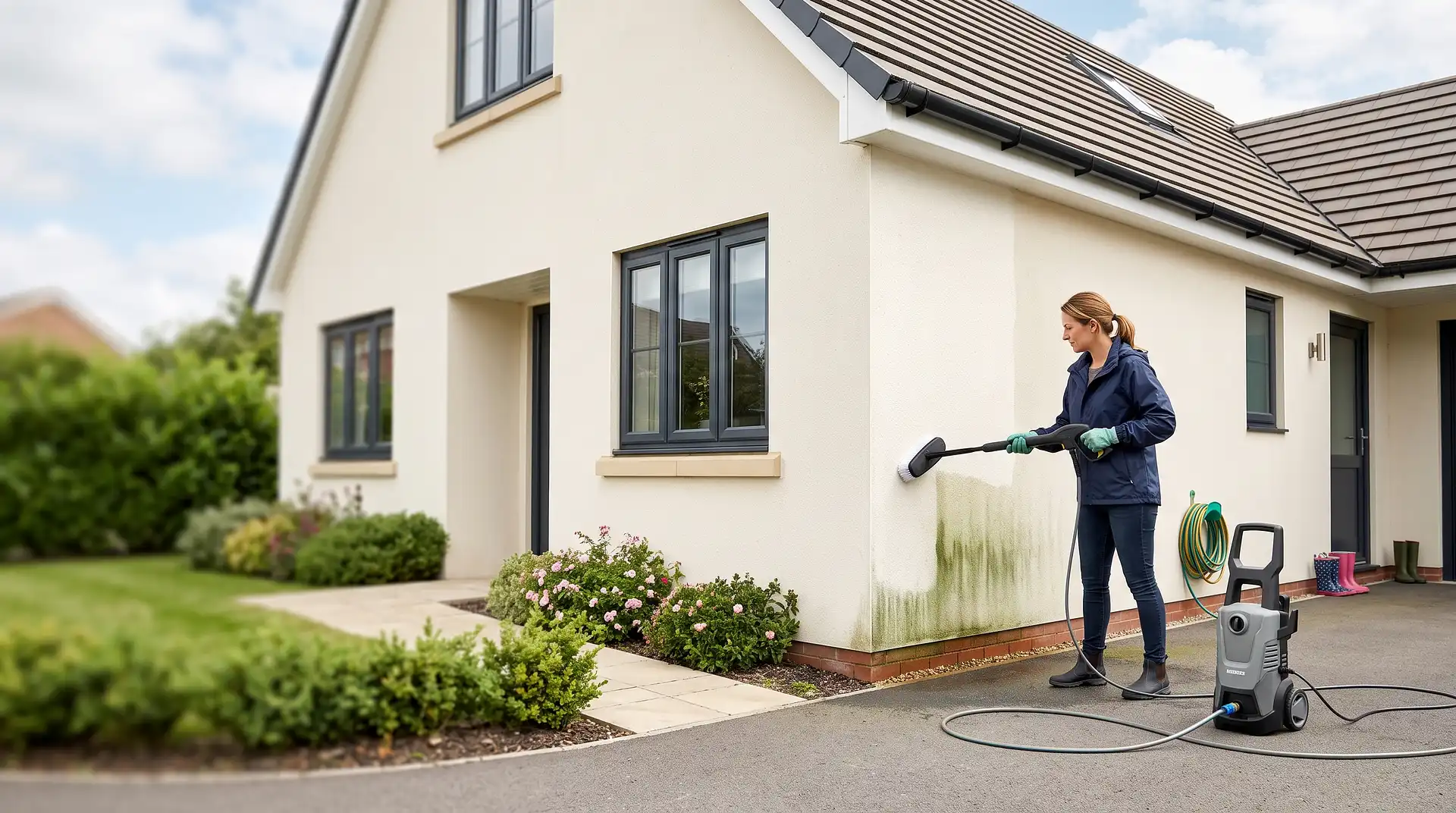
How to Clean Render on a House
29 August 2026
How to Clean Render on a House
The single most important decision in render cleaning is whether to use a pressure washer or a soft wash system, and the answer depends entirely on which type of render covers the wall. Pressure washing monocouche, silicone, or thin-coat render strips the surface layer, removing the colour and texture permanently. Soft washing the same surfaces with a low-pressure biocide application achieves a clean result without any surface damage.
Sand and cement render is more tolerant of low-pressure washing. Older pebbledash varies. Getting this decision right before picking up any equipment is what separates a clean wall from a remediation project.
Identify Your Render Type First
Four render types are common on UK homes, and each responds differently to cleaning.
Monocouche render is a factory-mixed, through-coloured render applied in a single coat that became popular in UK new-build and retrofit projects from the 2000s onwards. It has a fine textured surface that carries its colour throughout the thickness rather than being painted on top. Pressure washing at any useful distance removes this surface texture and exposes a paler, rougher layer beneath. Monocouche must be soft washed only.
Silicone and polymer render is a modern flexible render system used extensively on external wall insulation (EWI) systems. It has similar surface characteristics to monocouche and the same pressure washing vulnerability. The polymer content in the render makes it particularly susceptible to surface damage from high-pressure water at close range. Soft wash only.
Sand and cement render is the traditional render used on UK properties built before the 1990s and still used for repairs. It is considerably harder and more tolerant of pressure cleaning than modern thin-coat renders. Low-pressure washing at 80 to 100 bar at a distance of 300 mm or more is generally safe on sound sand and cement render, though the method should still start conservatively and increase pressure only if needed.
Pebbledash (dry dash) has a rough aggregate surface that traps dirt and biological growth more readily than smooth render. Pressure washing at normal settings dislodges the aggregate from older or poorly bonded pebbledash, leaving bare patches. Soft washing is the safer approach on any pebbledash that is more than 20 years old.
What Is Causing the Staining?
Matching the cleaning product to the contamination type produces better results than any single all-purpose cleaner.
Green algae and moss are the most common render contamination in the UK. They grow on any surface that retains moisture, particularly on north and east-facing elevations that receive less sun and stay damp for longer. Sodium hypochlorite-based exterior biocides are effective and remain the standard professional choice. The biocide kills the organism at its root rather than simply washing off the surface growth, which means the stain disappears over days or weeks as the dead growth weathers off rather than immediately after application.
Black staining on render is typically caused by airborne pollution and exhaust particulates bonding to the surface rather than by biological growth. This type of staining does not respond to biocides and requires a surfactant-based render cleaner that lifts the particulate film. In heavily trafficked urban areas, black streaking on white or light-coloured render is one of the more persistent maintenance problems precisely because the source (road traffic) continues indefinitely.
Rust staining appears as orange or brown streaks running downward from metal fixtures: window frames, fixings, satellite dish brackets, or older steel lintels corroding behind the render. Rust stains on render require a specialist oxalic acid-based rust remover. They will not respond to biocides or pressure washing.
Efflorescence appears as white or pale crystalline deposits on render surfaces, caused by soluble salts within the render or masonry migrating to the surface as water evaporates. Dry brushing when fully crystallised is the correct approach. Washing wet efflorescence drives the dissolved salts back into the render and they return as the surface dries again.
Paint on render (from previous decoration or from overspray) requires a paint-specific chemical remover rather than a cleaning product. The correct product depends on whether the paint is water-based or oil-based, and the render type limits which removal methods are safe.
Soft Washing: The Correct Method for Modern Render
Soft washing uses a low-pressure pump sprayer or soft wash nozzle to apply a diluted biocide or cleaning solution at mains hose pressure or below, without the high-pressure water jet that causes render damage. The chemistry does the cleaning work rather than mechanical force.
Step 1: Protect the surroundings. Cover or wet down any planting immediately below the wall, close windows and doors, and move vehicles away from the working area. Biocide overspray affects plants and vehicle paint.
Step 2: Mix the solution to label strength. Sodium hypochlorite-based render cleaners are typically diluted to 2 to 5% concentration for application depending on the contamination severity. Stronger solutions clean faster but carry greater risk to adjacent surfaces and planting. Never exceed the label recommendation.
Step 3: Apply from the bottom upward. Applying from top to bottom causes the biocide to run over dry wall below, producing streaks. Working upward keeps all treated surfaces wet during the application.
Step 4: Allow dwell time. Most biocides need 15 to 30 minutes on the surface to kill the organisms rather than just wetting them. Rinsing early produces an incomplete kill and the growth returns faster.
Step 5: Rinse from top downward. Once the dwell time is complete, rinse with a garden hose on a normal spray setting from the top of the wall downward. Do not use a pressure washer on monocouche or silicone render for the rinse either.
Step 6: Expect progressive improvement. Organic growth does not always disappear immediately. Dead algae and moss weather off over the following two to four weeks, and the render often looks progressively better without further cleaning.
Low-Pressure Washing for Sand and Cement Render
For sand and cement render with established biological growth or general grime, a low-pressure washer at 80 to 100 bar held at 300 mm or more from the surface is safe on sound render in good condition. Check the render condition before washing: any cracking, hollow sections (tap with a knuckle and listen for a drum sound indicating separation from the substrate), or areas that are already lifting should not be pressure washed, as water forced behind failed render accelerates the damage significantly.
Use a wide fan nozzle rather than a pencil jet, work in overlapping horizontal passes from top to bottom, and keep the wand moving continuously. Holding the lance at one point concentrates the force and damages render even at moderate pressures.
A Note on Render Sealers After Cleaning
Applying a penetrating silicone sealer to render after cleaning reduces the rate at which biological growth recolonises. Silicone sealers reduce water absorption into the render surface, which removes the moisture the organisms need to establish. On a clean, dry render surface, a quality silicone sealer typically extends the time between cleans from 12 to 24 months.
Sealers must be applied to a fully dry, clean surface. Sealing over damp or incompletely cleaned render traps moisture beneath the surface and can accelerate the render's deterioration. Allow two to three dry days after the final rinse before sealing.
When to Call a Professional
Render cleaning at height on a two-storey or above property requires either a scaffold tower or a water-fed pole system capable of reaching the full elevation. Most monocouche and silicone render jobs on a two-storey or larger property are professional work for access reasons alone, independent of the chemistry involved.
Call a professional if the render shows any signs of structural failure hollow sections, cracks wider than hairline, areas of lifting or bulging as cleaning these areas before repair causes water ingress damage. Also call a professional if the staining is from a source that requires specialist products such as rust, oil, or paint, and if the property is in a conservation area or has architectural features that require careful protection during cleaning.
According to InstantCost 2026 UK exterior cleaning pricing data, render soft washing costs £150 to £400 per elevation depending on area, access difficulty, and contamination severity. Exterior wall cleaning more broadly runs £200 to £600 per elevation for professional service including scaffold or access platform. For a full 2026 UK breakdown by surface type, elevation size, and region before getting quotes, the InstantCost exterior cleaning cost guide has a calculator you can filter before approaching any contractor.
Render cleaning is one part of a full exterior house clean that also covers gutters, fascias, windows, and paths. Our related guide on how to clean the exterior of a house covers the correct sequence for tackling all exterior surfaces together, including why the render should be cleaned before the paths rather than after.
Common Mistakes and What to Do Instead
Mistake: pressure washing monocouche or silicone render. These surface renders cannot withstand pressure washing. The result is a lighter, rough patch where the surface layer has been stripped. Always soft wash modern thin-coat renders.
Mistake: applying biocide to wet or damp render. A wet surface dilutes the biocide on contact and reduces the effective concentration. Apply to a dry surface for maximum dwell time effectiveness.
Mistake: rinsing too soon. Biocide needs 15 to 30 minutes on the surface to work. Rinsing immediately after application leaves live organisms on the wall and the growth returns within weeks.
Mistake: using a standard garden sprayer at high pressure for the rinse on monocouche. Even a jet spray setting on a garden hose can concentrate enough force to mark a freshly treated monocouche surface if held close. Use a wide rose or a gentle shower setting for the rinse.
Mistake: not protecting plants before applying biocide. Sodium hypochlorite at cleaning concentration bleaches and kills most garden plants and grass on contact. Wet down planting beforehand, cover it during application, and rinse the soil area thoroughly after completing the wall rinse.
Mistake: sealing render that has not fully dried after cleaning. Trapping moisture under a silicone sealer prevents it from evaporating and causes the render to remain damp, which accelerates biological growth rather than preventing it.
Mistake: cleaning render with visible structural problems. Water entering cracked or failed render during cleaning causes further damage. Repair structural render issues before cleaning, not after.
What It Costs in the UK
Item or service | Typical UK cost (2026) |
|---|---|
Render soft wash, per elevation (DIY materials) | £20 to £60 |
Sodium hypochlorite render cleaner | £15 to £35 per litre concentrate |
Surfactant render cleaner (black staining) | £20 to £40 per litre |
Rust stain remover | £15 to £30 |
Penetrating silicone sealer | £25 to £60 per litre |
Scaffold tower hire (per day) | £80 to £150 |
Professional render soft wash, per elevation | £150 to £400 |
Professional exterior wall cleaning, per elevation | £200 to £600 |
Figures based on InstantCost.co.uk's 2026 UK exterior cleaning pricing data and vary by property size, elevation height, access difficulty, and region. London and South East typically run 20 to 30% above the national average.
Staying Safe
Sodium hypochlorite-based cleaning products are classified as corrosive at cleaning concentrations and cause serious burns to eyes and skin on contact. Wear nitrile gloves, eye protection, and cover exposed skin when applying or handling biocide solutions. Work in a ventilated area and avoid inhaling spray mist by working with the wind behind you rather than into the spray.
Working at height is the most serious physical risk in render cleaning. For anything above comfortable reach from ground level, a scaffold tower providing a stable working platform is significantly safer than a ladder. A ladder combined with a sprayer, hose, and brush is an overloaded working position that experienced professionals avoid.
Biocide rinse water containing sodium hypochlorite must not be directed into a surface water drain, which discharges directly to watercourses. Direct runoff to soil or a foul drain. The concentration reaching the garden soil from a rinse is typically low enough not to cause lasting harm to established planting if the area is watered thoroughly after the job.
Keep children and pets away from the treated wall and the runoff area during the job and until the surface and surrounding ground have been thoroughly rinsed and dried.
Sodium hypochlorite products above 1% active chlorine concentration are regulated as biocidal products under the GB Biocidal Products Regulation. Products used for exterior render cleaning must be authorised for this use and applied according to label instructions. Commercial application of regulated biocides for payment requires appropriate product liability and public liability cover. Homeowners applying authorised products to their own property are not subject to this requirement. Regulations are subject to change: verify current authorisation status with the Health and Safety Executive before using any biocidal product commercially.
FAQ
Can you pressure wash rendered walls? It depends on the render type. Sand and cement render tolerates low-pressure washing at 80 to 100 bar with a wide fan nozzle held well back. Monocouche, silicone, and thin-coat renders must be soft washed only. Pressure washing modern renders strips the surface layer and causes permanent damage.
What is soft washing for render? Soft washing applies a diluted biocide or cleaning solution at low pressure using a garden hose or soft wash sprayer, allowing the chemistry to kill the algae or moss rather than relying on water pressure. It is the correct cleaning method for all modern thin-coat renders and the safest option for any rendered surface.
How often should rendered walls be cleaned? Most UK rendered walls need cleaning every two to four years depending on orientation, local climate, and whether a sealer has been applied after the previous clean. North-facing elevations in wetter regions typically need more frequent attention than south-facing walls in drier areas.
Why does render go green so quickly? Render retains surface moisture, particularly on north and east-facing walls with limited sun exposure, which creates ideal conditions for algae and moss growth. Applying a penetrating silicone sealer after cleaning reduces moisture retention and significantly slows the return of biological growth.
How much does it cost to have render professionally cleaned? Professional render soft washing runs £150 to £400 per elevation in 2026, depending on size, access difficulty, and contamination level. Scaffold tower hire adds to DIY costs for two-storey and above properties. London and the South East run 20 to 30% above the national average.
Can I use bleach to clean render? Household bleach contains sodium hypochlorite and is the active ingredient in most professional render biocide products. However, household bleach is less concentrated and less formulated for this use than purpose-made render cleaners, which include surfactants to improve surface wetting and penetration. A purpose-made exterior render biocide produces more consistent results than household bleach.