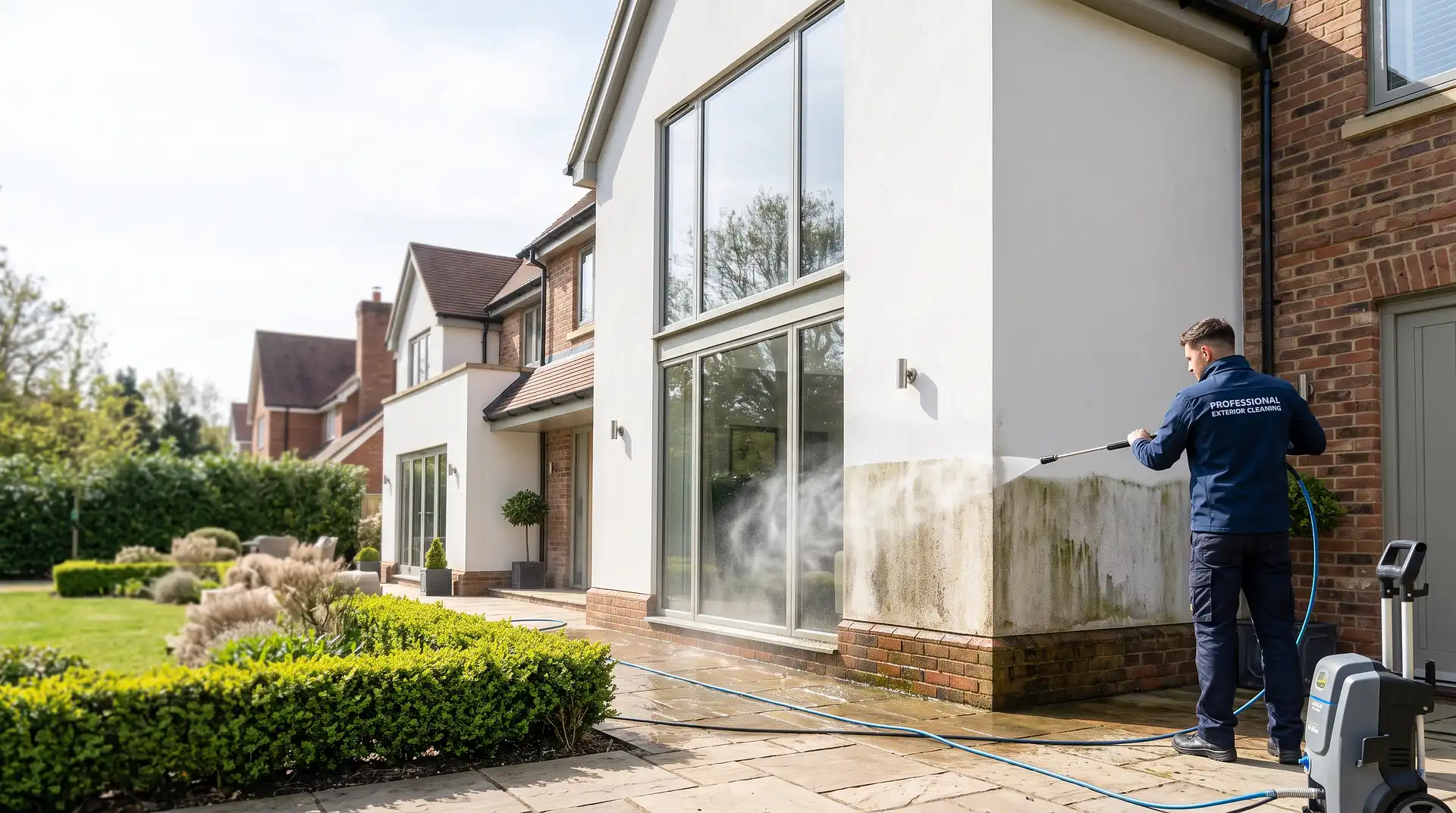
How to Clean the Exterior of a House
24 August 2026
How to Clean the Exterior of a House
Cleaning the outside of a house is not one job. It is six or seven jobs that share access equipment and ideally happen in the right order, because cleaning the walls after you have cleaned the paths means dirty runoff from the walls undoes the path clean. Getting the sequence right before anything else saves repeating work.
The surfaces involved, render, brick, UPVC fascias and soffits, windows, paths, and the driveway, each need different products, different pressures, and different techniques. Using a pressure washer on all of them because it is fast is how people damage render, flood window frames, and strip pointing from brickwork. The right method per surface is what this guide covers, in the order the work should be done.
The Correct Order for an Exterior Clean
Work top to bottom and outside to in. Dirty water, loosened moss, and cleaning product residue all run downward, so anything below the current working area gets cleaned afterwards, not before.
The sequence for a full exterior clean:
Roof and gutters first if included, since debris from these falls onto everything below
Walls, fascias, and soffits
Windows
Paths, patios, and driveway last
Within each surface, work from the highest point downward. On a two-storey wall, start at the eaves line and work down to the ground. On a driveway, start at the top of any slope and work toward the drain or soakaway.
Render: The Surface That Goes Wrong Most Often
Render is the most common source of damage in exterior cleaning jobs, because the correct method depends entirely on what type of render it is and most pressure washers applied at standard settings will damage all of them to some degree.
Sand and cement render is the most robust and tolerates low-pressure washing. Even here, the maximum safe pressure is around 100 bar at a distance of at least 300 mm. Higher pressure or closer application blows the render off the substrate, opens hairline cracks, and forces water behind the surface.
Monocouche and through-coloured render has a fine surface layer that carries the colour and the texture. Pressure washing strips it. The correct method for monocouche is soft washing: a low-pressure pump sprayer applying a sodium hypochlorite or specialist biocide solution, left for 15 to 30 minutes to kill algae and moss at the root, then rinsed with a garden hose on a normal setting. No pressure washer contact.
Dry dash (pebbledash) traps debris in the texture and is difficult to clean without dislodging the aggregate. A soft wash solution applied and rinsed is again the correct approach. A pressure washer at any useful distance and angle will remove pebbles from an older dash surface.
Before applying any cleaning product to render, check for cracks, hollow sections (tap with a knuckle and listen for a drum sound), and areas where the render is already lifting. Wet cleaning of a compromised render surface speeds up failure and forces water behind the substrate.
Brick: Identifying the Contamination Before Choosing a Product
The cleaning method for brick changes completely depending on what is on the surface, and using the wrong product damages the brick or leaves the underlying problem untouched.
General grime and carbon deposits from road traffic and urban air respond to a diluted brick cleaner applied with a stiff brush and rinsed. Low-pressure washing at 80 to 100 bar is safe on most sound brick. Never use full pressure directly on pointing.
Efflorescence (white salt deposits) is a mineral migration from inside the masonry. It brushes off dry when it has fully crystallised. Do not wash it wet, since water dissolves the salts and drives them back into the brick. Brush dry, then allow the surface to fully dry again before sealing if required.
Algae and moss need a biocide applied at low pressure or by sprayer, left to dwell, then rinsed. Scrubbing green growth before killing it disperses the spores and accelerates recolonisation.
Mortar smears from recent repointing are a dilute acid job. Proprietary brick acid applied carefully, kept off the pointing itself, neutralised, and rinsed. Brick acid on old or soft pointing dissolves it. Identify the pointing condition before using any acid product.
Paint on brickwork is the most difficult contamination to remove and almost always requires chemical paint stripper and considerable dwell time, mechanical assistance, or both. Pressure washing alone does not remove paint. It spreads it.
UPVC Fascias, Soffits, and Windows: No Abrasives, No Solvents
UPVC is easily scratched, and scratches accumulate airborne dirt faster than a smooth surface. Any abrasive pad, wire brush, or gritty cleaning product leaves a permanently dulled surface that looks dirtier faster.
For UPVC fascias and soffits: a soft cloth or microfibre pad, a UPVC-specific cleaner or diluted washing-up liquid, and rinse with a hose. For stubborn grey tide marks (oxidised pigment from UV degradation), a dedicated UPVC restorer product works better than any cleaning approach, since the grey is a surface change in the material rather than external dirt.
For windows: soft brush with a purified water hose feed, or the traditional squeegee method for accessible ground-floor windows. Purified water leaves no mineral deposits when it dries, which is why professional window cleaners use it as standard rather than mains water. Hard mains water air-dried on glass leaves visible calcium spots that make a clean window look dirty.
Do not use solvent-based products on UPVC. Acetone, white spirit, and similar solvents dissolve the plasticisers in UPVC and cause yellowing and surface crazing that is permanent.
Paths, Patios, and Driveways: Where the Pressure Washer Earns Its Place
These are the surfaces where a pressure washer genuinely does the job better than anything else, provided it is used correctly.
Block paving, concrete, and natural stone all respond well to pressure washing at 120 to 150 bar. The technique is a consistent sweeping motion across the surface, overlapping each pass, rather than pointing the lance at a single spot, which cuts channels and damages the surface edge.
After washing block paving, the kiln-dried sand in the joints washes out and must be replaced. Skipping this step leaves a paved surface that looks clean and then develops weed growth in the empty joints within a season. Joint sand costs a few pounds per bag and a standard driveway takes one to two bags.
Tarmac can be pressure washed at low to medium pressure. High pressure over time lifts the aggregate from the binder and causes surface breakdown. A tarmac driveway that is pressure washed annually at high pressure typically needs resurfacing five to ten years earlier than one maintained with low-pressure washing and occasional re-sealing.
Gravel paths and driveways cannot be pressure washed without redistributing the gravel. Blow leaf debris off with a blower, rake back to level, and treat any moss or algae growth with a path and patio weed treatment applied by watering can.
A Note on Access and Two-Storey Work
Ground-floor surfaces and fascias at low eaves height are reachable with a decent extension pole. Anything at first-floor level or above needs either a scaffold tower for sustained work, or a water-fed pole system that extends to 12 metres or more for window cleaning specifically.
A ladder leant against a wall for exterior cleaning is the wrong tool for any job that takes more than a couple of minutes. Sustained cleaning from a ladder, carrying a bucket, managing a hose, and working a brush or lance, requires both hands free and a stable working platform. Scaffold tower hire for a full day runs £80 to £150 and is consistently cheaper than the consequence of a fall.
If the elevation is three storeys or above, or if there are difficult access complications from a conservatory extension, bay windows, or sloped ground, this is a job for a professional with the correct access equipment.
Professional exterior cleaning costs in the UK vary by surface and service. According to InstantCost.co.uk's 2026 exterior cleaning pricing data, exterior wall cleaning runs £200 to £600 per elevation, driveway jet washing £90 to £220 for a standard 40m² surface, patio jet washing £70 to £180 for 20 to 30m², window cleaning £40 to £80 for a standard three-bed semi, and roof cleaning £350 to £750 for a standard semi-detached. Bundling services on the same visit saves 10 to 20% over separate bookings. The InstantCost exterior cleaning cost has a 2026 UK calculator you can filter by surface type, area, and region before approaching any contractor.
The gutter exterior is worth covering at the same time as the fascias and soffits, since access is shared. Our related guide on how to clean the exterior of gutters covers the tiger-striping problem from roof run-off that standard surface cleaning does not address, and which product type shifts it versus which makes it worse.
Common Mistakes and What to Do Instead
Mistake: starting at the bottom. Cleaning paths and drives before walls means dirty runoff from the walls lands on the clean path and the whole job gets repeated. Top to bottom, always.
Mistake: pressure washing monocouche or thin-coat render. These surface renders have a fine layer that pressure washing strips. Soft washing with a biocide solution and a garden hose rinse is the correct method.
Mistake: pressure washing block paving without resanding the joints. The kiln-dried joint sand washes out with the dirt. An unsanded joint surface colonises with weeds within one season. Resand immediately after washing.
Mistake: dry-brushing wet efflorescence on brickwork. Brush it dry, after the salts have fully crystallised. Washing wet efflorescence drives the salts back into the brick and they return to the surface within weeks.
Mistake: using abrasive pads or solvents on UPVC. Abrasives scratch permanently. Solvents dissolve the plasticisers. Both cause surface damage that accumulates dirt faster than the original surface.
Mistake: using a pressure washer on old or soft pointing. Even 80 bar directed at aging lime mortar pointing blows it out of the joint. If pointing is soft, crumbly, or already missing in sections, the wall needs repointing before any pressure washing.
Mistake: working from a ladder on sustained exterior cleaning tasks. A scaffold tower hire costs £80 to £150 per day. That is a straightforward trade against the risk of a serious fall from a ladder while managing equipment with both hands.
What It Costs in the UK
Surface or service | Typical UK cost (2026) |
|---|---|
Exterior wall cleaning, per elevation | £200 to £600 |
Render soft wash, per elevation | £150 to £400 |
Driveway jet wash (40m²) | £90 to £220 |
Patio jet wash (20 to 30m²) | £70 to £180 |
Roof jet wash or soft wash | £350 to £750 |
Window clean, standard 3-bed semi | £40 to £80 |
Window clean, 4-bed or larger | £80 to £150 |
Per window, one-off rate | £4 to £8 |
Conservatory windows | £50 to £100 |
Garden tidy and clean | £80 to £200 |
Scaffold tower hire, per day | £80 to £150 |
Block paving joint sand, per bag | £5 to £10 |
Bundling services saving | 10 to 20% |
Figures based on InstantCost.co.uk's 2026 UK exterior cleaning pricing data. London and South East typically run 20 to 30% above the national average. Access difficulty, surface condition, and dirt level all affect the final price.
Staying Safe
Two risks dominate exterior house cleaning: working at height and using chemical cleaning products.
On the height side, the guidance is simple. A scaffold tower for any work above single-storey height. Three points of contact on a ladder for brief tasks only. Never lean a ladder against guttering or UPVC fascias, which are not structural and will deflect or crack under point loads. Never overreach from a ladder or a tower platform. The majority of serious DIY injuries in the UK involve falls from height during maintenance work, and exterior cleaning is one of the highest-frequency activities in that category.
On the chemical side, biocides, brick acids, and render cleaners all carry hazard classifications. Wear nitrile gloves and eye protection for any chemical application. Biocides toxic to aquatic life must not be rinsed to a surface water drain, which discharges to watercourses. Direct rinse water to soil away from ponds or to a foul drain where the product label permits.
Brick acid, including proprietary formulations, is a dilute hydrochloric acid product that produces fumes and causes serious burns on skin and eye contact. Full PPE including an acid-resistant apron and face shield is appropriate. Never use brick acid on or near vegetation, on painted surfaces, or on limestone or calcium-rich stone, which it dissolves.
Keep children and pets off treated surfaces until fully dry. Biocide and cleaner residues on wet paths and drives are slip hazards and contact hazards for animals.
Soft washing products containing sodium hypochlorite at concentrations above 1% are classed as biocidal products under GB Biocidal Products Regulation and must be used according to label instructions on an authorised use. Commercial application of regulated biocides for a fee requires a products liability assessment. Homeowners applying authorised products to their own property are not subject to this requirement but the same safe use guidance applies.
FAQ
What is the best way to clean the outside of a house? Top to bottom by surface type: soft wash for render, low-pressure washing for brick, UPVC cleaner on fascias and soffits, purified water for windows, then pressure washing for paths and drives last. The order prevents dirty runoff from undoing earlier work.
Can I use a pressure washer on the exterior walls of my house? Depends on the surface. Sand-and-cement render at low pressure (80 to 100 bar) and at distance, yes. Monocouche or thin-coat render, no. Brick in good condition at low pressure, yes. UPVC, no. Old or soft pointing, no. The surface type determines the safe method.
How much does it cost to have the outside of a house cleaned in the UK? Exterior wall cleaning runs £200 to £600 per elevation, driveway jet washing £90 to £220, patio jet washing £70 to £180, and window cleaning £40 to £80 for a standard three-bed semi, based on InstantCost's 2026 UK data. Bundling services saves 10 to 20%.
How often should the outside of a house be cleaned? Windows every four to eight weeks for most UK homes. Paths and patios annually or every two years. Walls every three to five years for most render and brick, more frequently in high-pollution or coastal areas where salt or particulate deposits are heavier.
What removes green algae from exterior walls? A sodium hypochlorite-based biocide or a specialist exterior biocide applied at low pressure or by sprayer, left to dwell for 15 to 30 minutes, then rinsed. Scrubbing without first killing the algae disperses spores and accelerates return. Let the chemistry do the work, then rinse.
Is soft washing safe for all exterior surfaces? Safer than pressure washing for most surfaces, but the product still needs to match the surface. Sodium hypochlorite solutions bleach some materials and must be kept off painted timber, aluminium, and vegetation. Check product compatibility with the surface before applying.