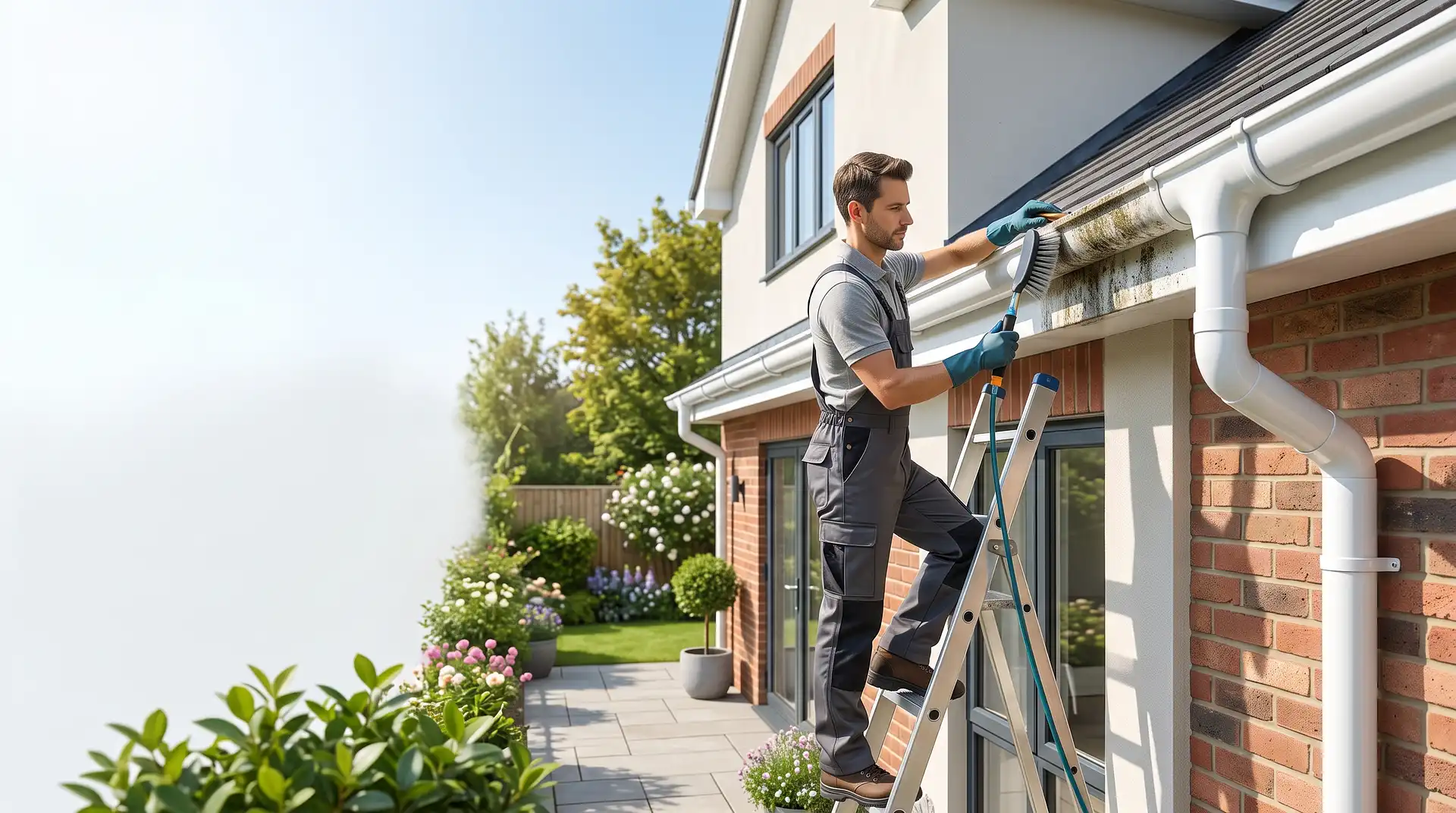
How to Clean the Exterior of Gutters
18 August 2026
How to Clean the Exterior of Gutters
Cleaning the exterior of gutters is a different job from clearing them out. The inside collects leaves and debris that block drainage. The outside collects what runs off the roof: black streaks from oxidised roof felt, green algae from standing damp, and general road grime that builds up on the face of the gutter over years. Neither clean does the other's job, and the outside is the one that affects how the front of your house actually looks.
The black streaks in particular catch people out. They look like dirt or mould, and they are neither. They are the result of roof felt and bitumen particles washing down during rainfall, leaving a dark residue that bonds to the gutter surface and does not shift with a sponge and washing-up liquid. Knowing what you are dealing with before you start determines whether you spend twenty minutes or two hours on the job.
Identify Your Gutter Material First
The cleaning method and products you use depend almost entirely on what the guttering is made of. Using the wrong product on the wrong surface causes fading, surface etching, or finish damage that a clean was never supposed to create.
Most UK homes have uPVC gutters, which are the most forgiving to clean. Cast iron gutters are common on older and Victorian properties and need more care, particularly around any painted or primed finish. Aluminium gutters are less common but react badly to alkaline cleaners. Galvanised steel is found on some older rural properties.
If you are unsure, uPVC is the safe default assumption on anything built after roughly 1970. Cast iron is almost always grey or black painted, heavier, and tends to have shaped joints rather than push-fit connectors.
What Causes the Black Streaks
Black streaks on the outside of gutters are called tiger striping, and they come from the same source regardless of gutter material: roof run-off. Rainwater washes particles from roof felt, bitumen, algae and airborne debris down the roof surface and over the gutter lip. The particles are hydrophobic, meaning they bond to the gutter face as the water runs off and resist water-based cleaning.
Standard household cleaners, including washing-up liquid, multi-surface spray, and most bathroom cleaners, do not touch them. You need either a dedicated gutter brightener product, which typically contains mild acid or surfactant chemistry formulated for this specific bond, or a solvent-based exterior cleaner. White spirit on a cloth removes tiger striping from uPVC reliably, though it needs a follow-up wash with soapy water to clear the residue.
Step 1: Set Up Safely
Before anything else, work out your access. Single-storey gutters on a standard UK semi are reachable from a decent step ladder. Two-storey and above is where the risk changes fundamentally, and a standard domestic ladder used from the ground to reach a first-floor gutter puts most people in a position they are not equipped to work from safely for any length of time.
For two-storey and above, a scaffold tower is the right tool: it gives you a stable platform, both hands free to work, and somewhere to rest your bucket and cloths without needing to descend constantly. Tower scaffold hire in the UK runs roughly £80 to £150 per week for a domestic unit, and that cost is worth measuring against the risk of an improvised ladder position.
Set the ladder or tower on firm, level ground. Never lean a ladder against the gutter itself, since plastic and aluminium guttering is not designed to take point loads from ladder feet and can crack or distort under the weight. Use a ladder standoff bracket, which holds the feet away from the wall and distributes load properly.
Step 2: Remove Loose Debris and Rinse
Before applying any product, knock off any loose debris from the gutter face and rinse with a garden hose or low-pressure spray to wet the surface and remove anything that will come off easily. This step prevents grit from scratching the surface when you apply a cloth or sponge in the next step.
Do not use a high-pressure jet washer directly on the gutter face at this point. Pressure applied at the wrong angle can force water behind the gutter and behind the fascia board, which can cause rot in timber fascias and damp ingress into the soffit. Gutters can also be dislodged or cracked by direct high-pressure contact, particularly older push-fit uPVC systems.
Step 3: Apply Your Cleaner
For uPVC gutters with tiger striping, apply a dedicated gutter brightener or white spirit to a cloth and work in sections of roughly 30 cm at a time, using light circular pressure. You will see the streaks lifting almost immediately on fresh product contact. Work along the gutter run rather than up and down, following the direction of the streak rather than fighting across it.
For general green algae and grime on uPVC, a diluted bleach solution (one part bleach to ten parts water) or a sodium hypochlorite exterior cleaner works well. Apply, leave for five minutes, then wipe and rinse.
For cast iron gutters, avoid bleach and strong acids, which can lift paint and accelerate surface rust at any exposed metal. Use a mild detergent solution and a soft brush, then rinse thoroughly. If the paint finish is worn, treat it as a paint and rust job rather than a cleaning job: a clean, primed, and repainted cast iron gutter is more useful than one that has been chemically cleaned but left with bare patches.
For aluminium, avoid alkaline cleaners entirely since they cause a chemical reaction that leaves a white powdery residue. Use a pH-neutral cleaner or plain warm water with a microfibre cloth.
Step 4: Rinse and Check Joints
Rinse the cleaned section with clean water before moving along. Leaving cleaning product sitting on the gutter face longer than necessary risks surface dullness on uPVC and chemical attack on paint finishes.
While you are at gutter height, check the joints and brackets. A push-fit uPVC joint that is leaking leaves a visible staining line down the fascia or wall below it, which is easy to spot once you are looking for it. A loose bracket shows as a section of gutter that sits at a slightly different angle than the rest of the run. Both are worth noting and fixing separately, since a gutter that drains correctly and is properly supported will stay cleaner for longer.
Step 5: Apply a Protective Finish (Optional)
On uPVC gutters, a silicone-based protectant or a spray wax applied after cleaning reduces the rate at which tiger striping reappears. It does not prevent it entirely, since the source is the roof rather than the gutter, but it makes the next clean considerably quicker. Apply with a microfibre cloth after the surface is fully dry.
This step is worth doing if you are already at height with everything set up. It takes ten minutes across a typical semi and extends the time before the job needs repeating from roughly twelve months to eighteen to twenty-four.
When to Call a Professional Instead
Two-storey and above is where most people should seriously consider whether they want to do this themselves. The job itself is not technically difficult, but sustained working at height on a ladder to clean a length of guttering is a different risk profile from a quick bulb change on a stepladder, and the consequences of a fall are serious.
If the guttering runs across a significant section of a two-storey or higher elevation, if access is awkward due to a conservatory extension, bay window, or sloped ground, or if you notice sections that are cracked, pulling away from the fascia, or leaking at joints, a professional clean combined with a condition report is the more practical option.
Exterior cleaning as part of a broader house exterior service in the UK typically costs £200 to £600 for exterior wall cleaning per elevation, with window cleaning for a standard 3-bed semi running £40 to £80. Gutter cleaning specifically is usually quoted as a standalone job rather than per linear metre. If you want exact current figures for your property type and region, the InstantCost exterior cleaning cost guide has a 2026 UK price breakdown you can filter by service and area before getting quotes.
Look for a cleaner who uses a scaffold tower or access platform for two-storey work rather than leaning an extended ladder against the guttering itself. That detail tells you something about how they approach the job, and the gutter condition tells you something about how careful they are with the property.
One more thing the exterior condition often reveals: if the fascia boards behind the guttering are visibly damp-stained or soft, that is a sign of overflow or failed joints rather than just surface dirt, and it is worth understanding our related guide on <a href="https://www.instantcost.co.uk/blog/how-to-clean-house-gutters-without-a-ladder">how to clean house gutters without a ladder</a>, which covers the inside drainage side of the job alongside the safe-access options for both tasks at once.
Common Mistakes and What to Do Instead
Mistake: using a pressure washer directly on the gutter face. High pressure at the wrong angle forces water behind the gutter and into the fascia. Rinse gently with a hose, and keep pressure washing for the wall below, not the gutter itself.
Mistake: leaning the ladder against the gutter. Guttering is not a structural element. A ladder leant against uPVC or aluminium guttering can crack it or pull the brackets off the fascia. Use a standoff bracket.
Mistake: using bleach on cast iron. It lifts paint and accelerates surface rust at any exposed metal beneath. Use mild detergent only, and address any bare metal with primer before it becomes a rust problem.
Mistake: using alkaline cleaners on aluminium. Alkaline products react with aluminium oxide and leave white powdering that is difficult to remove. Use pH-neutral cleaners only.
Mistake: cleaning without rinsing first. Wiping grit across a dry surface scratches uPVC permanently. Rinse to wet the surface and remove loose particles before applying any cloth or pad.
Mistake: ignoring the joints and brackets while you are up there. A leaking joint or sagging bracket causes the same staining as dirty gutters within months of cleaning. Check both while you have access and address them separately.
What It Costs in the UK
DIY costs are modest. A dedicated gutter brightener typically runs £8 to £15 for a bottle that covers a standard semi. White spirit costs £4 to £8. A silicone protectant spray runs £6 to £12. The main cost variable is access: a ladder standoff bracket runs £20 to £40, and scaffold tower hire runs roughly £80 to £150 per week.
For professional exterior cleaning, according to InstantCost.co.uk's 2026 UK exterior cleaning pricing data, exterior wall cleaning runs £200 to £600 per elevation and window cleaning for a standard 3-bed semi runs £40 to £80. Bundling gutter exterior cleaning with a broader house wash typically saves 10 to 20% versus booking separately.
Item or Service | Typical UK Cost (2026) |
|---|---|
Gutter brightener product | £8 to £15 |
White spirit | £4 to £8 |
Silicone protectant spray | £6 to £12 |
Ladder standoff bracket | £20 to £40 |
Scaffold tower hire (per week) | £80 to £150 |
Professional exterior wall clean (per elevation) | £200 to £600 |
Professional window clean, 3-bed semi | £40 to £80 |
Professional window clean, large or 4-bed+ house | £80 to £150 |
Figures based on InstantCost.co.uk's 2026 UK exterior cleaning pricing data and vary by region, property size, access difficulty, and provider.
Staying Safe
Working at height is the single biggest risk in this job, and it is worth stating plainly: more people are seriously injured falling from ladders during domestic maintenance than from almost any other DIY activity in the UK. The Health and Safety Executive identifies ladder misuse, overreaching, and working on unstable ground as the three most common causes.
Keep three points of contact with the ladder at all times. Do not overreach: if the section you need is not reachable without leaning, descend and reposition. Work with a second person present who can foot the ladder and pass equipment up rather than having tools hanging off rungs or balanced on steps.
Wear non-slip footwear and gloves. Cleaning products combined with wet aluminium ladder rungs are genuinely slippery, and gloves also protect against cut edges on older cast iron gutters.
Dispose of cleaning product rinse water responsibly. Products containing bleach or surfactant chemistry should not be directed into surface water drains, which discharge to watercourses. Direct rinse water to a soakaway or foul drain where possible.
Keep children and pets clear of the working area for the duration of the job and until all cleaning product residue has been rinsed and dried. Gutter brightener and bleach-based cleaners are harmful if swallowed or splashed in eyes. Store products in their original labelled containers and lock them away after use, never decant into unlabelled bottles.
If a child swallows a cleaning product or gets it in their eyes, call 111 for advice, or 999 if they are drowsy, struggling to breathe, or unresponsive.
Working at height on domestic ladders is one of the most common causes of serious injury in UK home maintenance. If you are not confident about the access, or if the elevation is two storeys or above, the professional cost is significantly less than a hospital stay. HSE guidance on safe ladder use is available at hse.gov.uk and is worth reading before the job rather than after.
FAQ
How do you get black streaks off the outside of gutters? Black streaks on gutters are caused by roof run-off carrying bitumen and felt particles, not by dirt or mould. They bond to the gutter surface and do not respond to standard household cleaners. Use a dedicated gutter brightener product or white spirit on a cloth, working in short sections. Follow with a rinse and soapy water wash to remove residue.
Can I use a pressure washer to clean the outside of gutters? Not directly on the gutter face. High pressure at the wrong angle forces water behind the gutter and into the fascia board, which can cause timber rot and damp ingress. Use a hose for rinsing and reserve the pressure washer for the wall and driveway below.
How often should gutter exteriors be cleaned? Once a year is a reasonable baseline for most UK homes. Houses with overhanging trees or near road traffic pick up staining faster. Applying a silicone protectant after cleaning extends the interval to 18 to 24 months in most cases.
Is it safe to clean gutters from a ladder? Single-storey gutters on firm level ground, yes, with a standoff bracket and a second person present. Two-storey and above, the safer option is a scaffold tower hire, which gives you a stable platform and both hands free. Never lean a ladder directly against the guttering.
Can I use bleach to clean uPVC gutters? Yes, diluted at roughly one part bleach to ten parts water for algae and green staining. Do not use bleach on cast iron gutters, where it lifts paint and accelerates rust at any bare metal.
How much does professional gutter exterior cleaning cost in the UK? Gutter exterior cleaning is usually quoted as part of a broader exterior house clean rather than as a standalone line. Exterior wall cleaning runs £200 to £600 per elevation and window cleaning for a standard 3-bed semi runs £40 to £80, based on InstantCost's 2026 UK data. Bundling services saves 10 to 20% versus separate bookings.