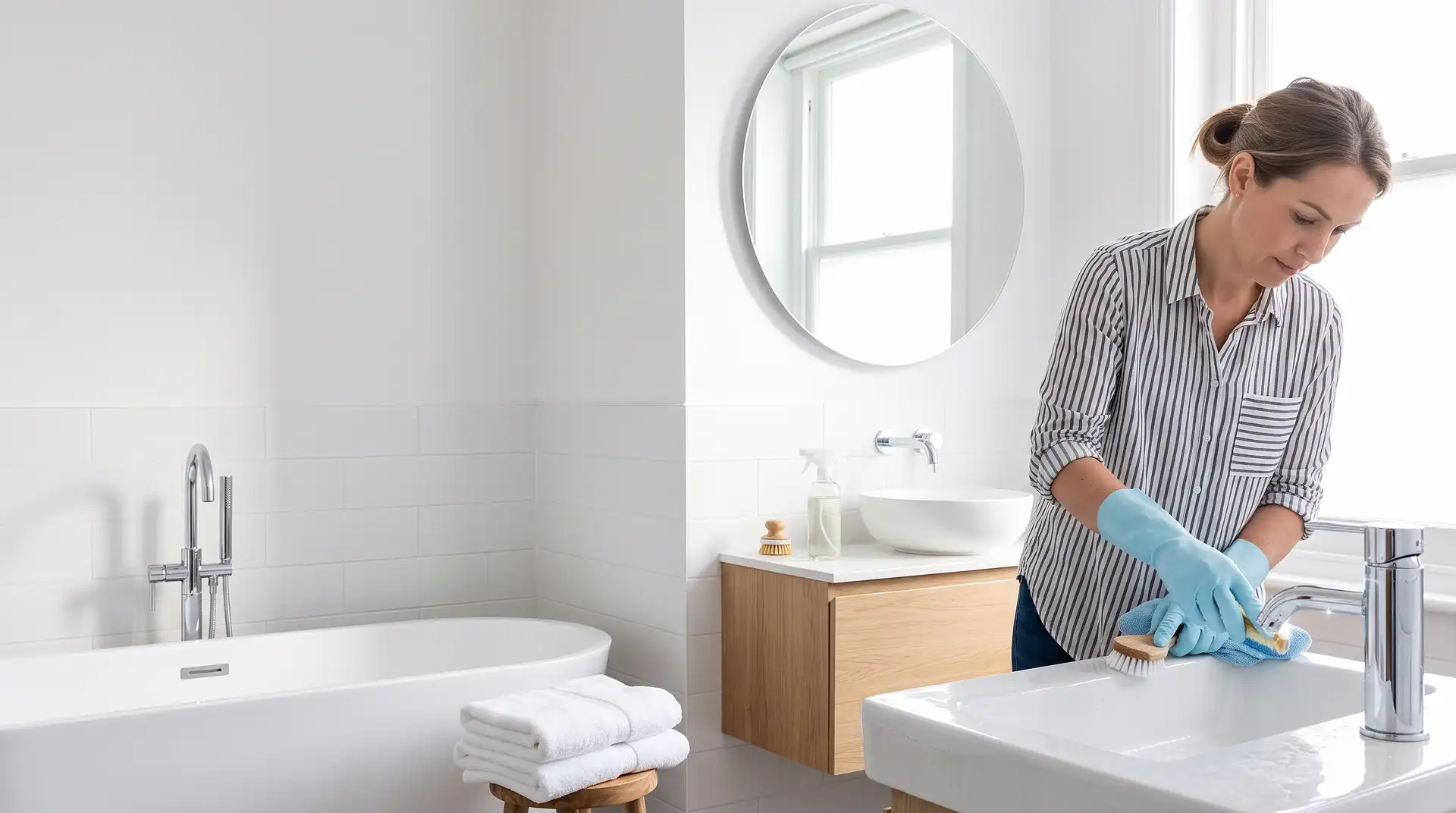
How to Deep Clean a Bathroom
12 July 2026
How to Deep Clean a Bathroom
A bathroom deep clean fails for one of two reasons: the wrong order of operations, or products that never got enough contact time to actually work. Bathrooms are the most chemically active room in the house — limescale, soap scum, mould, and bacteria all need different treatments, and rushing straight to scrubbing before letting anything dwell is why a "deep clean" often looks fine on the day and reverts within a week. Getting the sequence and dwell times right matters more than how hard you scrub.
Why Bathrooms Need a Different Approach Than Other Rooms
Everything in a bathroom is affected by water hardness, humidity, and repeated exposure to soap and skin residue. Limescale forms from mineral deposits in hard water and needs an acidic product (or dwell time) to dissolve, not just wiping. Mould needs a fungicidal product left to sit, since wiping visible mould without treating the spores underneath means it returns within days. Soap scum is a mix of soap and mineral residue that builds a film ordinary surface spray often just smears rather than removes. Treating all three the same way — spray and immediately wipe — is the single biggest reason bathroom cleaning underperforms compared to other rooms.
Step 1: Clear and Pre-Treat
Remove everything from surfaces — bottles, toothbrush holders, bath mats — so nothing gets missed underneath. Apply your treatments first and let them dwell while you work elsewhere: limescale remover on taps, showerheads, and around the base of the toilet; mould treatment on grout lines, sealant, and any visible black spotting in the shower or around window frames; a degreaser or bathroom cleaner on the toilet bowl, left to sit under the rim. Most products need 5–15 minutes of contact time to actually break down what they're targeting — check the label rather than guessing, since under-dwelling is the most common reason a product "doesn't work."
Step 2: Top to Bottom, By Zone
While treatments dwell, work through the room from highest surfaces to lowest, so dust and drips fall onto areas you haven't cleaned yet rather than ones you have.
Ceiling and extractor fan — wipe down the extractor grille and vacuum any visible dust; bathroom extractor fans accumulate moisture-laden dust that reduces airflow and worsens condensation over time if never cleaned.
Light fittings and mirror — dust fittings, then clean the mirror with a dedicated glass cleaner or a vinegar-water solution and a lint-free cloth to avoid streaking.
Tiles and grout — scrub grout lines with a stiff-bristled brush and a grout-specific cleaner or a baking-soda paste for lighter staining; this is the task most regular cleans skip entirely, which is why grout is usually where a deep clean shows the biggest visible difference.
Shower screen or curtain — descale glass screens with your pre-applied limescale remover and a non-scratch pad; wash or replace a shower curtain showing mould spotting, since fabric mould is harder to fully remove than treat.
Taps and showerhead — scrub with an old toothbrush to get into the fine gaps where limescale builds fastest; for a badly scaled showerhead, soaking the head in a bag of diluted descaling solution for an hour resolves buildup that scrubbing alone won't shift.
Bath and shower tray — scrub with a non-abrasive cleaner, paying attention to the corners and the drain surround, where soap scum concentrates.
Toilet, inside and out — scrub inside the bowl under the rim where the initial treatment was applied, then wipe the seat, lid, cistern, and base — the base and the floor immediately around it is one of the most commonly skipped spots in a normal weekly clean.
Sink and pedestal — clean the bowl, the overflow hole specifically (a common source of sink odour that's rarely addressed), taps, and the pedestal or cabinet front.
Floor — vacuum or sweep, then mop with a bathroom-appropriate cleaner, working from the far corner toward the door.
Tools and Products That Matter
A stiff grout brush or old toothbrush — for grout lines and tap gaps that a cloth can't reach into.
A dedicated limescale remover — general-purpose sprays rarely dissolve established limescale; a product formulated specifically for it, given proper dwell time, does.
A mould and mildew spray with fungicide — treats spores, not just visible staining, which is the difference between mould that stays gone and mould that returns in a fortnight.
Microfibre cloths, colour-coded if possible — one for the toilet, a separate one for surfaces and the sink, to avoid cross-contaminating cleaner areas.
A non-scratch scouring pad — for baths, shower trays, and screens, without damaging enamel or acrylic finishes.
Rubber gloves — bathroom chemicals are stronger than general household cleaners and worth protecting skin from with repeated contact.
Common Mistakes and What to Do Instead
Mistake: wiping mould without treating it. Visible surface wiping removes the stain but not the spores in porous grout or sealant, so it returns quickly. Use a fungicidal mould treatment and let it dwell fully before rinsing.
Mistake: spraying and immediately wiping limescale remover. This treats it like a surface cleaner rather than a chemical treatment. Give it the label's stated dwell time — often 10–15 minutes for established limescale — before scrubbing.
Mistake: using bleach on top of another cleaning product. Mixing bleach with limescale removers or other acidic products can produce toxic chlorine gas. Always rinse a surface fully and ventilate the room before switching product types.
Mistake: cleaning the shower curtain or screen last, after everything else has splashed onto it again. Do the highest, most splash-prone surfaces before the floor, and finish the floor last so it isn't re-dirtied by drips from higher surfaces.
Mistake: ignoring the extractor fan. A dusty, underperforming extractor fan means the room stays damp for longer after every shower, which directly feeds future mould growth. Cleaning it is part of preventing the problem you just spent an hour fixing.
Mistake: skipping behind the toilet and under the sink pedestal. These are the two spots almost every bathroom deep clean guide gets asked about after the fact, because they're genuinely easy to miss and collect dust and grime fastest due to poor airflow.
Advanced Tactics for a Bathroom That Stays Clean Longer
A squeegee used on the shower screen and tiles after every shower — a 30-second habit — prevents most of the limescale buildup that otherwise needs a dedicated deep-clean session to reverse. Running the extractor fan for 15–20 minutes after every shower, rather than switching it off the moment you're done, cuts the humidity that feeds mould growth in grout and sealant. Re-sealing grout or silicone sealant that's visibly staining despite cleaning is often more effective long-term than repeated mould treatment — once sealant is porous enough to hold mould below the surface, cleaning products can only ever manage it, not resolve it, and replacement becomes the actual fix.
What It Costs in the UK
Professional deep cleaning is generally priced by the hour or as part of a whole-property job rather than per bathroom alone, but bathrooms are consistently flagged by cleaning companies as the most labour-intensive room, since descaling and disinfecting take longer than dusting or vacuuming. Standard UK deep-clean rates run £20–£35 per hour, and a single bathroom as part of a broader deep clean typically adds somewhere in the region of £40–£90 to a quote, depending on size, number of fixtures, and how neglected the grout and limescale are.
A full one-off deep clean of a typical 3-bed house (which includes bathroom, kitchen, and all living spaces) usually runs £150–£400 in total, with heavily soiled or larger properties reaching higher. If a bathroom specifically needs remedial work beyond cleaning — regrouting or re-sealing, for instance — that's priced as a separate, smaller job rather than folded into a cleaning quote.
Service | Typical UK Price (2026) | Notes |
|---|---|---|
Deep clean, hourly rate | £20–£35/hour | National average, London 15–30% higher |
Bathroom deep clean (as part of a job) | £40–£90 | Depends on size, fixture count, limescale severity |
Full 3-bed house deep clean | £150–£400 | Includes bathroom, kitchen, all living spaces |
Grout/sealant replacement | Priced separately | Not a cleaning job — a small remedial repair |
These are UK market estimates and vary by property condition, region, and provider — get a few quotes, and confirm whether limescale removal and grout scrubbing are included as standard, since some cleaners charge these as add-ons.
Staying Safe
Bathroom chemicals are among the strongest most households use, so a few rules matter more here than in any other room. Never mix bleach with limescale remover, mould treatment, or any other cleaning product — the combination of bleach and acidic or ammonia-based cleaners can release toxic gas, and bathrooms are small, often poorly ventilated spaces where that risk is higher than elsewhere in the house. Keep the door open or the extractor fan running while using any strong product, and rinse one product fully before applying another.
Because bathroom cabinets are usually within a child's easy reach, store all cleaning products — limescale remover, mould spray, bleach — in a locked cupboard or one with a child safety catch, not just tucked under the sink. Keep everything in its original container with the label intact, and never leave a diluted solution in an open bucket unattended in a bathroom a child can access.
Chemical safety guidance and product formulations can change, so it's worth checking current advice (e.g. HSE.gov.uk) before combining or storing bathroom cleaning products, especially in a household with children.
FAQ
How often should a bathroom be deep cleaned? Most households benefit from a full deep clean every 1–3 months, with weekly cleaning handling surfaces, the toilet, and the sink in between.
Why does mould keep coming back after I clean it? Wiping mould removes the visible stain but not spores embedded in porous grout or sealant. A fungicidal mould treatment left to dwell fully treats the underlying spores, not just the surface.
What's the best way to remove limescale from a showerhead? Soak the showerhead in a bag of diluted descaling solution for around an hour rather than scrubbing dry — this dissolves buildup inside the nozzles that scrubbing alone can't reach.
Is it safe to mix bleach and limescale remover for a stronger clean? No. Mixing bleach with acidic products like limescale remover can release toxic gas. Always rinse one product away fully before using another.
How much does a professional bathroom deep clean cost in the UK? As part of a broader deep clean job, a bathroom typically adds £40–£90 to the total quote, reflecting the extra time needed for descaling and disinfecting compared to other rooms.
What's the most commonly missed spot in a bathroom clean? The sink overflow hole and the area behind and around the base of the toilet — both are easy to miss and are common sources of lingering odour even in an otherwise clean-looking bathroom.