How to Deep Clean a Kitchen
13 July 2026
How to Deep Clean a Kitchen (Room-by-Room, Done Properly)
A kitchen deep clean fails for a different reason than any other room in the house: grease. Dust wipes away easily, but cooking grease aerosolises during every meal and settles as a sticky film on cabinet tops, extractor filters, and anywhere above eye level — surfaces a normal wipe-down never reaches. Treating a kitchen deep clean like a bigger version of a regular clean, rather than a degreasing job first and a cleaning job second, is why kitchens are consistently rated by professional cleaners as the most labour-intensive room to deep clean properly.
Why Kitchens Need a Different Approach
Grease needs a degreaser or hot, soapy water with real dwell time to break down — wiping it with a dry or barely-damp cloth just spreads a thin layer around rather than lifting it. Limescale around taps and inside the kettle needs an acidic descaler and time to dissolve mineral deposits, not scrubbing. Food residue in appliance seals and drawer tracks needs to be physically extracted, since wiping alone can't reach into grooves. Treating all three the same way — a quick spray and wipe — is why a kitchen can look "done" after a normal clean and still feel greasy to the touch a day later.
Step 1: Clear and Pre-Treat
Empty worktops completely and clear out anything on top of cabinets. Apply degreaser to the extractor filter, hob surround, and any visibly greasy cabinet fronts, and let it dwell for the time stated on the product label — usually 5–15 minutes — while you start elsewhere. Fill the sink with hot water and a squirt of washing-up liquid for soaking removable parts (extractor filter, oven racks, hob grates) rather than scrubbing them dry from the start.
Step 2: Top to Bottom, By Zone
Working from the highest surfaces down means dust and drips land on areas you haven't cleaned yet, not ones you have.
Extractor fan and filter — degrease the filter (or run it through the dishwasher if the manufacturer allows), wipe down the extractor housing, and check the fan itself for a dust buildup that reduces its effectiveness over time.
Cabinet tops and upper cabinet fronts — this is the single most commonly skipped area in a normal clean, and where grease build-up is heaviest since it's rarely disturbed. A degreaser with proper dwell time is usually needed here, not just a damp cloth.
Inside cupboards — remove everything, wipe shelves, check for out-of-date food or spillage residue in corners, and wipe down the inside of doors where fingerprints and grease accumulate at handle height.
Splashback and tiles — degrease and scrub grout lines specifically, since grout traps grease and food splatter that a flat-surface wipe doesn't touch.
Hob — remove grates or knobs where possible and soak them; degrease the surface itself, paying attention to the area directly around burners where baked-on residue is hardest to shift.
Oven — either use a dedicated oven cleaner with proper dwell time, or book this as a specialist add-on, since a genuinely clean oven interior typically needs stronger degreasing than general kitchen products provide.
Fridge and freezer — empty, check use-by dates, wipe shelves and drawers with warm soapy water, and clean the door seal specifically, since food debris trapped in the seal groove is a common source of fridge odour that surface wiping misses.
Small appliances — descale the kettle with a proper descaling solution rather than just rinsing it, and wipe down the toaster, microwave interior, and any other countertop appliance, including underneath and behind them, which collects crumbs and grease that never gets seen day to day.
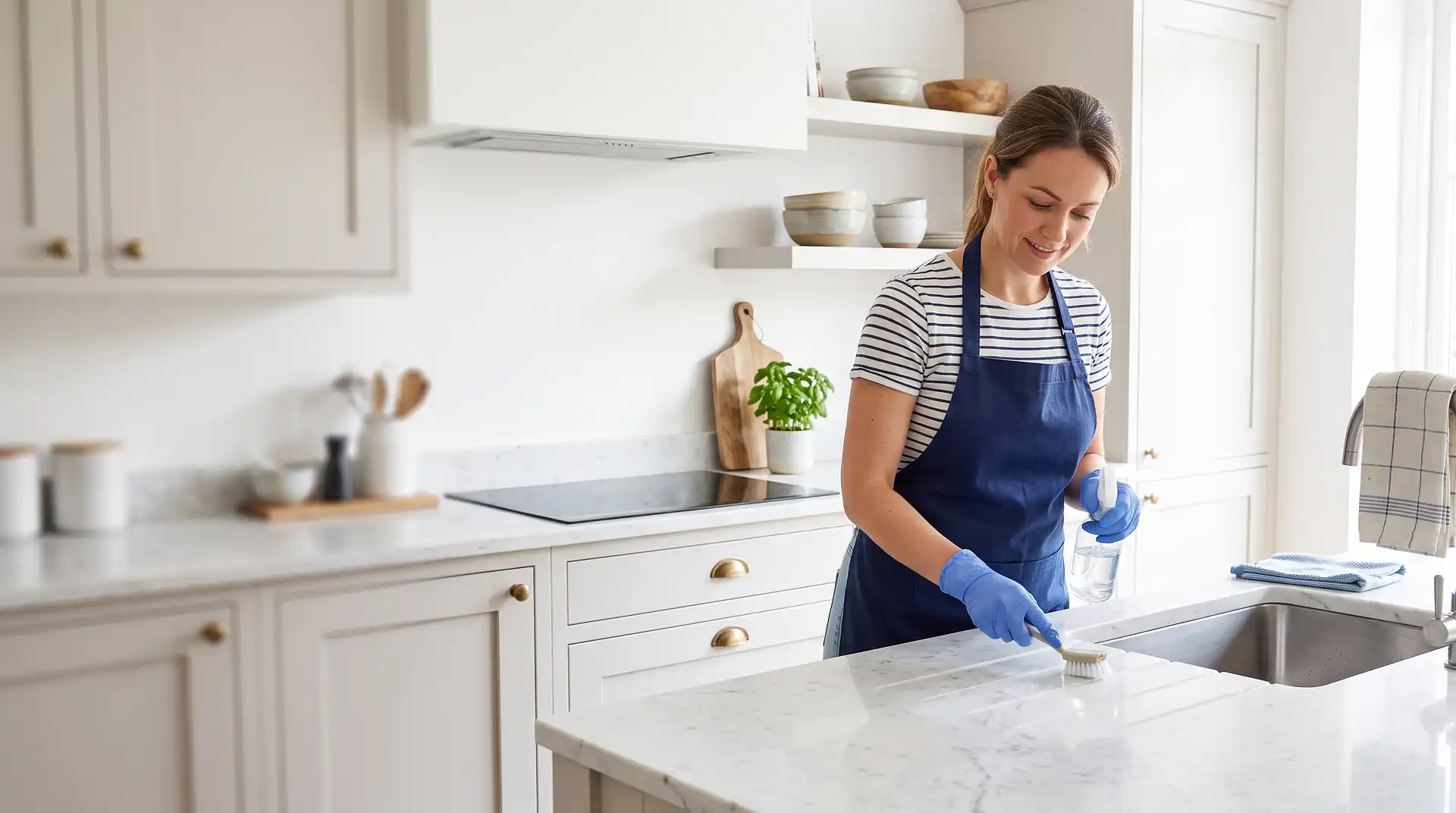
Worktops — clean and, for stone or wood worktops, check whether a specific care product is needed rather than a generic all-purpose spray, since some worktop materials can be dulled or damaged by the wrong cleaner.
Sink and taps — descale the taps, clean the plughole and overflow (a common source of kitchen sink odour that's easy to miss), and disinfect the sink basin itself.
Bin and bin area — wash the bin itself, not just empty it, since residue builds up on the inside walls and lid.
Floor — sweep or vacuum, then mop, moving furniture and appliances where possible to reach behind and underneath, which is where dropped food and grease genuinely accumulate over months.
Tools and Products That Matter
A proper degreaser — general all-purpose spray often isn't strong enough for established grease; a dedicated kitchen degreaser, given dwell time, does the job a quick wipe can't.
A descaling solution — for kettles, taps, and any hard-water marks, since scrubbing alone rarely shifts established limescale without a chemical assist.
An old toothbrush or small detail brush — for grout lines, appliance seals, and tight gaps around taps and hob controls that a cloth can't reach into.
Microfibre cloths, ideally colour-coded — one for surfaces, a separate one for the bin area, to avoid cross-contamination.
Rubber gloves — kitchen degreasers and descalers are stronger than everyday surface spray.
A step stool — cabinet tops and the area above the extractor fan are genuinely hard to reach properly without one, which is part of why they're so often skipped.
Common Mistakes and What to Do Instead
Mistake: wiping grease with a barely damp cloth. This smears a thin layer around rather than removing it, which is why surfaces can look wiped but still feel tacky. Use a proper degreaser and let it dwell before wiping.
Mistake: ignoring the tops of cabinets and the extractor filter. These are the two areas that build up the most grease precisely because they're rarely at eye level or touched during normal use. A genuine deep clean has to include them, not just the visible daily-use surfaces.
Mistake: cleaning the fridge without checking the door seal. Food debris trapped in the rubber seal groove is one of the most common causes of fridge odour, and it's invisible unless you specifically look at and clean the seal itself.
Mistake: scrubbing limescale dry. Limescale needs a descaling product and dwell time to dissolve, not just abrasive scrubbing, which can also scratch chrome taps and stainless steel. Apply, wait, then wipe.
Mistake: forgetting behind and underneath appliances. The fridge, oven, and dishwasher all sit on a section of floor and wall that's essentially never cleaned during a normal weekly routine, and it's often where the most food debris and grease genuinely accumulate.
Mistake: not washing the bin itself. Emptying the bin doesn't address residue and odour built up on the inside walls and lid, which is often the actual source of a lingering kitchen smell rather than anything else in the room.
Advanced Tactics for a Kitchen That Stays Clean Longer
Wiping down the extractor filter and hob surround weekly, rather than waiting for a deep clean, prevents most of the grease buildup that otherwise needs a strong degreaser and real effort to shift later. Running the extractor fan for the duration of cooking and for a few minutes after prevents a meaningful amount of the airborne grease that would otherwise settle on cabinet tops and walls. Descaling the kettle monthly, rather than waiting until limescale is visibly flaking into drinks, takes a fraction of the time a badly scaled kettle needs.
What It Costs in the UK (2026)
Professional kitchen deep cleaning is generally priced either as part of a whole-house deep clean or as a standalone kitchen-only job, and current UK market data puts general house cleaning services — covering standard, deep, and specialist cleans — starting from around £55 for a visit, with deep cleaning specifically commanding a higher hourly rate than standard cleaning across UK providers, typically £25–£35 per hour.
Looking at the kitchen specifically, since it's consistently the most labour-intensive room to deep clean, a standalone kitchen deep clean typically costs £70–£150 depending on size and condition, reflecting the extra time needed for degreasing surfaces, cabinet fronts, and appliance exteriors compared with a quicker general room. Oven cleaning, if not included in the base price, is usually quoted separately at £55–£85, since a genuinely clean oven interior needs specialist, stronger degreasing than a standard kitchen clean covers. A full one-off deep clean of an entire 3-bed house, which includes the kitchen alongside every other room, typically runs £150–£400 depending on property size and how neglected it is.
Service | Typical UK Price (2026) | Notes |
|---|---|---|
General house cleaning (from) | From £55/visit | Standard, deep, and specialist services |
Deep clean, hourly rate | £25–£35/hour | National average, higher in London and South East |
Kitchen deep clean (standalone) | £70–£150 | Most labour-intensive room per visit |
Oven cleaning (add-on) | £55–£85 | Usually quoted separately from general kitchen clean |
Full 3-bed house deep clean | £150–£400 | Includes kitchen, bathroom, and all living spaces |
These are UK market estimates and vary by property condition, region, and provider — get a few quotes, and confirm whether oven cleaning, cabinet interiors, and behind-appliance cleaning are included as standard, since these are commonly quoted as separate extras.
Staying Safe
Kitchen degreasers and descalers are generally stronger than everyday surface spray, and a few rules matter more here than elsewhere in the house. Never mix bleach with a descaler or any acidic cleaning product — the combination can release toxic gas, and this is a genuine risk in a kitchen specifically because acidic descalers are used routinely on taps and kettles. Ventilate the room while using any strong degreaser, and rinse one product fully before applying another.
Because kitchen cupboards are often within a child's easy reach and cleaning products are used frequently in this room, store degreasers, descalers, and oven cleaner in a locked cupboard or one with a child safety catch rather than an easily accessible under-sink space, and always keep them in their original labelled containers. Never leave a diluted cleaning solution unattended in an open bucket or spray bottle on a kitchen surface a child can reach.
Chemical safety guidance and product formulations can change, so it's worth checking current advice (e.g. HSE.gov.uk) before combining or storing kitchen cleaning products, especially in a household with children.
FAQ
How often should a kitchen be deep cleaned? Most households benefit from a full kitchen deep clean every 1–3 months, with weekly wiping of the extractor filter and hob surround in between to prevent heavy grease buildup.
Why does my kitchen still feel greasy after cleaning? Wiping with a barely damp cloth spreads grease into a thin film rather than removing it. A proper degreaser left to dwell for several minutes before wiping actually breaks down the grease rather than smearing it.
What's the most commonly missed spot in a kitchen deep clean? The tops of cabinets and the extractor filter, both of which accumulate the most grease precisely because they're rarely at eye level or touched during normal daily use.
How much does a professional kitchen deep clean cost in the UK? A standalone kitchen deep clean typically costs £70–£150 in 2026, reflecting the extra time needed for degreasing compared with other rooms, with oven cleaning usually quoted separately at £55–£85.
Is it safe to mix bleach and descaler for a stronger clean? No. Mixing bleach with descaler or other acidic products can release toxic gas. Always rinse one product away fully before using another, and never combine them.
Why does my fridge smell even though it looks clean? Food debris trapped in the rubber door seal is a common cause of fridge odour that's easy to miss during a normal wipe-down. Cleaning the seal groove specifically usually resolves it.