How to Find Underground Pipes
24 July 2026
How to Find Underground Pipes (Before You Dig)
Striking an underground pipe with a spade, fence post, or digger bucket is one of the most common and most avoidable accidents in home improvement — avoidable specifically because locating pipes beforehand is neither expensive nor especially time-consuming compared with the cost of the damage if you get it wrong. Whether you're planting a tree, putting up a fence, laying a patio, or planning an extension, knowing what's beneath the ground before you disturb it is a genuinely straightforward process with several layered methods, from free record checks through to professional scanning.
Why This Matters More Than People Expect
Water pipes are the least dangerous thing to strike, and even they cause a real inconvenience — a flooded garden, a burst main, and a repair bill. Gas pipes and electrical cables carry genuinely serious risk, and it's not always obvious from the surface which type of service runs where, particularly on older properties or those that have had extensions or landscaping work done over the years without clear records being kept. This is why locating pipes isn't just relevant for major building projects — the same caution applies to something as simple as fitting a fence post or planting a tree with a reasonably deep root ball.
Step 1: Check Existing Plans and Records
Start with whatever documentation already exists for the property — house deeds, previous renovation plans, or a home survey report sometimes show approximate pipe and drain routes. Water and gas utility companies can often provide plans showing the general route of mains supply pipes up to your property boundary, though these plans typically won't show private pipework once it crosses onto your land, which is where the responsibility (and the uncertainty) shifts to you as the homeowner.
Step 2: Look for Visible Clues Above Ground
Before any equipment comes out, a visual inspection of the property often reveals useful clues. Stop tap covers, inspection chamber covers, and manhole covers usually mark points where underground pipework runs nearby or connects to. Any patches of ground that look different from their surroundings — a slightly sunken strip, different vegetation growth, or a repaired section of paving — can indicate where a trench was previously dug for pipework. Air vents or small pipes poking up from the ground occasionally mark a drain run.
Step 3: Use a CAT Scanner (Cable Avoidance Tool) for Accurate Detection
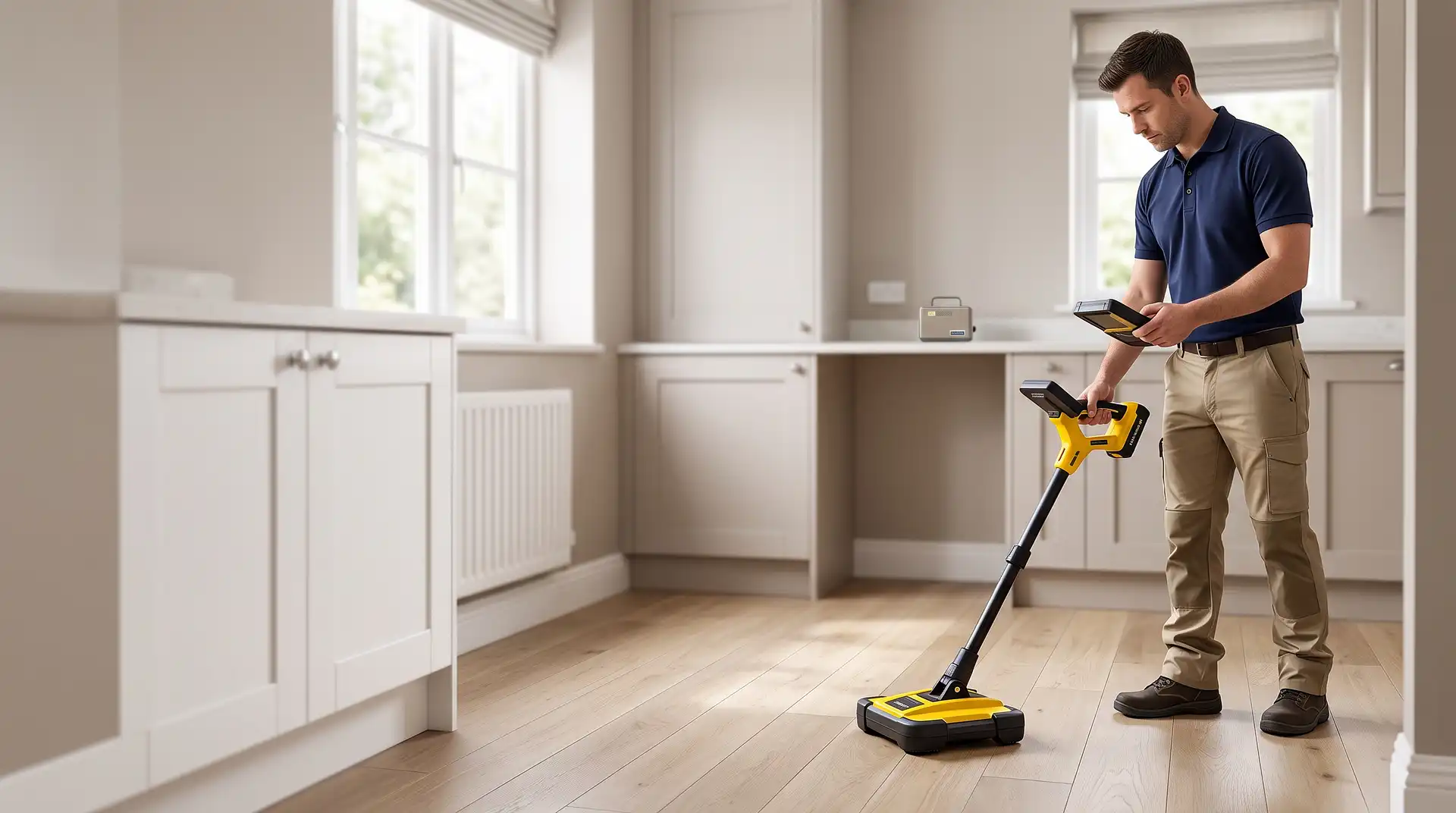
For anything beyond a very shallow, low-risk job, a Cable Avoidance Tool — commonly called a CAT scanner — is the standard professional method for locating underground pipes and cables. It works using electromagnetic and radio detection, identifying buried metallic pipes and cables (and, with a signal generator, some non-metallic pipes fitted with a tracer) without any digging required. This is the same equipment construction and utility companies use before any excavation work, and it's available both as a professional service and, for confident DIYers on simpler jobs, as rental equipment.
Step 4: Use Ground-Penetrating Radar for Non-Metallic Pipes
CAT scanning works well for metallic pipework and cables, but many modern plastic water and drainage pipes have no metallic content to detect electromagnetically. Ground-penetrating radar (GPR) is used for these cases, sending radar pulses into the ground and reading the reflections to map subsurface objects, including non-metallic pipes, regardless of material. This is more specialist equipment, generally used by professional utility locating services rather than DIY-rented, particularly for larger or more complex sites.
Step 5: For Drains Specifically, Consider a CCTV Survey
If you're specifically trying to trace the route of a drain rather than a water supply pipe, a CCTV drain survey — a small camera fed through the drainage system — can map the exact route, depth, and condition of pipework from the inside, which is particularly useful if you're planning to build over or near an existing drain run and need to know precisely where it sits.
Common Mistakes and What to Do Instead
Mistake: assuming pipe locations mirror the property's original plans exactly. Extensions, past repairs, and landscaping work often move or add pipework without updating original documentation. Treat old plans as a helpful starting point, not a guarantee, and verify with a scan before digging near anything that matters.
Mistake: digging based on a rough guess after finding one visible clue. A single stop tap or manhole cover tells you a pipe is nearby, not exactly where it runs or how deep it sits. Use a proper detection method to confirm the actual route before excavating.
Mistake: assuming DIY pipe/cable detectors are as reliable as professional CAT scanning for anything beyond a simple job. Consumer-grade detectors can miss non-metallic pipes or cables at certain depths. For anything beyond a shallow, low-risk task, professional scanning with proper equipment and training reduces the risk of a costly miss.
Mistake: not checking for gas and electrical services alongside water pipes. Focusing only on water pipework because that's what you expect to find can mean missing a gas line or buried electrical cable in the same area, which carries considerably higher risk if struck.
Mistake: excavating without a documented scan report for anything commercial or larger-scale. Beyond domestic DIY, HSG 47 (the UK's official guidance for avoiding underground services during excavation) expects a documented process for utility location before digging on any site where risk is non-trivial, and having a proper report also matters for insurance purposes if something does go wrong.
When to Hire a Professional Instead
DIY detection using a basic pipe/cable locator is reasonable for very shallow, low-risk jobs like a single fence post in an area with no visible signs of buried services. It's worth hiring a professional CAT scanning or utility locating service for anything larger — an extension, a new driveway, significant garden landscaping, or any excavation near a boundary shared with a neighbouring property — and particularly for anything where gas or electrical services might realistically be present. A professional service also provides a documented report, which matters both for your own confidence before digging and, in commercial or larger domestic projects, for compliance and insurance purposes.
What It Costs in the UK
Checking existing utility company plans is generally free or low-cost, and a good starting point before any physical detection work. A professional CAT scanning or pipe locating survey for a typical domestic property varies by scope, but a general utility survey for a standard-sized garden or building plot commonly runs from a few hundred pounds upward, scaling with property size and the complexity of what needs mapping.
For comparison, a standard plumbing inspection survey — useful if you're trying to understand a property's existing pipework more generally, not just locate it before digging — typically costs £100–£400, while a CCTV drain survey specifically typically averages around £90–£300 depending on the property and how much of the drain run needs surveying. If the goal is specifically finding a suspected leak rather than mapping pipe routes for a dig, dedicated leak detection services typically start from a few hundred pounds for an initial investigation, with acoustic detection commonly £300–£750, tracer gas detection £250–£2,000, and more complex cases running higher depending on the property and pipework involved.
Service | Typical UK Cost (2026) |
|---|---|
Utility company plan request | Free–low cost |
DIY pipe/cable locator (purchase or hire) | £30–£150 |
Professional CAT scan/utility survey (domestic) | From a few hundred pounds, scaling with site size |
Standard plumbing inspection survey | £100–£400 |
CCTV drain survey | £90–£300 |
Leak-specific detection (if applicable) | £250–£2,000 depending on method |
These are UK market estimates and vary by property size, complexity, and provider — for anything beyond a very small, low-risk job, a professional survey is generally cheap insurance against the cost of striking a pipe or cable you didn't know was there.
Staying Safe
Never dig based on assumption alone, particularly near a property boundary, an existing structure, or any area where a stop tap, manhole, or visible service marker suggests buried pipework nearby. If in doubt about whether a service might be gas or electrical rather than water, treat the area with the same caution as if it were confirmed gas or electrical, since the visual difference isn't always obvious from the surface and the consequences of striking either are considerably more serious than striking a water pipe.
For any excavation on a commercial site, or a domestic project of meaningful scale, following HSG 47 guidance — proper utility location, a documented process, and safe digging practices once services are marked — is worth treating as standard practice rather than an optional extra, both for safety and because it's expected by many insurers and, in some cases, by planning or building control processes.
Utility location best practice and HSG 47 guidance can be updated, so it's worth checking current guidance (e.g. via HSE.gov.uk) before any significant excavation, and always confirming with your specific utility providers whether up-to-date plans are available for your property.
FAQ
How do I find out where underground pipes are on my property? Start by checking any existing plans or utility company records, look for visible surface clues like stop taps and manhole covers, then use a CAT scanner or professional utility survey to confirm exact routes before digging.
What is a CAT scan for finding pipes? A Cable Avoidance Tool (CAT scanner) uses electromagnetic and radio detection to locate buried metallic pipes and cables without digging. It's the standard method used by professionals before excavation work in the UK.
Can a CAT scanner find plastic pipes? Not directly, unless the pipe has been fitted with a tracer wire or sonde. Ground-penetrating radar is generally used instead for detecting non-metallic pipes that a standard CAT scan can't pick up electromagnetically.
Do I need a professional to find pipes before planting a tree or fence post? For a single shallow post in an area with no visible signs of buried services, a basic DIY locator may be sufficient. For anything larger, or any uncertainty about gas or electrical services nearby, a professional survey is the safer choice.
How much does it cost to locate underground pipes in the UK? A professional CAT scan or utility survey for a domestic property typically starts from a few hundred pounds, scaling with site size, while related services like a plumbing inspection (£100–£400) or CCTV drain survey (£90–£300) can also help map existing pipework.
What happens if I accidentally strike an underground pipe while digging? Water pipe damage typically causes flooding and requires a repair, generally £330–£1,500 depending on severity. Striking gas or electrical services is considerably more serious and should be treated as an emergency requiring immediate professional attention.