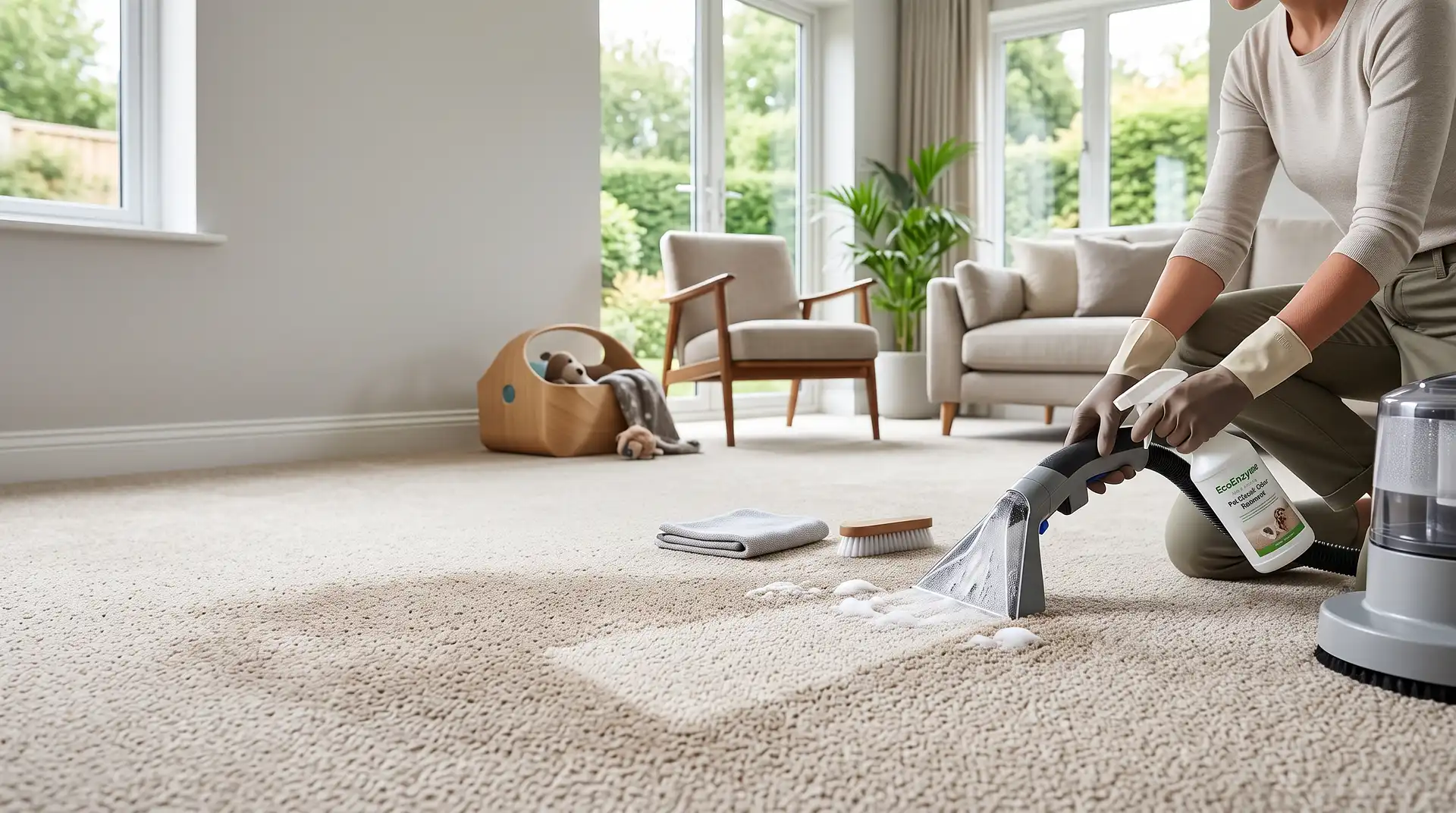
How to Get Urine Smell Out of Carpet
2 September 2026
How to Get Urine Smell Out of Carpet
Urine smell persists in carpet after cleaning because standard cleaning products do not address the root cause. When urine dries in carpet fibres, the water and ammonia evaporate but uric acid crystals remain bonded to the fibre. These crystals are odourless when dry, which is why a carpet can smell clean immediately after treatment and then smell again days later when humidity rises. Warmth and moisture reactivate the crystals and release the ammonia smell again.
Removing the smell permanently requires breaking down the uric acid crystals, not masking them. Enzyme-based cleaners are the only product type that achieves this. They contain biological enzymes that digest the uric acid at a molecular level, eliminating the source rather than covering it.
Why Standard Cleaners Fail on Urine Smell
Bicarbonate of soda, white vinegar, and standard carpet shampoos are effective at neutralising fresh odours and removing the water-soluble components of urine. They are not effective at breaking down uric acid crystals, which require a specific enzyme reaction.
White vinegar in particular is frequently recommended for urine smell and is one of the more counterproductive suggestions for dried urine. The acidity of vinegar does neutralise ammonia temporarily, which is why a carpet can smell better immediately after vinegar treatment. The uric acid crystals remain untouched and reactivate the next time the carpet absorbs humidity.
Air fresheners and deodorisers are surface treatments that mask the ammonia smell with a stronger scent. They provide temporary relief and have no effect whatsoever on the crystals in the pile.
Enzyme Cleaners: How They Work
Enzyme cleaners contain bacteria that produce specific enzymes targeting uric acid, proteins, and other organic compounds in urine. When applied to the affected area, the enzymes digest the uric acid crystals and break them down into carbon dioxide and water, both of which evaporate from the carpet. Once the enzyme reaction is complete, the source of the smell is gone rather than masked.
Two conditions are necessary for enzyme cleaners to work effectively. First, the carpet must be damp when the cleaner is applied enzymes require moisture to be active. Second, the cleaner must remain in contact with the affected area for long enough for the enzyme reaction to complete. Most products recommend 10 to 30 minutes of dwell time, and some suggest covering the area with a damp cloth or cling film to maintain moisture during treatment.
Enzyme cleaners are available from pet shops, supermarkets, and online retailers across the UK. Products labelled as pet urine removers, biological stain removers, or enzyme-based carpet treatments all work on the same principle. Prices run from £5 to £20 depending on size and brand.
Fresh Urine: Act Quickly
The faster fresh urine is removed from the carpet, the less penetrates into the backing and underlay. Blot with a clean white cloth or thick kitchen roll, pressing firmly and lifting cleanly without rubbing. Work from the outer edge of the wet area inward. Keep blotting with fresh cloth sections until no more moisture transfers.
Pour a small amount of cold water onto the area to dilute the remaining urine and blot again. This reduces the concentration of uric acid that will eventually crystallise in the fibre.
Apply an enzyme cleaner according to the product instructions while the area is still damp. Fresh urine treated with an enzyme cleaner within the first hour rarely causes a persistent smell problem. The crystals have not yet fully formed and the enzyme treatment addresses the urine at its most accessible stage.
Dried Urine and Old Stains
Dried urine that has been in the carpet for days, weeks, or months has fully crystallised uric acid bonded deep in the fibre, in the backing, and potentially in the underlay beneath. This is the situation that requires the most thorough treatment.
Step 1: Identify the full extent of the affected area. This is consistently underestimated. Urine spreads horizontally as it soaks down through the pile, and the area that smells is often considerably larger than any visible stain. A UV blacklight torch, available for under £15 from online retailers, reveals dried urine deposits that are invisible in normal light. They glow yellow-green under UV. Use it in a darkened room to map the full extent before treating.
Step 2: Rehydrate the area. Apply clean warm water to the full affected area identified under the UV light, enough to dampen the pile and backing but not to soak through completely. This activates dormant crystals and prepares the surface for enzyme treatment.
Step 3: Apply enzyme cleaner generously. Cover the full affected area with enough enzyme cleaner to penetrate to the depth the urine reached. For a stain that has soaked through to the underlay, this means applying enough product to reach the underlay. Underapplication is the most common reason enzyme treatment fails on old stains.
Step 4: Maintain moisture and dwell time. Cover the treated area with a damp cloth or cling film to prevent the enzyme cleaner from drying out before the reaction is complete. Leave for the time specified on the product, which may range from 30 minutes to several hours depending on the formulation. Longer dwell time on old, deep stains is always better than shorter.
Step 5: Blot and rinse. After the dwell time, blot up the residue with clean cloths and rinse with cold water. Blot dry and allow to air dry fully before checking with the UV torch again.
Pet Urine Versus Human Urine
The smell-removal process is the same for both, but cat urine deserves specific mention because it is significantly more concentrated than dog or human urine and contains felinine, a sulphur-containing compound that adds a particularly sharp, distinctive component to the smell. Cat urine is harder to fully neutralise and typically requires more enzyme cleaner, longer dwell time, and sometimes multiple treatments.
Some enzyme cleaners are formulated specifically for cat urine and contain additional enzyme types targeting felinine. These are worth seeking out for persistent cat urine problems rather than using a generic pet urine product.
Elderly or incontinent occupants may produce human urine deposits that are concentrated and involve larger volumes than typical pet accidents. The treatment approach is identical but the scale of application needs to match the volume of the original deposit.
When the Smell Has Penetrated the Underlay
Underlay beneath a carpet absorbs a significant proportion of any urine deposit that is not caught immediately. Enzyme treatment applied to the carpet surface can reach the upper portion of the underlay, but deep saturation that has been left untreated for weeks may have affected the underlay fully. In this situation, the underlay itself becomes the ongoing source of smell regardless of how well the carpet surface has been treated.
Lifting the carpet to inspect and if necessary replace the underlay in the affected area is the definitive solution for persistent urine smell that does not respond to repeated surface treatment. Replacing underlay beneath the affected section costs £5 to £15 per square metre in materials, and relaying the carpet over new underlay is work a carpet fitter can do for £50 to £150 depending on the area size.
A professional carpet cleaning service using hot water extraction can also reach deeper into the pile and backing than DIY methods, which is worth considering for large or heavily saturated areas. According to InstantCost.co.uk's 2026 UK carpet cleaning pricing data, a single stain treatment runs £10 to £25 and a small room clean costs £35 to £55. Professional cleaners who specialise in pet urine treatment use industrial-strength enzyme solutions and extraction equipment that removes more of the treated residue than blotting alone. The InstantCost carpet cleaning cost guide has a 2026 UK price calculator you can filter by room size and treatment type before booking.
If the smell is coming from a clearly defined older stain that has been cleaned for the liquid but not for the odour, our related guide on how to clean dog pee from carpet covers the stain removal process that should precede any odour treatment, including the blotting sequence that removes as much liquid as possible before enzyme treatment begins.
Common Mistakes and What to Do Instead
Mistake: using white vinegar as a long-term urine smell solution. Vinegar neutralises ammonia temporarily but leaves uric acid crystals intact. The smell returns when humidity rises. Use enzyme cleaner instead.
Mistake: treating only the visible stain area. Urine spreads horizontally as it penetrates the pile. The affected area is typically larger than what is visible. Map the full extent with a UV blacklight before treating.
Mistake: applying insufficient enzyme cleaner. The product needs to reach the same depth as the urine. For old deep stains, generous application that saturates through to the backing level is necessary. A light surface application on a deep old stain achieves nothing.
Mistake: not allowing enough dwell time. Enzyme reactions take time. Rinsing after five minutes rather than the specified 30 minutes or longer prevents the reaction from completing and leaves uric acid crystals partially intact.
Mistake: using a steam cleaner on urine-affected carpet. Heat sets the uric acid crystals more firmly into the fibre and can make the smell worse and harder to treat. Never apply heat to a urine-affected area. Cold or lukewarm water only.
Mistake: applying an air freshener or deodoriser and considering the problem solved. Masking products provide temporary relief. The crystals remain and the smell returns. Enzyme treatment eliminates the source.
What It Costs in the UK
Item or service | Typical UK cost (2026) |
|---|---|
Enzyme-based pet urine cleaner | £5 to £20 |
UV blacklight torch | Under £15 |
Underlay replacement (per m²) | £5 to £15 |
Carpet refitting over new underlay | £50 to £150 |
Professional per-stain treatment | £10 to £25 |
Professional clean, small room | £35 to £55 |
Professional clean, large room | £55 to £90 |
Professional clean, 3-bed house | £140 to £240 |
Figures based on InstantCost.co.uk's 2026 UK carpet cleaning pricing data and vary by region, carpet type, and provider.
Staying Safe
Enzyme cleaners are biological products and are generally low-hazard. Some formulations may cause mild skin irritation on prolonged contact. Wear gloves when applying large volumes and wash hands after treatment.
Keep children and pets off the treated area until the carpet is fully dry. Enzyme cleaners are not acutely toxic but are not designed for ingestion, and a crawling infant or pet that licks a freshly treated area will ingest the product residue.
Do not mix enzyme cleaners with bleach or any bleach-containing carpet cleaner. Bleach denatures the enzymes immediately and renders the treatment ineffective. If bleach-based products have been used previously on the area, rinse thoroughly with water and allow to dry before applying any enzyme-based treatment.
Store enzyme cleaners at room temperature. Most formulations are sensitive to very high temperatures that denature the live bacteria in the product, reducing their effectiveness. Check the storage instructions on the label.
UK carpets with repeated or significant urine contamination may fail the hygiene standards required under the Housing Health and Safety Rating System (HHSRS) in rented properties. Landlords are responsible for ensuring carpets meet basic hygiene standards. Tenants who identify significant urine contamination in a rented property should report it in writing to the landlord and keep a record.
FAQ
Why does urine smell keep coming back after cleaning? Uric acid crystals from dried urine remain in the carpet fibre after standard cleaning removes the liquid and surface odour. These crystals are odourless when dry but release ammonia smell when they absorb moisture from the air. Only enzyme cleaners break down the crystals permanently.
What is the best product to remove urine smell from carpet? An enzyme-based pet urine cleaner is the most effective product available for removing urine smell from carpet. The enzymes digest the uric acid crystals that cause the persistent smell. Brands such as Simple Solution, Bio-One, and similar enzyme cleaners are widely available in UK pet shops and online.
Does baking soda remove urine smell from carpet? Bicarbonate of soda absorbs surface moisture and neutralises some ammonia odour, which provides temporary improvement. It does not break down uric acid crystals and the smell returns as the crystals reactivate in humidity. It is a useful interim measure but not a permanent solution.
How do you find dried urine stains on carpet? A UV blacklight torch used in a darkened room reveals dried urine deposits that are invisible in normal light. They glow yellow-green under UV illumination. UV torches cost under £15 and are the most reliable way to identify the full extent of old urine deposits before treating.
Can steam cleaning remove urine smell from carpet? No. Heat sets uric acid crystals more firmly into carpet fibres and can intensify the smell. Use cold or lukewarm water only when treating urine-affected carpet. Steam cleaning should only be considered after successful enzyme treatment has eliminated the crystals.
When should I call a professional carpet cleaner for urine smell? When the affected area is large, when the smell persists after two or three enzyme treatments, when the underlay appears to be saturated, or when the carpet is wool or a delicate fibre that needs specialist care. Professional carpet cleaners use industrial enzyme solutions and hot water extraction equipment that removes more treated residue than DIY blotting.