How to Increase Pressure on a Worcester Boiler Without a Key
20 August 2026
How to Increase Pressure on a Worcester Boiler Without a Key
Most Worcester Bosch boilers do not need a key to top up the pressure. The majority of Worcester models use either an internal keyless filling loop built into the boiler itself, or an external braided hose filling loop with inline valves that turn by hand. If someone has told you a key is needed, they are likely referring to an older or non-Worcester filling loop that has been fitted at some point in the property's history, or a separate filling key valve that an engineer installed separately from the boiler.
Before you search further for a key that may not exist, check which system you actually have. That takes two minutes and determines everything else.
What Normal Pressure Looks Like
The pressure gauge on a Worcester Bosch boiler is either a dial with a needle or a digital readout on the display. Normal operating pressure when the system is cold is 1 to 1.5 bar. Most Worcester Bosch models show a green zone on the dial covering this range. When the heating is running, pressure rises naturally to 1.5 to 2 bar, which is also normal.
If the gauge reads below 0.5 bar, the boiler will typically display a fault code and stop working. Common Worcester Bosch low pressure codes are EA 229, 2970, or a flashing pressure symbol depending on the model. Topping up the pressure is the correct first response to any of these.
Step 1: Locate Your Filling Loop
Worcester Bosch boilers use three different filling arrangements depending on the model and age of installation. Identifying yours first saves time.
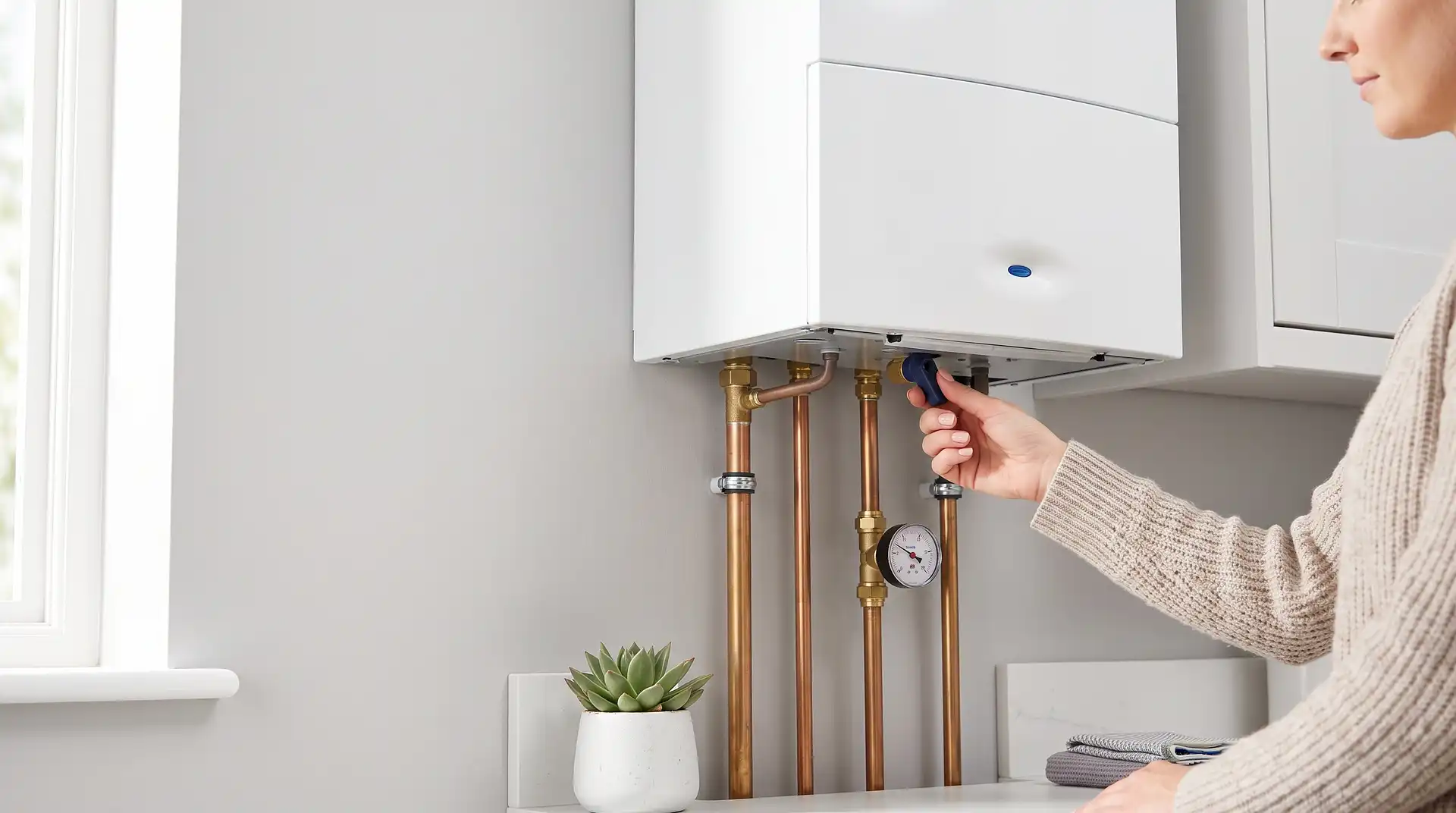
Option 1: Internal keyless filling loop (most common on Worcester Bosch Greenstar models) Look underneath the boiler for a small black or grey hose, roughly 30 cm long, clipped into a bracket. This is the internal filling loop. It connects between two points on the pipework beneath the boiler. There is no key involved. The valves on each end operate by hand using a slot-head screw or a small lever, no tool needed beyond a flat-head screwdriver if the slot is stiff.
Option 2: External braided hose filling loop This is a silver braided flexible hose, usually 30 to 60 cm long, connected between the cold mains supply and the central heating pipework near the boiler. Both ends have inline valves, either lever-type or slot-head. Again, no key required. This type is common on older Worcester installations and on properties where the boiler has been serviced by an engineer who preferred external loops.
Option 3: Key-operated filling valve This is a separate valve, usually chrome or brass, mounted on the pipework near the boiler. It has a square socket on the top and requires a specific small filling key to open it. If this is the only filling point you can find, this is where the key is genuinely required. Worcester Bosch filling keys cost £3 to £8 online and from most plumber's merchants. The alternative is asking your heating engineer to replace the key-operated valve with a standard lever valve at the next service visit.
Step 2: Top Up Without a Key (Options 1 and 2)
For the internal keyless filling loop:
Check the pressure gauge and confirm it reads below 1 bar.
Locate the filling loop hose clipped under the boiler.
Connect the hose between the two filling points if it is not already connected. Push each end onto its fitting and turn clockwise until hand-tight.
Open the first valve slowly using the slot-head or lever. You will hear water entering the system.
Watch the pressure gauge. Turn the valve closed when the gauge reaches 1 to 1.5 bar.
Open the second valve briefly to confirm pressure is holding, then close it.
Disconnect the filling hose and clip it back into its storage bracket. The hose must be disconnected after use to prevent backflow contaminating the mains water supply.
Reset the boiler using the reset button, usually marked with a flame symbol or the word Reset on the control panel.
For the external braided hose filling loop:
Confirm the pressure gauge reads below 1 bar.
Locate the braided hose between the cold supply and the heating pipework.
Open both inline valves slowly, one at a time, using the lever or a flat-head screwdriver in the slot.
Watch the pressure gauge and close both valves when it reaches 1 to 1.5 bar.
Do not leave both valves open and walk away. Pressure rises faster than expected and overpressure above 3 bar requires bleeding from a radiator to bring it back down.
Reset the boiler.
Step 3: Check the Pressure Holds
Once the boiler has restarted, run the heating for 30 minutes and check the gauge again. Pressure rising slightly to 1.5 to 2 bar during operation is normal. Pressure rising above 2.5 bar when the system is hot suggests an overfilled system or a faulty pressure relief valve, and that needs a professional.
If the pressure drops back below 1 bar within a few days, the system has a leak. That is not a repressurising problem, it is a leak problem, and topping up repeatedly without finding the source masks a fault that will worsen.
When the Key Really Is Required
If the only filling point you can find is the key-operated valve, you need either the key or a replacement valve.
Worcester Bosch filling keys are not model-specific. The square socket size is standardised across most UK heating systems, which means a generic filling key will work on a Worcester-installed key valve. They are available from Screwfix, Toolstation, Amazon, and most plumber's merchants. Searching "central heating filling key" or "boiler filling key" returns the correct product.
If you rent the property, contact the landlord or letting agent. A filling key is part of the normal operation of the heating system and the landlord is responsible for providing access to it or arranging the repressurising.
Why the Pressure Keeps Dropping
A single pressure drop once or twice a year is not unusual, particularly after bleeding radiators, which releases a small amount of water from the system along with the air. That is normal and a top-up is the correct response.
Pressure that drops to below 1 bar within days of topping up, or that needs topping up more than three or four times a year, indicates a system leak. The most common locations are a weeping radiator valve, a corroded section of pipework, a failed pressure relief valve that is releasing water to the condensate drain, or a faulty expansion vessel that is no longer holding its charge.
A leak that is discharging to the condensate pipe rather than visibly pooling anywhere can go undetected for months while the homeowner tops up the pressure repeatedly. The sign is a pressure relief valve discharge pipe, usually a small copper pipe exiting through an outside wall, that is wet or dripping when the heating has been running.
Diagnosing and repairing a system leak is a professional job. If the pressure on your Worcester Bosch boiler is dropping consistently, the right move is a heating engineer who can pressure-test the system and identify the source rather than continuing to top up.
For an idea of what that repair visit is likely to cost, and how it compares to what a boiler service covers, the InstantCost boiler cost guide has a full 2026 UK breakdown of service costs, repair visit rates, and when a repair versus replacement decision makes financial sense, with a calculator you can filter by boiler type and region.
A Note on Worcester Bosch Model Differences
Worcester Bosch has changed filling loop design across its generations, and the location varies by model:
The Greenstar 2000, 4000, and 8000 series all use an internal keyless filling loop clipped under the boiler. On the 8000 series it is accessible through the front panel without removing any casing.
The Greenstar i and Si series (older models, pre-2015) more commonly have an external braided hose or a key-operated valve depending on the original installation.
The Highflow CDi and old CDi series are system boilers rather than combis and have a different filling arrangement involving the system's own filling loop rather than a boiler-mounted hose. If your Worcester Bosch is a system boiler, the filling loop is typically on the pipework below the boiler, often near the cylinder or pump, rather than attached to the boiler itself.
If you cannot identify your model, it is printed on a label inside the front casing of the boiler. Our related guide on how to drain a radiator covers the broader process of isolating and draining sections of the heating system, which is directly relevant if a pressure drop turns out to be a leaking radiator valve that needs replacing rather than a simple top-up job.
Common Mistakes and What to Do Instead
Mistake: assuming a key is always required. Most Worcester Bosch boilers use keyless filling loops. Check which type you have before searching for a key that does not exist for your system.
Mistake: overfilling the system. Pressure above 1.5 bar on a cold system is already at the top of normal range. Above 2.5 bar when hot, the pressure relief valve opens to protect the system, releasing water to the discharge pipe. Top up to 1 to 1.5 bar only.
Mistake: leaving both filling loop valves open. Water continues entering the system and pressure rises while you are not watching. Open valves, watch the gauge, close at 1 to 1.5 bar.
Mistake: not disconnecting the internal filling hose after use. The hose must be removed and stored in its bracket after topping up. A permanently connected filling hose creates a cross-connection between the central heating water and the mains cold supply, which is a Water Regulations compliance issue and risks contaminating the drinking water supply.
Mistake: topping up repeatedly without investigating the cause. Frequent pressure loss means a leak somewhere in the system. Topping up masks the fault rather than resolving it.
Mistake: resetting the boiler before topping up the pressure. The reset clears the fault code but not the low pressure. The boiler will lock out again within seconds if pressure is still below the minimum. Top up first, then reset.
What It Costs in the UK
Topping up boiler pressure yourself costs nothing if you have a keyless loop. A filling key, if genuinely required, costs £3 to £8 from a plumber's merchant or online.
If a heating engineer needs to attend for a pressure-related fault, according to InstantCost.co.uk's 2026 UK boiler and plumbing pricing data, a standard call-out and diagnostic visit runs £80 to £150, and most simple repressurising and fault investigation jobs complete within one hour at the standard rate of £40 to £80 per hour.
Item | Typical UK cost (2026) |
|---|---|
Filling key (if required) | £3 to £8 |
Heating engineer call-out | £80 to £150 |
Engineer hourly rate | £40 to £80 |
Pressure relief valve replacement | £100 to £200 |
Expansion vessel recharge or replacement | £150 to £300 |
Leak detection and repair | £150 to £400 |
Figures based on InstantCost.co.uk's 2026 UK boiler and plumbing pricing data and vary by region and provider.
Staying Safe
Repressurising a boiler is a low-risk task when done correctly. Two things to be aware of.
Do not repressurise when the system is hot. Water expands when heated, so pressure on a hot system is naturally higher than on a cold one. Topping up a hot system produces a higher final cold pressure and risks overpressure when the system cools and is then reheated. Always repressurise on a cold system, meaning the heating has been off for at least an hour.
The pressure relief valve discharge pipe is a safety device. If it is discharging water regularly, that is the system protecting itself from overpressure and it means something in the system is causing pressure to rise above safe limits. Do not cap or block the discharge pipe. Call an engineer.
Keep children away from the boiler and filling loop area during the task. The filling loop connections are under mains pressure, and a poorly seated connector can release a jet of water when opened.
If you smell gas at any point near the boiler, do not touch anything. Leave the property, turn off gas at the meter if safe to do so, and call the National Gas Emergency Service on 0800 111 999.
Worcester Bosch boilers are covered by the Gas Safe regulations for any work involving the gas valve or combustion components. Repressurising via the filling loop is a water-side task and does not require Gas Safe registration, but any fault that takes you inside the boiler casing to a gas or combustion component must be handled by a Gas Safe registered engineer. Check the Gas Safe Register at gassaferegister.co.uk.
FAQ
Do you need a key to repressurise a Worcester Bosch boiler? No, for most models. Worcester Bosch Greenstar 2000, 4000, and 8000 series boilers use an internal keyless filling loop clipped under the boiler. Some older Worcester installations and certain third-party filling valves use a key-operated valve. Check which type is fitted before searching for a key.
Where is the filling loop on a Worcester Bosch boiler? On most Greenstar models it is a short black or grey hose clipped in a bracket beneath the boiler body. On older models it may be an external braided silver hose connecting the cold supply to the heating pipework near the boiler. On some installations a key-operated valve is fitted on the nearby pipework instead.
What pressure should a Worcester Bosch boiler be at? Normal cold pressure is 1 to 1.5 bar, shown in the green zone on the dial gauge. When the heating is running, pressure naturally rises to 1.5 to 2 bar. Below 0.5 bar the boiler will typically fault and stop. Above 2.5 bar when hot indicates a problem requiring investigation.
Why does my Worcester Bosch boiler keep losing pressure? A single pressure drop once or twice a year after bleeding radiators is normal. Pressure dropping to below 1 bar within days of topping up, or needing topping up more than three or four times a year, indicates a system leak, most commonly at a radiator valve, a section of pipework, the pressure relief valve, or the expansion vessel.
What is the Worcester Bosch low pressure fault code? The most common codes are EA 229 or 2970 depending on model, or a flashing pressure gauge symbol on digital displays. Top up the pressure first, then press the reset button. If the fault code returns quickly, the pressure has dropped again and there is a leak in the system.
Can I use a generic filling key on a Worcester Bosch valve? Yes. The key-operated filling valve socket is a standardised square size used across most UK central heating systems, not specific to Worcester Bosch. A generic central heating filling key available from Screwfix, Toolstation, or online for £3 to £8 will operate a Worcester-installed key valve.