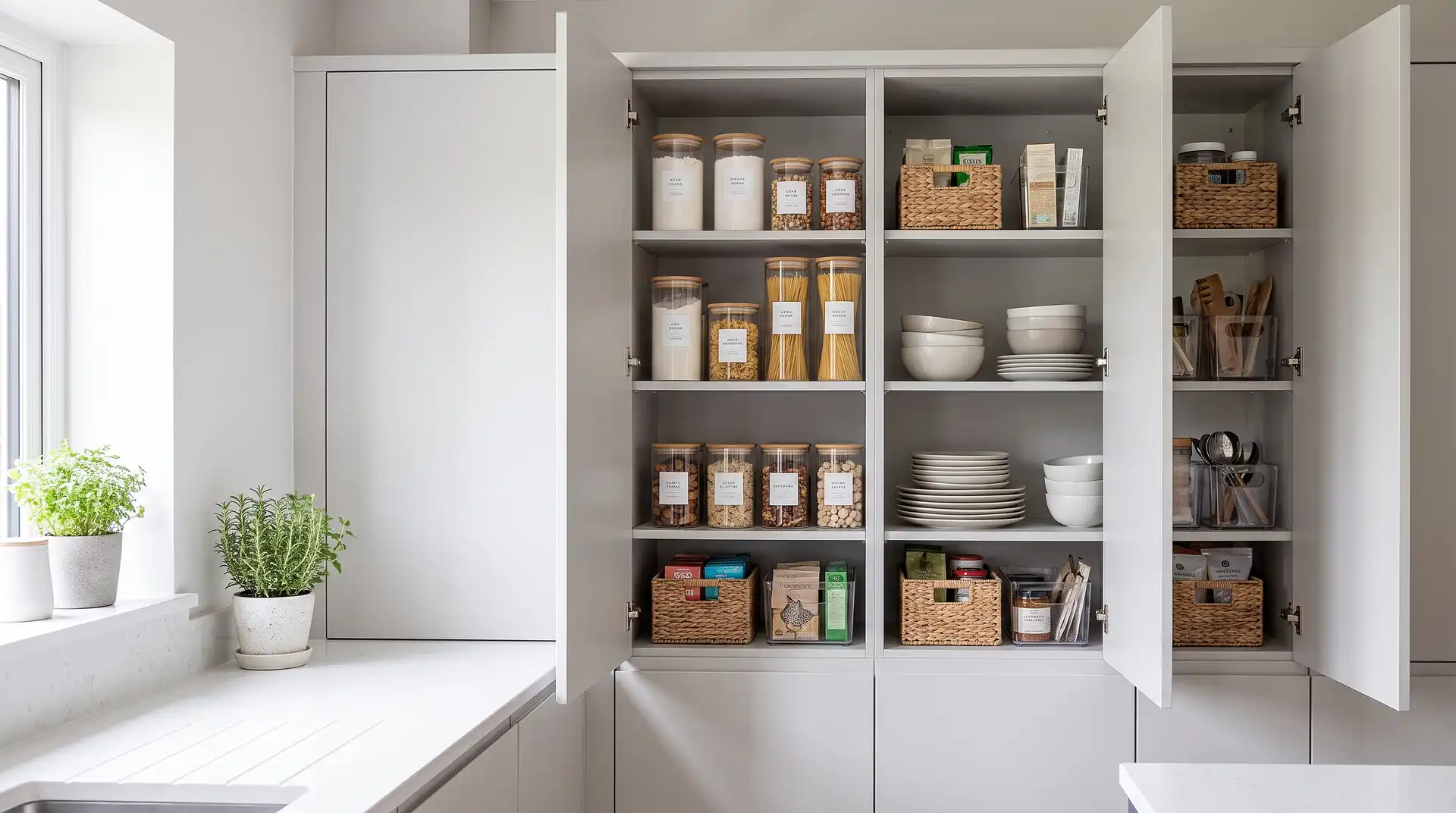
How to Organise Kitchen Cupboards
11 August 2026
How to Organise Kitchen Cupboards (A System That Actually Sticks)
Most kitchen cupboard organisation fails within a few weeks because it's based on how the space looked on the day you tidied it, not on how you actually use the kitchen day to day. A system built around genuine usage frequency, rather than what looks neat in the moment, is what actually holds, since it puts things back roughly where your hand reaches for them anyway rather than fighting your own habits every time you cook.
Start With Zones, Not Cupboards
Before touching a single cupboard, think about your kitchen in terms of activity zones rather than storage units. A baking zone, near where you actually roll out dough or mix batter. An everyday cooking zone, close to the hob, for oils, spices, and pans in regular rotation. A crockery and cutlery zone, near the dishwasher or sink, since that's where these items get put away from. Once you've mapped zones to how you actually move through the kitchen, cupboard assignment becomes straightforward, each zone's items go in the storage closest to where they're used, not wherever happened to have space when you moved in.
Sort by Frequency, Not Category Alone
Category-based organisation, all baking things together, all pans together, is a reasonable starting point, but frequency matters just as much for where within that category things actually live. Items used daily belong at eye level or in the most easily reached drawer, no bending, no stretching, no moving other things out of the way first. Items used weekly or monthly go in the next tier down or up. Items used only a few times a year, the turkey roasting tray, the fondue set, belong in the least accessible spots, a high shelf or the very back of a low cupboard, since you're not fighting daily friction to reach something you'll use twice a year anyway.
Tackle Corner Cupboards Properly
Corner cabinets are consistently the most wasted storage in a kitchen, deep, awkward, and easy to lose things in permanently. A pull-out carousel or swing-out shelf system genuinely transforms this space from a black hole into usable storage, and it's one of the higher-value organisational upgrades you can make to an existing kitchen without touching the units themselves. If a full carousel isn't in budget, even organising by placing frequently used items toward the front and accepting the very back corner as long-term storage for rarely used items is a meaningful improvement over no system at all.
Use Vertical Space Properly
Most cupboards are organised as a flat surface with wasted air above each item. Stackable shelf risers, particularly in cupboards storing plates or tins, let you use that vertical space properly rather than leaving it empty above every single stacked item. Over-the-door organisers, fitted to the inside of a cupboard door, add genuine storage capacity for flat items like chopping boards, trays, and lids without needing any structural change to the kitchen itself.
Drawer Organisation Matters as Much as Cupboards
Drawer dividers, whether a simple insert or a proper adjustable system, stop a utensil drawer becoming the place where everything eventually migrates and nothing can be found. Group by function within the drawer, cooking utensils together, cutting tools together, measuring tools together, rather than letting everything settle randomly.
The "One In, One Out" Principle
This is the single habit that keeps an organised kitchen organised rather than sliding back into clutter within a month. When a new item enters a category that's already at capacity, a new gadget, another mug, a genuinely honest assessment of whether something existing needs to leave keeps the system from slowly overflowing the way most kitchens do without anyone quite noticing it happening.
Declutter Before You Organise, Not After
Organising cluttered cupboards just produces a tidier version of too much stuff. Go through each category first and be honest about duplicates, items you haven't used in over a year, and anything genuinely broken or incomplete. This step is uncomfortable but it's what makes the organisation that follows actually fit the space properly, rather than being a cramped compromise around too much volume for the cupboards available.
When the Real Problem Is Capacity, Not Organisation
Sometimes no amount of organising fixes the underlying issue, because the kitchen genuinely doesn't have enough storage for the household using it. If you've decluttered honestly and applied a proper zone system and things still don't fit, that's a capacity problem rather than an organisation one, and it's worth knowing what actually adding storage costs before assuming a full renovation is the only route. Our related guide covers how much it costs to fit a kitchen in the UK, useful if you're weighing up whether additional units, a larder cupboard, or reconfigured storage would solve a problem that organisation alone genuinely can't.
Common Mistakes and What to Do Instead
Mistake: organising by category alone without considering frequency of use. Grouping all baking items together is a good start, but if they're stored somewhere awkward to reach, you'll still avoid using the system day to day. Combine category grouping with frequency-based placement.
Mistake: putting daily items in a high or hard-to-reach cupboard. This creates daily friction that erodes the system within weeks, since you'll start putting things down wherever's convenient rather than back where they belong.
Mistake: organising cluttered cupboards without decluttering first. This just produces a tidier version of having too much stuff, and the system strains against the volume from day one rather than genuinely fitting.
Mistake: ignoring corner cupboards as a lost cause. Even a partial system, front-loading with frequently used items, is a meaningful improvement over leaving a corner cabinet as an unorganised black hole.
Mistake: not using vertical space within cupboards. Flat storage wastes the air above every stacked item. Shelf risers and stackable solutions genuinely increase usable capacity without needing more cupboards.
Mistake: assuming organisation can fix a genuine capacity shortage. If there's honestly not enough storage for the household's needs after decluttering properly, no organisational system fully solves that, and it's worth considering whether additional storage or a reconfiguration is the real fix.
What It Costs in the UK
Organisational products are genuinely inexpensive relative to the improvement they make. Drawer dividers typically cost £8 to £20 depending on size and adjustability. Stackable shelf risers typically cost £10 to £25 for a set. Over-the-door organisers typically cost £10 to £20. A pull-out carousel or swing-out corner cupboard system is the bigger investment among organisational upgrades, typically £40 to £120 depending on size and mechanism, but transforms what's otherwise one of the most wasted spaces in most kitchens.
If organisation genuinely isn't enough and additional storage capacity is needed, according to InstantCost.co.uk's 2026 UK kitchen renovation pricing data, a fully fitted kitchen typically costs £8,000 to £15,000 for a standard 8 to 12 unit kitchen, with budget options starting from £5,000. Within that budget, units and worktops typically represent 35 to 45% of the total cost, appliances 15 to 25%, labour 25 to 35%, and finishing touches 5 to 10%. For a smaller-scale addition, a single larder unit or additional run of cabinets is a considerably more modest cost than a full refit and worth discussing with a kitchen fitter as a standalone addition rather than assuming a full renovation is the only option.
Item or Service | Typical UK Cost (2026) |
|---|---|
Drawer dividers | £8 to £20 |
Stackable shelf risers (set) | £10 to £25 |
Over-the-door organiser | £10 to £20 |
Pull-out corner carousel | £40 to £120 |
Fully fitted kitchen, budget | From £5,000 |
Fully fitted kitchen, standard (8-12 units) | £8,000 to £15,000 |
Organisational product prices are general UK market estimates. Kitchen renovation figures are based on InstantCost.co.uk's 2026 UK pricing data and vary by specification and region.
Staying Safe
Store heavier items, large pans, mixing bowls, appliances, in lower cupboards rather than overhead storage, both for ease of access and to avoid the genuine injury risk of a heavy item falling from height. Keep any cleaning products or sharp tools stored separately from food items and, if children are in the home, in cupboards they can't easily access, ideally with a child safety catch fitted.
Storage weight limits vary by cupboard and shelf construction, so avoid overloading shelves beyond what they're rated for, particularly with pull-out or swing-out mechanisms.
FAQ
What's the best way to organise kitchen cupboards? Combine zone-based thinking, storing items near where you actually use them, with frequency-based placement, daily items at eye level, rarely used items in the least accessible spots, after decluttering honestly first.
How do I organise a corner kitchen cupboard? A pull-out carousel or swing-out shelf system is the most effective solution, transforming typically wasted space into genuinely usable storage. Without one, front-loading with frequently used items is still better than no system.
Should I declutter before organising my kitchen cupboards? Yes, always. Organising around too much volume just produces a tidier version of clutter. A genuine declutter first is what lets the organisation system actually fit the space properly.
How much does it cost to organise kitchen cupboards? Individual organisational products, drawer dividers, shelf risers, over-the-door storage, typically cost £8 to £25 each. A corner carousel system typically costs £40 to £120, the larger investment among common organisational upgrades.
What if my kitchen genuinely doesn't have enough storage? That's a capacity problem organisation alone can't solve. A fully fitted kitchen typically costs £8,000 to £15,000 in the UK, though a smaller addition like a single larder unit is a considerably more modest cost worth discussing with a fitter separately.
How often should I reorganise my kitchen cupboards? A quick check every few months catches drift back toward clutter early, with a fuller declutter and reorganisation annually, or whenever household needs genuinely change, a new baby, a new hobby, that shifts what you actually use daily.