How to Put Christmas Lights on a Tree
6 August 2026
How to Put Christmas Lights on a Tree (Properly, and Safely)
Most people wrap Christmas lights around the outside of a tree in a spiral, which is why most Christmas trees look flat and patchy once they're lit. The method that actually produces depth, the one used in shop displays and by professional decorators, works vertically rather than horizontally, and involves getting light into the interior of the tree rather than just draping it across the surface. It's not more difficult, it's just a different approach than the one most of us inherited.
How Many Lights You Actually Need
The general rule is roughly 100 lights per foot of tree height, so a 6ft tree needs around 600 lights and a 7ft tree around 700. This is noticeably more than most households use, and under-lighting is genuinely the most common reason a tree looks sparse once decorated. If you want a fuller, more professional look, particularly on a dense artificial tree, going up to 150 lights per foot is worth considering rather than sticking to the minimum.
Test the Lights Before You Start
Plug in and check every set before a single strand goes near the tree. A dead bulb or faulty section discovered halfway through decorating means either unwinding everything or living with a dark patch all season, and it takes two minutes to avoid entirely. This is also the moment to check cables for any fraying, damage, or exposed wiring, which matters for safety rather than just convenience.
The Vertical Method (What Professionals Actually Do)
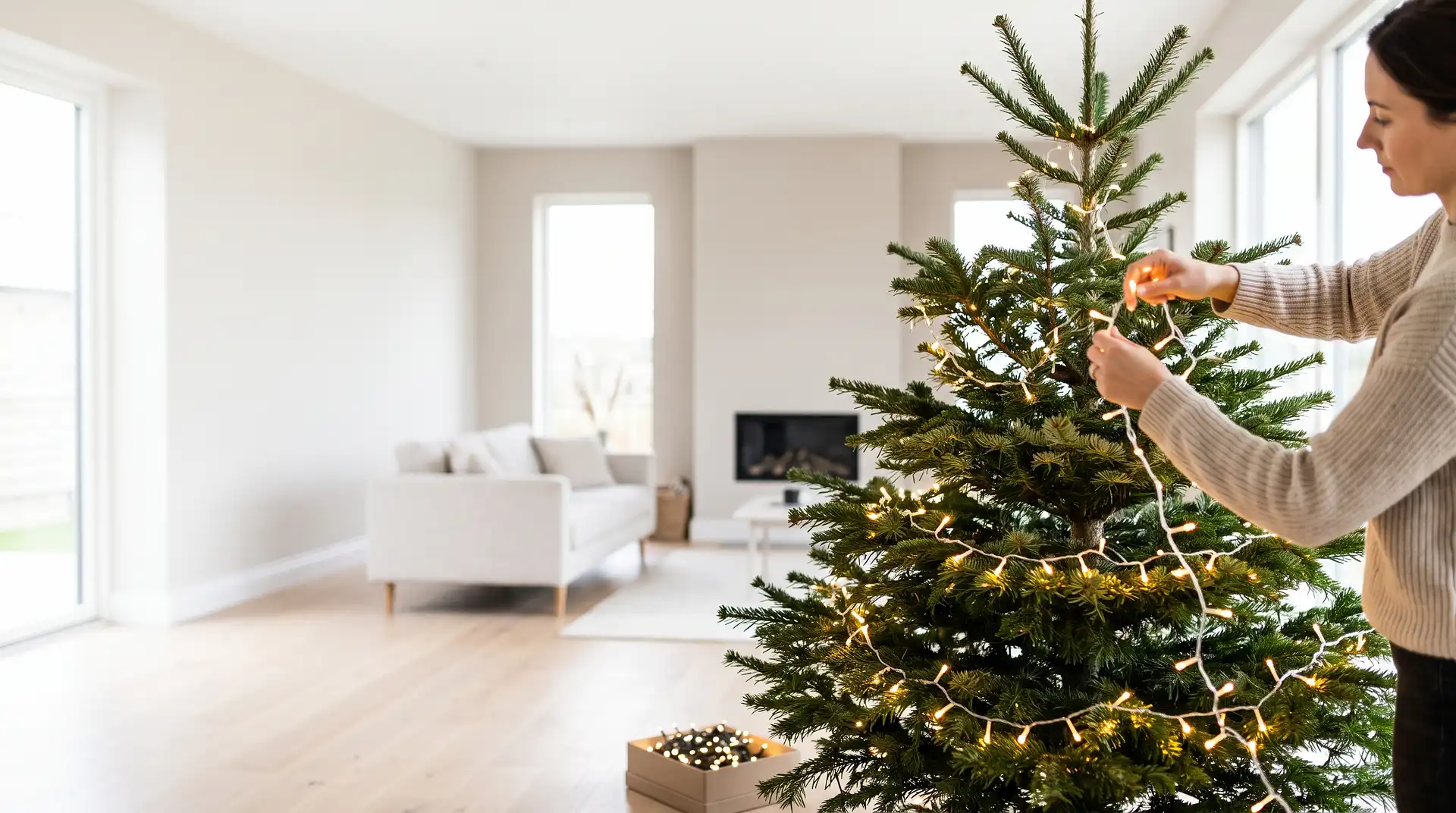
Start at the base of the tree near the trunk, with the plug end closest to your power source. Work the lights vertically up and down rather than spiralling horizontally around the outside. Take a strand from the base up toward the top along one section of the tree, then bring it back down, moving slightly around the tree each time, creating a zigzag up-and-down pattern that gradually works its way around the full circumference.
The key detail that makes this method work: push some of the lights deeper into the tree, closer to the trunk, rather than keeping every bulb on the outer branches. This interior lighting is what creates genuine depth, the tree glows from within rather than just having a lit surface, and it's the single biggest difference between a professionally decorated tree and a home-wrapped one.
Working Top-Down Instead
Some decorators prefer starting at the top and working down, particularly if your power source is nearer the top of the tree or you're using battery-operated sets. The same vertical zigzag principle applies either way, what matters is the up-and-down motion and the interior placement, not which end you begin from.
Getting Even Coverage
Step back from the tree regularly as you work, ideally after every couple of sections, since gaps and clusters are far easier to see from across the room than from arm's length. It's also worth turning the tree, if it's on a stand that allows it, or walking fully around it, to check the back and sides are getting the same treatment as the front you're naturally facing while working.
Common Mistakes and What to Do Instead
Mistake: wrapping lights horizontally around the outside of the tree. This produces a flat, surface-lit look with no depth. The vertical zigzag method, pushing some lights toward the trunk, is what creates the glow that makes a tree look properly lit rather than just decorated.
Mistake: using too few lights. Around 100 lights per foot of tree height is the baseline, and most people significantly under-light. If the tree looks sparse once lit, more lights is almost always the answer rather than repositioning what's already there.
Mistake: not testing lights before starting. A faulty set discovered halfway through means unwinding everything. Test every strand while it's still in the box.
Mistake: connecting too many light sets end to end. Most manufacturers specify a maximum number of sets that can safely be connected in series, and exceeding this is a genuine fire and overload risk, not just a technical guideline. Check the packaging for the stated limit and stick to it.
Mistake: leaving lights on overnight or when out of the house. Even modern LED sets shouldn't be left running unattended for extended periods. A plug-in timer is an inexpensive way to handle this automatically rather than relying on remembering.
Mistake: using indoor-rated lights outdoors. Indoor and outdoor light sets are rated differently for weather exposure, and using an indoor set on an outdoor tree or porch is a genuine electrical safety risk rather than a minor technicality.
Electrical Safety Worth Taking Seriously
Christmas lights are one of the few times most households run additional electrical load for weeks at a time, often from sockets already carrying other demands. A few things genuinely matter here: check every set for damaged cables or cracked casings before use, don't overload a single socket or extension lead with multiple sets plus other appliances, and use an RCD-protected socket or plug-in RCD adapter for added protection, particularly with older light sets.
If your sockets are showing any warning signs, warmth, scorching, buzzing, or repeated tripping when lights are plugged in, that points to an existing wiring issue rather than a problem with the lights themselves, and it's worth investigating before adding seasonal load on top. Our related guide on the InstantCost blog covers how to diagnose and fix flickering lights , which explains what warmth, buzzing, or intermittent behaviour at a socket or fitting actually indicates, worth a read before assuming a flickering Christmas light set is simply a faulty strand.
Older Properties and Seasonal Load
If your home hasn't been rewired since before 1985, or still has a fuse box rather than a modern consumer unit with RCDs, it's genuinely worth being more cautious about seasonal electrical load. Round-pin sockets, recurring trip-outs, and scorched or warm sockets are all signs an electrical system needs professional assessment, and adding weeks of continuous Christmas lighting to an already-strained system isn't the moment to discover that.
What It Costs in the UK
Christmas light sets themselves are inexpensive, typically £10 to £40 for a set covering a section of a standard tree, with a full 6ft tree needing several sets depending on how many lights each contains. A plug-in timer, worth having so lights aren't left running unattended, typically costs £5 to £15.
If seasonal lighting reveals an underlying electrical issue, or you simply want peace of mind before adding load to an older system, according to InstantCost.co.uk's 2026 UK electrician pricing data, hourly rates run £40 to £75, with London and the South East at £55 to £75 and the Midlands, North and Wales closer to £40 to £55. Most electricians charge a one-hour minimum plus a call-out fee of £40 to £80 for short jobs. An EICR safety inspection, which assesses the whole property's electrical installation, typically costs £150 to £350 depending on property size and is strongly recommended for owner-occupiers every 10 years. If the assessment reveals your consumer unit needs upgrading, a modern replacement including RCDs and Part P notification typically costs £550 to £950 fully fitted.
Item or Service | Typical UK Cost (2026) |
|---|---|
Christmas light set | £10 to £40 |
Plug-in timer | £5 to £15 |
Electrician hourly rate | £40 to £75 |
Call-out fee (short jobs) | £40 to £80 |
EICR safety inspection | £150 to £350 |
Consumer unit replacement | £550 to £950 |
Electrician figures are based on InstantCost.co.uk's 2026 pricing data and vary by region and provider. Light set pricing varies considerably by brand, length, and bulb count.
Staying Safe
Never leave Christmas lights running overnight or while the house is empty, a plug-in timer handles this reliably for a few pounds. Check every set for damaged cables, cracked casings, or exposed wiring before use each year, and replace rather than repair anything showing damage. Don't overload sockets or extension leads by daisy-chaining multiple sets alongside other appliances, and always check the manufacturer's stated maximum for how many sets can safely be connected in series.
If children or pets are in the home, keep cables secured and out of reach where possible, both to prevent pulling and to avoid trip hazards around the base of the tree, and be particularly careful that low-hanging cables aren't accessible to a crawling child or a chewing pet.
Manufacturer guidance on maximum connected sets and indoor versus outdoor ratings varies by product, so check the packaging for your specific lights rather than assuming.
FAQ
How many Christmas lights do I need for my tree? Around 100 lights per foot of tree height as a baseline, so roughly 600 for a 6ft tree. For a fuller, more professional look, particularly on a dense artificial tree, 150 per foot is worth considering.
What's the best method for putting lights on a Christmas tree? Work vertically in an up-and-down zigzag from the base, gradually moving around the tree, and push some lights deeper toward the trunk rather than keeping them all on outer branches. This interior lighting is what creates depth.
Should I start at the top or bottom of the tree? Either works, what matters is the vertical zigzag motion and pushing some lights toward the interior. Start wherever your power source makes most practical sense.
Is it safe to connect multiple sets of Christmas lights together? Only up to the manufacturer's stated maximum, which is printed on the packaging. Exceeding it is a genuine overload and fire risk rather than a technicality, so check before daisy-chaining sets.
Can I leave Christmas lights on overnight? It's not recommended, even with LED sets. A plug-in timer, typically £5 to £15, handles switching them off automatically rather than relying on remembering each night.
What should I do if my sockets get warm when Christmas lights are plugged in? Stop using that socket and have it checked. Warmth, buzzing, or scorching indicates an existing wiring issue rather than a lighting problem, and it's worth an electrician's assessment before adding further load.