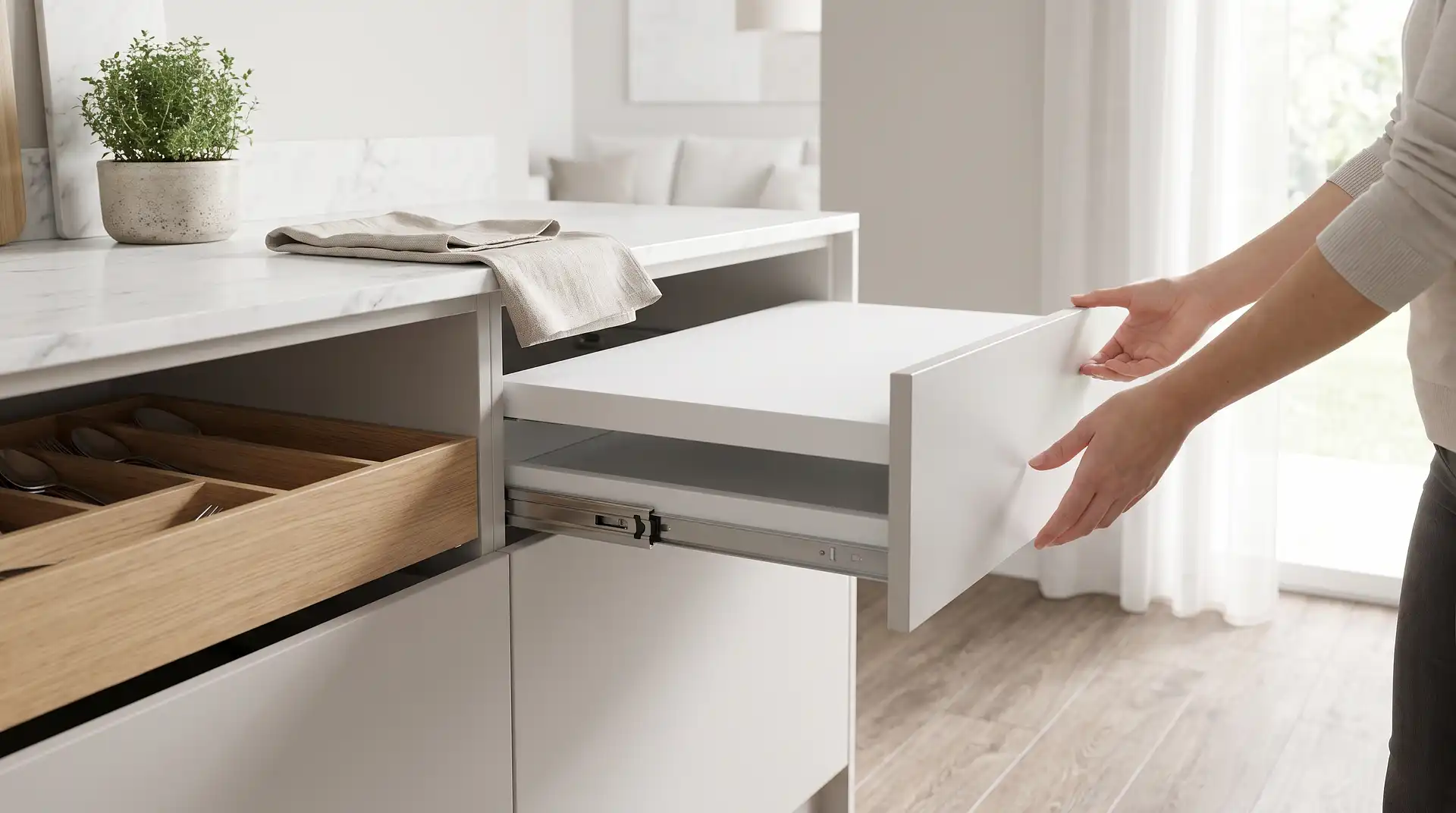
How to Remove a Wren Kitchen Drawer
3 September 2026
How to Remove a Wren Kitchen Drawer
Wren kitchen drawers use either Blum Tandem Plus or Hettich InnoTech soft-close drawer runner systems, both of which have a specific lever or clip release mechanism that must be operated before the drawer will slide free. Pulling the drawer straight out without releasing this mechanism either jams the drawer mid-travel or damages the runner clips, which makes refitting considerably more difficult.
The good news is that once you know where the release lever or clip is, the drawer comes out in about 10 seconds. The confusion comes from the fact that the release is not visible when the drawer is in the closed position and varies slightly between Blum and Hettich systems.
Identify Which Runner System Your Wren Kitchen Has
Open the drawer fully. Look at the runner on each side of the drawer box the metal rail that the drawer slides along. There are two common systems in Wren kitchens.
Blum Tandem Plus Blumotion: The runner is a robust grey or silver metal rail with a soft-close mechanism at the rear. The release is a small grey or white plastic lever located on the front of the runner, visible on the left and right sides when the drawer is fully open. On Blum systems the lever points downward when the drawer is engaged and flips upward to release.
Hettich InnoTech Atira: The runner has a similar profile but the release mechanism is a clip rather than a lever. A small orange or grey plastic clip sits on the front section of each runner when the drawer is engaged. Pressing the clip inward or downward (depending on the generation) disengages the drawer box from the cabinet runner.
If you are still unsure which system you have, look for the brand name embossed or printed on the runner body. Both Blum and Hettich mark their hardware.
Removing a Blum Tandem Drawer
Open the drawer fully to its maximum extension.
Locate the grey or white plastic release lever on the left runner, near the front of the drawer box where it sits over the cabinet rail.
Flip the lever upward (toward the top of the drawer) until it clicks into the release position.
Repeat on the right runner.
With both levers in the release position, tilt the front of the drawer upward slightly raise the front by approximately 15 to 20 degrees and slide the drawer forward and out.
The slight upward tilt at the front is the step most people miss. Blum runners require this tilt to disengage the rear of the drawer box from the runner. Pulling straight forward without the tilt jams the rear hook on the cabinet runner and feels as though the drawer is still locked.
If the drawer is a deep pan drawer or a heavy drawer with integrated bins, have a second person support the base of the drawer as it comes free. Wren deep drawers are heavier than they appear when fully loaded, and the release can be sudden.
Removing a Hettich InnoTech Drawer
Open the drawer fully.
Locate the orange or grey plastic clip on the left runner where the drawer box connects to the cabinet runner section.
Press the clip tab inward or downward depending on the specific generation older Hettich clips press inward toward the cabinet side, newer clips press downward.
Repeat on the right runner.
Lift the front of the drawer slightly and slide it forward and out.
On some Hettich systems a small screwdriver is helpful to press the clip if it is stiff or in an awkward position. Use a flat-head screwdriver applied to the clip tab gently rather than forcing the drawer.
What If the Drawer Will Not Release?
If the lever or clip is in the release position but the drawer will not come free, check two things.
First, confirm that both sides are released simultaneously. Releasing one side and then trying to pull the drawer forward while the other side is still engaged jams it at an angle. Release both sides before attempting to remove.
Second, check whether the drawer has a soft-close mechanism that is still engaged. Some Wren drawers have a secondary soft-close dampener at the rear of the cabinet that holds the drawer closed against the face frame. This is a spring-loaded mechanism that the drawer pushes past on the way in and that requires the drawer to be pulled firmly but not forced on the way out. If the drawer is released on both sides but still feels held, a firm steady pull rather than a jerk usually moves it past the dampener.
If the drawer genuinely will not move after both releases are confirmed, do not force it. A jammed drawer that is forced risks bending the runner or cracking the drawer box side. Contact Wren's customer service line or a local kitchen installer, as the runner may have a manufacturing fault or a runner clip that has broken internally.
Adjusting Wren Drawer Runners After Removal
Drawer removal is often the gateway to a runner adjustment that was the original reason for removing the drawer. Blum and Hettich runners both allow three-axis adjustment: height, side-to-side, and depth (how far the front face sits from the cabinet).
Height adjustment: A screw on the runner body near the front of the cabinet adjusts the drawer height. A cross-head screwdriver turned clockwise raises the drawer, anticlockwise lowers it. Adjust in small increments a quarter turn at a time and refit the drawer to check the gap at the top and bottom of the face before adjusting further.
Side-to-side adjustment: An eccentric cam near the front of the runner adjusts lateral position. Turn the cam with a flat-head screwdriver to move the drawer left or right to close any gap at the sides of the face relative to adjacent doors.
Depth adjustment: On Blum systems, a screw at the very front of the cabinet runner body adjusts how far forward the drawer face sits. This is less commonly needed but useful when a drawer front is slightly proud of or recessed behind the adjacent doors.
Write down the original position of each adjustment before changing anything. This is the fastest way to restore the original setting if an adjustment makes things worse.
Refitting the Drawer
Align the rear of the drawer box with the cabinet runners. The rear of the drawer box has two hooks or clips that engage with the rear section of the cabinet runners. Lower the rear slightly and slide the drawer back along the runners until the front clips or levers click back into the locked position.
Push the drawer fully closed and open it several times to confirm the soft-close mechanism engages correctly and the drawer runs smoothly from full open to full close without catching or rattling.
If the drawer face has come loose from the drawer box during removal or adjustment, Wren drawer fronts are typically attached by two or four screws through the interior face of the drawer box. These are adjusted with a cross-head screwdriver from inside the drawer, and the face can be repositioned before tightening.
Understanding how individual components of a Wren kitchen work is useful context when deciding whether any part of the kitchen is worth repairing or whether a broader refresh makes more sense. For a full 2026 UK cost breakdown of kitchen types from flat-pack through to high-end, including what Wren-tier rigid unit kitchens typically cost supplied and fitted, the InstantCost kitchen renovation cost guide has a calculator you can filter by spec and region before approaching any contractor.
If the drawer runner itself is worn or damaged and needs replacing, this is a straightforward parts job. Wren kitchens use standard Blum and Hettich components that are available separately from Blum and Hettich distributors, kitchen hardware suppliers, and online. Our related guide on how much a new kitchen costs in the UK covers when a kitchen is worth repairing versus replacing, which is the broader question that sometimes sits behind a drawer problem in a kitchen that is several years old.
Common Mistakes and What to Do Instead
Mistake: pulling the drawer straight out without releasing the lever or clip. Both Blum and Hettich systems require the release mechanism to be operated before the drawer will come free. Pulling without releasing jams the drawer or damages the runner clips.
Mistake: releasing one side only before pulling. Both sides must be released simultaneously before the drawer will come out. A single-side release causes the drawer to jam at an angle.
Mistake: not tilting the front of the drawer upward when removing a Blum drawer. Blum Tandem drawers require a slight upward tilt at the front to clear the rear hooks from the cabinet runner. Pulling straight forward without the tilt feels like the drawer is still locked.
Mistake: forcing a drawer that will not release. Forcing a jammed drawer bends the runner and can crack the drawer box side. Confirm both releases are operated and try a firm steady pull before concluding the drawer has a fault.
Mistake: adjusting runners without recording the original settings. Write down the original position of each adjustment screw before turning anything. A quarter-turn on the wrong screw can take several minutes of back-and-forth to recover.
Mistake: not checking the drawer face screws after refitting. If the drawer face was moved during removal, it may not be correctly aligned when refitted. Push the drawer closed and check the face alignment against adjacent drawers and doors before tightening the face screws.
What It Costs in the UK
Item | Typical UK cost (2026) |
|---|---|
Replacement Blum Tandem Plus runner (pair) | £25 to £60 |
Replacement Hettich InnoTech runner (pair) | £20 to £50 |
Blum drawer adjustment tool | £8 to £15 |
Kitchen installer call-out (1 hour) | £60 to £120 |
Drawer front replacement (Wren) | £20 to £80 depending on size and finish |
Wren Kitchens offers a 10-year guarantee on all cabinet and hardware components. Check whether the runner fault is covered under the guarantee before purchasing replacement parts.
Staying Safe
Drawer removal is a low-risk task. The main practical hazard is the weight of a deep or heavily loaded drawer that releases suddenly. Empty the drawer contents before removal to reduce weight and confirm you have a secure grip before the drawer comes free.
Do not place a removed drawer on a sloped or unstable surface. The box can slide and the exposed runner clips and drawer base corners are sharp.
If the drawer is in a high cabinet or a tall unit where you need to stand on a step to access the runner release, use a stable step stool with a non-slip surface rather than a kitchen chair.
Keep children away from the work area while runners are exposed. Drawer runner clips under spring tension can release unexpectedly and the exposed runner channel inside the cabinet has sharp edges.
Wren Kitchens' 10-year guarantee covers manufacturing defects in cabinet and hardware components. Runner failure that is not due to misuse or incorrect installation may be covered. Check the guarantee terms on the Wren Kitchens website or contact their customer service before replacing components at your own cost.
FAQ
How do you remove a Wren kitchen drawer? Open the drawer fully, locate the grey plastic release lever on each runner (Blum system) or the orange clip (Hettich system), release both sides simultaneously, then tilt the front of the drawer upward slightly and slide it forward and out. Both sides must be released before the drawer will come free.
Why will my Wren drawer not come out? The most common reasons are that only one runner release has been operated rather than both, or that the Blum system requires an upward tilt at the front that has not been applied. If both releases are confirmed and the drawer still will not move, do not force it contact Wren or a kitchen installer.
Do Wren kitchens use Blum runners? Most Wren kitchen drawers use either Blum Tandem Plus Blumotion or Hettich InnoTech Atira runners. Both are high-quality European soft-close systems. The brand is typically embossed on the runner body. The release mechanism differs between the two.
How do I adjust a Wren kitchen drawer that is not level? With the drawer removed, locate the height adjustment screw on the cabinet runner near the front. Turn clockwise to raise and anticlockwise to lower, in quarter-turn increments. Refit and check the gap at the top and bottom of the face before adjusting further.
Can I replace Wren drawer runners myself? Yes. Wren kitchens use standard Blum and Hettich components available from kitchen hardware suppliers. Measure the existing runner length before ordering and confirm the runner type from the brand marking. Replacement is a straightforward swap once the old runner is unscrewed from the cabinet side.
Does the Wren 10-year guarantee cover drawer runners? Wren's 10-year guarantee covers manufacturing defects in cabinet and hardware components including runners. Runner failure through normal use rather than misuse should be assessed against the guarantee terms before purchasing replacement parts.