How to Replace a Light Switch
28 July 2026
How to Replace a Light Switch (Safely, and Legally)
Replacing a light switch is one of the more approachable electrical jobs for a confident DIYer in the UK — a straightforward, like-for-like swap is generally considered non-notifiable work under Part P of the Building Regulations, meaning you don't need to inform Building Control to do it yourself. But "approachable" doesn't mean "risk-free": the wiring is still live until you isolate it properly, and getting the isolation and testing steps wrong is where DIY electrical work actually becomes dangerous, not the switch-swapping itself.
Is This a DIY Job or Not?
A like-for-like light switch replacement — same number of gangs, same basic function, no new wiring or circuit changes — is generally fine for a competent DIYer to carry out in England, and doesn't require Building Control notification under Part P. However, if you're adding a new switch where none existed, changing the circuit in any way, or the work is in a bathroom's zoned area near water, that shifts into notifiable territory or, in the case of bathroom electrics specifically, work that should go to a qualified electrician given the added water-related risk. If in doubt about whether your specific job counts as notifiable, a quick check with a registered electrician or your local Building Control department resolves it before you start.
What You Need
A voltage tester (a proper one, not just a cheap plug-in "socket tester") — used to confirm the circuit is genuinely dead before you touch any wiring, not just to see if the light works.
A screwdriver set, appropriate for your specific switch plate fixings.
The new switch, matching the number of gangs (single, double, etc.) and switch type of the one you're replacing.
A torch or portable light, since you'll have switched the relevant circuit off.
Insulating tape, for securing any exposed wire ends if needed during the process.
Step 1: Turn Off the Power at the Consumer Unit
Locate your consumer unit (fuse box) and switch off the specific circuit breaker for the lighting circuit you're working on — if you're not certain which breaker controls that specific switch, it's safer to turn off the main switch for the whole consumer unit while you work, rather than guess.
Step 2: Test That the Circuit Is Actually Dead
This is the step that genuinely matters for safety, and it's the one most commonly skipped by confident DIYers who assume flipping the breaker is enough. Use a proper voltage tester on the switch terminals themselves once you've removed the switch plate, confirming there's no live current present, rather than relying solely on the breaker being switched off. Breakers can be mislabelled, and older consumer units in particular aren't always wired exactly as their labels suggest.
Step 3: Remove the Old Switch Plate
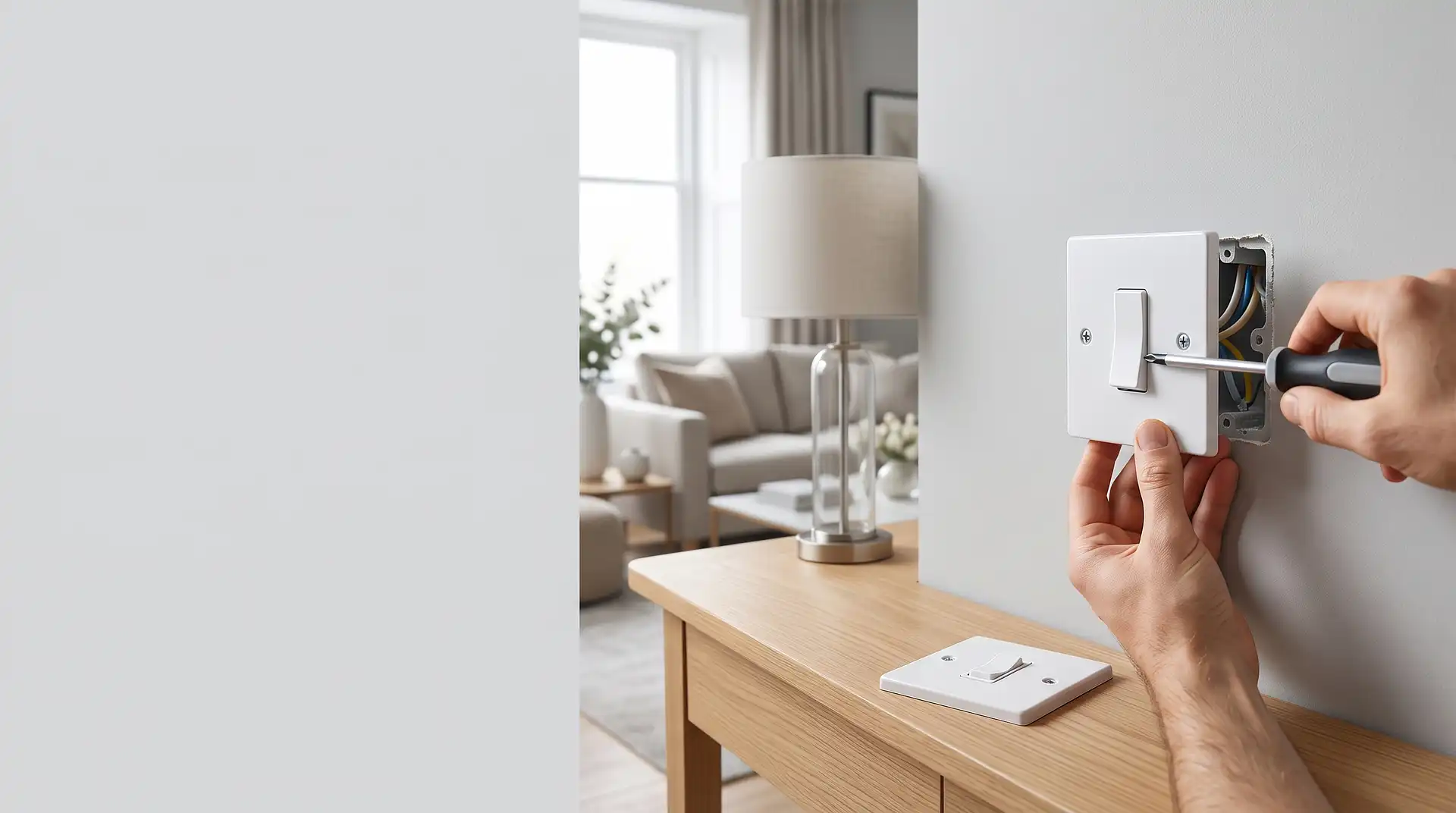
Unscrew the switch plate from the wall box, gently pulling it forward to reveal the wiring behind. Take a photo of the existing wiring configuration before disconnecting anything — this is genuinely useful as a reference, particularly if the new switch's terminals aren't laid out identically to the old one.
Step 4: Note the Wiring Configuration
UK light switch wiring typically involves a small number of conductors — commonly a permanent live feed and a switched live wire, sometimes with a neutral present depending on your specific setup and switch type (this varies more than people expect, particularly with certain smart switches that need a neutral where a standard mechanical switch might not). If anything about your existing wiring looks different from what your new switch's instructions describe, that's worth pausing on and checking rather than guessing at the connection.
Step 5: Disconnect and Reconnect to the New Switch
Loosen the terminal screws on the old switch and disconnect the wires, then connect them to the corresponding terminals on the new switch, following your reference photo and the new switch's own wiring diagram. Ensure each terminal screw is tightened securely — a loose connection is a common cause of a switch that works intermittently or, worse, overheats at the connection point.
Step 6: Fit the New Switch Plate
Carefully push the wiring back into the wall box, avoiding any sharp folds, and screw the new switch plate into place, checking it sits flush and level against the wall.
Step 7: Restore Power and Test
Turn the circuit breaker (or main switch) back on and test the new switch. It should operate smoothly and control the light as expected, with no flickering, buzzing, or warmth at the switch plate once it's been on for a few minutes.
Common Mistakes and What to Do Instead
Mistake: relying on the breaker alone without testing for dead. A mislabelled circuit or an older consumer unit can mean the circuit you think you've switched off isn't actually the one supplying the switch you're working on. Always test with a proper voltage tester before touching bare wiring.
Mistake: not photographing the original wiring before disconnecting. This is a simple step that avoids genuine confusion later, particularly if your new switch's terminal layout differs even slightly from the old one.
Mistake: assuming all light switches wire up identically. Some switch types, particularly certain smart or dimmer switches, need a neutral wire present where a standard switch doesn't. Check your new switch's specific wiring requirements against what's actually present in your wall box before assuming compatibility.
Mistake: leaving terminal screws loose. A loose connection is a common cause of switches that work intermittently, and in more serious cases can lead to overheating at the connection point. Always confirm each terminal is properly tightened.
Mistake: doing this in a bathroom's zoned area without professional help. Electrical work near water carries meaningfully higher risk, and bathroom electrical zones have specific regulations. This is a case where hiring a qualified electrician is the sensible choice rather than a DIY attempt.
When to Call an Electrician Instead
If you're not confident with any step of the isolation and testing process, if the job involves anything beyond a simple like-for-like swap (adding a switch, altering the circuit, installing a smart switch that needs a neutral your current wiring doesn't have), if the work is in a bathroom or any area near water, or if you find anything unexpected once you open up the switch plate — unusual wiring, signs of scorching, or wiring that doesn't match any standard configuration you recognise — it's a reasonable and sensible point to call a qualified, ideally NICEIC or similar registered, electrician rather than continue.
What It Costs in the UK
If you'd rather not do it yourself, or the job falls into notifiable or higher-risk territory, hiring an electrician for a straightforward light switch repair or replacement typically costs around £85 in the UK as a fixed-fee job, generally falling within the £63–£200 range most simple electrical jobs sit in. If charged hourly instead, UK electricians typically charge £40–£75 an hour, with a commonly cited average around £50, and Birmingham often cited as one of the cheapest UK cities at around £20 an hour, against London rates that can reach £75 or more.
For larger jobs charged by the day rather than the hour, UK day rates typically run £200–£400 for a standard 8-hour day, with some regional variation. Emergency or urgent call-outs typically cost more, often £80–£100 an hour, reflecting the same-day or out-of-hours nature of the work. London and the South East generally run 15–20% above the rest of the UK across all electrical work.
Service | Typical UK Cost (2026) |
|---|---|
Light switch repair/replacement (fixed fee) | ~£85 (range £63–£200) |
Electrician hourly rate | £40–£75 (avg. ~£50) |
Electrician day rate | £200–£400 |
Emergency/urgent call-out | £80–£100/hour |
Light fitting install/repair (comparable job) | ~£42/hour or fixed equivalent |
These are UK market estimates and vary by region, job complexity, and provider — London and the South East typically run 15–20% higher than the rest of the UK. Always confirm whether a quote includes materials (the switch itself) or labour only.
Staying Safe
Never work on a light switch, or any electrical fitting, without first isolating the power at the consumer unit and testing that the circuit is genuinely dead with a proper voltage tester — this is the one step in this whole process that isn't optional or worth rushing, regardless of how straightforward the rest of the job seems. If you have any doubt about which breaker controls the circuit you're working on, switch off the main supply at the consumer unit while you work rather than guessing.
If children are in the home, keep them away from the work area while the switch plate is off and wiring is exposed, and never leave a switch partially disconnected and accessible, even briefly, without either finishing the job or properly making the circuit safe first.
Part P notification requirements and what counts as notifiable work can be updated, and specific rules for Scotland, Wales, and Northern Ireland differ from England, so it's worth checking current guidance (e.g. via GOV.UK) or asking a registered electrician if you're at all unsure whether your specific job needs notifying.
FAQ
Do I need an electrician to replace a light switch? Not necessarily, for a straightforward like-for-like swap — this is generally considered non-notifiable DIY work in England under Part P. However, work in a bathroom, adding new switches, or anything beyond a simple swap is worth having a qualified electrician handle.
How do I know if the power is really off before I start? Switch off the relevant circuit breaker (or the main switch if unsure which breaker it is), then use a proper voltage tester directly on the switch terminals to confirm there's no live current, rather than relying on the breaker alone.
Can I replace a standard switch with a smart switch myself? Sometimes, but check first — many smart switches need a neutral wire present at the switch, which standard UK wiring doesn't always include. Confirm your existing wiring is compatible before buying a smart switch.
Is it legal to replace a light switch myself in the UK? Yes, for a straightforward like-for-like replacement in most of England, this is non-notifiable work under Part P. Rules can differ slightly for Scotland, Wales, and Northern Ireland, and bathroom electrical work has its own specific considerations.
How much does it cost to have an electrician replace a light switch? A straightforward light switch repair or replacement typically costs around £85 as a fixed fee in the UK, or £40–£75 an hour if charged hourly, with most simple electrical jobs falling in the £63–£200 range overall.
What should I do if I find unusual or damaged wiring when I open the switch plate? Stop and call a qualified electrician rather than continuing. Signs of scorching, unusual wiring configurations, or anything that doesn't match a standard setup are worth a professional assessment before proceeding.