How to Switch Off a Radiator
26 July 2026
How to Switch Off a Radiator (And When You Shouldn't)
Switching off a single radiator is simple, but there's a meaningful difference between turning it down, turning it fully off temporarily, and shutting it off completely for an extended period and the third option carries a real risk in cold weather that the first two don't. Getting this distinction right matters more in winter than most people realise, since a radiator fully isolated in an unheated room is genuinely at risk of frozen pipework if the room drops low enough.
The Two Valves on Every Radiator
Every standard radiator has two valves: the control valve (often a thermostatic radiator valve, or TRV) at one end, which you adjust for everyday temperature control, and the lockshield valve at the other end, usually under a plastic cap, which is set once during system balancing and not meant for regular adjustment. Turning the control valve down or to its "off" setting reduces flow to that radiator without fully isolating it from the system. Closing both the control valve and the lockshield fully isolates the radiator completely.
Turning a Radiator Down or Off for Everyday Use
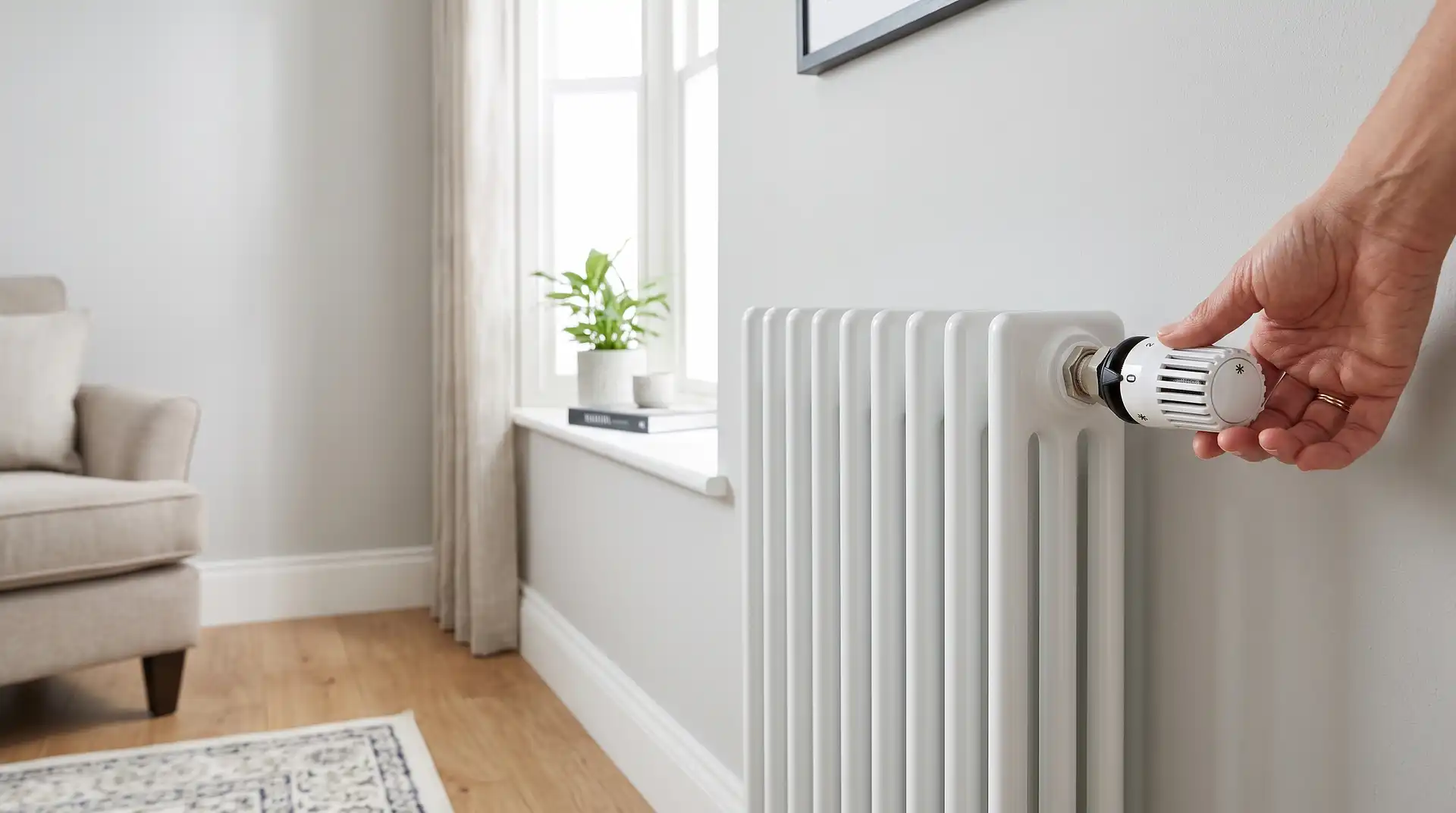
For day-to-day control — a room you're not using much, or one you want cooler than the rest of the house — turning the TRV to its lowest setting (often marked "0" or with a snowflake symbol, sometimes labelled "off") is all that's needed. This reduces flow significantly without isolating the radiator or the pipework running to it from the rest of the system, which means there's no meaningful frost risk from doing this, since some residual warmth and circulation typically remains in the system reaching that room.
Fully Isolating a Radiator (For Removal, Repair, or Redecorating)
If you're removing a radiator, replacing a valve, or need it completely isolated for another reason, close both the control valve and the lockshield valve fully. Turn the control valve to its lowest or "off" position first, then use a radiator key or spanner to close the lockshield valve, turning clockwise until it stops. Both closed together fully isolates that radiator from the rest of the heating system, which is necessary for tasks like removing the radiator or draining it, but this isn't intended as a long-term everyday setting.
Why You Shouldn't Fully Isolate a Radiator Long-Term in Winter
A radiator and its pipework that's fully isolated from the heating system has no water movement and no residual warmth reaching it from elsewhere in the system. In a genuinely cold room — an unheated spare room or outbuilding, for instance — water sitting static in isolated pipework or the radiator itself can freeze in sustained low temperatures, and frozen water expanding inside pipework or a radiator is a common cause of cracks and subsequent leaks once it thaws. This is the main reason turning a TRV down to a low setting, rather than fully isolating both valves, is generally the safer long-term choice for a room you simply want cooler through winter, reserving full isolation for situations where the radiator genuinely needs to be disconnected for work.
Step-by-Step: Turning Down for Everyday Use
Locate the TRV, usually on the pipe at one end of the radiator, often with a numbered dial or a temperature symbol.
Turn it down to your desired setting, or to its lowest marked position if you want minimal heat in that room without fully isolating it.
Check the radiator after 20–30 minutes — it should be noticeably cooler than radiators left on a normal setting, without being stone cold if the TRV is at its lowest rather than a genuine off position on some models.
Step-by-Step: Fully Isolating for Removal or Repair
Turn the heating off and let the radiator cool fully.
Turn the control valve (TRV) to its lowest or off position.
Locate the lockshield valve at the opposite end, usually under a removable plastic cap.
Using a radiator key or an adjustable spanner, turn the lockshield clockwise until it stops, noting the number of turns if you'll need to return it to the same balanced position afterward.
Confirm isolation by opening the bleed valve briefly — minimal to no water or pressure release confirms the radiator is properly isolated from the system.
Common Mistakes and What to Do Instead
Mistake: fully isolating a radiator in a cold room for the whole winter to save money. This creates a genuine frost risk to static water in the pipework and radiator. Turning the TRV down to a low setting, rather than fully closing both valves, achieves most of the energy saving without that risk.
Mistake: not noting the lockshield's original position before closing it. If a radiator was previously balanced against the rest of the system, closing the lockshield without recording how many turns it took to close means you'll need to rebalance rather than simply return it to the same setting afterward.
Mistake: assuming a TRV at "0" fully isolates the radiator. On most systems it doesn't — it significantly reduces flow but the radiator and its pipework aren't fully disconnected from the system the way closing both valves achieves. This is actually the safer setting for winter, but it's worth understanding it isn't the same as full isolation.
Mistake: forcing a stiff or seized lockshield valve. Lockshields that haven't been touched in years can seize slightly. Forcing it can damage the valve or the pipe connection. If it won't turn with reasonable effort, it's worth calling a heating engineer rather than risking damage.
Mistake: switching off radiators in rooms with sensitive contents without considering condensation. An unheated room can develop condensation issues, particularly if it's adjacent to consistently heated rooms, which is worth factoring in alongside the frost risk when deciding whether to switch a radiator off long-term rather than just turning it down.
When to Call a Heating Engineer Instead
If a TRV or lockshield valve is seized and won't turn safely, if you're isolating a radiator because it's leaking or damaged rather than for routine work, or if you're not confident distinguishing the control valve from the lockshield on your specific system, it's worth calling a heating engineer rather than forcing anything. A stuck or seized valve is a comparatively small, cheap fix when addressed properly, and a much bigger one if forced and damaged in the process.
What It Costs in the UK
Turning a radiator down or fully isolating it for DIY purposes costs nothing beyond a radiator key, typically £3–£10 if you don't already own one. If a valve is seized or needs replacing, thermostatic radiator valves typically cost £15–£30 for the part alone, with supply-and-fit pricing (including labour) commonly £70–£140 per valve, and general valve replacement including a standard lockshield typically running £50–£150 per radiator depending on the valve type and how straightforward the job is.
If a radiator needs replacing entirely rather than just its valve — because it's damaged, corroded, or simply not performing well even after bleeding and balancing — a standard like-for-like replacement typically costs £150–£350 including the new radiator, labour, and valves, with designer or vertical radiators running higher, often £350–£900+. For context on the wider heating system, if valve or radiator issues are recurring across an older setup and a broader upgrade is being considered, current 2026 UK data puts the average installed cost of a new boiler at around £2,400, with the full realistic range spanning roughly £1,800–£3,500 for a straightforward like-for-like swap.
Item/Service | Typical UK Cost (2026) |
|---|---|
Radiator key | £3–£10 |
TRV (part only) | £15–£30 |
TRV, supply and fit | £70–£140 per valve |
Valve replacement (incl. lockshield) | £50–£150 per radiator |
Radiator replacement (like-for-like) | £150–£350 |
Designer/vertical radiator replacement | £350–£900+ |
New boiler, average installed cost (wider context) | ~£2,400 (range £1,800–£3,500) |
These are UK market estimates and vary by provider, valve type, and region — a seized valve is generally a small, worthwhile fix rather than something to force, since forcing it risks turning a cheap repair into a bigger one.
Staying Safe
Never force a valve that feels genuinely stuck rather than just a little stiff — this risks damaging the valve or the pipe connection, turning a small job into a bigger repair. If you're fully isolating a radiator in a room that will stay cold through winter, be aware of the frost risk to static water in the pipework, and consider whether turning the TRV down to a low setting, rather than full isolation, is the safer choice for that specific room.
If children are in the home, keep radiator keys and any tools used for valve adjustment out of easy reach when not in use, and make sure any radiator being worked on has fully cooled before handling.
Valve types and system configurations vary between properties, so it's worth checking your system's documentation if anything looks non-standard, and consulting a heating engineer if you're ever unsure which valve does what on your specific radiators.
FAQ
What's the difference between turning a radiator down and switching it off completely? Turning the TRV down (even to its lowest setting) reduces flow without isolating the radiator from the system. Fully switching it off means closing both the control valve and the lockshield valve, completely disconnecting that radiator from the rest of the heating system.
Is it safe to fully switch off a radiator for the whole winter? It carries a frost risk if the room gets cold enough for static water in the isolated pipework to freeze. Turning the TRV down to a low setting, rather than fully isolating both valves, is generally the safer long-term option for a room you want cooler.
How do I fully isolate a radiator to remove it? Turn the control valve (TRV) to its lowest or off position, then close the lockshield valve at the other end fully using a radiator key or spanner, turning clockwise until it stops.
Why won't my radiator's lockshield valve turn? It may have seized slightly if it hasn't been adjusted in years. Don't force it — a heating engineer can address a seized valve safely, whereas forcing it risks damaging the valve or pipe connection.
How much does it cost to replace a radiator valve in the UK? A thermostatic radiator valve typically costs £70–£140 supply and fit, with general valve replacement including a lockshield running £50–£150 per radiator, depending on valve type and job complexity.
Should I switch off radiators in rooms I don't use to save money? Turning the TRV down to a low setting is a reasonable way to save energy in an unused room without the frost risk that comes with fully isolating the radiator for an extended period.