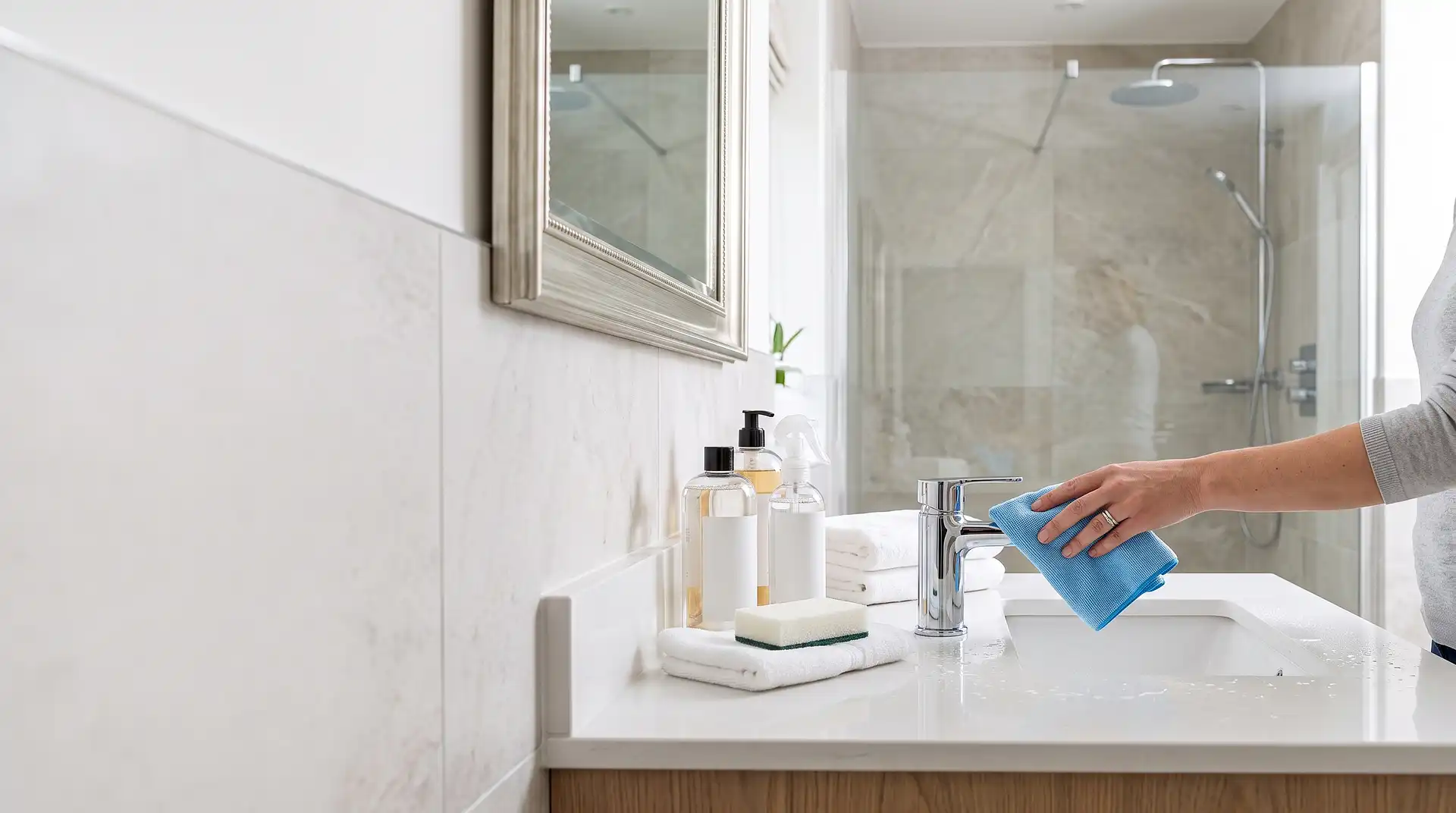
How to Wash the Bathroom
22 July 2026
How to Wash the Bathroom (A Routine That Actually Holds)
Washing a bathroom regularly is a different job from deep cleaning one — it's maintenance, not restoration, and treating it that way is what keeps it quick. A bathroom washed properly once a week rarely needs more than 20–30 minutes; the same bathroom left for a month needs a genuine deep clean instead, because limescale, soap scum, and mould all get harder to remove the longer they're left. The routine wash exists specifically to stop that build-up from ever reaching the point where it needs stronger products and real effort.
The Order That Makes It Quick
Work from the areas that dry fastest and get least dirty to the ones that need more time, finishing with the floor last so nothing drips onto it afterward. A sensible order: mirror and glass surfaces first, then sink and taps, then bath or shower, then toilet, then floor. This isn't an arbitrary sequence — it means you're never re-cleaning something you've already finished, and the toilet (the highest bacteria risk) is cleaned with its own cloth, kept separate from everything else.
Step 1: Clear and Spray
Move bottles and clutter off surfaces so nothing gets missed, and spray your bathroom cleaner or a mild limescale remover onto taps, the sink, and the shower screen or bath surround before you start wiping anything. Giving it even a couple of minutes to sit while you deal with the mirror means you're not scrubbing dry residue by the time you get to it.
Step 2: Mirror and Glass
Wipe the mirror with a glass cleaner or a vinegar-water solution and a lint-free cloth, working top to bottom to avoid streaking. Do this early, since anything splashed onto the mirror later in the routine — from the sink or shower — undoes it if it's done last.
Step 3: Sink and Taps
Wipe the basin, then focus on the taps specifically, where limescale builds fastest — a quick scrub with an old toothbrush around the base and any visible mineral buildup makes a bigger visible difference than most other single tasks in the routine. Don't skip the overflow hole; it's a common, easy-to-miss source of sink odour.
Step 4: Bath or Shower
Wipe down the bath or shower tray and the screen or curtain, using a squeegee on glass if you have one, since it takes seconds and prevents the limescale that a normal weekly wipe alone doesn't fully stop. A quick pass over the grout with a stiff brush, even without a dedicated grout cleaner, keeps it from building up between the times it gets a proper treatment.
Step 5: Toilet
Use a dedicated toilet brush and cleaner, scrubbing under the rim where most people don't look, then wipe the seat, lid, and outer surfaces with a cloth kept separate from anything used elsewhere in the bathroom. Finish by wiping the base and the floor immediately around it, which is one of the most commonly skipped spots in a quick clean.
Step 6: Floor
Vacuum or sweep, then mop last, working from the far corner of the room back toward the door so you're not walking back across a floor you've just finished.
Common Mistakes and What to Do Instead
Mistake: cleaning the floor before other surfaces. Anything wiped or splashed after the floor is done risks landing on it. Floors go last in every bathroom wash, without exception.
Mistake: using the same cloth on the toilet and everywhere else. This is a straightforward way to spread bacteria around the room. Keep a separate cloth or use disposable wipes specifically for the toilet.
Mistake: spraying and wiping limescale remover immediately. Even a light routine wash benefits from letting a limescale product sit for a couple of minutes rather than wiping it straight off, since that's what actually gives it time to work rather than just spreading residue.
Mistake: skipping the squeegee on shower glass. It takes seconds and is the single easiest way to stop limescale building up between washes, which is otherwise one of the main reasons a "quick" weekly wash still leaves visible buildup over time.
Mistake: letting the routine wash slide for "just one more week." A bathroom skipped for a few weeks doesn't need a slightly longer wash — it typically needs an actual deep clean, with dwell times and stronger products, because grime that's had weeks to set is a different job from grime that's a few days old.
Why Keeping On Top of This Matters Beyond Hygiene
A bathroom washed regularly isn't just more pleasant to use — it protects the bathroom itself. Limescale left unaddressed for years can permanently etch tiles, taps, and shower screens. Mould left untreated in grout and sealant can spread into the substrate behind tiles, and in the worst cases contributes to the kind of damp and deterioration that turns a cosmetic refresh into a genuine renovation. According to InstantCost.co.uk's 2026 UK pricing data, even a basic like-for-like bathroom refit typically costs £3,500–£5,500, rising to £5,500–£8,500 for the mid-range renovation most UK households end up needing, and considerably more if damaged tiling, rotten flooring from long-term water ingress, or failed sealant means the work goes beyond a simple refresh. A regular wash costing nothing but 20–30 minutes a week is a genuinely small investment set against that.
What It Costs in the UK
Washing your own bathroom regularly costs almost nothing beyond basic cleaning products — a bathroom cleaner, limescale remover, and toilet cleaner together typically run £10–£20 and last for weeks of regular use. If you outsource routine cleaning, a standard clean is generally priced by the hour, typically £15–£25, with a bathroom usually taking a portion of a broader visit rather than being booked as a standalone routine wash. A full professional deep clean — needed if a bathroom has been neglected for a while rather than washed regularly — typically adds £40–£90 to a broader cleaning visit, reflecting the extra time needed for the descaling and disinfecting a routine wash would otherwise have prevented from building up.
Set against renovation costs, the gap is stark: InstantCost.co.uk's 2026 data puts a full mid-range bathroom renovation at £5,500–£8,500, and even a small cloakroom refresh at £1,800–£3,000. A consistent weekly wash, costing a few pounds in products and half an hour of time, is one of the more effective ways to delay ever needing that renovation for reasons of neglect rather than simply wanting an update.
Item/Service | Typical UK Cost (2026) |
|---|---|
Weekly wash (DIY products) | £10–£20 total, lasts weeks |
Professional standard clean (hourly, bathroom as part of visit) | £15–£25/hour |
Professional deep clean add-on (neglected bathroom) | £40–£90 |
Small cloakroom renovation (if neglect causes damage) | £1,800–£3,000 |
Mid-range bathroom renovation | £5,500–£8,500 |
Renovation figures are from InstantCost.co.uk's 2026 UK pricing data; cleaning figures are UK market estimates and vary by provider and region.
Staying Safe
A regular bathroom wash still involves the same chemical rules as a deep clean — never mix bleach with limescale remover or any acidic product, since the combination can release toxic gas, and bathrooms are typically small, less ventilated spaces where this matters more than elsewhere in the house. Keep the door open or extractor fan running while using any stronger product.
Store all bathroom cleaning products in a locked cupboard or one with a child safety catch, since bathroom cabinets are usually within easy reach for a child, and keep everything in its original labelled container rather than a decanted, unlabelled spray bottle.
Chemical safety guidance can vary by product and change over time, so it's worth checking current advice (e.g. HSE.gov.uk) for any household regularly using bathroom cleaning chemicals, especially with children present.
FAQ
How often should I wash my bathroom? Weekly for most households. A consistent weekly wash takes 20–30 minutes and prevents the buildup that turns into a much longer job, or eventually a deep clean, if left for weeks at a time.
What order should I clean a bathroom in? Mirror and glass first, then sink and taps, then bath or shower, then toilet, then floor last — this order avoids re-cleaning anything and keeps the highest-bacteria task (the toilet) contained to its own cloth.
Can neglecting bathroom cleaning actually damage the bathroom itself? Yes. Long-term limescale can etch tiles and fixtures permanently, and untreated mould can spread into grout and the substrate behind tiles, in serious cases contributing to damp and damage that turns a simple refresh into a full renovation.
How much does it cost to keep a bathroom clean weekly versus paying for a deep clean later? Weekly DIY washing costs £10–£20 in products for weeks of use. A neglected bathroom needing a professional deep clean typically costs £40–£90 as an add-on to a cleaning visit — a small cost, but avoidable with regular washing.
Is it safe to use bleach and limescale remover together for a stronger clean? No. Mixing bleach with limescale remover or other acidic products can release toxic gas. Always rinse one product fully before applying another.
How much does a full bathroom renovation cost if neglect leads to real damage? According to 2026 UK pricing data, a mid-range bathroom renovation typically costs £5,500–£8,500, with even a small cloakroom refresh starting around £1,800–£3,000 — a renovation is a substantially bigger cost than the maintenance that helps avoid needing one for damage-related reasons.