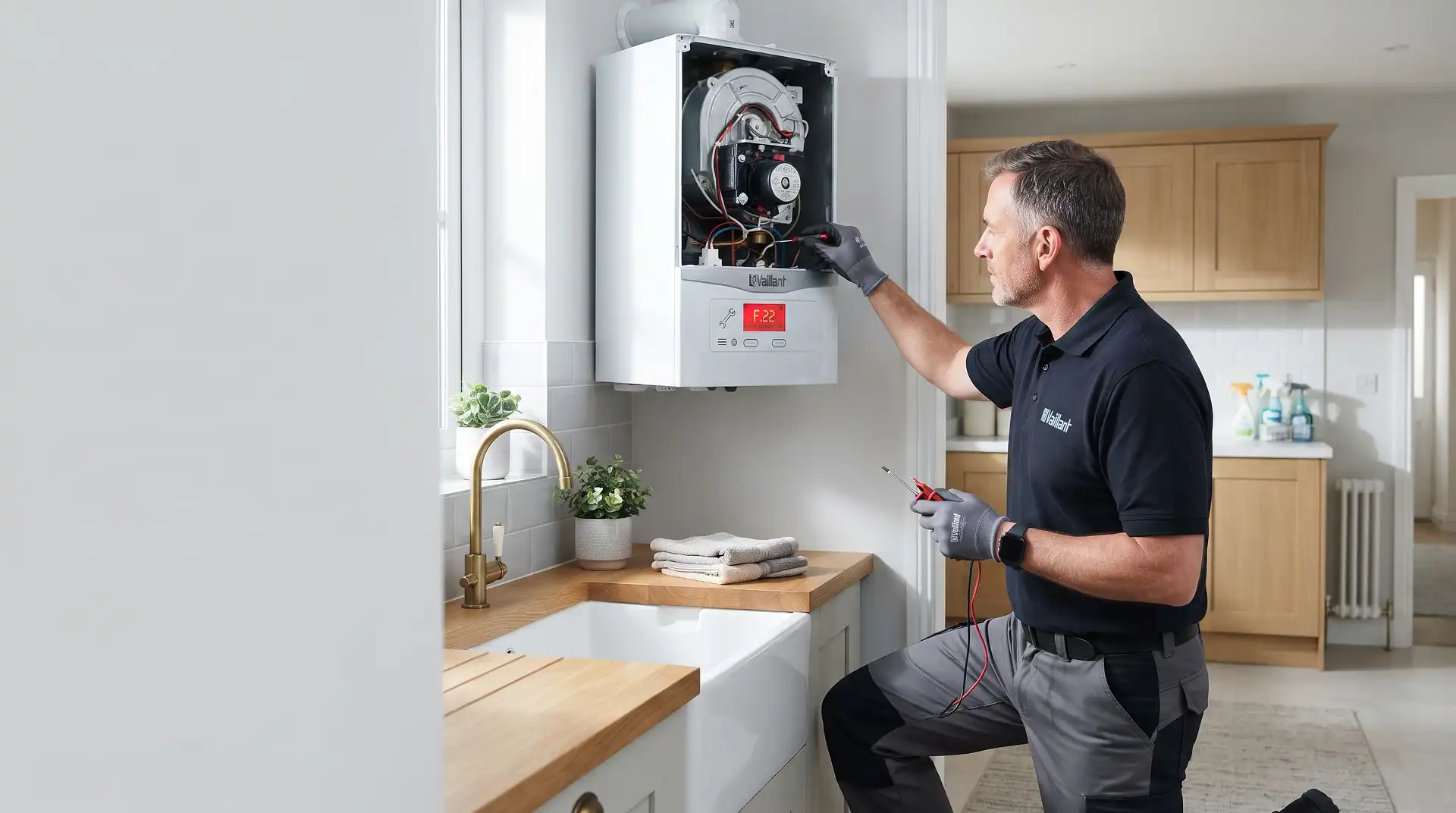
Vaillant Boiler F22 Error: What It Means and How to Fix It
16 September 2026
Vaillant Boiler F22 Error: What It Means and How to Fix It
An F22 fault code on a Vaillant boiler means the system pressure has dropped too low for the boiler to operate safely, so it's shut down as a protective measure rather than running with insufficient water circulating through the heat exchanger and radiators. Most Vaillant boilers expect a pressure between 1.0 and 1.5 bar when the system is cold, and F22 typically triggers once pressure falls to somewhere around 0.3 to 0.6 bar, depending on the specific model.
The fix in the vast majority of cases is straightforward: top the pressure back up using the filling loop. What actually matters is what you do afterward. A single F22 that clears after topping up and doesn't return is usually nothing to worry about. An F22 that keeps coming back within days or weeks points to a genuine leak or a faulty component somewhere in the system, and repeatedly topping up pressure without finding that cause just delays a proper fix.
Step 1: Check the Pressure Gauge
Locate your boiler's pressure gauge, either a physical dial or a digital display depending on your specific model, and confirm the reading is genuinely low, generally below 1.0 bar and often well below that when F22 has actually triggered. This confirms the fault code matches what the gauge is showing before you take any action.
Step 2: Locate the Filling Loop
The filling loop is a flexible braided hose, either permanently attached beneath the boiler or a separate hose you connect between two valves, depending on your Vaillant model. Check your specific boiler's manual for its exact location and type, since Vaillant uses slightly different filling loop arrangements across its range.
Step 3: Top Up the Pressure
Ensure both ends of the filling loop are properly connected if using a detachable hose.
Open the valves slowly, listening for water flowing into the system and watching the pressure gauge rise.
Stop once the gauge reaches the normal range, typically 1.0 to 1.5 bar, closing the valves promptly to avoid overfilling.
Disconnect the filling loop if it's a detachable type, since leaving it connected on some models can itself cause a fault or a slow pressure rise over time.
Step 4: Reset the Boiler
Once pressure is restored to the normal range, most Vaillant boilers need a manual reset to clear the F22 code and resume normal operation. Check your specific model's manual for the reset button location and method, since this varies across the Vaillant range.
Step 5: Monitor Over the Following Days
Check the pressure gauge daily for the next week or so after topping up. A system that holds steady confirms the original drop was likely a one-off, perhaps from bleeding a radiator recently or a very minor, self-sealing air release. A system that drops back down again within days indicates an ongoing leak or component fault that needs proper investigation.
A Note on What Causes Recurring F22 Faults
The most common cause of a genuinely recurring F22 is a small leak somewhere in the heating system, radiators, pipework, or valve joints, that isn't necessarily visible as a puddle but is gradually losing water over time. A faulty pressure relief valve, a failing expansion vessel, or occasionally a fault with the pressure sensor itself can also cause repeated low-pressure readings even without an active leak. Distinguishing between these causes generally needs a Gas Safe registered engineer's diagnosis rather than repeated home top-ups.
A Note on Recently Bled Radiators
If you've recently bled one or more radiators to clear trapped air, a drop in system pressure afterward is expected and normal, since releasing air from the system also releases a small amount of water. A single F22 following radiator bleeding, resolved with one top-up that then holds steady, isn't cause for concern.
When to Call a Professional
If F22 recurs within days or weeks of topping up, if you notice any visible sign of a leak, damp patches near radiators or pipework, or a puddle near the boiler itself, or if the boiler won't clear the fault even after a proper top-up and reset, contact a Gas Safe registered engineer. Continuing to top up a system that's actively losing pressure without addressing the cause risks introducing more dissolved oxygen into the system over time, which can accelerate internal corrosion.
Use InstantCost's heating system cost calculator to see what a boiler service or leak investigation would cost in your area. If you're not sure how to locate or use your specific filling loop, how to increase boiler pressure covers the general process across boiler brands in more detail.
Common Mistakes and What to Do Instead
Mistake: Repeatedly topping up pressure without investigating a recurring fault. If F22 keeps returning, the underlying cause needs finding and fixing, not masking with regular top-ups. Call a Gas Safe engineer once a pattern of recurrence is clear.
Mistake: Overfilling the system when topping up. Adding too much water pushes pressure above the normal range, which can trigger a different fault or cause the pressure relief valve to discharge. Stop as soon as the gauge reaches the normal range stated in your manual.
Mistake: Leaving a detachable filling loop connected after use. Some Vaillant models can develop a fault or a slow pressure creep if the filling loop isn't properly disconnected after topping up. Always disconnect it fully once you've finished.
Mistake: Assuming F22 always means the same thing regardless of pattern. A single, resolved F22 after bleeding a radiator is very different from a fault that returns every few days. Judge the situation based on whether it recurs, not just on the fault code appearing once.
Mistake: Ignoring visible signs of a leak because the boiler itself seems fine after topping up. A damp patch near a radiator or valve is worth investigating immediately, even if the boiler has cleared the fault temporarily. Small leaks get worse, not better, if left unaddressed.
Mistake: Not checking your specific model's manual for filling loop type and location. Vaillant uses different filling loop arrangements across its range, and following generic instructions for a different model type can lead to confusion or an incomplete top-up. Always check your own boiler's manual.
What It Costs in the UK
Item or Service | Typical UK Cost (2026) |
|---|---|
DIY pressure top-up | £0 (no parts needed on most systems) |
Gas Safe engineer call-out (fault diagnosis) | £80–£150 |
Leak detection and repair (minor) | £100–£250 |
Pressure relief valve replacement | £80–£180 |
Expansion vessel replacement | £150–£350 |
Full boiler service | £70–£120 |
Figures based on InstantCost.co.uk's 2026 UK heating system pricing data and vary by region, fault complexity, and provider.
Staying Safe
Only work on the filling loop when the boiler is cold or has been off for a reasonable period, since a hot system under pressure can release scalding water if a connection isn't secure. Follow your manual's specific instructions for your model rather than assuming a generic process applies exactly, since filling loop types and reset procedures do vary across the Vaillant range.
If you smell gas at any point, or suspect the fault relates to anything beyond water pressure, such as a burning smell or unusual noise from the boiler, stop and contact a Gas Safe registered engineer immediately rather than continuing to investigate yourself.
Gas Safe Register maintains the official list of legally registered gas engineers in the UK. Any suspected gas-related fault, as opposed to a straightforward pressure issue, should be referred to a Gas Safe registered engineer without delay.
Frequently Asked Questions
Can I fix a Vaillant F22 error myself? Yes, in most cases. Topping up the pressure using the filling loop and resetting the boiler resolves a one-off F22 fault. If the fault keeps returning, the underlying cause needs a Gas Safe engineer to diagnose.
What pressure should my Vaillant boiler be at? Most Vaillant boilers operate normally between 1.0 and 1.5 bar when the system is cold. Check your specific model's manual, since the exact recommended range can vary slightly.
Why does my Vaillant boiler keep showing F22 after I've topped it up? A recurring F22 usually points to a leak somewhere in the system, radiators, pipework, or valve joints, or occasionally a faulty pressure relief valve, expansion vessel, or pressure sensor. This needs a Gas Safe engineer to properly diagnose rather than repeated home top-ups.
Is F22 the same as low boiler pressure on other brands? The underlying issue, low system pressure, is common across most boiler brands, though the specific fault code differs. Worcester Bosch boilers, for example, typically display a different code for the same underlying low-pressure condition.
Does bleeding a radiator cause an F22 fault? It can, since releasing trapped air from a radiator also releases a small amount of water, which can drop system pressure enough to trigger F22. A single occurrence following radiator bleeding, resolved with one top-up, generally isn't a concern.
How urgent is it to fix a recurring F22 fault? Reasonably urgent. A recurring pressure drop indicates an ongoing leak or component issue that will likely worsen over time if left unaddressed, and repeatedly topping up without investigating the cause can accelerate internal corrosion in the system.