How Do I Repressurise a Worcester Boiler
12 August 2026
How Do I Repressurise a Worcester Boiler? (All Three Systems)
Worcester Bosch is genuinely different from most other boiler brands here, because there isn't one repressurising method, there are three, and using the wrong one wastes time and can potentially damage the boiler. Before you do anything else, you need to work out whether your specific Greenstar model uses an internal filling key, an external filling loop, or a keyless blue lever. Getting this identification step right first is the single most useful thing in this whole process.
Step One: Identify Which System You Have
Turn the boiler off and let it cool until it's safe to touch, then remove the bottom panel or hatch on the underside and look at what's there.
If you see a white plastic key clipped inside, and a slot marked with open and closed padlock symbols, you have the internal filling key system. This is common on models like the Greenstar 30Si.
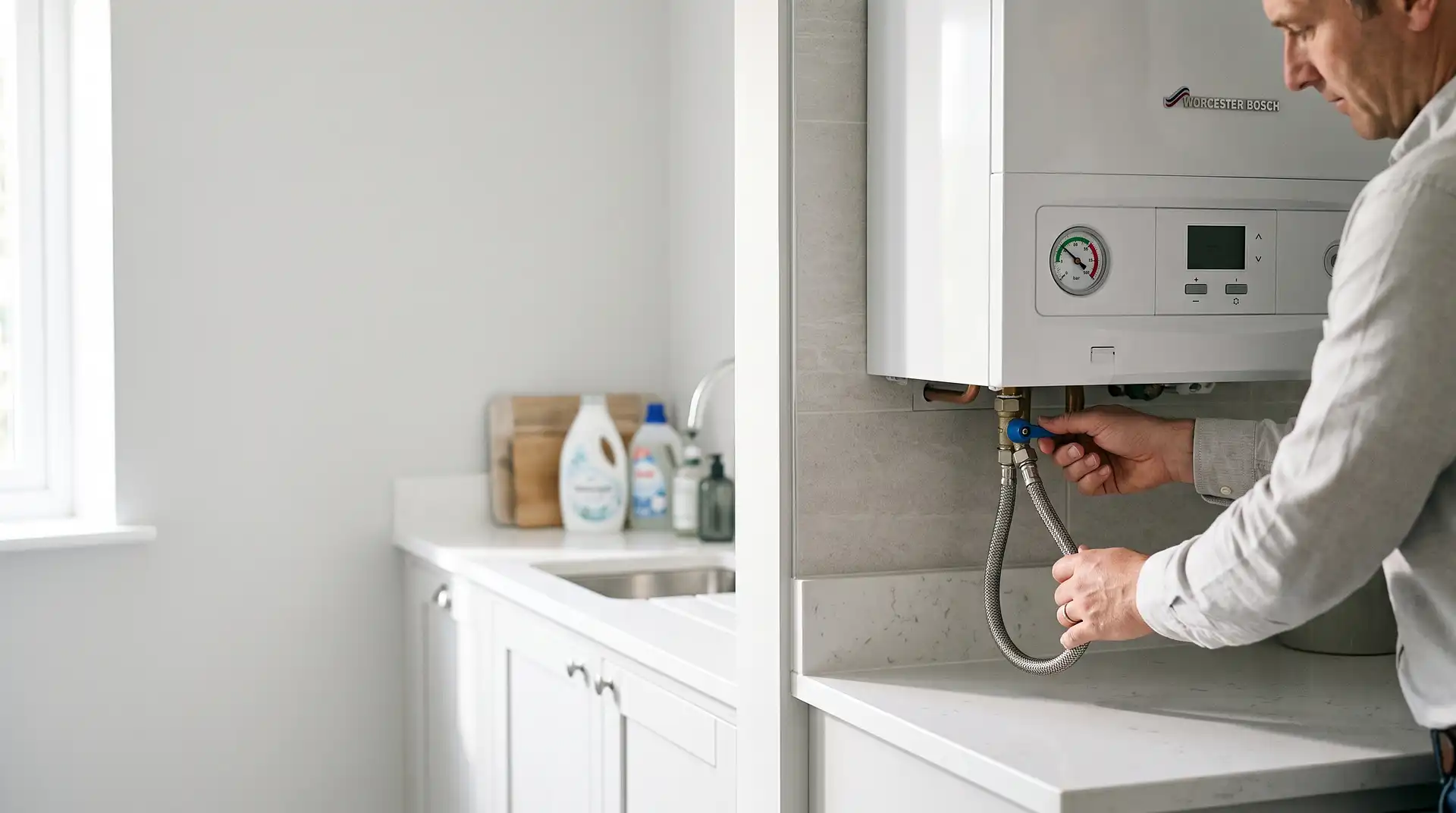
If you see a silver braided hose connecting two valves, you have an external filling loop, the same arrangement most other boiler brands use.
If you see a blue lever at the bottom of the boiler with no braided hose and no key, you have a keyless filling link, fitted to newer models including the Greenstar CDi Classic range.
If none of these are obvious, check your boiler's model number and refer to the manual, or Worcester Bosch's own website, rather than guessing.
Method One: Internal Filling Key
This is the fiddliest of the three, and it genuinely requires more force than people expect to seat the key properly, which is a common source of frustration rather than a sign you're doing it wrong.
Lay an old towel underneath the boiler first to catch any drips. Take the white plastic key from its clip and insert it into the black plastic manifold, pushing firmly until it engages properly. Turn the key to the right until it stops, with the arrow lining up against the closed padlock symbol, and check it's genuinely locked and can't still turn, this bridges the gap between the two sections of the filling loop, and a loose fit is exactly what causes water to escape rather than entering the system.
With the key locked, turn the white knob to the left to let water in. Watch the pressure gauge and, once it reaches between 1 and 1.5 bar, turn the white knob back to the right to close the valve, without overtightening. Turn the key back to the left until it stops, with the arrow against the open padlock symbol, then pull it straight down to remove it. Dry it off and clip it back into the bottom panel, since losing it makes future top-ups considerably harder.
Method Two: External Filling Loop
If you have the silver braided hose with a valve at each end, this works the same way as most other boilers. Open one valve, then the other, slowly rather than both fully at once, since house water pressure can be high enough to push the boiler's pressure up too quickly if you open everything at once. Watch the gauge, and close both valves once it reaches 1 to 1.5 bar.
Method Three: Keyless Blue Lever
The simplest of the three. Pull down the blue lever at the bottom of the boiler, watch the pressure rise on the gauge, and release the lever once it's above 1 bar, ideally in the 1 to 1.5 bar range.
After Repressurising
Switch the boiler back on and, if the display shows a fault, press and hold the reset button for around five seconds, then release. Many Worcester models need a manual reset after a low-pressure lockout before they'll fire up normally again. Check the gauge again once the heating has been running, since a small settling is normal but a significant drop within a day or two points to something beyond a simple top-up.
Common Problems and What They Mean
The pressure won't rise at all. Most commonly the key isn't fully seated, which is genuinely easy to get wrong given how firmly it needs to be pushed in. Other possibilities are a faulty filling loop, or, less commonly, house mains water pressure that's only around 1 bar itself, in which case you simply can't raise the boiler above that figure.
The blue lever is jammed and won't move. Don't force it. A seized lever is worth having a Gas Safe engineer look at rather than risking damage to the mechanism.
Pressure rises extremely slowly. This can indicate a partially blocked or faulty filling mechanism, worth mentioning to an engineer at your next service rather than persisting for an hour to gain a fraction of a bar.
If You Keep Having to Do This
An occasional top-up is normal, particularly after bleeding radiators, which releases system water and drops pressure as a direct result. This is genuinely the most common innocent cause of a Worcester boiler needing repressurising, and it's worth knowing whether that's what's actually happened before assuming a fault. Our related guide covers how to bleed a radiator properly, including why the pressure check afterward matters, worth reading if you've recently bled radiators and found the boiler needing a top-up straight afterward.
If you're repressurising every few weeks with no obvious cause, that's a different situation. Two things are worth checking: look around pipes, radiators, and beneath the boiler for damp patches indicating a leak, never inside the boiler itself, which is Gas Safe engineer territory only. If there's no visible leak, a failing expansion vessel is the other very common cause, and this is genuinely widespread across all boiler brands rather than a Worcester-specific weakness. An expansion vessel can often be recharged rather than replaced, and this check is typically part of a proper annual boiler service, meaning a service can sometimes resolve recurring pressure loss without needing a separate repair visit at all.
Common Mistakes and What to Do Instead
Mistake: not identifying which filling system you have first. Worcester uses three different methods across its range. Trying the wrong one wastes time and can potentially damage components, so check the bottom panel before starting.
Mistake: not pushing the filling key in firmly enough. This is the single most common reason the internal key method appears not to work. It needs considerably more force to seat properly than most people expect.
Mistake: opening both external filling loop valves fully at once. House water pressure can push boiler pressure up too fast. Open them slowly and watch the gauge as you go.
Mistake: leaving the filling key in the boiler or losing it. Store it back in its clip in the bottom panel after every use. Replacement keys are available but it's an avoidable hassle.
Mistake: repeatedly topping up without investigating why. Regular pressure loss points to a leak or a failing expansion vessel, neither of which resolves itself. Persistent top-ups just delay a proper diagnosis.
Mistake: forcing a jammed blue lever or stiff key. A seized mechanism is a smaller problem than a broken one. Stop and call an engineer rather than applying more force.
What It Costs in the UK
Repressurising the boiler yourself costs nothing, and the filling key, if you've lost yours, is inexpensive to replace through Worcester Bosch or a merchant.
If pressure keeps dropping and needs proper investigation, according to InstantCost.co.uk's 2026 UK pricing data, fault diagnosis and repair typically costs £90 to £280, with the first hour usually included. An annual service typically costs £75 to £130, and since an expansion vessel check and recharge is generally part of a proper service, booking one can sometimes resolve recurring pressure loss without a separate repair charge, worth considering if your service is due anyway.
If recurring pressure problems are one symptom among several on an ageing boiler, Worcester Bosch sits in the premium tier for replacement, with a Greenstar typically costing £2,800 to £3,800 supplied and fitted, against £2,300 to £3,000 for mid-range brands like Vaillant's ecoTEC and £1,800 to £2,400 for budget brands like Ideal or Baxi.
Situation | Typical UK Cost (2026) |
|---|---|
DIY repressurising | Free |
Replacement filling key | Low cost, via Worcester Bosch or merchant |
Annual service (includes expansion vessel check) | £75 to £130 |
Fault diagnosis and repair | £90 to £280 |
New Worcester Bosch Greenstar, supplied and fitted | £2,800 to £3,800 |
Figures based on InstantCost.co.uk's 2026 UK pricing data and vary by provider and region. London and the South East typically add 10 to 20% to labour costs.
Staying Safe
Turn off the boiler's electrical supply and let it cool before removing any panel or attempting to repressurise. Never look or reach inside the boiler casing itself, this is Gas Safe engineer territory regardless of how confident you feel with the external filling mechanism. If you smell gas at any point, stop, turn off the gas at the meter if safe to do so, ventilate the property, and call the National Gas Emergency Service on 0800 111 999.
Keep children away from the boiler while the bottom panel is off and the filling key is out, and store the key back in its clip rather than leaving it accessible.
Filling systems vary across the Worcester Bosch range and by production year, so check your specific model's manual, available via Worcester Bosch's website using your model number, if anything looks different from the three systems described here.
FAQ
How do I know which filling system my Worcester boiler uses? Remove the bottom panel and look. A white plastic key with padlock symbols means an internal filling key. A silver braided hose with two valves means an external filling loop. A blue lever with neither means a keyless filling link.
Why won't my Worcester boiler pressure rise when I use the filling key? Most commonly the key isn't pushed in firmly enough to engage properly, it genuinely needs more force than expected. Other causes include a faulty filling loop or house mains pressure that's itself only around 1 bar.
What pressure should my Worcester boiler be at? Between 1 and 1.5 bar when cold, which Worcester marks as zone A on the gauge. Stop filling once the needle reaches this range.
Do I need to reset my Worcester boiler after repressurising? Often yes. Many models lock out after low pressure and need the reset button held for around five seconds before they'll fire up normally again.
Why does my Worcester boiler keep losing pressure? Either a leak somewhere in the system, worth checking pipes and radiators for damp patches, or a failing expansion vessel, which is common across all boiler brands and can often be recharged during a routine service.
How much does it cost if repressurising doesn't fix the problem? Fault diagnosis and repair typically costs £90 to £280 according to 2026 UK data, though an annual service at £75 to £130 includes an expansion vessel check and can sometimes resolve recurring pressure loss on its own.