How Do You Clean Exterior Brick
31 July 2026
How Do You Clean Exterior Brick?
The short answer is: start gentler than you think you need to. Exterior brick looks tough, and in one sense it is, but the cleaning method that works safely on a modern, hard-fired brick house can genuinely damage an older or softer one, and there's often no obvious way to tell the difference just by looking at it from across the street. The safest general approach is to treat every brick house as potentially sensitive until you've confirmed otherwise, rather than assuming maximum pressure and the strongest product available is the fastest route to a clean result.
What You'll Need
A stiff, non-wire brush, for loosening dirt, moss, and cobwebs before any water touches the wall.
A bucket, warm water, and a mild detergent, or a purpose-made brick and masonry cleaner for more established grime.
A fungicidal wash, specifically for any algae, moss, or lichen, rather than relying on plain water to rinse it away.
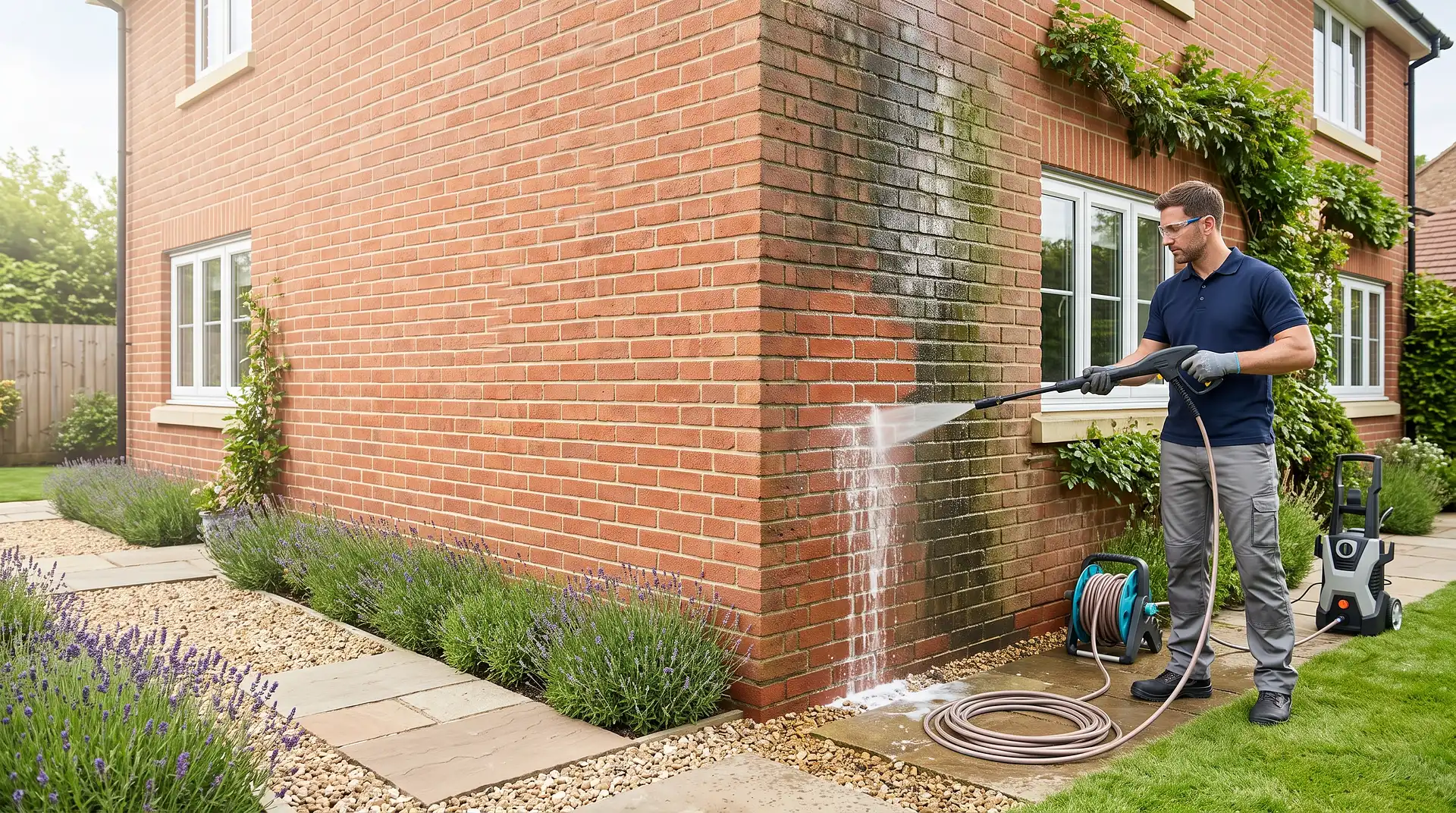
A garden hose or a pressure washer set to a low setting, for rinsing, though a hose alone is often the safer choice on older or uncertain brick.
Gloves and eye protection, since cleaning products for exterior brick are generally stronger than household surface sprays.
Step 1: Work Out What You're Dealing With
Before you clean anything, take a moment to consider your brick's likely age and condition. Brick from roughly the 1950s onward is generally harder-fired and more tolerant of moderate pressure washing. Older, handmade, or softer brick, common on Victorian and other pre-war properties, is more porous and can be damaged by the same pressure that's perfectly safe on newer brick. If you genuinely don't know which category applies, that uncertainty is useful information in itself: it's the signal to start gentle and only step up the method if it's clearly not working.
Step 2: Brush Off Loose Debris First
Use a stiff, non-wire brush to remove cobwebs, loose dirt, and any surface moss before introducing water. This single step prevents you from turning dry, loose dirt into a muddy paste that's harder to remove once wet, and it's a step that's easy to skip when you're keen to just get the hose out.
Step 3: Treat Any Algae, Moss, or Lichen Properly
If you can see green, black, or grey patches of growth on the brick, don't just rinse them off with water. Apply a fungicidal wash and let it dwell for the time stated on the product, commonly 15 to 30 minutes, before you move on to general washing. Rinsing off visible growth without treating it leaves spores behind that regrow, often within a matter of months, which is why this step matters more for long-term results than the general wash that follows it.
Step 4: Wash From the Bottom Up
Wet the wall starting from the bottom and working upward. This might seem backward, but it prevents dirty runoff from streaking down and drying onto sections of wall you haven't cleaned yet, which is a common cause of a patchy, uneven-looking result.
Step 5: Scrub With a Mild Solution
Work a mild detergent or brick-specific cleaner into the surface with your brush, working in manageable sections rather than trying to cover the whole wall in one pass. This gives you better control over dwell time and pressure than rushing across the entire surface at once.
Step 6: Rinse From the Top Down
This time, rinse in the opposite direction, from the top of the wall downward, so the dirty water runs over brick you've already cleaned rather than onto brick you haven't reached yet.
Step 7: Let It Dry and Assess
Brick often looks patchy or uneven while still damp, and evens out considerably once fully dry. Resist the urge to judge the result, or reapply more product, until the wall has had a chance to dry properly.
Common Mistakes and What to Do Instead
Mistake: reaching for a pressure washer on full power as the default first step. This is the single most common cause of DIY brick-cleaning damage, particularly on older or softer brick where high pressure can force water behind the surface. Start with a hose and gentle scrubbing, and only consider pressure washing on brick you're confident is modern and in good condition.
Mistake: using a wire brush. Wire bristles scratch the brick face and can leave behind metal fragments that rust and stain the wall later. Stick to stiff nylon or natural-bristle brushes throughout.
Mistake: rinsing off algae or moss without treating it first. This removes what's visible but leaves the spores behind, and growth commonly returns within months. Use a proper fungicidal wash with adequate dwell time before general cleaning.
Mistake: using bleach or a strong acid-based product without testing first. Some chemicals react unpredictably with specific brick or mortar compositions, causing permanent discolouration. Test any new product on a small, hidden patch and wait 24 to 48 hours before treating the whole wall.
Mistake: cleaning mortar the same way as the brick around it. Mortar is generally softer than brick and wears down faster under high pressure or harsh chemicals, which can weaken the wall structurally over time even while the brick itself still looks fine.
Mistake: cleaning in direct sun or freezing weather. Cleaning solution dries too quickly in strong sun for an even result, and cleaning in frost risks water freezing inside the brick's pores, causing exactly the kind of damage careful cleaning is meant to avoid.
When It's Worth Hiring a Professional
A single-storey wall with general dirt or light algae, on brick you're reasonably confident is modern, is a fair DIY job for most people. It's worth bringing in a professional for an older property or uncertain brick age, heavy or stubborn staining that a standard wash hasn't shifted, anything requiring working at height, or brick sitting near render or other more delicate surfaces where a mismatched cleaning approach could cause problems elsewhere on the property. A professional will typically test a small patch and judge porosity before choosing a method, which is genuinely where much of the value in hiring out sits, more than the equipment itself.
A Note on Pricing
The InstantCost.co.uk page linked for this article covers carpet cleaning specifically, which doesn't apply to exterior brick, so the figures below come from current UK exterior cleaning trade data instead. If you're also planning to give the rest of the property's exterior some attention while you're at it, our guide on cleaning exterior walls before painting covers the closely related process for render and previously painted surfaces, worth a read if your property has a mix of brick and other exterior finishes.
What It Costs in the UK
Brick cleaning is generally priced per square metre, and current UK data puts the typical range at £10 to £25 per m² for a standard clean, stretching wider, £5 to £55 per m², depending on method, brick condition, and how heavily soiled the property is. Pressure washing on brick confirmed suitable for it sits toward the lower to mid part of this range, while gentler specialist methods for older or heritage brick, or chemical treatment for heavy staining, sit toward the top.
For a full house exterior, the UK average is commonly cited around £500 to £695, though a typical 3-bedroom semi-detached or terraced house generally lands between £600 and £1,500, and larger or more heavily soiled properties can reach £800 to £2,200 or more. Scaffolding or working-at-height access, if needed for an upper storey, adds a meaningful amount on top of the basic per-m² figure, so it's worth confirming whether a quote already includes this.
Job | Typical UK Cost (2026) |
|---|---|
Standard brick clean, per m² | £10 to £25 |
Heavy staining or specialist treatment, per m² | Up to £55 |
Average whole-house clean, UK-wide | £500 to £695 |
Typical 3-bed semi or terrace | £600 to £1,500 |
Larger or heavily soiled property | £800 to £2,200 |
These are UK market estimates and vary by region, brick condition, and access. Get a few quotes, and confirm whether scaffolding or repair work is included or charged separately.
Staying Safe
Fungicidal washes and any chemical brick cleaners are generally stronger than household cleaning products, so wear gloves and eye protection, and avoid applying them in direct sun where the product might dry before it's had time to work properly. If you're working at height on an upper storey, treat it with the same caution as any exterior task, never overreach from a ladder, and consider proper access equipment or a professional for anything beyond safe, stable reach.
Runoff from cleaning chemicals can affect nearby plants, so check the product label for guidance before use, and keep children and pets away from the area while any solution is applied and left to dwell.
Product-specific safety data and application guidance vary by manufacturer, so it's worth checking the label for ventilation, dwell time, and runoff guidance before use, particularly near planting or in a household with children or pets.
FAQ
Can I pressure wash exterior brick myself? Only if the brick is modern and in good condition. Older, softer, or handmade brick can be damaged by pressure that forces water behind the surface, leading to frost damage or damp issues later.
How do I know if my brick is safe for pressure washing? As a rough guide, brick from roughly the 1950s onward is more likely to be hard-fired and tolerant of moderate pressure. Handmade or pre-1950s brick is more likely to be porous, so start gentle if you're unsure.
Why does the algae keep coming back after I've cleaned it off? Rinsing off visible growth without a fungicidal treatment leaves spores behind, which regrow, often within months. Always treat algae, moss, or lichen with a proper fungicidal wash and adequate dwell time first.
How much does it cost to clean exterior brick in the UK? The UK average for a full house exterior is commonly cited around £500 to £695, with a typical 3-bed semi or terrace generally costing £600 to £1,500, depending on size and condition.
What's the difference between pressure washing and a gentler wash for brick? Pressure washing uses high-force water alone and can damage porous or older brick. A gentler wash, combining hand scrubbing or low pressure with a mild cleaning solution, is generally safer and is what professionals often use on older brick.
Should I clean the mortar the same way as the brick? No. Mortar is generally softer and wears faster under high pressure or harsh chemicals than the brick around it, which can weaken the wall structurally over time even if the brick itself looks unaffected.