How Do You Remove Oil Stains From a Driveway
29 July 2026
How Do You Remove Oil Stains From a Driveway?
Oil doesn't sit on top of a driveway the way dirt does — it soaks into the surface, which is why a quick scrub with washing-up liquid rarely shifts anything beyond the top layer. Getting an oil stain out properly means drawing the oil back out of the material it's soaked into, using an absorbent first and a degreaser second, rather than trying to wash it away in one step. The exact method also depends heavily on what your driveway is actually made of — concrete, tarmac, block paving, and resin all hold onto oil differently, and treating them the same way is the most common reason a DIY attempt only gets the stain partway out.
Why Fresh vs. Old Stains Need Different Approaches
A fresh spill, caught within hours, is still mostly sitting on the surface and hasn't fully penetrated yet — this is the easiest case, and prompt action makes a real difference to how much of it lifts out. An old, set-in stain has had time to soak deep into a porous surface like concrete or block paving, and often needs a stronger degreaser, a longer dwell time, or repeated treatments to fully draw out. This is worth knowing upfront, since it sets expectations: a stain that's been there for months may never come out completely with DIY methods, and that's a realistic outcome to plan for rather than a sign you're doing something wrong.
Step 1: Absorb Any Fresh Oil First
If the spill is recent, cover it immediately with an absorbent material — cat litter, sawdust, or a commercial oil absorbent all work — and leave it for several hours, ideally overnight, to draw as much oil out of the surface as possible before it has a chance to soak in further. Sweep up the absorbent material once it's done its job, then move on to degreasing whatever staining remains.
Step 2: Apply a Degreaser
Apply a dedicated driveway degreaser or a strong dish soap solution directly to the stain, working it in with a stiff (non-wire) brush. Commercial driveway oil stain removers are formulated specifically to break down oil's chemical bond with concrete or tarmac in a way general detergent can't fully replicate, and they're generally worth the modest extra cost over dish soap for anything beyond a very light or fresh mark. Let the product dwell for the time stated on the label — often 10–20 minutes, sometimes longer for set-in stains — rather than rinsing immediately.
Step 3: Scrub and Rinse
Scrub the treated area with a stiff brush, working in a circular motion to lift the loosened oil, then rinse thoroughly with clean water. For fresh, light stains, this single degreaser-and-scrub cycle is often enough. For older or heavier staining, expect to repeat steps 2 and 3 more than once, since deeply set oil rarely lifts fully on the first attempt.
Step 4: For Stubborn Stains, Try a Poultice
For genuinely stubborn, set-in stains, a poultice method works better than repeated surface scrubbing: mix an absorbent powder (baking soda or a proprietary poultice product) with a degreasing liquid into a thick paste, spread it over the stain, and cover with plastic sheeting to slow evaporation, leaving it for 24–48 hours. This gives the paste time to actively draw oil out of the pores of the material rather than just treating the surface, and is genuinely more effective on old, deep-set stains than any amount of scrubbing alone.
Method by Driveway Material
Concrete is porous and absorbs oil readily, which is why concrete driveways are particularly prone to staining but also generally respond well to degreasing and poultice treatments, since the same porosity that lets oil in also lets a properly applied treatment draw it back out.
Tarmac is more oil-resistant than concrete in general, but very old or already-softened tarmac can be damaged by high-pressure washing or overly aggressive scrubbing a lower-pressure approach with a dedicated degreaser is safer than reaching for maximum pressure washer power.
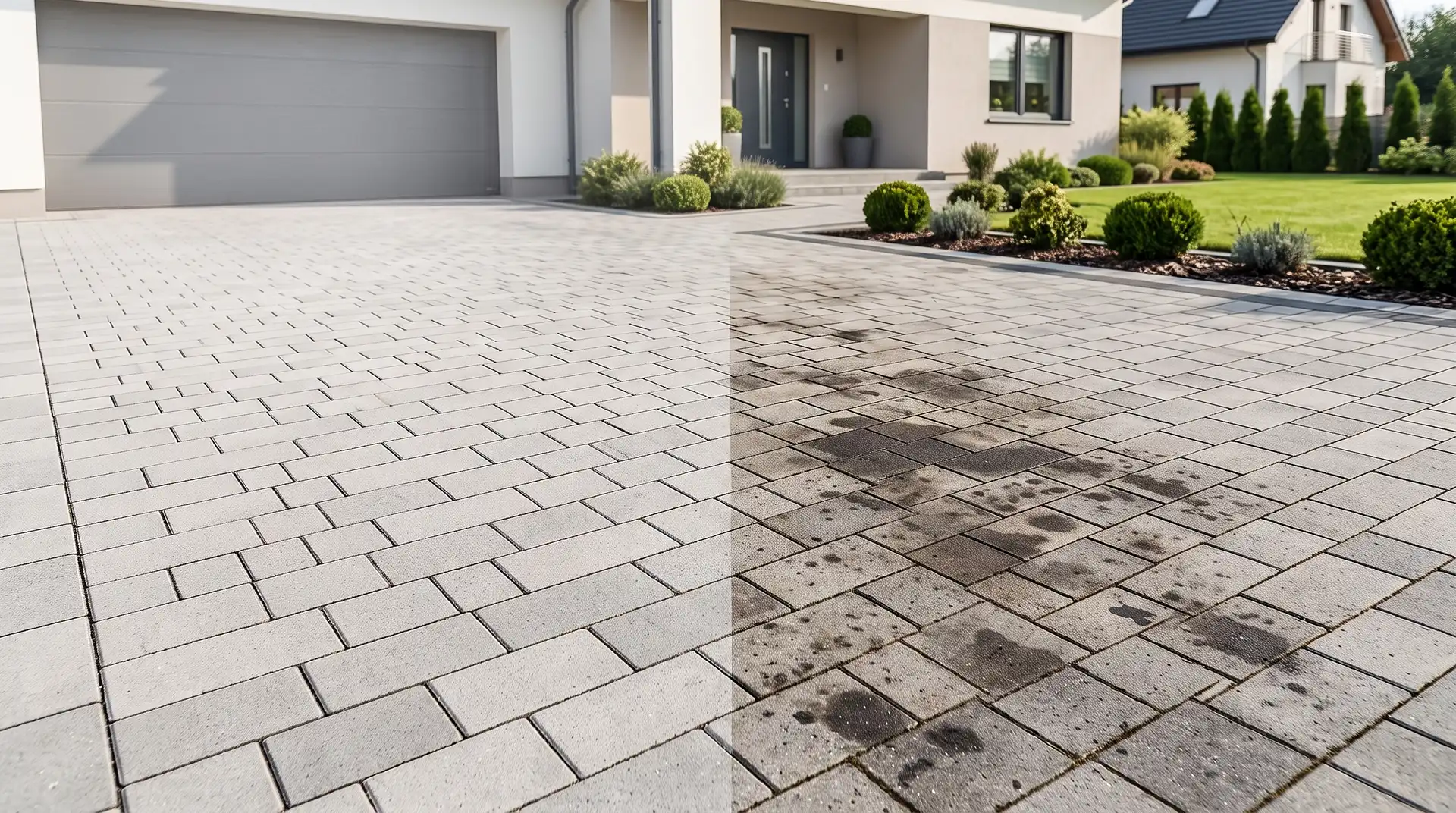
Block paving has the added complication of the joints between blocks, where oil can seep down and settle, making a simple surface treatment less effective than fully accounting for what's happened between the blocks. Persistent staining sometimes means individual affected blocks need lifting and replacing, or the jointing sand needs removing and replacing, rather than continuing to treat the surface indefinitely.
Resin-bound and gravel driveways are generally the hardest to fully de-stain, since resin-bound surfaces are less porous in a way that can trap oil at the surface rather than letting a poultice draw it through, and gravel simply can't be scrubbed the way a solid surface can often the more practical fix for gravel is removing and replacing the affected stones rather than attempting to clean them in place.
When Pressure Washing Helps (and When It Doesn't)
A pressure washer is useful for rinsing away loosened degreaser and oil after treatment, and for general surrounding grime, but pressure alone rarely removes a genuine oil stain it can even drive the oil deeper into a porous surface if used without a degreasing pre-treatment first. Think of pressure washing as the rinse step in this process, not the primary stain-removal method. For a broader driveway clean beyond just the oil stain general dirt, moss, algae the same top-down, pre-treat-then-rinse principle covered in our guide on cleaning a brick house exterior applies here too: treat first, then rinse, rather than relying on pressure alone.
Common Mistakes and What to Do Instead
Mistake: scrubbing a fresh spill without absorbing it first. This spreads the oil across a wider area and pushes some of it deeper into the surface. Always absorb as much as possible with cat litter or sawdust before any scrubbing or degreasing.
Mistake: using washing-up liquid alone on an old, set-in stain. General detergent can shift light surface residue but isn't formulated to break oil's bond with porous concrete or tarmac the way a dedicated degreaser is. Use a proper driveway oil stain remover for anything beyond a very fresh, light mark.
Mistake: rinsing off degreaser immediately after applying it. This is the same dwell-time mistake that undermines a lot of DIY cleaning — giving the product time to actually break down the oil, rather than treating it like a quick surface spray, makes a real difference to the result.
Mistake: pressure washing before degreasing. High pressure alone can drive oil further into a porous surface rather than removing it. Degrease first, then use the pressure washer to rinse.
Mistake: giving up after one treatment on an old stain. Deeply set oil often needs two or three repeated degreaser-and-scrub cycles, or a poultice treatment left for 24–48 hours, rather than a single attempt. A stain that doesn't fully lift the first time isn't necessarily unremovable — it may just need repeating.
Mistake: treating block paving joints the same as the block surface. Oil that's seeped into the sand between blocks needs separate attention, sometimes removal and replacement of the jointing sand, rather than assuming a surface treatment alone will fully resolve it.
When to Call a Professional Instead
DIY treatment handles most fresh-to-moderate oil stains well, particularly on concrete and tarmac. It's worth calling a professional driveway cleaning company for stains that have set for months or years and resist repeated DIY treatment, block paving where oil has clearly reached the joints and sand, resin-bound driveways where DIY poultice methods have limited effect, or if the stain covers a large area alongside general heavy soiling, moss, or algae that's better addressed as a full professional clean rather than piecemeal. Professionals have access to stronger, trade-only degreasing chemicals and, in persistent cases, hot water extraction equipment that goes beyond what consumer pressure washers and products can achieve.
What It Costs in the UK
DIY materials are inexpensive: a bottle of dedicated driveway degreaser or oil stain remover typically costs £15–£40, cat litter or sawdust for absorption costs a few pounds, and a stiff outdoor brush, if you don't already own one, typically costs £10–£20. Pressure washer hire, if needed for the rinse stage and you don't own one, typically runs £40–£60 per day or £80–£120 per week.
Professional oil stain treatment specifically is usually priced by area rather than per stain for larger jobs, commonly £3.50–£7.50 per m² for chemical treatment with proper dwell time — for context, treating oil staining across a 30m² concrete driveway typically costs £150–£200 as a targeted job. Some companies instead quote oil stain treatment as a flat per-stain fee, typically £10–£30 per stain, which suits smaller, isolated marks rather than widespread staining. If oil staining is one part of a broader driveway clean — general dirt, moss, algae included — a full professional driveway clean typically costs £250–£400 for a medium-sized driveway, with heavy staining or moss adding roughly £50–£100 to that baseline for the extra preparation and treatment time involved.
Option | Typical UK Cost (2026) |
|---|---|
DIY degreaser/oil stain remover | £15–£40/bottle |
Absorbent material (cat litter/sawdust) | A few pounds |
Pressure washer hire (if needed) | £40–£60/day, £80–£120/week |
Professional oil stain treatment (per m²) | £3.50–£7.50 |
Professional oil stain treatment (per stain) | £10–£30 |
Full professional driveway clean (medium drive) | £250–£400 |
Heavy staining/moss surcharge | +£50–£100 |
These are UK market estimates and vary by driveway material, stain severity, and provider — get a couple of quotes for anything beyond a small, isolated stain, and ask specifically whether oil treatment is included in a general clean or charged as an add-on.
Staying Safe
Driveway degreasers are generally stronger than household cleaning products, so wear gloves and avoid skin contact, and check the product label for any specific ventilation or run-off guidance, since some degreasing chemicals shouldn't be allowed to run directly into drains or nearby planting untreated. If you're using a pressure washer, keep it at a safe distance from the surface to avoid etching or damaging the driveway material, particularly on older tarmac or softer block paving — the same working-at-height and equipment caution covered in our guide on <a href="/how-to-clean-exterior-walls-before-painting">cleaning exterior walls before painting</a> applies to handling pressure washing equipment safely here too.
Keep children and pets away from the area while degreaser or poultice treatment is applied and dwelling, and store all products in their original labelled containers, out of reach, once you're finished.
Product-specific safety data and application guidance vary by manufacturer, so it's worth checking the label for ventilation, dwell time, and drainage guidance before use, particularly near planting or in a household with children or pets.
FAQ
Can you remove oil stains from a driveway yourself? Yes, in most cases — absorbing fresh spills promptly, then treating with a dedicated degreaser and repeating as needed, works well on concrete and tarmac. Older, deeply set stains may need a poultice treatment or several repeated attempts.
What's the best way to remove an old oil stain from concrete? A poultice — an absorbent powder mixed with degreasing liquid, spread over the stain, covered, and left for 24–48 hours — is generally more effective on old, set-in stains than repeated surface scrubbing alone.
Does pressure washing remove oil stains? Not on its own, and it can even push oil deeper into a porous surface if used before degreasing. Use pressure washing to rinse away loosened oil and degreaser after proper chemical treatment, not as the primary removal method.
Why won't the oil stain fully come out of my block paving? Oil often seeps into the sand-filled joints between blocks, not just the block surface. Persistent staining here sometimes needs the jointing sand removed and replaced, or affected blocks lifted, rather than continued surface treatment.
How much does professional oil stain removal cost for a driveway in the UK? Chemical treatment typically costs £3.50–£7.50 per m², or £10–£30 per stain for smaller, isolated marks. A full professional driveway clean including oil stain treatment typically costs £250–£400 for a medium-sized driveway.
Is washing-up liquid enough to remove an oil stain? Only for very fresh, light marks. For anything set-in or older, a dedicated driveway degreaser formulated to break oil's bond with the surface material is considerably more effective than general detergent.