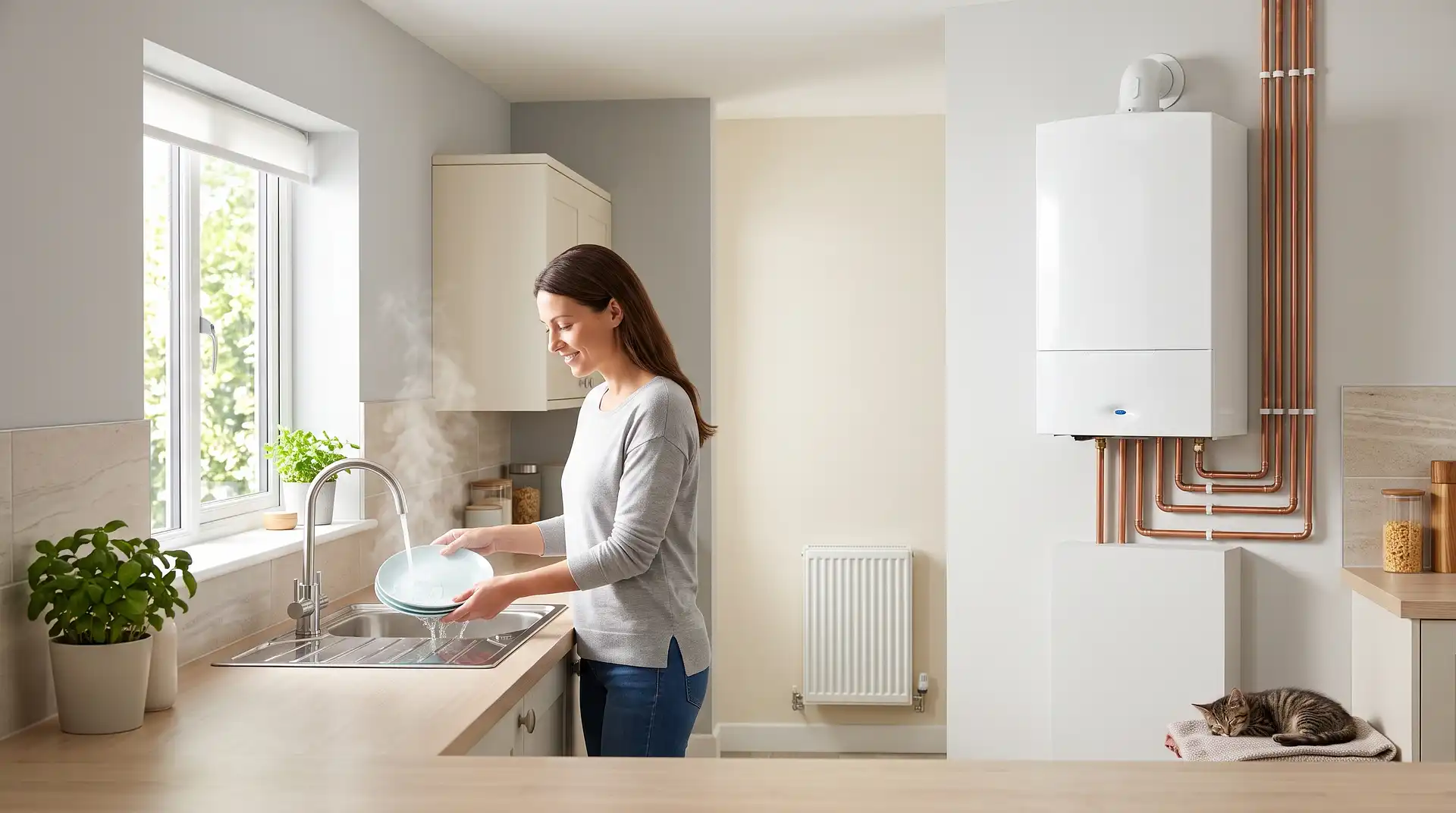
How Does a Combi Boiler Work
4 August 2026
How Does a Combi Boiler Work?
A combi boiler heats water the moment you ask for it, and not a second before, which is really the entire idea behind the design. There's no tank of hot water sitting ready in a cupboard somewhere in the house, and no cold water tank taking up space in the loft. Instead, cold mains water passes through the boiler and gets heated instantly, on demand, whenever a hot tap or the heating calls for it. Understanding that one principle explains almost everything else about how a combi boiler behaves, day to day, compared with older tank-based systems.
The Core Mechanism
Cold water enters the boiler directly from the mains supply. When you turn on a hot tap or start a shower, a flow sensor inside the boiler detects the movement of water and triggers the burner to fire up. The water passes over a heat exchanger, essentially a network of pipes heated by the burner, which transfers heat into the water as it flows past, and hot water comes out the other side within seconds. The moment you turn the tap off, the flow stops, the sensor detects this, and the burner shuts off. Nothing is heated and stored in advance, the boiler only ever heats exactly what's being used, right when it's being used.
Two Jobs, One Unit
A combi boiler does two separate jobs from inside a single unit: providing hot water for taps and showers, and providing hot water to circulate through the central heating system's radiators. These are two distinct circuits inside the boiler, and a component called a diverter valve switches between them depending on what's being asked for. If you turn on a hot tap while the heating's running, the diverter valve typically prioritises hot water for the tap, briefly reducing flow to the radiators until the tap demand stops, which is why some combi systems show a brief, temporary dip in radiator heat if hot water and heating are both being called for at exactly the same moment.
Why There's No Tank
Older, conventional boiler systems store hot water in a cylinder, heated in advance and kept ready for when it's needed, with a separate cold water tank in the loft feeding the system by gravity. A combi boiler skips both of these entirely, hence the name, it combines water heating and central heating into one compact unit with no separate storage anywhere in the property. This is the main reason combi boilers have become the most common choice in UK homes over the past couple of decades, no loft tank means no risk of a loft tank freezing or leaking, and no hot water cylinder means a genuinely usable airing cupboard instead of one taken up by a tank.
Mains Pressure, Not Stored Pressure
Because a combi boiler draws directly from the mains rather than from a gravity-fed tank, hot water comes out of the tap at mains pressure, generally stronger and more consistent than the gravity-fed pressure a tank-and-cylinder system produces, unless that older system has its own separate pump fitted. This is part of why a combi shower often feels noticeably more powerful than one running from an older tank-based system without a pump, the water pressure is fundamentally coming from a different source.
The One Genuine Limitation
Because a combi heats water on demand rather than from a stored supply, it can only heat one flow of water at a time at full performance. Running a shower and a hot tap simultaneously in different parts of the house means sharing the boiler's single heating capacity between both, which typically shows up as reduced temperature or pressure at one or both outlets rather than each running at full strength independently. This is the main practical trade-off against a system boiler, which stores hot water in a cylinder and can therefore supply multiple outlets simultaneously without this compromise, a genuine consideration for a household with two or more bathrooms used at the same time regularly.
What This Means for Everyday Use
In a typical one or two-bathroom household, this limitation rarely matters in practice, since simultaneous full-power hot water demand from multiple outlets isn't a common daily occurrence. In a larger household with several bathrooms used at similar times, particularly in the morning rush, it's worth knowing this trade-off exists before assuming a combi is automatically the right fit, since a system boiler with a properly sized cylinder may suit that specific usage pattern better despite taking up more space.
Understanding this trade-off is genuinely useful before choosing between boiler types, but it's also worth knowing what you'd actually pay for each option once you've decided which suits your household. Our related guide on the InstantCost blog covers how much a new boiler actually costs , breaking down combi, system, and conventional pricing side by side, worth reading alongside this explanation of how a combi specifically works before making a final decision.
Common Signs a Combi Boiler Isn't Working Properly
No hot water at all, but the heating still works often points to a fault with the diverter valve or the flow sensor specifically, since these are the components responsible for switching to and triggering hot water production.
Hot water but no heating can indicate a separate issue with the central heating circuit, sometimes trapped air in the system, sometimes a fault elsewhere, since the two functions run through partly separate pathways despite sharing one boiler unit.
Pressure that keeps dropping usually points to a leak somewhere in the system or a failing expansion vessel, rather than anything specific to the combi design itself, this affects combi, system, and conventional boilers in broadly similar ways.
Reduced pressure when the heating and hot water run together is often just the diverter valve doing exactly what it's designed to do, prioritising one function briefly over the other, rather than a fault at all.
Common Misconceptions
"A combi boiler heats water constantly, wasting energy." This is backward, a combi only fires up and heats water when there's actual demand, unlike a tank-based system, which keeps a full cylinder of water hot and ready at all times, using energy to maintain that temperature even when nobody's using it.
"Combi boilers can't cope with big households." They can, provided the unit's output (measured in kW) is properly matched to the property and hot water demand, it's specifically simultaneous multi-outlet use at full performance that's the genuine limitation, not overall household size on its own.
"A combi boiler is always cheaper to run." Generally more efficient than an older, poorly insulated tank system, yes, but running cost depends on far more than boiler type alone, insulation, radiator efficiency, and how the system is used all matter considerably too.
What It Costs in the UK
According to InstantCost.co.uk's 2026 UK pricing data, a combi boiler supplied and fitted typically costs £1,800 to £3,800, depending on brand tier. Budget brands like Ideal and Baxi, suitable for a straightforward like-for-like swap, typically cost £1,800 to £2,400. Mid-range units, Vaillant's ecoTEC range being a common example, typically cost £2,300 to £3,000. Premium models, Worcester Bosch Greenstar among them, typically cost £2,800 to £3,800.
For comparison, a system boiler, which stores hot water in an unvented cylinder and avoids the simultaneous-demand limitation covered above, typically costs £2,400 to £3,800, generally higher than a combi due to the additional cylinder work involved. A conventional boiler with a tank and cylinder typically costs £2,600 to £4,200. Output matters too, a 24kW combi suits a one to two-bathroom flat, a 30kW unit suits a typical three-bed semi, and 35kW or higher is needed for larger homes with multiple bathrooms, with higher output units typically costing £150 to £400 more than a lower-output equivalent.
Boiler Type | Typical UK Cost, Supplied and Fitted (2026) |
|---|---|
Combi, budget (Ideal, Baxi) | £1,800 to £2,400 |
Combi, mid-range (Vaillant ecoTEC) | £2,300 to £3,000 |
Combi, premium (Worcester Bosch Greenstar) | £2,800 to £3,800 |
System boiler | £2,400 to £3,800 |
Conventional/regular boiler | £2,600 to £4,200 |
System to combi conversion | £2,800 to £4,500 |
These are UK market estimates based on InstantCost.co.uk's 2026 pricing data and vary by region and installer. London and the South East typically add 10 to 20% to labour costs.
Staying Safe
Any combi boiler installation, repair, or service must legally be carried out by a Gas Safe registered engineer in the UK, always check the ID card on arrival regardless of who you've booked with. Building regulations now require a magnetic system filter, thermostatic radiator valves on every radiator, and proper condensate disposal on any new installation, most reputable installers include these as standard, but it's worth confirming they're part of any quote you receive, since cheaper quotes sometimes leave them out.
Building regulations for boiler installations can be updated, so it's worth checking current guidance and confirming with your installer that a quote includes all required components before booking.
FAQ
How does a combi boiler heat water so quickly? Cold mains water passes over a heat exchanger inside the boiler, heated by the burner, the moment a tap or shower is turned on. There's no waiting for a stored tank to heat up, since the water is heated instantly as it flows through.
Why does my shower get weaker when someone runs a tap elsewhere in the house? This is the diverter valve sharing the boiler's single heating capacity between simultaneous demands, a genuine limitation of the on-demand design rather than a fault, and it's the main practical trade-off against a system boiler.
Does a combi boiler need a loft tank or hot water cylinder? No, this is the entire point of the design. A combi combines water heating and central heating into one unit, with no separate tank or cylinder needed anywhere in the property.
Is a combi boiler suitable for a house with multiple bathrooms? It can be, provided the output is properly sized for the property, but simultaneous full-power use from multiple outlets at once is the genuine limitation. A system boiler may suit better if this happens regularly in your household.
How much does a combi boiler cost in the UK? Typically £1,800 to £3,800 supplied and fitted according to 2026 UK data, depending on brand tier, with budget brands like Ideal and Baxi at the lower end and premium brands like Worcester Bosch Greenstar at the top.
What's the difference between a combi and a system boiler? A combi heats water on demand with no storage, taking up less space but sharing capacity across simultaneous demands. A system boiler stores hot water in a cylinder, allowing multiple outlets to run at once without the same trade-off, at a generally higher installed cost.