How Does Solar Energy Work
15 August 2026
How Does Solar Energy Work? (PV and Thermal Explained)
There are two genuinely different technologies that both get called solar panels, and they do completely different jobs. Solar photovoltaic, or PV, converts light into electricity. Solar thermal converts sunlight into heat for your hot water. They look broadly similar on a roof, they're sold by overlapping sets of installers, and they're routinely conflated in conversation, but they solve different problems and suit different households. Knowing which one people mean is the first thing worth sorting out.
Solar PV: Light Into Electricity
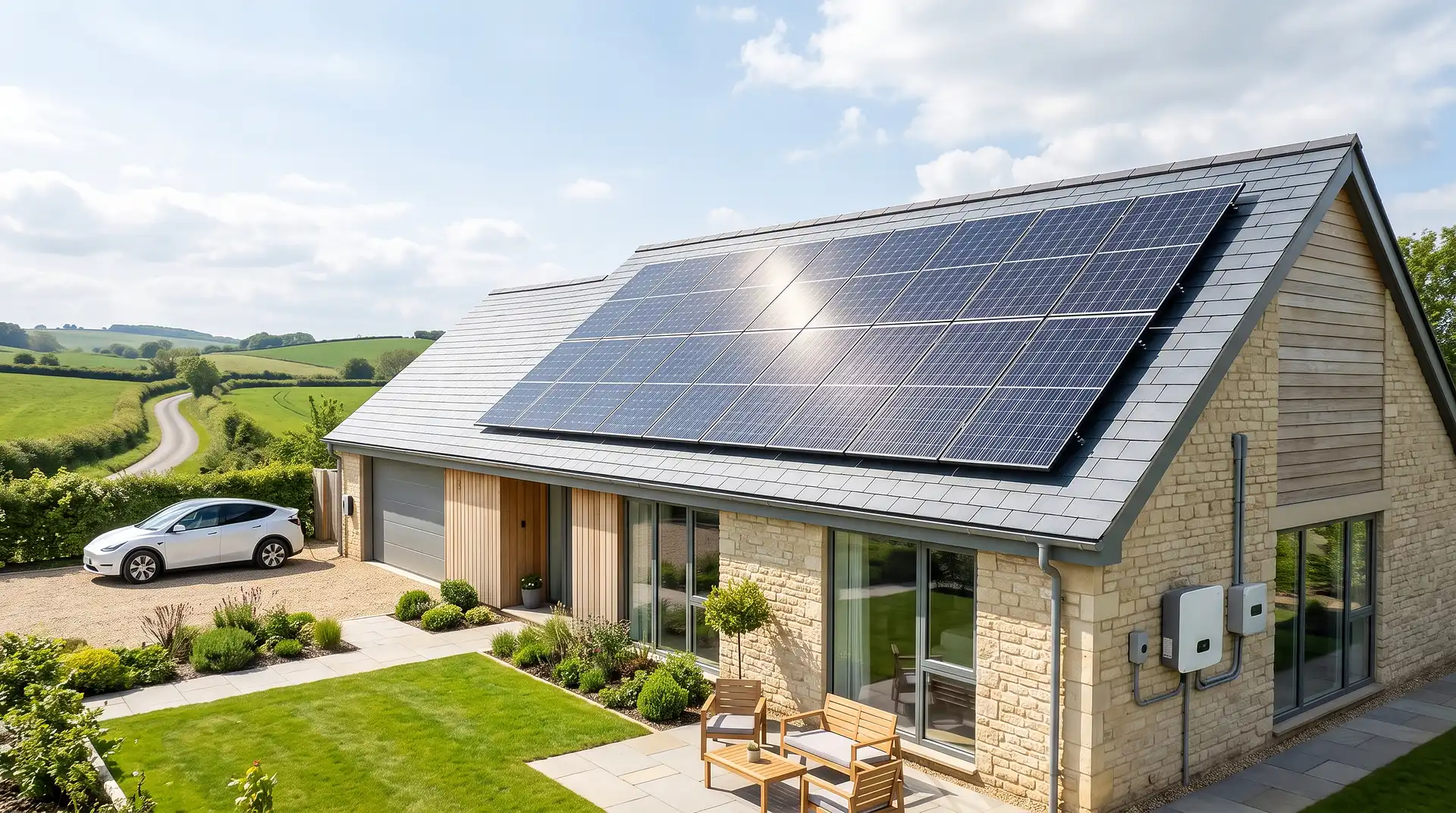
This is what most people mean by solar panels. Photovoltaic cells, typically silicon, generate an electric current when light strikes them. Photons knock electrons loose, and an electric field built into the cell structure forces those electrons to flow in one direction rather than drifting randomly, which is what makes it a usable current rather than just agitated particles.
The output is direct current, DC, so an inverter converts it to the alternating current, AC, that your home and the grid use. That electricity then powers whatever's running in your house at that moment, with any surplus either charging a battery or being exported.
Solar Thermal: Sunlight Into Hot Water
Solar thermal works on a completely different principle, no electricity involved. Collectors on the roof absorb solar radiation as heat, which is transferred to a fluid circulating through them. That fluid runs through a coil in your hot water cylinder, heating the water stored there.
The critical compatibility point is that solar thermal needs a hot water cylinder to heat. Homes with a combi boiler generally don't have one, since combis heat water on demand rather than storing it, which makes solar thermal impractical without adding a cylinder. Our related guide covers how a combi boiler works, including why the absence of a stored hot water cylinder is fundamental to the design, which is worth understanding if you're weighing solar thermal against solar PV and aren't sure what heating system you actually have.
For most UK households, PV is the more flexible choice, since electricity can be used for anything including hot water via an immersion heater, whereas solar thermal only ever produces hot water.
The Generation Cycle Nobody Explains
Solar output isn't steady, and understanding its rhythm explains most of the practical decisions around installing it.
Through the day, generation follows a curve, rising from dawn, peaking around solar noon, and falling to zero after dusk. Peak generation typically occurs in the early afternoon, which for most working households is precisely when nobody's home to use it.
Through the year, UK generation is heavily summer-weighted. A system producing well in June generates a fraction of that in December, when daylight hours are shortest and the sun sits lowest. Annual figures like the roughly 3,400 kWh a 4kW system generates are averages across that whole swing, not a monthly rate.
Through the weather, panels respond to light rather than heat, so they generate on overcast days at reduced output. They also lose a small amount of efficiency at very high temperatures, meaning the hottest day of the year isn't necessarily the highest-output one.
How the Grid Fits In
Your home stays connected to the grid regardless of how much you generate. When you're producing more than you're using, the surplus is exported. When you're producing less, you import as normal. The grid effectively acts as a backstop rather than being replaced.
The economics of that exchange are asymmetric, and this is the single most important thing to understand about solar energy in practice. Electricity you use yourself saves the full import rate, currently around 27p per kWh. Electricity you export earns the Smart Export Guarantee rate, around 15p per kWh. That roughly 12p gap is why timing matters more than total generation.
Why Storage Exists
A battery bridges the gap between when solar energy is produced and when a household actually uses it. Storing midday surplus for evening use converts export-rate electricity into import-rate savings.
According to InstantCost.co.uk's 2026 UK data, this shifts self-consumption from roughly 50% without a battery to around 75% with one. Annual savings rise from £550 to £750 up to £850 to £1,100, but payback extends from 9 to 12 years out to 11 to 14, because the battery adds £2,500 to £4,000 for a 5kWh unit or £4,500 to £7,000 for 10kWh.
Whether that trade is worth making depends on when you're actually home. Evening-heavy usage or a time-of-use tariff makes a battery work. Daytime-empty households get less from it.
What Affects How Much Energy You Generate
Roof direction. South-facing is the benchmark. East or west loses roughly 15% of generation. North-facing rarely pays.
Shading. Even partial shading from a tree, chimney, or neighbouring building affects output disproportionately on some system configurations, and it's worth raising specifically during a site survey.
System size. A 3kW system suits a 1 to 2 bed home, 4kW is the most common UK size, and 5 to 6kW suits larger homes with higher consumption.
Panel condition. Panels are typically warranted for 25 years and degrade slowly rather than failing suddenly. The inverter, by contrast, generally needs replacing sooner.
Common Misconceptions
"Solar doesn't work in Britain." It works on overcast days at reduced output. A UK 4kW system generating around 3,400 kWh a year is a genuinely British figure.
"Solar panels and solar thermal are the same thing." They're entirely different technologies. PV makes electricity, thermal makes hot water, and thermal needs a hot water cylinder to work with.
"You go off-grid with solar." Domestic systems stay grid-connected. The grid covers shortfalls and receives your surplus.
"Heat improves output." Light drives generation, not heat, and panels actually lose slight efficiency at high temperatures.
"A battery makes any system better." It improves self-consumption but extends payback. It suits evening-heavy usage specifically, not every household.
Common Mistakes and What to Do Instead
Mistake: assuming solar thermal and solar PV are interchangeable. Check which one an installer is actually quoting for, and confirm you have a hot water cylinder before considering thermal.
Mistake: sizing a system on roof area rather than consumption. Generating more than you can use or store means the surplus earns 15p rather than saving 27p.
Mistake: ignoring shading at survey stage. Partial shading can affect output more than its apparent coverage suggests. Raise it explicitly rather than assuming the installer has accounted for it.
Mistake: judging solar by summer output. UK generation is strongly seasonal. Annual totals, not peak-month figures, are what payback calculations should rest on.
Mistake: not asking what assumptions underpin a savings quote. Import rate, export rate, and self-consumption percentage all move the answer substantially.
What It Costs in the UK
Item | Typical UK Cost (2026) |
|---|---|
3kW system (8 panels) | £4,500 to £6,000 |
4kW system (10 panels) | £5,500 to £7,500 |
5 to 6kW system | £7,000 to £10,000 |
5kWh battery | £2,500 to £4,000 |
10kWh battery | £4,500 to £7,000 |
Scaffolding | £500 to £1,000 |
Annual savings, panels only | £550 to £750 |
Annual savings, with battery | £850 to £1,100 |
Payback, panels only | 9 to 12 years |
Payback, with battery | 11 to 14 years |
All figures based on InstantCost.co.uk's 2026 UK solar pricing data. Savings assume 27p per kWh import, 15p per kWh export under SEG, a south-facing unshaded roof, and 50% self-consumption without a battery or 75% with one. There is no VAT on domestic solar installations.
Some low-income households qualify for funded solar under ECO4, which runs to 31 December 2026. Roof-mounted panels are permitted development on most UK homes, so planning permission usually isn't required, with listed buildings and conservation areas the main exceptions.
Staying Safe
Solar installation involves working at height and connecting to your consumer unit, so use an MCS-certified installer rather than a general builder. Certification also matters financially, since Smart Export Guarantee payments generally require an MCS-certified installation, meaning an uncertified install can cost you the export income your payback calculation depends on.
Don't attempt roof-level maintenance yourself. Panels are low-maintenance by design, and any cleaning that's genuinely needed should be done from the ground or by a professional.
Export tariff rates and grant scheme eligibility change periodically, so confirm current SEG rates and ECO4 criteria before relying on them in financial planning.
FAQ
What's the difference between solar PV and solar thermal? Solar PV converts light into electricity using photovoltaic cells. Solar thermal absorbs solar radiation as heat and transfers it to a hot water cylinder. PV is more flexible, thermal only produces hot water and needs a cylinder to work with.
Can I have solar thermal with a combi boiler? Generally not without adding a hot water cylinder, since combi boilers heat water on demand rather than storing it, and solar thermal needs stored water to heat.
Why does the time of day matter so much with solar? Electricity you use yourself saves around 27p per kWh, while exported electricity earns around 15p. Peak generation is early afternoon, so households out during the day export most of what they generate unless a battery shifts it.
Does solar energy work in winter in the UK? Yes, but at substantially reduced output. UK generation is strongly summer-weighted, and annual figures like 3,400 kWh for a 4kW system average across that seasonal swing.
Do solar panels work without direct sunlight? Yes, they respond to light including diffuse light through cloud. Output is lower on overcast days but generation continues.
How much does a solar system cost in the UK? A 4kW system costs £5,500 to £7,500 fitted in 2026, with 3kW at £4,500 to £6,000 and 5 to 6kW at £7,000 to £10,000. Batteries add £2,500 to £7,000 depending on capacity.