How Much Plumbers Tape to Use
26 August 2026
How Much Plumbers Tape to Use
For most threaded plumbing joints in the UK, two to four wraps of PTFE tape applied clockwise around the male thread is the correct amount. Fewer than two wraps on a fine thread and the seal is incomplete. More than five or six wraps on a standard fitting and the tape compresses unevenly, distorts the thread engagement, and can cause the joint to cross-thread or crack the fitting under torque.
The number of wraps is only half the answer, though. PTFE tape works only on threaded joints where the seal is made by thread-to-thread contact. It does nothing on compression fittings, push-fit connections, or flare joints, and applying it to these in the belief that more sealing material means a better joint is one of the most persistent misconceptions in domestic plumbing.
What PTFE Tape Actually Does
PTFE (polytetrafluoroethylene) tape, sold in the UK as plumbers tape or thread seal tape, works by filling the microscopic gaps between male and female threads as they engage. It compresses under the torque of tightening, creating a continuous seal along the thread helix without permanently bonding the joint.
It does not act as a glue, a filler, or a general waterproofing agent. The seal it creates is entirely dependent on the thread engagement compressing it evenly and continuously. A thread that is cross-threaded, damaged, or tapered incorrectly will not seal with tape regardless of how many wraps are applied.
Which Joints Need PTFE Tape
Tapered BSP (British Standard Pipe) threaded joints: These are the most common threaded joints in UK domestic plumbing. The taper on BSP threads means the joint tightens progressively as the threads engage, and PTFE tape fills the spiral gap between the tapered male and female threads. Two to four wraps is standard for 15 mm and 22 mm fittings.
Parallel BSP threads with a fibre or rubber seating washer: Some parallel BSP joints (marked BSPF) rely on a seating washer at the face of the fitting rather than thread engagement for the primary seal. These do not need PTFE tape on the thread itself -- the washer does the sealing job. Applying tape here is harmless but redundant.
Flexible tap connectors and supply hoses: The threaded connections at each end of a flexible tap connector are typically parallel threads with a rubber washer seated at the face. PTFE tape is not needed on these. The rubber washer is the seal, and over-torquing to compensate for missing tape damages the washer.
Gas fittings: PTFE tape is used on gas threaded joints, but only gas-rated PTFE tape (usually yellow, rated for gas use) should be used on gas pipework. Standard white plumbing PTFE is not rated for gas applications in the UK.
Which Joints Do Not Need PTFE Tape
Compression fittings: A compression joint seals by a brass olive compressed between the fitting body and the compression nut as the nut tightens. The seal is between the olive and the pipe, and between the olive and the fitting seat. Thread tape on the thread of a compression fitting does nothing to improve this seal and can slightly reduce the torque available to compress the olive correctly.
Push-fit fittings: Push-fit connections (Speedfit, Hep2O, and similar) seal by an O-ring inside the fitting that compresses around the pipe as it is inserted. There is no thread involved and PTFE tape has no role.
Flare fittings: These seal by the flared end of the copper pipe against the seating face of the fitting. A thread seal tape on the thread cannot help a metal-to-metal face seal.
Soldered (capillary) joints: Sealed by solder flowing into the joint gap. PTFE tape contaminating the joint surfaces prevents the solder from flowing and wicking correctly, producing a failed joint.
How to Apply PTFE Tape Correctly
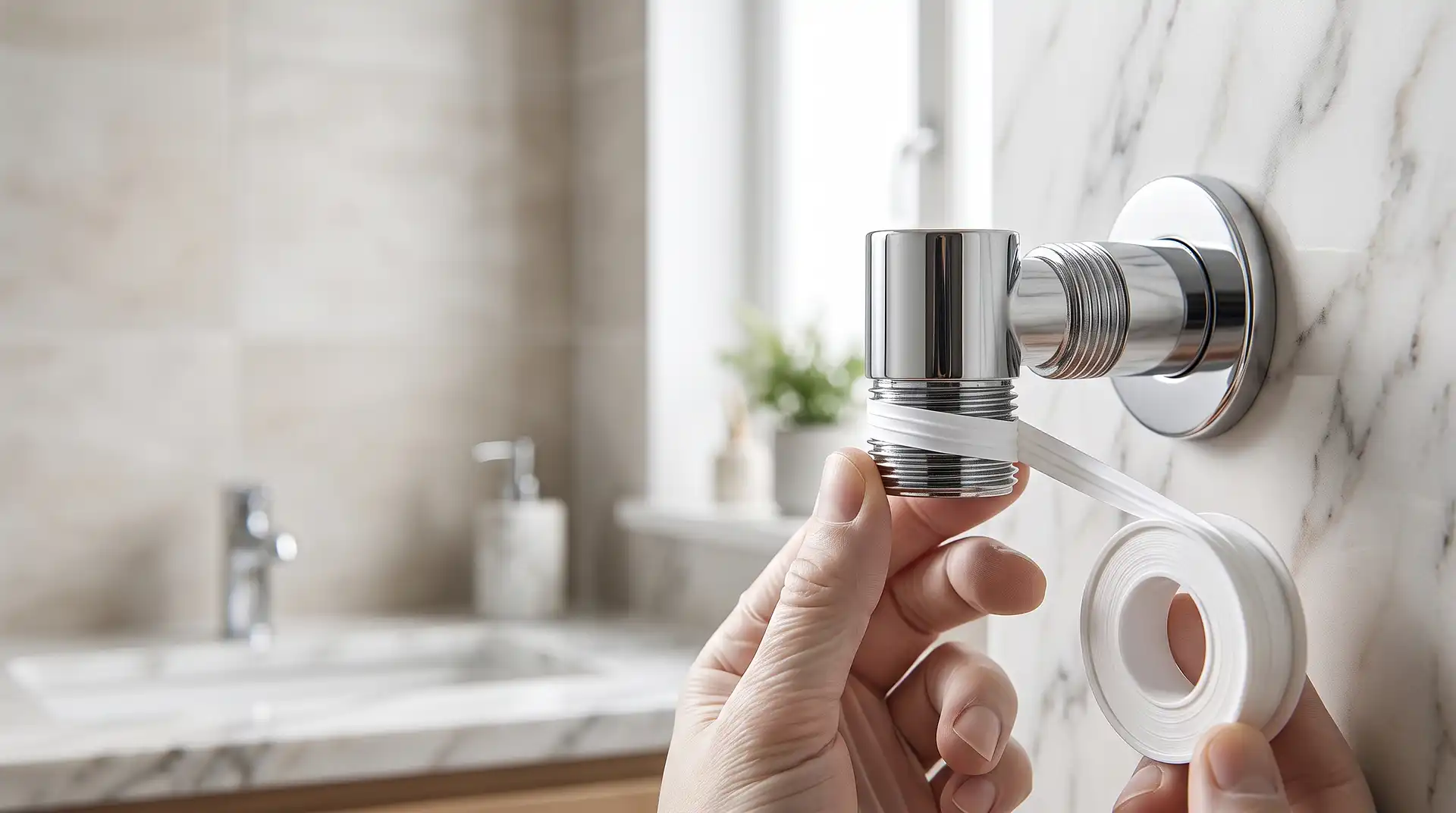
Direction: Wind the tape clockwise when looking at the end of the male thread -- the same direction the fitting will tighten. This ensures that as the joint is screwed together, the tape wraps tighter rather than unwinding and bunching ahead of the fitting.
Starting point: Begin half a thread from the end of the male thread, not at the very tip. Starting at the absolute tip leaves a loose end that can fold into the bore of the fitting as the joint tightens.
Tension: Apply with light tension so the tape stretches slightly and conforms to the thread profile rather than sitting loosely on top of it. Tape applied without tension sits above the thread peaks and compresses unevenly.
Overlapping: Each pass should overlap the previous one by roughly half the tape width. This builds up the seal evenly along the thread helix rather than leaving gaps at the edges.
Finishing: After the final wrap, tear the tape and press the end flat against the thread with a fingertip so it does not trail.
How Many Wraps for Common UK Fittings
Fitting type | Recommended wraps | Notes |
|---|---|---|
15 mm BSP tapered thread | 2 to 3 | Standard hot and cold supply |
22 mm BSP tapered thread | 3 to 4 | Slightly more wraps for larger thread |
28 mm BSP tapered thread | 4 to 5 | Larger thread needs more coverage |
Gas BSP fitting | 2 to 3 (yellow gas tape only) | Never use white PTFE on gas |
Showerhead thread | 2 to 3 | Fine thread, fewer wraps |
Radiator valve thread | 3 to 4 | Often parallel thread -- check for seating washer |
Flexible tap connector | Not required | Rubber washer seals at face |
Boiler pressure gauge | 2 to 3 | Check whether PTFE is manufacturer-approved |
A Note on PTFE Tape and Leak Investigation
PTFE tape is not a remedy for a leaking joint that has already failed. A joint that drips after initial assembly with tape either has a damaged thread that needs replacing, was cross-threaded on assembly, or has an insufficient number of wraps. Adding more tape to an assembled joint that has already leaked by disassembling, cleaning off the old tape, and re-applying fresh tape is a legitimate fix. Wrapping additional tape around the outside of a leaking assembled joint is not.
When a joint leaks despite correct tape application, the sequence to check is: thread condition (damaged, corroded, or cross-threaded threads do not seal), fitting type (compression joints do not benefit from tape), and tightening torque (an undertightened tapered BSP joint leaves a gap in the helix that tape cannot bridge if the threads have not fully engaged).
When PTFE Tape Becomes the Wrong Call Entirely
For any joint that carries gas, always verify the tape is rated for gas. Yellow PTFE tape sold as gas-rated has a higher density and tear strength than standard white plumbing PTFE and is specified for this use. Using standard white PTFE on a gas thread joint may comply with the thread seal requirement while failing the product specification for gas applications.
For joints on potable (drinking) water systems, PTFE tape sold in the UK is generally food-safe and non-reactive, but if the installation requires documentary compliance (commercial premises, social housing, new-build sign-off) confirm that the product carries a WRAS (Water Regulations Advisory Scheme) approval marking. Most standard white PTFE tape sold in UK plumbing merchants is WRAS-approved, but this is worth confirming if required.
Understanding where PTFE tape fits within the broader range of plumbing sealing materials is also worth knowing if you are doing more than a single joint repair. For an idea of what a professional plumber charges to carry out threaded joint work as part of a larger job -- tap installation, radiator valve replacement, or supply pipework connections InstantCost plumbing cost guide has a 2026 UK breakdown by job type including hourly rates, call-out fees, and common job prices so you can judge whether a job is DIY-viable or worth the plumber's time.
PTFE tape is also one of the consumables mentioned in our related guide on how to change a washer on a kitchen mixer tap , which covers the specific tap tail thread connections where tape is needed and the flexible hose connections where it is not -- a distinction that comes up on every tap installation job.
Common Mistakes and What to Do Instead
Mistake: winding tape anticlockwise. Anticlockwise tape unwinds and bunches as the fitting tightens rather than compressing into the thread. Always wind clockwise when looking at the end of the male thread.
Mistake: applying tape to compression fittings. PTFE tape does nothing on a compression joint. The seal is between the olive and the pipe. Tape on the thread of a compression fitting is harmless but completely ineffective.
Mistake: using too many wraps. More than five or six wraps on a standard fitting causes uneven compression, makes the fitting harder to thread correctly, and can crack plastic fittings under the additional torque needed to seat the joint. Two to four wraps is correct for most UK plumbing threads.
Mistake: starting the tape at the very tip of the thread. The end at the tip can fold into the fitting bore on assembly. Start half a thread back from the tip.
Mistake: using white PTFE tape on gas fittings. Gas connections require yellow gas-rated PTFE tape. Standard white plumbing tape is not rated for gas applications.
Mistake: applying tape to a damaged or corroded thread. Tape cannot bridge a physically damaged thread. The thread needs repair or the fitting needs replacement before a tape seal will hold.
Mistake: reusing tape from a disassembled joint. Always remove all old tape before reassembly and apply fresh tape. Old tape that has been compressed loses its sealing properties and does not recompress correctly.
What It Costs in the UK
Item | Typical UK cost (2026) |
|---|---|
Standard white PTFE tape (12 mm roll) | £1 to £3 |
Gas-rated yellow PTFE tape | £2 to £5 |
Wide PTFE tape (19 mm or 25 mm) | £2 to £4 |
PTFE thread sealant paste | £4 to £10 |
Plumber hourly rate (if calling one in) | £40 to £80 |
PTFE tape is one of the lowest-cost consumables in plumbing. The cost of a roll is never a reason to skimp on wraps or reuse old tape.
Staying Safe
PTFE tape itself is chemically inert, non-toxic, and safe to handle without protective equipment. The safety considerations around plumber's tape are entirely about the plumbing context rather than the tape.
On gas fittings, always confirm the supply is turned off at the meter before disassembling any gas threaded joint. Never use standard white PTFE tape on gas pipework. If there is any smell of gas before, during, or after working on a gas fitting, stop immediately, turn off the gas at the meter, ventilate the space, leave the property, and call the National Gas Emergency Service on 0800 111 999.
On potable water supply joints, run the water for 30 seconds after assembly and check all joints before confirming the job is complete. A slow drip at a threaded joint that has been incorrectly taped will not announce itself until the cabinet below is wet.
Keep tape rolls away from young children. While PTFE is non-toxic, the roll is a swallowing and entanglement hazard.
PTFE tape for use on gas fittings in the UK must be suitable for the operating pressure and temperature of the system. Yellow gas-rated PTFE tape is typically rated to 10 bar and -200 to +260 degrees Celsius, which covers all domestic UK gas applications. If in any doubt about gas pipework, always use a Gas Safe registered engineer.
FAQ
How many times should you wrap PTFE tape? Two to four wraps for most standard UK plumbing thread sizes. Three wraps is a reliable default for 15 mm and 22 mm BSP fittings. Larger threads (28 mm and above) benefit from four to five wraps. Never exceed six wraps on standard fittings.
Do you need PTFE tape on compression fittings? No. Compression fittings seal by an olive compressed between the fitting and the nut -- not by thread engagement. PTFE tape on a compression fitting thread does nothing to improve the seal.
Which direction do you wrap PTFE tape? Clockwise when looking at the end of the male thread -- the same direction the fitting tightens. This ensures the tape wraps tighter as the joint is assembled rather than unwinding and bunching.
Can you use too much PTFE tape? Yes. More than five or six wraps causes uneven compression and can make threading difficult, increase the torque needed to tighten the fitting, and crack plastic fittings under excess load. Two to four wraps is the correct range for most joints.
Can PTFE tape stop a leak on an existing joint? Not by adding tape to the outside of an assembled joint. Disassemble the joint, remove all old tape, apply fresh tape correctly, and reassemble. If the thread is damaged, tape alone will not produce a lasting seal.
What is the difference between white and yellow PTFE tape? White PTFE tape is for water plumbing. Yellow PTFE tape is gas-rated, with higher density and tear strength, for use on gas threaded fittings. Always use yellow gas-rated tape on gas connections.