How to Bleed a Towel Radiator
27 August 2026
How to Bleed a Towel Radiator
A towel radiator that is warm at the bottom but cold higher up has air trapped in the upper section of the rail, and bleeding it releases that air so hot water can circulate through the full height. The process takes under five minutes once you have found the bleed valve -- which, on a towel rail, is the part that trips most people up.
Standard panel radiators have the bleed valve at one of the top corners, clearly visible as a square or slotted plug. Towel rails are different. Depending on the style, the valve can be on the top rail, inside an end cap, behind a decorative cover, or on the pipework below the rail body rather than on the rail itself. Some cheaper models have no bleed valve at all and require a different approach.
Before going any further, there is one question worth settling first.
Is the Towel Rail Hydronic or Electric?
This is the step that determines whether bleeding is even possible.
A hydronic towel rail is connected to the central heating system and carries hot water from the boiler through the rail. It has two pipes at the base connecting to the heating pipework, usually one flow and one return. These rails can and do trap air, and bleeding them is the correct fix for cold spots.
An electric towel rail runs on electricity alone. It has a cable or plug rather than pipework connections, and the heating element inside the rail does not carry water. There is nothing to bleed. A cold spot on an electric rail is either a failed heating element, a faulty thermostat, or a rail that simply has not been on long enough to heat fully.
A dual-fuel towel rail can run on either central heating or electricity. When connected to the heating system it can trap air and needs bleeding in the same way as a hydronic rail. When running in electric-only mode, cold spots are an electrical issue.
Check the base of the rail. Two pipe connections going into the floor or wall confirm it is hydronic. A single cable or no visible connections at all confirm it is electric.
Finding the Bleed Valve on a Towel Rail
Once hydronic operation is confirmed, the search for the bleed valve begins. These are the most common locations by rail type.
Ladder-style chrome rails (the most common UK type): The bleed valve is usually at the top of one of the upright rails, set into the end cap. It looks like a small square or hexagonal plug, sometimes with a slot for a flat-head screwdriver. On some models it is inside the end cap and requires removing a decorative cover first -- these caps unscrew anticlockwise by hand or with a spanner.
Flat panel towel radiators: These typically have the bleed valve at one of the upper corners, similar in position to a standard panel radiator but sometimes smaller in size and requiring a smaller bleed key.
Designer and asymmetric rails: The valve position varies by manufacturer. On vertical column-style rails the valve is usually at the highest point of the rail, sometimes accessed from the rear. Check along the top edge and the back face before assuming there is no valve.
Rails with no visible bleed valve: Some budget and older towel rails were manufactured without a dedicated bleed valve. In this case, a manual bleed plug -- a solid brass or plastic screw in the end cap -- can be loosened very slightly with a flat-head screwdriver to allow air to escape. This requires care: loosening it too far releases water rather than just air.
Bleed point on the pipework: On some installations the bleed valve was fitted to the flow pipe below the rail during installation rather than to the rail body itself. Check the pipework immediately below the rail for a valve that looks out of place on an otherwise straightforward pipe run.
Tools Needed
A radiator bleed key for standard bleed valves -- these cost under £2 from any hardware shop and fit most UK domestic heating valves. A flat-head screwdriver for slotted valves or manual bleed plugs. A small container or cloth to catch the water released when bleeding. Old towels on the floor below the rail if the bathroom floor is tiled, since the water released is often discoloured from heating system corrosion inhibitor and stains grout.
Step 1: Check the Boiler Pressure First
Before bleeding any radiator or towel rail, check the boiler pressure gauge. Bleeding releases a small amount of water from the system, which causes a corresponding pressure drop. If the boiler pressure is already at or below 1 bar before bleeding starts, top it up to 1.5 bar first. Bleeding from a system already at low pressure risks dropping it below the minimum threshold the boiler needs to operate, triggering a lockout.
Step 2: Turn the Heating On and Identify the Cold Spots
Run the heating for 15 minutes and feel along the rail from bottom to top. Hot at the bottom and progressively cooler toward the top confirms air is trapped in the upper section. A rail that is completely cold despite the heating running and hot water confirmed elsewhere in the system has either a closed lockshield valve at the base or a blockage rather than an air pocket.
Turn the heating off and wait 10 to 15 minutes before bleeding. Working on a pressurised hot system risks a scalding water release rather than an air release when the valve is opened.
Step 3: Bleed the Rail
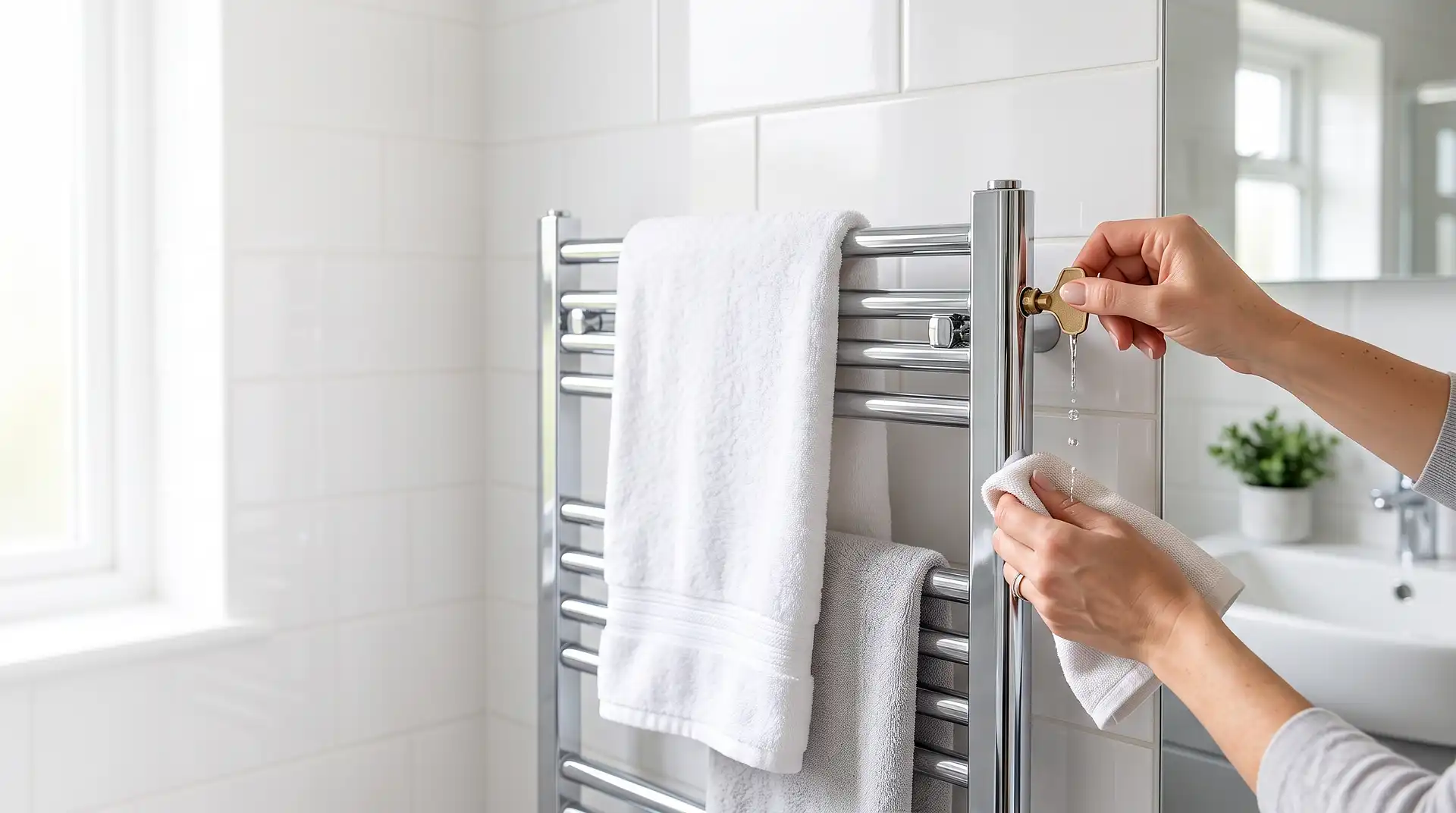
Place the container or cloth below the bleed valve. Insert the bleed key or screwdriver into the valve and turn anticlockwise by a quarter turn only -- not a full rotation, just enough to open the valve slightly.
A hissing sound confirms air is escaping. Keep the valve open until the hissing stops and a steady bead of water appears at the valve. At that point, close the valve by turning clockwise back to its original position. Do not overtighten snug is sufficient, and overtightening damages the valve seat on smaller towel rail valves more readily than on standard radiator valves.
If water appears immediately with no hissing, there was no significant air pocket in that location. Check whether the rail has a second bleed point at the opposite end, which some ladder-style rails have on both uprights.
Step 4: Check the Boiler Pressure Again
After bleeding, recheck the boiler pressure gauge. A single towel rail bleed typically causes a pressure drop of 0.1 to 0.2 bar -- small enough that topping up is often unnecessary. If pressure has dropped below 1 bar, top up through the filling loop before restarting the heating.
Step 5: Test the Rail
Restart the heating and allow 15 minutes for the system to circulate. Run your hand along the full height of the rail from the bottom connection upward. Even warmth across the full height, with the upper rails as warm as the lower section, confirms the air has been cleared successfully.
If the upper section of the rail is still cooler than the lower after 15 minutes, there may be a second air pocket, a partial blockage, or the lockshield valve at the base may be partially closed. Check the lockshield -- the valve cap at the base of the rail that looks different from the thermostatic or manual valve -- and confirm it is open. A lockshield closed more than it should be restricts flow through the rail regardless of whether air has been cleared.
When Bleeding Does Not Fix It
A towel rail that returns to the same cold-top pattern within a few weeks of bleeding has either a persistent air entry point in the system, a failing automatic air vent somewhere in the circuit, or a micro-leak that is slowly introducing air as water escapes. Repeated bleeding that only provides temporary relief is a prompt to have a heating engineer inspect the system rather than to bleed more frequently.
A rail that has never heated correctly since installation may have been incorrectly commissioned -- valves not fully open, air not bled at installation, or a flow direction issue if the flow and return connections were reversed.
If the towel rail is part of a bathroom that is overdue for a broader update -- new suite, retiling, or replumbing -- it is worth factoring in whether the current rail position, size, and specification suits the room. A properly sized hydronic towel rail for an average UK bathroom requires around 500 to 800 watts of output to both heat the towels effectively and contribute to room warmth, and undersized rails are a common source of persistent dissatisfaction regardless of how well they are bled. The InstantCost boiler and heating cost guide covers 2026 UK pricing for heating system work including radiator and towel rail installation costs, engineer day rates, and when a full heating system assessment makes sense financially alongside a bathroom renovation.
For the broader radiator maintenance picture, our related guide on how to take a radiator off the wall covers the isolation and draining process that applies when a towel rail needs removing for bathroom decoration or replacement, including how to record the lockshield valve setting before closing it so the system balance is preserved when the rail goes back on.
Common Mistakes and What to Do Instead
Mistake: trying to bleed an electric towel rail. Electric rails have no water and no air to bleed. A cold spot on an electric rail is a fault with the element or thermostat, not trapped air.
Mistake: bleeding with the heating running at full temperature. Hot pressurised water releases suddenly when the valve opens and scalds. Turn the heating off and wait for the system to cool before opening any bleed valve.
Mistake: opening the bleed valve more than a quarter turn. A quarter turn is enough to release air. Further rotation risks the valve coming out of the fitting entirely on older or corroded valves, releasing a flow of system water that is difficult to stop without turning off the whole system.
Mistake: not checking the boiler pressure before bleeding. Bleeding from a low-pressure system drops it further and locks out the boiler. Check pressure first, top up if needed, then bleed.
Mistake: not checking the lockshield valve when bleeding fails to fix cold spots. A partially closed lockshield restricts flow through the rail. Confirm both valves at the base of the rail are fully open before concluding the problem is air rather than flow restriction.
Mistake: assuming one bleed point covers the whole rail. Some ladder-style towel rails have bleed valves at both upper ends. If bleeding from one end produces water immediately with no air, check the other end before concluding the job is done.
What It Costs in the UK
Item | Typical UK cost (2026) |
|---|---|
Radiator bleed key | Under £2 |
Replacement bleed valve | £3 to £8 |
Heating engineer call-out | £80 to £150 |
Heating engineer hourly rate | £40 to £80 |
New hydronic towel rail (budget) | £40 to £120 |
New hydronic towel rail (mid-range) | £120 to £350 |
Towel rail installation (labour) | £80 to £200 |
Figures based on InstantCost.co.uk's 2026 UK heating pricing data and vary by region and provider.
Staying Safe
Heating system water is not drinking water. It contains corrosion inhibitors and biocides that are irritating on skin contact and harmful if swallowed. Wear gloves if handling significant quantities and wash hands after any contact with system water. The discoloured water released during bleeding should go into a container for disposal down a foul drain, not directly into a bathtub or hand basin used for washing.
Do not bleed a rail on a system with a known gas fault or when a gas smell is present. Deal with any gas concern first by turning off the supply at the meter, ventilating, leaving the property, and calling the National Gas Emergency Service on 0800 111 999.
Keep children out of the bathroom during the bleeding process. The valve releases water at heating system temperature, which is hot enough to cause burns even after the heating has been off for 10 minutes.
Bleeding a radiator or towel rail is a user maintenance task that does not involve the gas or electrical components of the heating system and does not require Gas Safe registration or Part P notification. Any work on the valves, pipework, or connections of a hydronic heating system beyond bleeding requires a competent person and, where gas-related work is involved, a Gas Safe registered engineer.
FAQ
Why is my towel rail warm at the bottom but cold at the top? Air has collected in the upper section of the rail, preventing hot water from reaching the full height. Bleeding the rail at the highest bleed point releases the trapped air and allows hot water to circulate through the whole rail.
Where is the bleed valve on a towel radiator? It depends on the style. On ladder-style chrome rails it is usually at the top of one of the upright bars, inside or on the end cap. On flat panel rails it is typically at an upper corner. Some rails have the valve on the pipework below rather than on the rail body itself. Check the top of the rail and the end caps first.
Can you bleed an electric towel rail? No. Electric towel rails contain no water and have nothing to bleed. A cold spot on an electric rail is a fault with the heating element or thermostat control.
How often should a towel rail need bleeding? Once at the start of the heating season is normal as part of general radiator maintenance. A rail that needs bleeding repeatedly throughout the season has an air entry point or a micro-leak in the system that needs investigating.
What if no air or water comes out when I open the bleed valve? Either the valve is fully closed and needs a further quarter turn, the bleed point is not at the highest point of the rail and there is a second valve elsewhere, or the lockshield valve at the base of the rail is closed and preventing any circulation.
Will bleeding a towel rail affect my boiler pressure? Slightly. A single bleed typically drops system pressure by 0.1 to 0.2 bar. Check the boiler pressure gauge before and after. If it drops below 1 bar, top up through the boiler filling loop before restarting the heating.