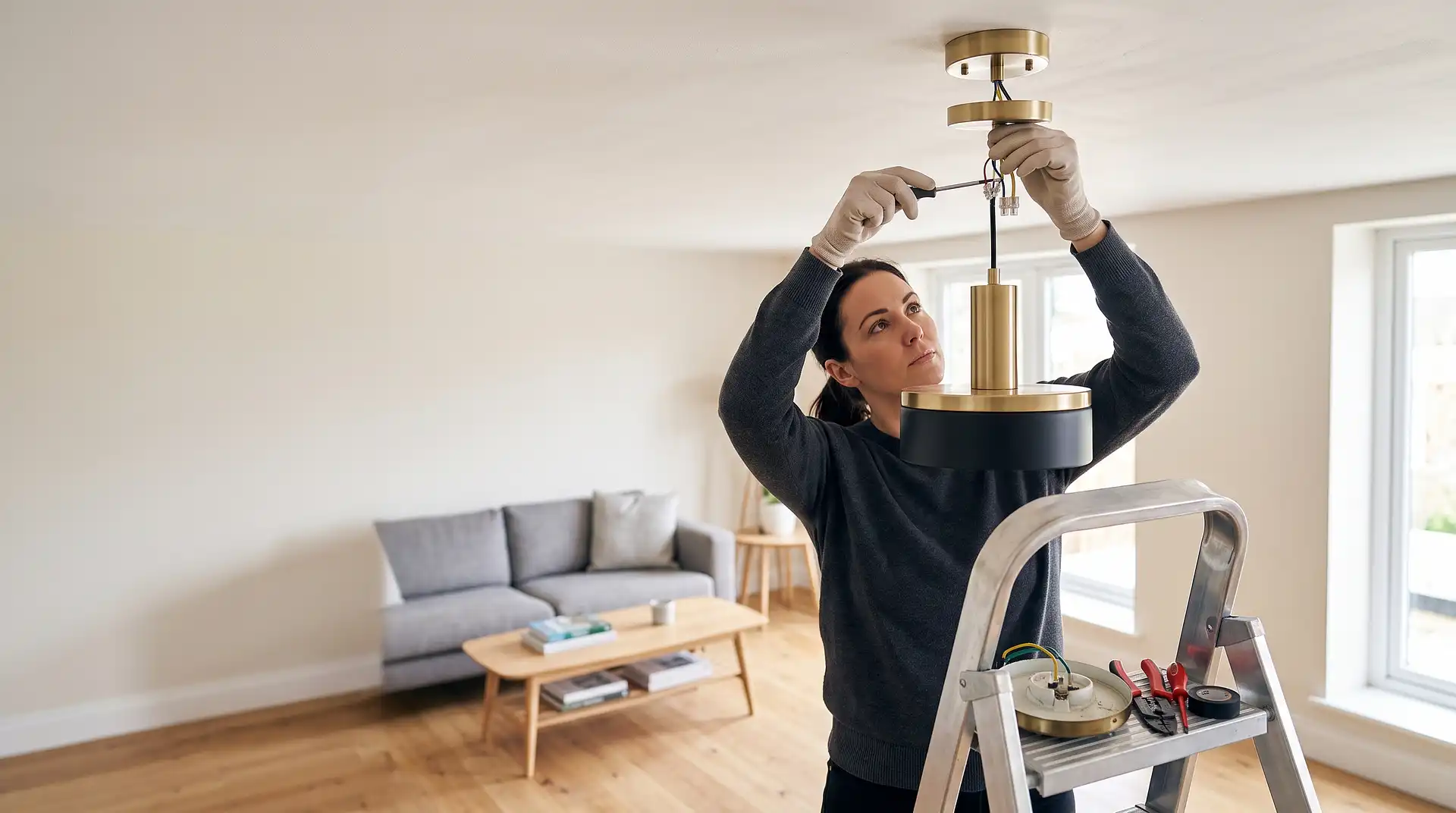
How to Change a Light Fitting
27 August 2026
How to Change a Light Fitting
Swapping one ceiling light fitting for another in the same position is legal DIY work in the UK for a competent homeowner. It does not require an electrician, does not need notifying to building control, and in a straightforward bedroom or living room installation takes under an hour. What trips most people up is not the job itself but the wiring they find when the old fitting comes down because UK ceiling roses can be wired in one of two configurations, and the one you have determines how the connections are made.
There is also a clear line in UK law between what a homeowner can do and what requires a registered electrician. Staying on the right side of that line is worth understanding before starting.
What You Can and Cannot Do Yourself
Under Part P of the Building Regulations, electrical work in dwellings is either notifiable or non-notifiable. Replacing a light fitting on an existing circuit at the same position is non-notifiable work you can do it yourself without involving building control or a registered electrician.
The work becomes notifiable the moment you move beyond like-for-like replacement: adding a new lighting circuit, moving a light to a different position that requires new cable runs, installing a fitting in a bathroom or shower room (these are special locations with stricter rules), or adding new switch wiring that was not there before. Any of these require either a registered electrician to carry out the work and self-certify, or a building control application before work begins.
For a standard like-for-like ceiling light swap in a living room, bedroom, hallway, or kitchen, you are well within the permitted scope for a competent homeowner.
Turn Off the Power and Confirm It Is Off
Go to the consumer unit and switch off the circuit breaker for the lighting circuit serving that room. If the circuits are not labelled, switch off all lighting breakers and use a plug-in lamp to identify which one controls the room you are working in.
After switching off at the consumer unit, use a non-contact voltage tester on the existing fitting wires before touching anything. These cost £10 to £20 and are worth buying for any electrical work around the home. A circuit breaker that has tripped rather than been switched off, or a property with a secondary consumer unit, can leave a circuit live that appears to be isolated. Confirm with the tester every time.
Remove the Old Fitting
Most UK ceiling roses and light fittings are held by one or two screws into a plastic backing plate, which is itself fixed to the ceiling joist or to a batten mounted between joists. Unscrew the cover or canopy of the old fitting to expose the wiring. Do not pull on the wires support the fitting while the connections are undone.
Photograph the wiring before disconnecting anything. This takes five seconds and gives you a reference if the new connections are queried at any point.
Understanding What You Will Find
Two wiring systems are common in UK homes and the connections differ between them.
Loop-in wiring (most common in post-1960s homes): The ceiling rose is the junction point for the circuit. When the cover comes off you will typically see three or more cables entering the rose, with connections in multiple terminals: line (live), neutral, and switch wire groups. The line conductors are connected in one terminal block, the neutrals in another, and the switch wire feeds the lamp terminals. This system is wired at the ceiling rose itself rather than at a separate junction box.
Junction box wiring (common in older properties): A junction box is hidden in the ceiling void above. Only two wires drop to the ceiling rose: one feed and the switch return. The rose itself has simpler connections because the junction point is elsewhere.
If you see only two thin cables entering the rose, you likely have junction box wiring. If you see multiple cables with several conductors each, it is loop-in. Both are straightforward once identified the key is matching the new connections to the old arrangement shown in your photograph.
Conductor colours in UK properties:
Modern cable (post-2004): brown is line (live), blue is neutral, green/yellow is earth. Old cable (pre-2004): red is line, black is neutral, green/yellow is earth.
Some properties have both, particularly where partial rewiring has been done. Old black neutral conductors are sometimes sleeved in red when they carry line voltage in a switch return if you see a black conductor with red or brown sleeving, treat it as live.
Connecting the New Fitting
Most modern light fittings terminate in a simple connector block or push-fit connectors rather than a traditional ceiling rose. Connect line to line, neutral to neutral, and earth to earth using the terminal designations on the new fitting.
If the new fitting has no earth terminal but the circuit cable includes an earth conductor, sleeve the earth with a green/yellow earth sleeve and connect it to the metal backplate of the fitting if it has one, or cap it with a connector and leave it in the ceiling void if the fitting is double-insulated. Double-insulated fittings are marked with a square-within-a-square symbol on the packaging.
Do not leave any conductors exposed. All terminations must be inside the fitting canopy or within the ceiling rose cover. Push-fit connectors should be tugged gently after insertion to confirm they have seated properly.
Secure the fitting to the ceiling using the fixings provided. If the fitting is heavier than a standard shade a large chandelier, a lantern, or a multi-arm fitting confirm the ceiling backplate is fixed to a joist or a batten capable of supporting the weight. A fitting fixed only to plasterboard with plastic plugs will not support anything heavier than a few kilograms over time.
Restore Power and Test
Switch the circuit breaker back on and test the light. If the circuit breaker trips immediately on restoration, there is a wiring fault a short circuit, usually a bare conductor touching another or the metalwork. Switch off again, recheck every connection, and confirm no conductor is touching the fitting body.
If the light does not come on but the breaker holds, check the lamp is correctly seated, confirm the switch is on, and check the connections at the switch wire terminals in the rose.
Bathrooms and Kitchens: Different Rules Apply
Any light fitting in a bathroom or shower room falls under the IP rating and zone rules in Part P. Zone 0 is inside the bath or shower, Zone 1 is directly above, Zone 2 extends to 0.6 metres horizontally from the bath edge and up to 2.25 metres above the floor. Standard domestic light fittings are not rated for Zones 0 or 1, and most are not suitable for Zone 2 without an appropriate IP rating.
Replacing like-for-like in a bathroom is still technically possible for a competent person, but the zone compliance, the correct IP rating for the replacement fitting, and the supplementary bonding requirements make bathroom lighting the one area where using a registered electrician removes all ambiguity. A fitting installed incorrectly in a bathroom zone is an insurance and liability issue in addition to a safety one.
Kitchens are not special locations in the same sense, but fittings near a sink or cooker should have an appropriate IP rating for the environment.
When to Call an Electrician
Use a registered electrician for anything beyond a like-for-like swap: adding a dimmer to a circuit that was not previously dimmed (requires checking the circuit's dimmer compatibility), moving a light to a different position, installing lighting in a bathroom, adding a new pendant in a room that currently has none, or if you open the ceiling rose and find wiring that does not match any configuration you can identify.
According to InstantCost 2026 UK electrician pricing data, a light fitting installation by a registered electrician costs £120 to £280 per fitting depending on complexity, access, and whether a new circuit or switch position is required. The electrician hourly rate runs £40 to £75, and most straightforward fitting installations complete in one to two hours. For a full breakdown of electrical job costs across fitting types, switch additions, and consumer unit work, the InstantCost electrician cost guide has a 2026 UK calculator you can filter by job type and region before accepting any quote.
When the job involves spotlights specifically whether replacing a full recessed downlight assembly or just swapping the bulb in a GU10 holder the process and the compliance question differ from a pendant fitting. Our related guide on how to change a spotlight bulb covers the critical distinction between fittings where the bulb is replaceable and sealed integrated LED units where the whole assembly needs changing, which affects both the cost and whether the work stays within DIY scope.
Common Mistakes and What to Do Instead
Mistake: not confirming the circuit is dead with a voltage tester before touching any wires. A switched-off breaker is not the same as a confirmed dead circuit. Use a non-contact tester on every conductor before making contact.
Mistake: not photographing the original wiring before disconnecting. The photograph is your reference and your proof of the original configuration if any question arises later.
Mistake: treating old black neutrals as always neutral. In switch return wiring, a black conductor can carry line voltage. Look for red or brown sleeving as an indicator, and if unsure, test with the voltage tester before assuming.
Mistake: fixing a heavy fitting to plasterboard alone. Plasterboard fixings holding a pendant fitting that weighs more than 2 to 3 kg will eventually fail. Identify the joist position with a detector and fix into the structural ceiling, or have a batten installed before fitting.
Mistake: installing a standard fitting in a bathroom zone without checking the IP rating. A fitting without the appropriate ingress protection rating in a wet zone is non-compliant and a safety risk.
Mistake: assuming a dimmer swap is like-for-like. LED-compatible dimmers have specific compatibility requirements with LED driver circuits. A dimmer swap that introduces flicker, buzzing, or minimum-load behaviour was not a compatible substitution.
What It Costs in the UK
| Item or service | Typical UK cost (2026) | |,-|,-| | Non-contact voltage tester | £10 to £20 | | Basic pendant light fitting | £15 to £60 | | Mid-range ceiling light | £60 to £200 | | Designer or statement fitting | £200 to £1,000+ | | Electrician hourly rate | £40 to £75 | | Like-for-like fitting installation (electrician) | £120 to £280 | | New lighting circuit (electrician, with certification) | £300 to £600 | | Bathroom lighting installation (electrician) | £150 to £350 |
Figures based on InstantCost 2026 UK electrician pricing data and vary by region, access, and job complexity.
Staying Safe
Every step of this job depends on the circuit being genuinely isolated. The most serious risk is not a shock from a 230-volt supply that risk is eliminated by correct isolation and verification it is the assumption of isolation without the verification step. Buy a non-contact voltage tester before starting and use it on every conductor before touching it, every time.
Earth continuity matters. A fitting with exposed metalwork that is not earthed creates an electric shock hazard if a fault develops in the circuit. Confirm the earth conductor is connected to any accessible metal in the fitting. If the new fitting is double-insulated and has no earth terminal, the earth conductor should be capped and left in the ceiling void rather than left bare.
Keep children and pets out of the room while working and until the consumer unit is restored. Exposed wiring at ceiling level is not a realistic hazard to a child at floor level, but tools and components on the floor are.
Replacing a like-for-like light fitting in a UK dwelling is non-notifiable work under Part P of the Building Regulations when carried out by a competent person. Work that introduces new circuits, new switch positions, or fittings in special locations (bathrooms, outdoor) must either be carried out and certified by a registered electrician (NICEIC, NAPIT, ELECSA) or notified to building control before work begins. Uncertified notifiable electrical work is a problem at sale and remortgage. Verify current Part P requirements at planningportal.co.uk.
FAQ
Do I need an electrician to change a light fitting in the UK? Not for a like-for-like replacement on an existing circuit at the same position. This is non-notifiable work under Part P that a competent homeowner can carry out. Bathroom fittings, new circuit work, and moving a light to a new position all require a registered electrician.
What wiring will I find when I remove a ceiling light? Either loop-in wiring (multiple cables entering the ceiling rose, the rose acting as the circuit junction point) or junction box wiring (fewer cables, the junction point hidden above in the ceiling void). Photograph the connections before removing anything.
What do the wire colours mean in UK lighting circuits? In modern cable: brown is live, blue is neutral, green/yellow is earth. In older cable: red is live, black is neutral, green/yellow is earth. Some properties have both if partially rewired. A black conductor with red or brown sleeving in switch return wiring carries live voltage.
Can I change a bathroom light fitting myself? Technically it remains like-for-like replacement, but bathroom zones have IP rating requirements and supplementary bonding rules that make this the one area where using a registered electrician removes all compliance risk. Most homeowners use an electrician for bathroom lighting work.
How much does an electrician charge to change a light fitting? £120 to £280 for a straightforward installation in 2026. Electricians charge £40 to £75 per hour and most fitting installations take one to two hours depending on access and any switch or circuit complications.
What if the circuit breaker trips when I restore power after changing the fitting? Switch off immediately and recheck all connections. A tripped breaker on restoration usually means a short circuit a bare conductor touching the fitting metalwork or another conductor. Do not repeatedly reset the breaker. Find and fix the fault before restoring power.