How to Clean Candle Wax Out of Carpet
13 August 2026
Spilled candle wax is genuinely one of the more satisfying carpet stains to deal with, because unlike most spills, the standard advice is the opposite of what instinct suggests: don't rush. Let it harden completely before touching it. Wax that's fully set breaks apart and lifts cleanly, whereas wax you try to blot or wipe while still liquid gets pushed deep into the fibres and spreads across a wider area, turning a small, contained problem into a considerably larger one.
There's also a second issue that catches people out. Coloured candle wax is really two stains in one, the wax itself and the dye within it. Removing all the wax doesn't necessarily remove the colour, and knowing that in advance stops you assuming you've failed when a faint tint remains after the wax is genuinely gone.
Step 1: Let It Harden Completely
Resist the urge to do anything while the wax is still soft or warm. If you want to speed the process, place an ice pack or a bag of ice cubes on top for ten to fifteen minutes, which sets it firm and brittle. Never place ice directly onto the carpet without a bag, since you don't want to add water to the fibres before you've removed the wax.
Step 2: Scrape Away the Bulk
Once fully hard, use a blunt tool, the edge of a spoon, a butter knife, or a plastic scraper, to break up and lift away as much of the solid wax as you can. Work from the outer edge of the spill inward, which stops you pushing wax outward into clean carpet. Vacuum up the loose fragments as you go rather than letting them get trodden back in.
Avoid anything genuinely sharp here. A knife blade angled wrongly cuts carpet fibres, and that damage is permanent in a way the wax stain isn't.
Step 3: The Iron and Paper Method
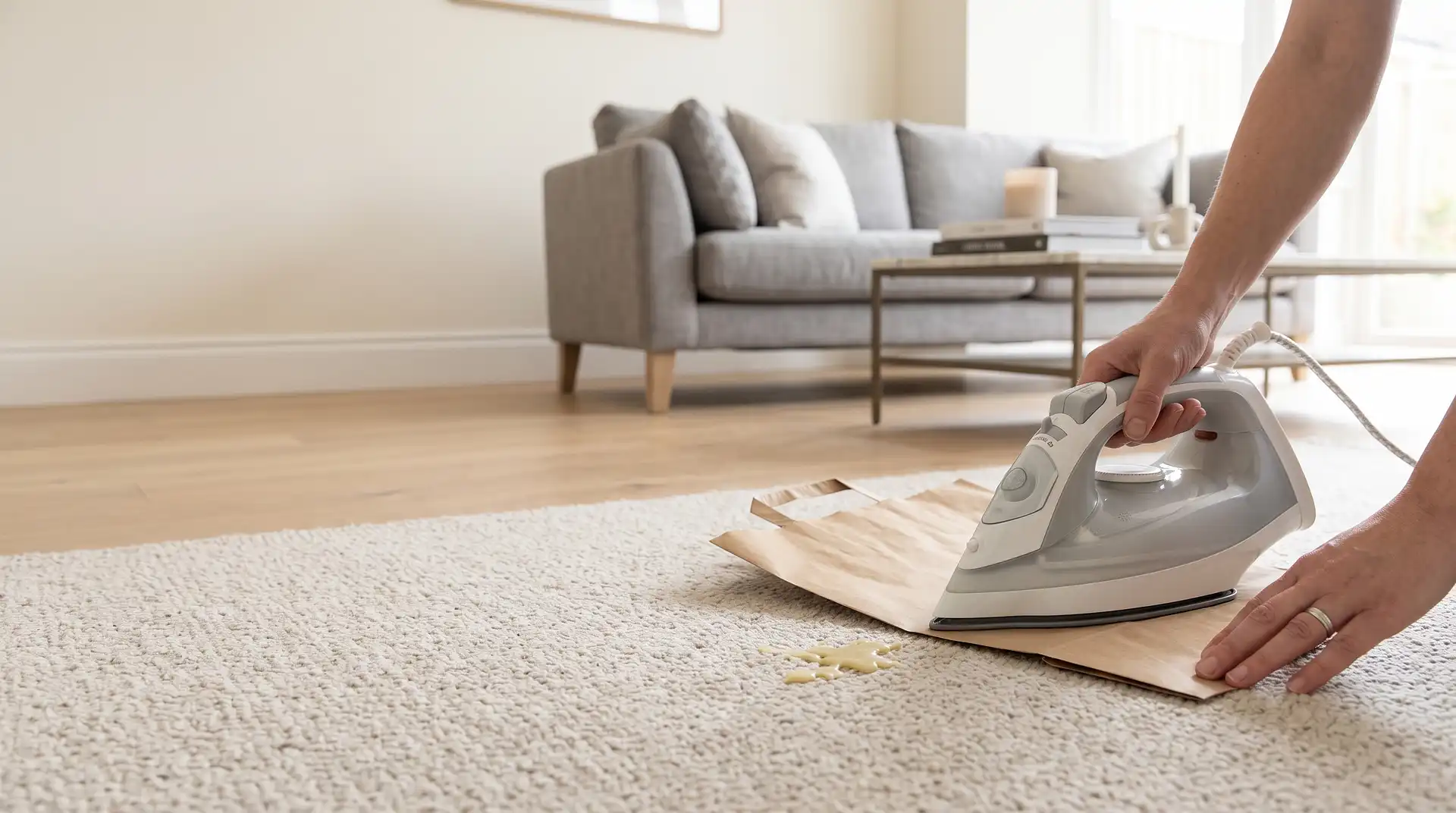
This is the core technique, and it works by melting the remaining embedded wax and giving it something more absorbent than carpet fibre to soak into.
Set an iron to a low or medium heat with the steam function switched off entirely, since steam adds moisture that works against you here. Place a clean piece of brown paper, a plain paper bag, or a folded white paper towel over the waxy area. Some people use a thin cotton cloth instead, which also works, though paper shows the absorbed wax more visibly so you can see progress.
Press the iron onto the paper for a few seconds at a time rather than holding it in place, and lift to check. You should see wax transferring onto the paper. Move to a clean section of paper each time, this matters more than it sounds, since a saturated patch of paper stops absorbing and starts redepositing melted wax back into the carpet.
Repeat with fresh paper until no more wax transfers.
Step 4: Deal With Coloured Wax Dye
If the candle was coloured, you may still see a tint once the wax is gone. Treat this as a separate stain rather than more wax. Dab, don't rub, with a cloth dampened in isopropyl alcohol or a mix of white vinegar and water, testing on a hidden section of carpet first. Work from the outside in, using a clean part of the cloth each time, then blot with cold water and dry.
Step 5: Restore the Pile
Once everything's dry, the treated area may look slightly flattened or matted compared to the carpet around it. Gently brush or rake the pile with a soft brush to lift the fibres back up, which usually blends the area back in.
A Note on Synthetic Carpets
Heat is the main risk in this method. Synthetic fibres, particularly polypropylene and some polyester blends, can melt or glaze under a hot iron, and unlike the wax stain, that damage doesn't come out. Keep the iron on a low setting, always work through paper or cloth rather than touching the carpet directly, and never hold the iron in one position. If you're genuinely unsure what your carpet is made of, test on a hidden area first, or skip the iron method entirely and rely on freezing and scraping alone, which is slower but carries no heat risk.
When to Skip DIY Entirely
If the spill is large, if it's on a wool or delicate natural fibre carpet where you'd rather not risk heat, if coloured dye has left a stain that alcohol hasn't shifted, or if a previous attempt has already spread the wax across a wide area, professional treatment is a reasonable call. Professionals have solvents formulated for wax specifically and won't be improvising with a household iron on an expensive carpet.
If the wax spill is one of several marks you're dealing with rather than an isolated incident, it may be worth treating the room as a whole rather than spot-treating repeatedly. Our related guide covers how to remove different types of carpet marks, since mud, wine, grease, ink and blood each need genuinely different approaches, and using the wrong method on the wrong stain is a common way to set a mark permanently rather than lift it.
Common Mistakes and What to Do Instead
Mistake: trying to clean wax while it's still soft. This pushes it deeper into the pile and spreads it wider. Let it harden fully, or accelerate that with an ice pack, before touching it.
Mistake: using a sharp knife to scrape. Carpet fibres cut easily and permanently. Use a blunt spoon edge, butter knife, or plastic scraper.
Mistake: leaving the iron on steam. Steam adds moisture that works against absorption. Switch it off completely and use dry heat only.
Mistake: reusing the same patch of paper. Once a section is saturated, it stops absorbing and starts putting melted wax back into the carpet. Move to clean paper every few passes.
Mistake: holding the iron in one place. Short presses with checks in between prevent heat damage to synthetic fibres. Continuous contact risks melting or glazing the pile.
Mistake: assuming remaining colour means the wax is still there. With coloured candles, dye is a separate stain needing separate treatment. The wax may be entirely gone while a tint remains.
What It Costs in the UK
DIY removal costs essentially nothing, brown paper or paper towels, an iron you already own, and a blunt scraper. Isopropyl alcohol for dye residue typically costs £3 to £8 for a bottle that lasts a long time.
If professional treatment is needed, according to InstantCost.co.uk's 2026 UK carpet cleaning pricing data, individual stain treatment is typically priced at £10 to £25 per stain, which is generally the most sensible option for a single isolated wax spill rather than booking a full room. If the wax is one of several issues on a carpet that's due a broader clean anyway, a single small room typically costs £35 to £55, a single large room £55 to £90, stairs and landing £40 to £70, and a whole 3-bed house £140 to £240. Deep-pile or shag carpets may carry a 10 to 20% surcharge, since they take longer to work through and dry.
Item or Service | Typical UK Cost (2026) |
|---|---|
Brown paper, iron, blunt scraper | Usually already owned |
Isopropyl alcohol (for dye residue) | £3 to £8 |
Professional per-stain treatment | £10 to £25 |
Professional clean, single small room | £35 to £55 |
Professional clean, single large room | £55 to £90 |
Professional clean, whole 3-bed house | £140 to £240 |
Deep-pile or shag surcharge | 10 to 20% |
Figures based on InstantCost.co.uk's 2026 UK carpet cleaning pricing data and vary by region, carpet condition, and provider.
Staying Safe
Keep the iron on its lowest effective setting and never leave it face down on carpet, even briefly, since scorch damage happens quickly and can't be undone. Unplug it before walking away and keep children and pets clear of the area while you're working with a hot iron at floor level, which is an unusual and easy-to-forget hazard position.
Ventilate the room if using isopropyl alcohol for dye residue, and store it in its original labelled container out of reach afterward.
Carpet fibre types react differently to heat, so test on a hidden section first if you're unsure what yours is made of, particularly with synthetic carpets where melting is a genuine risk.
FAQ
Should I clean up candle wax while it's still warm? No, this is the most common mistake. Warm wax spreads and pushes deeper into the fibres. Let it harden completely, or speed that up with an ice pack, before scraping.
Does the iron method work on all carpets? It works on most, but synthetic fibres like polypropylene can melt under heat. Keep the iron low, always work through paper, never touch carpet directly, and test on a hidden area if unsure of your carpet type.
Why is there still a stain after I removed all the wax? Coloured candles leave dye behind, which is a separate stain from the wax itself. Treat it with isopropyl alcohol or a vinegar and water mix, dabbing rather than rubbing.
Can I use a hairdryer instead of an iron? It can work for softening wax, but an iron with absorbent paper is more effective, since the paper is what actually removes the melted wax rather than just liquefying it in place.
How much does professional candle wax removal cost? Individual stain treatment typically costs £10 to £25 per stain in the UK, generally more sensible than booking a full room clean for a single isolated spill.
What if the carpet looks flattened after treatment? Gently brush or rake the pile with a soft brush once fully dry, which usually lifts the fibres and blends the treated area back in with the surrounding carpet.