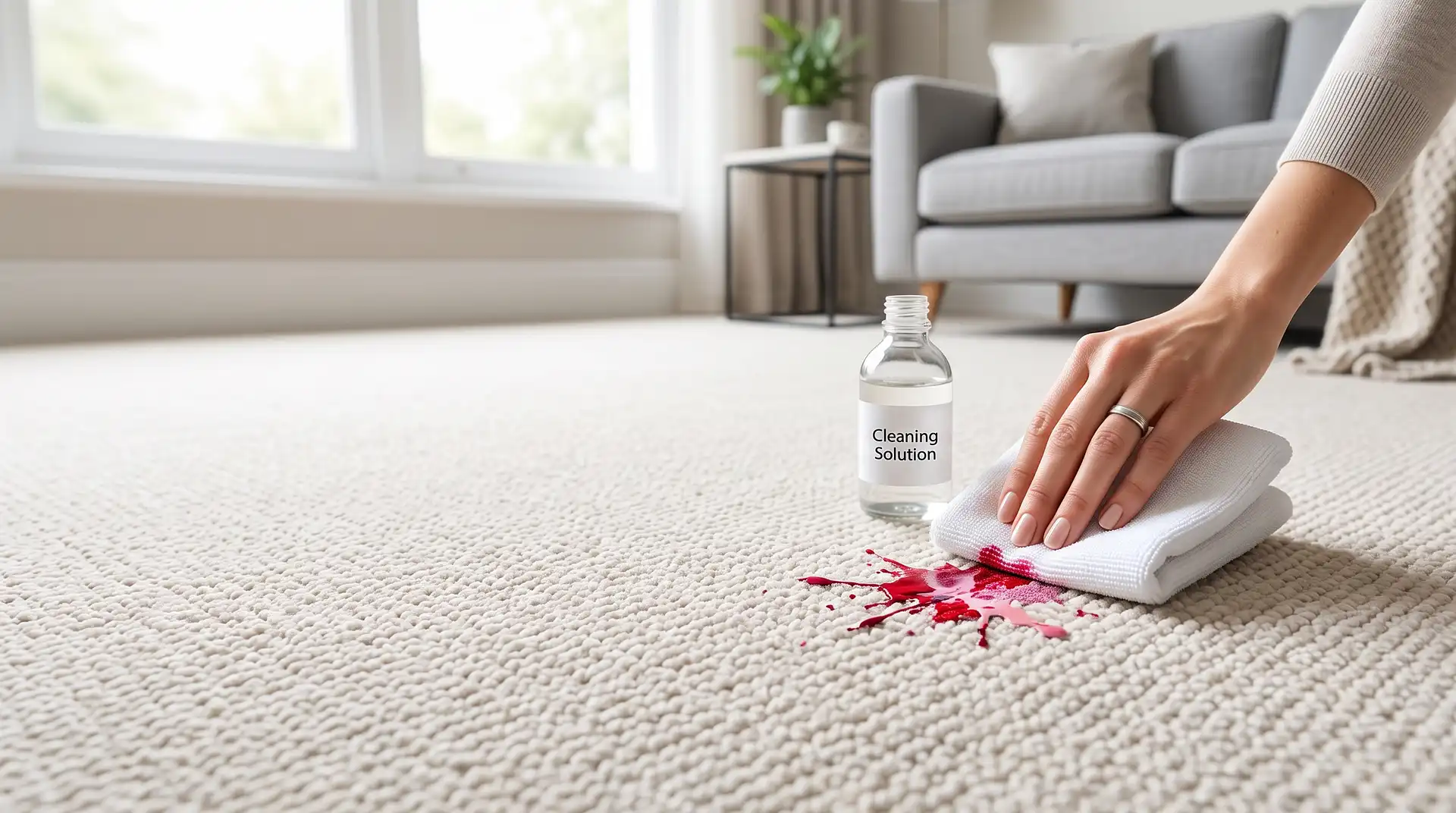
How to Get Nail Polish Out of Carpet
18 August 2026
How to Get Nail Polish Out of Carpet
Nail polish is a nitrocellulose resin dissolved in fast-evaporating solvent, with pigment added for colour. When it dries, the solvent leaves and the resin sets into a film that wraps around carpet fibres rather than soaking into them. That means this is a dissolving job, not a washing job, and detergent and water alone will barely touch it.
There is also a decision to make before you reach for any product: what is your carpet made of? Acetone is the most effective solvent for dissolving nail polish and one of the most damaging things you can put on the wrong carpet. Getting that order right, fibre first, product second, is the difference between a clean result and a bald patch. Most guides skip it entirely.
Check Your Carpet Fibre First
Look at a door threshold offcut, check the original invoice, or lift the carpet edge and read the label on the back. If you genuinely cannot identify it, treat it as wool, which is the cautious default.
The rule is simple. Acetone is safe on nylon, polyester, and polypropylene. It strips dye from wool and dissolves acetate and viscose fibres outright. If your carpet is wool, wool blend, acetate, or viscose, use non-acetone remover or surgical spirit instead, and expect the job to take longer.
One more thing acetone does that the fibre charts tend to miss: it can attack the latex adhesive bonding tufted carpet to its backing. Apply it to a cloth and blot, never pour it directly onto the carpet, because soaking through to the backing risks delamination even on a fibre that is otherwise perfectly acetone-safe.
Step 1: Act Before It Dries
Wet polish is a five-minute job. Dry polish is a forty-minute job. If you have just spilled, move the bottle away first, because knocking it again while panicking about the first spill is how a small stain becomes a large one.
Blot with a clean white cloth or kitchen roll immediately. White only, since coloured cloth can transfer dye into damp carpet. Press straight down and lift, do not rub, and move to a clean section of cloth each time. Work from the outer edge of the spill inward so you are shrinking the stain rather than spreading it. Do not add water at this stage.
Step 2: Apply the Right Remover
Dampen a white cloth with your chosen solvent. Damp, not dripping. Press and hold against the stain for 15 to 30 seconds, because the solvent needs contact time to soften the resin film. Rushing this step is the single most common reason people conclude a product did not work.
Blot and check the cloth. You should see pigment transferring onto it. Move to a clean section every pass, because a saturated cloth stops lifting colour and starts putting it back into the carpet.
For nylon, polyester, or polypropylene, use acetone or acetone-based nail polish remover. For wool, wool blends, or anything you are not sure about, use non-acetone remover containing ethyl acetate, or surgical spirit. Ethyl acetate works more slowly than acetone, so each pass needs 30 to 45 seconds of contact time rather than 15 to 30, and expect roughly twice the number of passes.
Step 3: Work on Dried Polish
If the polish has already set, soak a cloth in your chosen remover and lay it flat over the stain for 10 to 15 minutes to let the solvent penetrate the cured film. Then scrape gently with a spoon held nearly flat to the pile. The angle matters: a nearly flat spoon lifts softened film without cutting fibres; anything more vertical risks permanent pile damage.
Alternate between the cloth dwell time and the spoon scrape until the film has gone, then continue with blotting passes until no more colour transfers.
Step 4: Deal With Coloured Polish Dye
This is the step that catches people out. Once the resin film is gone, there may still be a tint. That is pigment that has migrated into the base of the fibre, and it is a separate stain from the polish itself. Assuming you have failed and applying more solvent is the wrong move.
Treat the remaining tint with a small amount of isopropyl alcohol or a diluted white vinegar solution, dabbing with a clean white cloth rather than rubbing, and patch test first. On light-coloured non-wool carpets, a very diluted 3% hydrogen peroxide solution can help with a pink or red shadow, but it lightens dark carpet, so it is a last resort for pale floors only, and always patch tested first.
Step 5: Rinse and Dry
Blot the treated area with a cloth dampened in cold water, then blot dry. Skipping the rinse leaves solvent residue in the pile that attracts dirt, producing a grey patch within a few weeks.
Then weight it dry: lay dry kitchen roll or a folded white towel over the spot, press something flat and heavy on top, and leave for a few hours to draw remaining moisture up out of the pile. Once fully dry, vacuum to lift the fibres back to their original height.
When to Skip DIY Entirely
If your carpet is wool, viscose, silk, or a rug you care about and your patch test showed dye transfer onto the cloth, stop. If the stain covers more than a hand-sized area, if you have already layered three or more products over each other, or if the colour runs on contact with any solvent, call a professional. Layered chemistry from multiple DIY attempts makes a professional's job harder and sometimes impossible, so be direct about what you have already applied.
Professional carpet cleaning for a single stain removal typically costs £10 to £25, which set against the cost of replacing a carpet is an easy decision on anything you value. If the nail polish is one of several marks the carpet needs dealing with, it is usually worth treating the room as a whole at the same time. Our related guide covers how to remove different types of carpet marks, since mud, wine, grease, ink and blood each need genuinely different approaches, and using the wrong method on the wrong stain is a reliable way to set it permanently rather than lift it.
Common Mistakes and What to Do Instead
Mistake: rubbing the stain. Rubbing spreads pigment sideways into clean fibres and drives resin toward the carpet backing. Blot only, pressing straight down and lifting cleanly.
Mistake: pouring remover directly onto the carpet. Solvent that soaks through the pile can dissolve the latex backing adhesive. Apply it to a cloth, not to the carpet.
Mistake: skipping the contact time. 15 to 30 seconds of dwell time is what allows the solvent to soften the resin. Moving straight to blotting without waiting produces the impression that the product did nothing.
Mistake: reusing a saturated cloth section. Once a section is loaded with pigment, it redeposits colour rather than lifting it. Use a clean section on every pass.
Mistake: treating coloured dye residue as more polish. Once the resin film is gone, any remaining tint is pigment, not polish, and it needs a different product and a gentler touch.
Mistake: using acetone on wool or acetate. Acetone strips dye from wool and dissolves acetate fibres. Identify the fibre before choosing a product.
Mistake: skipping the rinse. Solvent residue left in the pile attracts dirt and produces a grey patch within weeks.
What It Costs in the UK
The DIY cost is low. A bottle of non-acetone remover costs £3 to £8. Surgical spirit runs £2 to £5. Acetone-based remover is usually under £5. Isopropyl alcohol for pigment residue typically costs £4 to £10.
If professional treatment is needed, according to InstantCost.co.uk's 2026 UK carpet cleaning pricing data, a single stain treatment typically costs £10 to £25. If the nail polish is one of several problems and the carpet is due a broader clean, a single small room typically costs £35 to £55, a single large room £55 to £90, stairs and landing £40 to £70, and a whole 3-bed house £140 to £240. Deep-pile or shag carpets may carry a 10 to 20% surcharge due to longer drying and working time.
Item or Service | Typical UK Cost (2026) |
|---|---|
Non-acetone remover | £3 to £8 |
Acetone-based remover | Under £5 |
Surgical spirit | £2 to £5 |
Isopropyl alcohol | £4 to £10 |
Professional per-stain treatment | £10 to £25 |
Professional clean, single small room | £35 to £55 |
Professional clean, single large room | £55 to £90 |
Professional clean, stairs and landing | £40 to £70 |
Professional clean, whole 3-bed house | £140 to £240 |
Deep-pile or shag surcharge | 10 to 20% |
Figures based on InstantCost.co.uk's 2026 UK carpet cleaning pricing data and vary by region, carpet condition, and provider.
Staying Safe
Acetone and nail polish remover are classified under the GB CLP Regulation as highly flammable and can cause eye irritation and drowsiness from vapour inhalation. Ventilate properly: open two openings for cross-flow, not just a single window. Acetone vapour is heavier than air and settles at floor level, which is exactly where your face is while working on a carpet. No candles, no smoking, no gas hob running in the room.
Wear nitrile gloves and eye protection. Solvent-soaked cloths should air dry outdoors before going in the bin, never straight into a lined kitchen bin where accumulated vapour can build.
Keep children and pets out of the room for the whole job and until the carpet is completely dry to the touch. Store remover in its original labelled container, never decanted into an unlabelled bottle or drinks container. A brightly-coloured, sweet-smelling liquid in an accessible bottle is exactly what a young child will reach for.
If a child swallows nail polish remover or gets it in their eyes, call 111 for advice, or 999 if they are drowsy, struggling to breathe, or unresponsive. Do not induce vomiting.
Nail polish remover is among the more common causes of accidental poisoning in young children in the UK. Store it locked away or out of reach, not on a bedroom shelf or bathroom ledge at child height, and dispose of leftover remover rather than keeping a part-used bottle within easy access.
FAQ
Can nail polish remover damage carpet? Acetone-based remover can strip dye from wool and dissolve acetate and viscose fibres. It is safe on nylon, polyester, and polypropylene after a patch test. Apply it to a cloth rather than pouring directly, since soaking through to the backing can also dissolve the latex adhesive bonding tufted carpet.
Does dried nail polish come out of carpet? Yes, but it takes considerably more effort than fresh polish. Lay a remover-dampened cloth over the stain for 10 to 15 minutes to rehydrate the cured film, scrape gently with a spoon held flat, then continue with blotting passes. Expect 4 to 10 passes on a set stain.
Why is there still a tint after I removed the nail polish? Coloured nail polish leaves two things in the carpet: the resin film and the pigment. The remover lifts the film. Any remaining tint is pigment that has migrated into the fibre base and needs a separate, gentler treatment with isopropyl alcohol or diluted white vinegar.
Can I use hairspray to remove nail polish from carpet? Rarely. The method relied on older hairspray formulations that were mostly alcohol. Modern products are largely polymer-based and leave a sticky residue on top of the stain rather than dissolving it. Surgical spirit does the same job properly.
How much does professional nail polish stain removal cost? A single stain treatment typically costs £10 to £25 in the UK. If the carpet needs a more general clean at the same time, a small room runs £35 to £55.
What if I have already tried several products and the stain is still there? Stop adding more products. Layered chemistry makes a professional's job harder. Call a cleaner, tell them exactly what you have applied and in what order, and let them assess what is still possible.