How to Measure a Radiator
11 September 2026
How to Measure a Radiator
Measuring a radiator means two genuinely separate things: taking its physical dimensions, height, width, and depth, so a replacement fits the available wall space and existing pipe centres, and calculating its BTU heat output requirement based on the room it's heating, which determines whether a radiator is actually powerful enough for the space regardless of how well it physically fits. Confusing these two measurements is one of the most common reasons people end up with a radiator that fits perfectly but never quite heats the room properly.
If you're replacing a radiator like-for-like, physical dimensions matter most. If you're changing radiator type, upgrading heating in a room that's always felt cold, or fitting a radiator during a renovation, the BTU calculation matters just as much, since a beautifully sized radiator that's underpowered for the room will never perform as expected.
Measuring Physical Dimensions
Height and Width
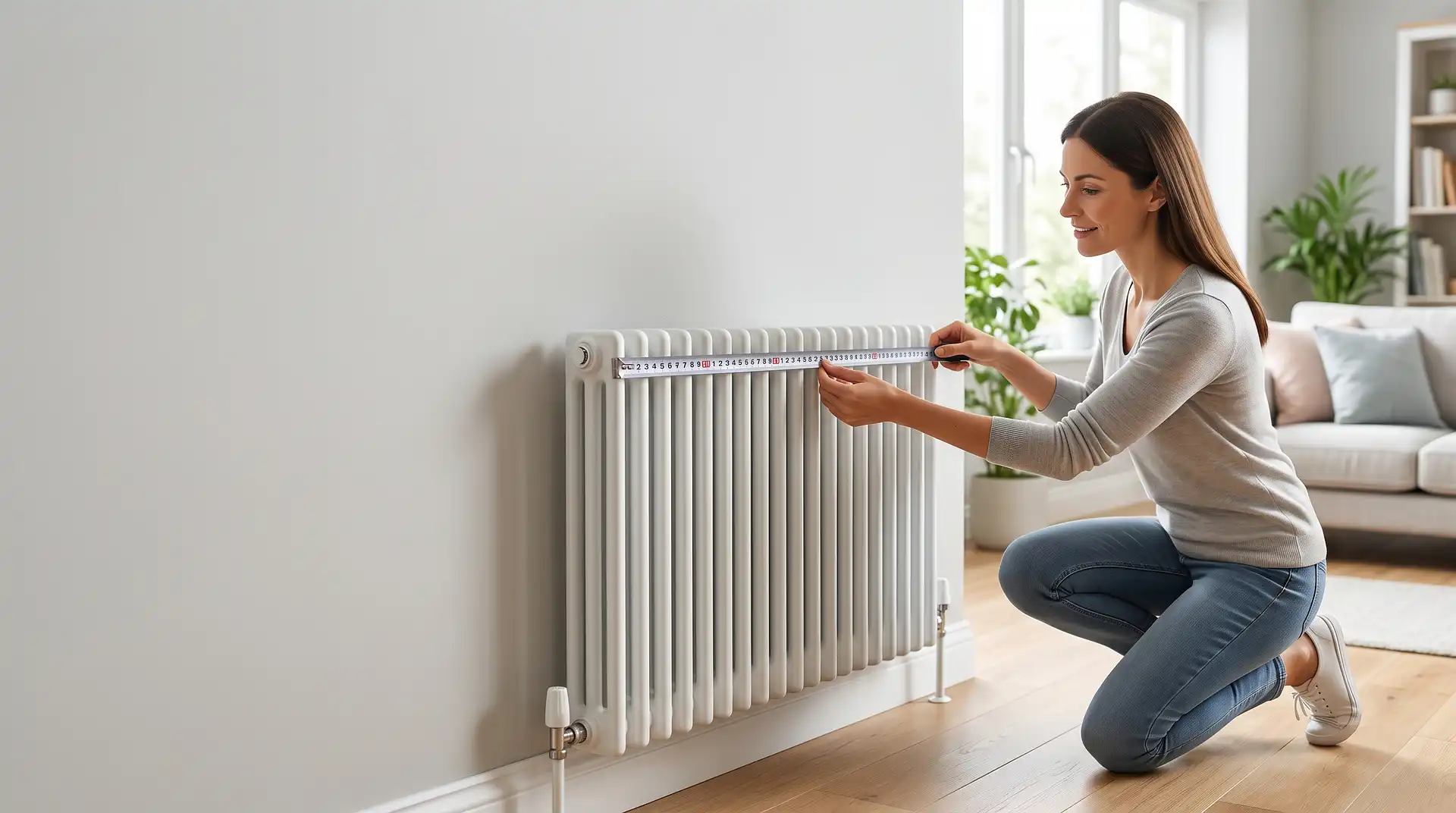
Measure the radiator's height from the very bottom to the very top, and width from one end to the other, using a tape measure held flat against the radiator's face rather than following any curves or fins, which can give a slightly inflated reading. Round down to the nearest millimetre rather than up, since manufacturers list radiators by their actual size, and a slightly oversized measurement can lead to ordering a radiator that doesn't fit the available space.
Depth
Depth, sometimes listed as "projection," is measured from the wall-mounting bracket's face out to the front of the radiator. This matters particularly in tighter spaces, under a windowsill, in a narrow hallway, or where furniture needs to sit close by, where even a small increase in depth compared with the original radiator can create a clearance problem.
Valve or Pipe Centres
Pipe centres, the distance between the two pipes coming up from the floor or out from the wall, need to match the valve spacing on the new radiator, or the new radiator's valves need to be adjustable enough to accommodate your existing pipe positions. Measure from the centre of one pipe to the centre of the other, not from the outer edges, since this is the figure radiator specifications typically reference.
Calculating BTU Requirement
BTU, or British Thermal Units, measures a radiator's heat output, and getting this right matters as much as physical fit, particularly if you're changing radiator type or size rather than doing a direct like-for-like swap.
Step 1: Measure the Room
Measure the room's length, width, and height in metres, then calculate its volume by multiplying these three figures together.
Step 2: Apply a BTU Multiplier
A commonly used rule of thumb multiplies room volume by a factor based on the room type, since bathrooms and conservatories typically need more heat per cubic metre than a well-insulated bedroom.
Room Type | Typical BTU Multiplier (per m³) |
|---|---|
Bedroom, well insulated | 90–100 |
Living room | 100–110 |
Kitchen | 90–100 |
Bathroom | 100–120 |
Conservatory or poorly insulated room | 150–200 |
Multiply your room's volume in cubic metres by the appropriate figure from this table to get a rough BTU requirement. A living room measuring 4m by 4m with a 2.4m ceiling has a volume of roughly 38.4 cubic metres, which at 100 to 110 BTU per cubic metre suggests a requirement of roughly 3,800 to 4,200 BTU.
Step 3: Adjust for Windows and Insulation
Rooms with large single-glazed windows, poor loft insulation, or an exposed exterior wall on more than one side typically need a higher multiplier than the baseline figures above suggest. Conversely, a well-insulated modern room with double glazing throughout can sometimes manage with a slightly lower figure than the standard multiplier.
A Note on Choosing Between Multiple Smaller Radiators or One Larger One
Some rooms achieve their required BTU output more effectively with two smaller radiators positioned on different walls rather than one large radiator on a single wall, particularly in rooms with an awkward layout or where even heat distribution matters, such as an open-plan living and dining space. This is worth considering during the planning stage rather than assuming a single radiator sized to the full BTU requirement is automatically the right approach for every room shape.
A Note on Double Panel and Double Convector Radiators
Radiators with the same height and width can have very different BTU outputs depending on whether they're a single panel, double panel, or double panel with convector fins, since the additional panels and fins increase surface area and heat output significantly within the same physical footprint. If a room's calculated BTU requirement is high but wall space is limited, checking double panel or double convector options at the same physical dimensions is often the better solution than looking for a physically larger radiator.
When to Call a Professional
If you're unsure about your BTU calculation, particularly for a room with unusual proportions, poor insulation, or high ceilings, a heating engineer can calculate this more precisely using a proper heat loss assessment, which accounts for insulation levels, window types, and room orientation in more detail than a rule-of-thumb calculation. This is particularly worth doing if you're planning wider heating changes rather than a single radiator swap.
Use InstantCost's heating system cost calculator to see what a radiator replacement or upgrade would cost in your area. If you've settled on the correct size and are ready to fit it, how do I replace a radiator covers the full installation process step by step.
Common Mistakes and What to Do Instead
Mistake: Measuring only height and width, ignoring depth. A radiator that's the right height and width but too deep for the available space can clash with a windowsill, skirting board, or nearby furniture. Always check depth against the specific location before ordering.
Mistake: Assuming pipe centres will automatically match a new radiator. Different radiator ranges and brands sometimes use different standard valve spacings. Measure your existing pipe centres and check them against the specific radiator's specification before buying.
Mistake: Skipping the BTU calculation entirely for a like-for-like swap. If the room has changed since the original radiator was fitted, added insulation, new windows, or a loft conversion above, the original BTU sizing might no longer be appropriate. Recalculate rather than assuming the existing size is still correct.
Mistake: Using a generic BTU calculator without adjusting for window size or insulation. A simple volume-based calculation can undersize a radiator for a room with large windows or poor insulation. Adjust the multiplier upward for rooms with these characteristics.
Mistake: Choosing a radiator based on appearance before checking it meets the BTU requirement. A stylish, physically well-fitting radiator that's underpowered for the room will never heat it properly, regardless of how good it looks. Confirm BTU output meets or exceeds your calculated requirement before finalising a style choice.
Mistake: Not accounting for radiator output ratings measured differently between manufacturers. Some manufacturers rate output at a higher water temperature (Delta T) than others, which can make direct BTU comparisons between brands misleading. Check the Delta T rating stated alongside the BTU figure when comparing radiators from different manufacturers.
What It Costs in the UK
Item or Service | Typical UK Cost (2026) |
|---|---|
Standard single panel radiator | £40–£100 |
Double panel radiator | £70–£180 |
Double panel with convector fins | £90–£220 |
Designer or vertical radiator | £150–£400+ |
Radiator install, per radiator, including pipework | £200–£450 |
Heating engineer heat loss assessment | £80–£150 |
Figures based on InstantCost.co.uk's 2026 UK heating system pricing data and vary by region, radiator type, and installation complexity.
Staying Safe
Always turn off the heating and allow the radiator to cool fully before measuring it, since a hot radiator surface can cause burns and pipework may still be under pressure. If you need to remove the radiator briefly to measure depth or pipe centres accurately, isolate it first using the valves on either side rather than working on a still-connected, pressurised system.
Keep the tape measure and any tools clear of children while working, and be aware that older radiators can have sharp edges or corroded brackets that need careful handling during any measuring that involves touching or slightly moving the unit.
General UK home heating safety guidance recommends allowing radiators to cool fully before any handling or maintenance work, and isolating individual radiators at their valves before disturbing pipework connections.
Frequently Asked Questions
Do I need to measure BTU output if I'm just replacing a radiator with an identical size? Not strictly, if the room's insulation and windows haven't changed since the original radiator was fitted. If anything about the room's heat loss has changed, it's worth recalculating rather than assuming the original size is still correct.
What's the difference between BTU and kW for radiator sizing? BTU (British Thermal Units) and kW (kilowatts) are both measures of heat output, with roughly 3,412 BTU equal to 1kW. Some manufacturers list output in one unit, some in the other, so convert between them if you're comparing radiators listed differently.
How do I measure pipe centres if the radiator is already removed? Measure directly between the centre points of the two pipes coming up from the floor or out of the wall where the radiator valves would connect, using a tape measure held level between the two pipe centres.
Can I fit a radiator with different pipe centres to my existing pipework? Sometimes, using adjustable valves or by having pipework altered slightly to match, but this adds cost and complexity. Checking pipe centres before ordering avoids this extra work in most cases.
Why do two radiators with the same dimensions have different BTU outputs? Radiator construction varies, single panel, double panel, and double panel with convector fins all have different surface areas and airflow characteristics within similar physical dimensions, which changes how much heat each design can output.
Is it better to have one large radiator or two smaller ones in a big room? It depends on the room's layout and heat distribution needs. Two smaller radiators on separate walls can sometimes heat a room more evenly than one large radiator concentrated on a single wall, particularly in open-plan or irregularly shaped spaces.