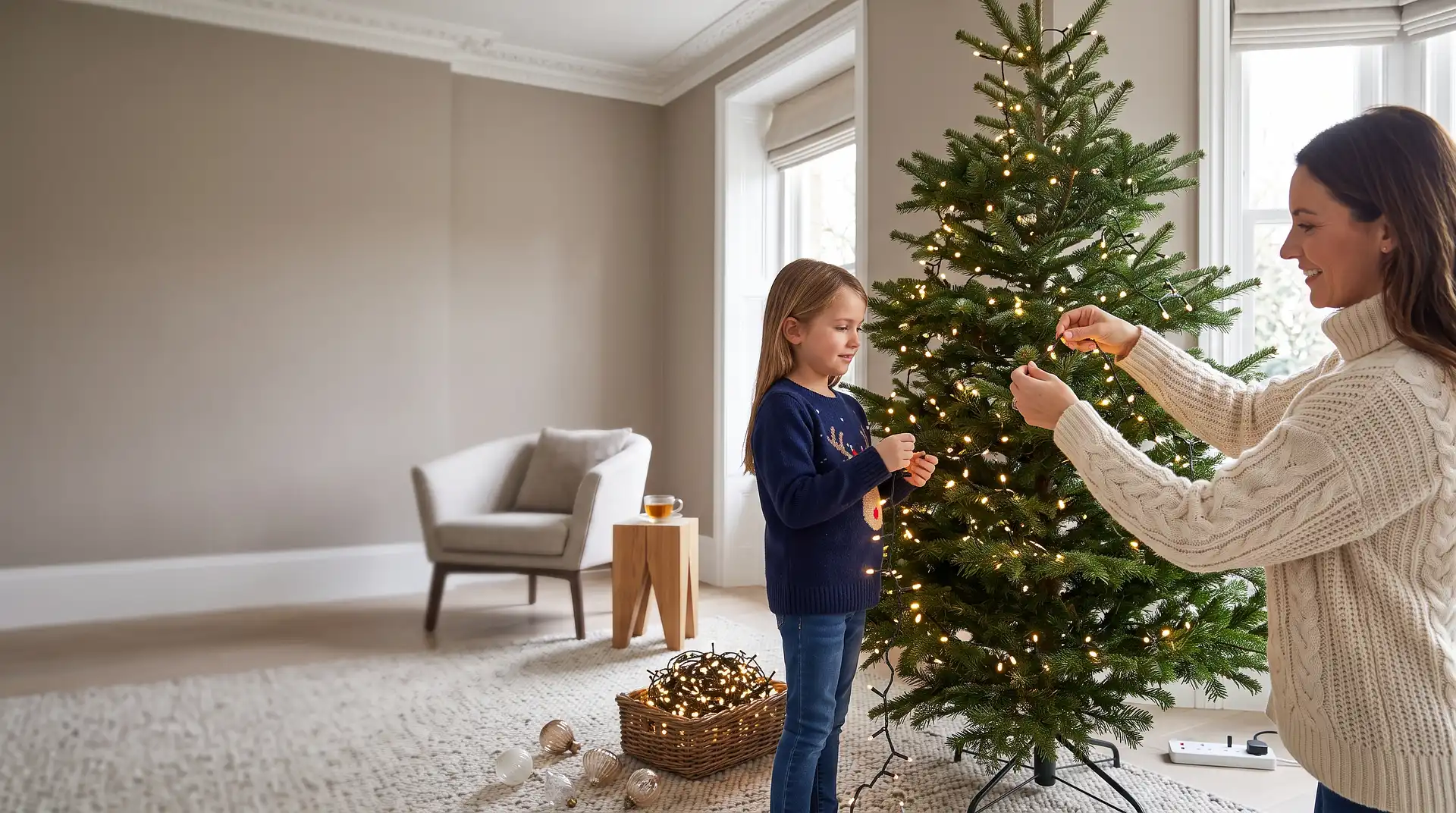
How To Put Xmas Lights On A Tree
20 August 2026
How to Put Christmas Lights on a Tree
The method for putting Christmas lights on a tree that produces an evenly lit result is the opposite of what most people do. Most people wrap lights around the outside of the tree in a spiral from top to bottom, which is fast, easy, and produces a flat, patchy result once switched on because it illuminates only the surface. The method that actually works starts at the trunk and works outward, weaving lights into the interior of the tree before bringing them to the tips of the branches.
But before technique, there are two decisions worth making that most guides skip entirely: what type of lights you are using, and whether the tree is real or artificial. Both change what is possible and what is safe.
Decision 1: Lights Type
LED lights are now the overwhelming choice for good reasons. They run cool, which matters both for fire safety on a real tree and for not melting any artificial needles near a bulb. They use roughly 80 to 90% less energy than traditional incandescent sets. They last considerably longer, and modern LED sets produce warm white tones that are indistinguishable from traditional bulb colour at a glance.
Incandescent or traditional bulb sets run warm to the touch. On a dry real tree in the second or third week of the season, this is a genuine fire risk that LED sets do not carry. If you have old incandescent sets, check them against the BS EN 60598 or BS 8559 standard printed on the packaging before using them this year.
Battery-powered lights suit artificial trees where hiding the wire run to a socket is difficult, and anywhere a mains socket is not conveniently located. Check the IP rating if the tree is near a window or in a conservatory with temperature fluctuation: IP44 is the minimum for a damp environment.
Mains-powered sets should carry the CE or UKCA mark and be rated for indoor or outdoor use as appropriate. Do not use indoor-rated lights outside, even under a porch or covered area, since the insulation is not rated for moisture exposure.
Decision 2: Real or Artificial Tree
Real trees drop needles as they dry, and dry needles near a heat source are a fire risk. Water the tree daily, keep it away from radiators and open fires, and switch lights off when you leave the room or go to bed. LED lights reduce but do not eliminate this risk. Check the tree base daily and top up the water reservoir if the stand has one.
Artificial trees do not dry out, which reduces the fire risk from the tree itself, but some older artificial trees are made from PVC that is not fire-retardant. If your artificial tree predates roughly 2005 and you do not have the original packaging confirming a fire-retardant rating, it is worth replacing it.
Pre-lit artificial trees come with lights already wired through the branches. The main consideration here is what to do if a section of lights fails. Most pre-lit trees are wired in sections, so a failed section is usually one set of connectors rather than the whole tree. Check whether replacement sections are available for your model before assuming the tree needs replacing.
How Many Lights for Your Tree Size
Tree height | Recommended lights (standard density) | Dense or show look |
|---|---|---|
4ft | 100 to 150 | 200 |
5ft | 150 to 200 | 300 |
6ft | 200 to 300 | 400 to 500 |
7ft | 300 to 400 | 600 to 700 |
8ft | 400 to 500 | 700 to 900 |
These are minimums for a result that does not look sparse. If you are going for a high-density display, double the lower figure. Multiple shorter sets are easier to manage than one very long set, and separate sets give you the option to replace a failed set without restringing the whole tree.
Step 1: Test Every Set Before It Goes on the Tree
Plug in and test every set before a single light goes on the tree. Finding a failed set or a section of dead bulbs after the tree is fully dressed takes considerably longer to fix than finding it before you start. For LED sets, a single failed bulb rarely takes the whole string out. For older incandescent sets it often does, because they are wired in series.
Untangle each set fully before testing. A tangled set that works when straight sometimes has a loose connection that fails once it is bent around a branch.
Step 2: Start at the Plug End and Plan the Wire Route
Identify which end of each set has the plug, and start from that end. Plan the wire route before you begin: the plug end needs to reach the socket without a visible wire running across the floor or up the wall. On most UK trees this means starting at the trunk near the base, where the wire can run down behind the tree to a floor-level socket or extension lead.
Do not use an extension lead that is not rated for the combined wattage of the lights. LED sets draw very little current, but stacking several sets of incandescent lights on an underrated extension lead is a genuine hazard. Check the rating on the extension lead label.
Step 3: Work from the Trunk Outward
This is the step that separates a lit tree from a well-lit tree.
Starting at the trunk near the base of the tree, push the first section of lights into the interior of the tree, close to the central stem. Work the lights in and out along individual branches from the base toward the tip, bringing the string to the tip of each branch and then back toward the trunk before moving to the next branch.
Work in sections around the tree at each height level before moving up, rather than working in a spiral. This distributes the light source through the interior of the tree, which produces depth and glow rather than a lit surface.
Bring the last section of each string to the outer tips of branches at that level before wrapping back. The tip of each branch should have a cluster of two or three bulbs visible from the front. The interior illumination is what makes the whole tree appear to glow rather than just the outer branches.
Step 4: Add Sets for the Upper Sections
Work up the tree in horizontal bands, one set of lights per section. Connect each set to the one below using an in-line connector if your sets support it, or run separate cables to the extension lead at the base. Do not chain more sets end-to-end than the manufacturer's instructions specify: most UK sets are rated for a maximum of three sets connected in series.
The top third of the tree needs more lights per branch length than the lower sections, because the branches are shorter and the tip of the tree is what the eye goes to first. Front-load the top third with slightly more light density than feels necessary from close up -- it always looks right from the other side of the room.
Step 5: Check from a Distance Before Decorating
Before adding any other decorations, step back and switch the lights on in a darkened room. Look for dark patches, which indicate sections where the lights are all running along a single plane rather than through the depth of the tree. Push those sections deeper into the branches rather than adding more lights on the surface.
Rotating the tree slightly often reveals that the well-lit side is the back rather than the front. It is easier to fix this before the decorations go on.
When It Needs an Electrician
Putting lights on a tree is a DIY task. The point at which it stops being one is when the electrical installation around the tree needs changing: adding a socket closer to the tree position, installing outdoor power for a tree in a bay window visible from outside, or setting up a timer circuit for a large outdoor display.
Adding or relocating a socket in the UK is notifiable work under Part P of the Building Regulations and must be carried out by a registered electrician. According to InstantCost.co.uk's 2026 UK electrician pricing data, adding or replacing a socket typically costs £90 to £150 including the minor works certificate. A light fitting installation per room runs £120 to £280. An electrician hourly rate runs £40 to £75, with London and the South East at the upper end. If you are thinking about a more permanent display installation dedicated garden power, an outdoor socket, or a timer circuit the InstantCost electrician cost guide has a full 2026 UK breakdown by job type with a calculator to check quotes before booking.
For changing bulbs in other light fittings around the house during the Christmas decorating season, our guide on how to change a spotlight bulb covers the important distinction between replaceable bulb spotlights and sealed integrated LED units where the whole fitting needs replacing rather than just the bulb.
Common Mistakes and What to Do Instead
Mistake: wrapping lights around the outside of the tree in a spiral. This illuminates only the surface and produces flat, patchy light. Work from the trunk outward on individual branches instead.
Mistake: not testing sets before they go on the tree. A failed set found after the tree is fully dressed takes far longer to fix than one found before you start.
Mistake: starting from the wrong end. Always start from the plug end so the cable routes naturally to the socket. Starting from the tip end leaves the plug somewhere in the middle of the tree.
Mistake: chaining more sets than the manufacturer specifies. Most UK LED sets allow a maximum of three connected in series. Exceeding this overloads the first plug's fuse and connector.
Mistake: using outdoor-rated lights inside and indoor-rated lights outside. The ratings exist for a reason. Outdoor lights can be used inside. Indoor lights must not be used outside, even in a covered or sheltered position.
Mistake: leaving lights on an unattended or drying real tree. Switch lights off when leaving the room and when going to bed. A drying real tree and a heat source in contact with it is a fire risk regardless of LED versus incandescent.
Mistake: overloading an extension lead. Check the wattage rating of the extension lead against the combined load of everything plugged into it. LED sets are low draw, but older incandescent sets add up quickly.
What It Costs in the UK
Item | Typical UK cost (2026) |
|---|---|
LED light set, 100 lights | £5 to £15 |
LED light set, 200 lights | £10 to £25 |
LED light set, 400 lights (large tree) | £20 to £50 |
Outdoor-rated LED set | £12 to £35 |
Battery-powered LED set | £8 to £20 |
Timer plug adapter | £5 to £15 |
Adding or replacing a socket (electrician) | £90 to £150 |
Electrician hourly rate | £40 to £75 |
Outdoor socket installation | £120 to £200 |
Electrician figures based on InstantCost.co.uk's 2026 UK electrician pricing data and vary by region. London and South East sit at the upper end of hourly rates.
Staying Safe
Christmas lights are involved in a meaningful number of UK house fires each year, almost all of which are preventable. The risks are well understood and the precautions are straightforward.
Check every set of lights against the UKCA or CE mark and the BS EN 60598 or BS 8559 standard before use. Lights without a standard mark should not be used. Discard any set with cracked insulation, a damaged plug, flickering that is not explained by a loose bulb, or any sign of scorch or discolouration near a bulb or connector.
Never leave lights on when you go to bed or leave the house, regardless of whether the tree is real or artificial. A timer plug is the practical solution: it costs under £15 and removes the need to remember to switch them off every night.
Do not run cables under rugs or carpet, where heat cannot dissipate and damage to the insulation goes unseen. Do not staple or pin cables, which compresses the insulation. Keep cables away from radiators, fireplaces, and candles.
Keep children and pets away from light strings when unplugged, as trailing cables and accessible bulbs are both hazards. Bulbs that are small enough to be swallowed should not be accessible to young children.
If a plug or set feels warm to the touch during use, switch it off, unplug it, and do not use it again. Warmth at the plug or along a cable indicates a fault that does not self-resolve.
Electrical products sold in the UK must carry the UKCA mark (or CE for products placed on the market before January 2025). Products without this mark have not been assessed against UK electrical safety standards. The Electrical Safety First charity recommends buying from established UK retailers rather than unbranded marketplace listings, which is where most non-compliant products enter the market. Check elf.org.uk for current guidance before the Christmas season.
FAQ
How many lights do I need for a 6ft Christmas tree? 200 to 300 for a standard look, 400 to 500 for a dense display. Multiple shorter sets are easier to manage than one long set, and give you the option to replace a failed section without restringing the whole tree.
Should I use LED or traditional bulb Christmas lights? LED for almost every situation. They run cool, which significantly reduces fire risk on a drying real tree, use 80 to 90% less energy, and last considerably longer. Modern warm white LEDs are visually indistinguishable from incandescent at a glance.
Can I use indoor Christmas lights outside? No. Indoor-rated sets are not insulated against moisture and must not be used outside, including in covered or sheltered positions. Outdoor-rated lights can be used indoors without issue.
How do I fix a section of Christmas lights that has stopped working? On LED sets, check for a single failed bulb with a loose connection first, since LEDs are usually wired in parallel and one failed bulb rarely kills the whole string. On older incandescent sets wired in series, one failed bulb takes the whole string out. A bulb tester tool costs £5 to £10 and locates the failed bulb without testing each one individually.
Is it safe to leave Christmas lights on overnight? No. Switch off and unplug before going to bed and when leaving the house. A timer plug, set to turn the lights off at bedtime, is the practical solution and costs under £15.
How do I stop Christmas lights from tangling when I store them? Wind each set around a piece of stiff card, securing the plug end last. Store in a sealed bag or box to keep out dust and moisture. Alternatively, purpose-made reel-style light storage systems hold a typical set without tangling and allow you to pay out the lights directly when next decorating.