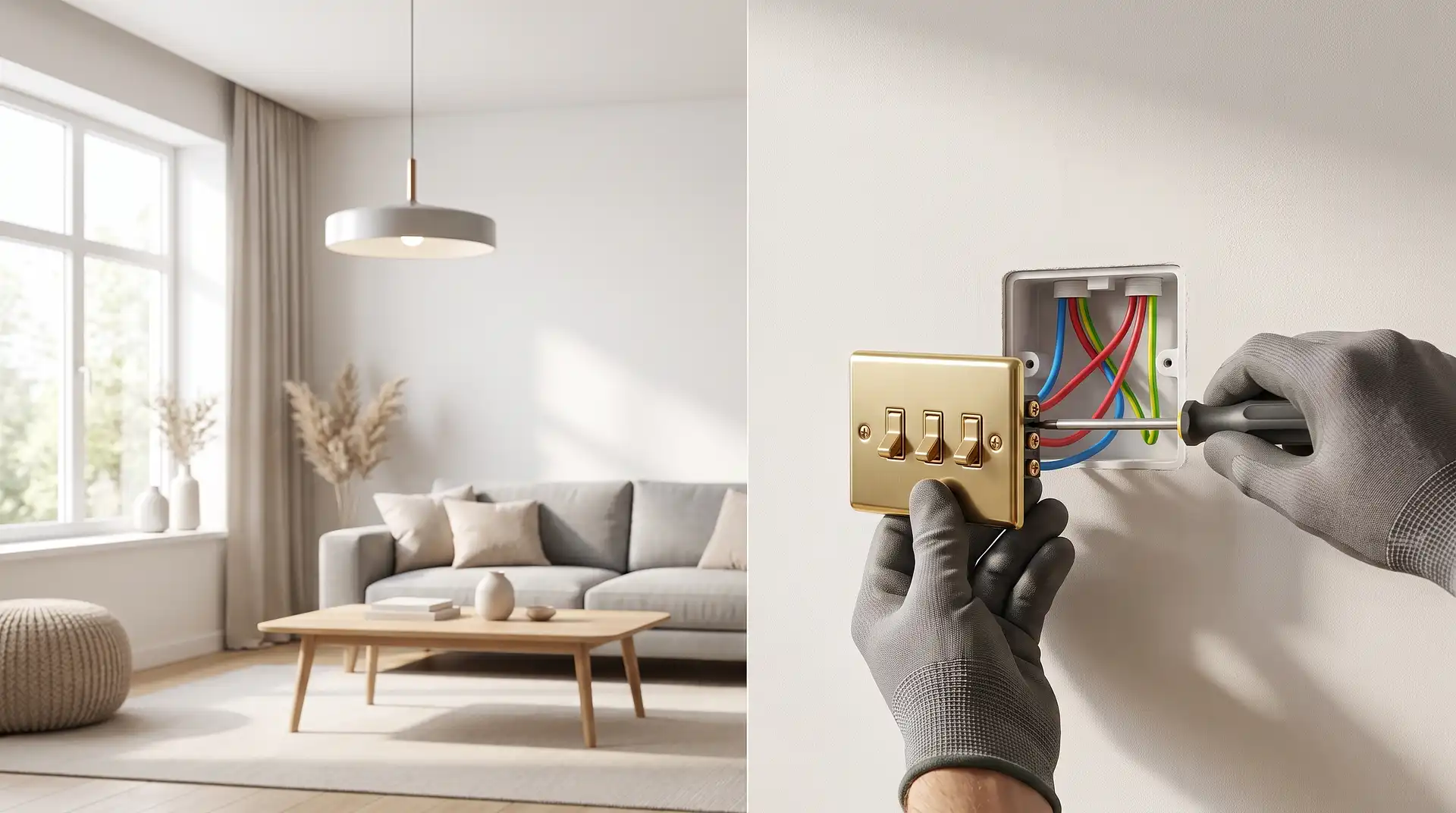
How to Wire a 3-Way Light Switch
5 September 2026
How to Wire a 3-Way Light Switch
Controlling one light from three separate switches, often called 3-way switching, actually uses a two-way switch at each end of the run and an intermediate switch in the middle, connected by four-core cable rather than the standard three-core cable used for a simple two-way circuit. This is the detail that trips up most DIYers coming from a two-way switch job, because the middle switch works completely differently from the two either side of it.
The safest way to approach this job is to treat it as three separate stages: understanding which switch does what, running the correct cable between them, and connecting each switch to the right terminals. Getting any one stage wrong typically results in a light that's permanently on, permanently off, or that stops working correctly at one specific switch while the other two still function.
Understanding the Three Switch Positions
The two switches at either end of the run are two-way switches, identical to the type used in a standard landing light circuit with just two switches. Each has three terminals: common (C), and two others usually marked L1 and L2.
The switch in the middle is different. It's an intermediate switch, and it has four terminals rather than three. Its job is to either pass the connection straight through, or cross it over, depending on its position, which is what allows the light to be controlled from a genuinely middle position in the run rather than just an end.
If you buy a standard two-way switch by mistake for the middle position, it will not work correctly. Intermediate switches are sold separately and clearly labelled, but they're a less common item than two-way switches, so check carefully before buying, especially if working from a kit or an online order where the switch type isn't obvious from the product photo.
Cable Requirements
A 3-way intermediate circuit needs:
Standard two-core-and-earth cable from the light fitting to the first (two-way) switch
Three-core-and-earth cable between the first two-way switch and the intermediate switch
Three-core-and-earth cable between the intermediate switch and the second two-way switch
Two-core-and-earth cable from the second two-way switch back to the light, or however your specific circuit is arranged
Three-core-and-earth cable has three insulated conductors, commonly coloured brown, grey and black under current UK cable colour standards, plus an earth. The strapping wires between the two-way switches run through the intermediate switch, which is what allows the middle position to intercept and control the circuit.
Step-by-Step: Wiring the Circuit
Isolate the circuit at the consumer unit before touching any wiring, and use a proper voltage tester to confirm the circuit is dead at every switch position, not just the one you're starting at.
Identify the common terminal on each two-way switch, usually marked C or COM, and connect the feed from the light or the supply into this terminal on the first switch.
Run the strapping wires from L1 and L2 on the first two-way switch to the corresponding terminals on the intermediate switch. Intermediate switches typically label their four terminals in a way that shows which pair connects to which side, so check the manufacturer's diagram for your specific model rather than assuming a universal layout.
Continue the strapping wires from the other side of the intermediate switch through to L1 and L2 on the second two-way switch.
Connect the common terminal on the second two-way switch to the light fitting or the return path, depending on how your circuit is arranged.
Connect all earth conductors to the earth terminal at each switch and at the light fitting, sleeving bare earth wires in green and yellow sleeving where required.
Restore power at the consumer unit and test the light from all three switch positions before closing up any switch plates, checking that toggling any one switch changes the light's state regardless of how the other two are currently set.
A Note on Switch Terminal Layout Varying by Manufacturer
Not every intermediate switch labels its terminals identically. Some use L1, L2, L3, L4, while others use different letter or number combinations, or colour-coded terminal screws. Always check the wiring diagram printed on the switch itself or in its packaging rather than relying on a diagram from a different brand, since a mismatched terminal connection is one of the most common reasons this job doesn't work first time.
A Note on Working with Existing Wiring vs New Installs
Adding a third switch to an existing two-way circuit means pulling in new three-core-and-earth cable to the point where the intermediate switch will sit, which often means lifting floorboards or chasing a wall channel. This is a considerably bigger job than wiring the same circuit from scratch during a renovation when walls and floors are already open, so factor that into your decision if you're retrofitting a third switch position into a room that's already decorated.
When to Call a Professional
Intermediate switching is genuinely one of the more error-prone domestic wiring jobs for a confident DIYer, because a wiring mistake here doesn't always fail obviously. A switch can appear to work while actually leaving a live conductor connected in a way that becomes dangerous later, particularly if someone else works on the circuit in future without realising the intermediate wiring is non-standard. If you're not fully confident reading and following the switch manufacturer's wiring diagram exactly, this is a sensible job to hand to a qualified electrician.
Use InstantCost's electrician cost calculator to see what this job typically costs in your area before booking anyone. If you're also updating the light fitting itself as part of this project, how to change a light fitting covers that side of the job separately.
Common Mistakes and What to Do Instead
Mistake: Buying a two-way switch for the middle position. A standard two-way switch does not have the internal crossover function an intermediate switch needs. Always buy a switch specifically labelled as intermediate for the middle position in a 3-way run.
Mistake: Using two-core cable where three-core is needed. The sections of cable between the two-way switches and the intermediate switch need the extra strapping conductor that two-core cable doesn't provide. Running the wrong cable means having to redo that section entirely once the fault shows up.
Mistake: Guessing terminal connections instead of checking the specific switch's diagram. Terminal layouts vary between manufacturers even for switches that look identical. Always follow the diagram printed on or supplied with your exact switch model.
Mistake: Testing only from the switch you're standing at. A wiring error can leave two switches working correctly while the third does something unexpected, like turning the light on but not off. Always test from all three positions before considering the job finished.
Mistake: Skipping earth continuity. It's easy to focus on getting the switching function working and forget to properly connect and sleeve earth conductors at every switch. Check every earth connection is secure and correctly sleeved before closing up switch plates.
Mistake: Not isolating fully before starting. Some homeowners turn off the light switch itself rather than isolating the circuit at the consumer unit, which leaves parts of the wiring live. Always isolate at the consumer unit and test with a voltage tester before touching any conductor.
Mistake: Leaving the job without a completion certificate where required. Depending on the location, particularly bathrooms or outdoor areas, this work may be notifiable under Part P. Check whether your specific job needs Building Control notification before finishing.
What It Costs in the UK
Wiring a dedicated three-switch circuit isn't listed as a standalone item on most UK price guides, so the figures below combine standard electrician hourly rates with the extra materials and cable-running time this job typically needs compared with a simple two-way switch.
Item or Service | Typical UK Cost (2026) |
|---|---|
Intermediate switch, DIY parts | £8–£20 |
Two-way switch (pair needed), DIY parts | £10–£25 |
Three-core-and-earth cable, per metre | £1.50–£3 |
Electrician call-out and one-hour minimum | £60–£110 |
Electrician fitting a new 3-way circuit (existing walls open) | £150–£300 |
Electrician retrofitting into finished walls (cable running required) | £300–£600 |
Minor Works Certificate (if required) | Often included in the quote |
Full room rewire including switching | £1,800–£4,000 |
Figures based on InstantCost.co.uk's 2026 UK electrician pricing data and vary by region, access, and whether walls need opening.
Staying Safe
Always isolate the correct circuit at the consumer unit and confirm it's dead with a voltage tester before touching any wiring, checking at every switch position in the run, not just the first one. A three-switch circuit has more points where a live conductor could still be present if isolation is incomplete.
Domestic electrical work in England and Wales that involves new circuits or work in special locations such as bathrooms falls under Part P of the Building Regulations, and some intermediate switching work may need notification or certification depending on where it sits in the property. Check whether your specific job is notifiable before starting, and use a Part P registered electrician if there's any doubt.
Keep children away from any area where switch plates are removed or cables are exposed during the job, and never leave a circuit partially wired and live overnight or unattended. Cap off any exposed conductors properly and isolate the circuit at the consumer unit if you need to stop partway through.
Part P of the Building Regulations covers electrical safety in dwellings in England and Wales. Certain electrical work must be carried out by a registered competent person or separately inspected and certified. Verify current notification requirements with your local Building Control department or a NICEIC or NAPIT registered electrician.
Frequently Asked Questions
What's the difference between two-way and intermediate switching? Two-way switching uses two switches, each with three terminals, to control a light from two positions. Intermediate switching adds a third switch with four terminals in the middle of the run, which crosses or passes through the connection to allow control from a genuinely middle position.
Can I use a two-way switch instead of an intermediate switch? No. A two-way switch lacks the internal crossover function an intermediate position needs, and using one there will not give reliable control of the light from all three positions.
How many switches can control one light? Two switches use two-way switching alone. Any number of switches beyond two uses one intermediate switch for each additional position, so four switches would need two intermediate switches between the two end two-way switches.
Do I need special cable for a 3-way switch circuit? Yes. The sections of cable running between the two-way switches and the intermediate switch need three-core-and-earth cable rather than the standard two-core-and-earth used for simpler switching, because of the extra strapping conductor required.
Is wiring a 3-way switch notifiable under Part P? It depends on the location and scope of the work. New circuits and work in bathrooms or outdoor areas are typically notifiable, while like-for-like switch replacement usually isn't. Check with your local Building Control department if you're unsure.
Why does my light stay on even when I flick a switch off? This is a classic symptom of a wiring fault in intermediate switching, usually a strapping wire connected to the wrong terminal on the intermediate switch. Isolate the circuit and check the intermediate switch's wiring against its manufacturer's diagram rather than trying to fix it by trial and error while live.