How Does Plug-In Solar Work
28 August 2026
How Does Plug-In Solar Work?
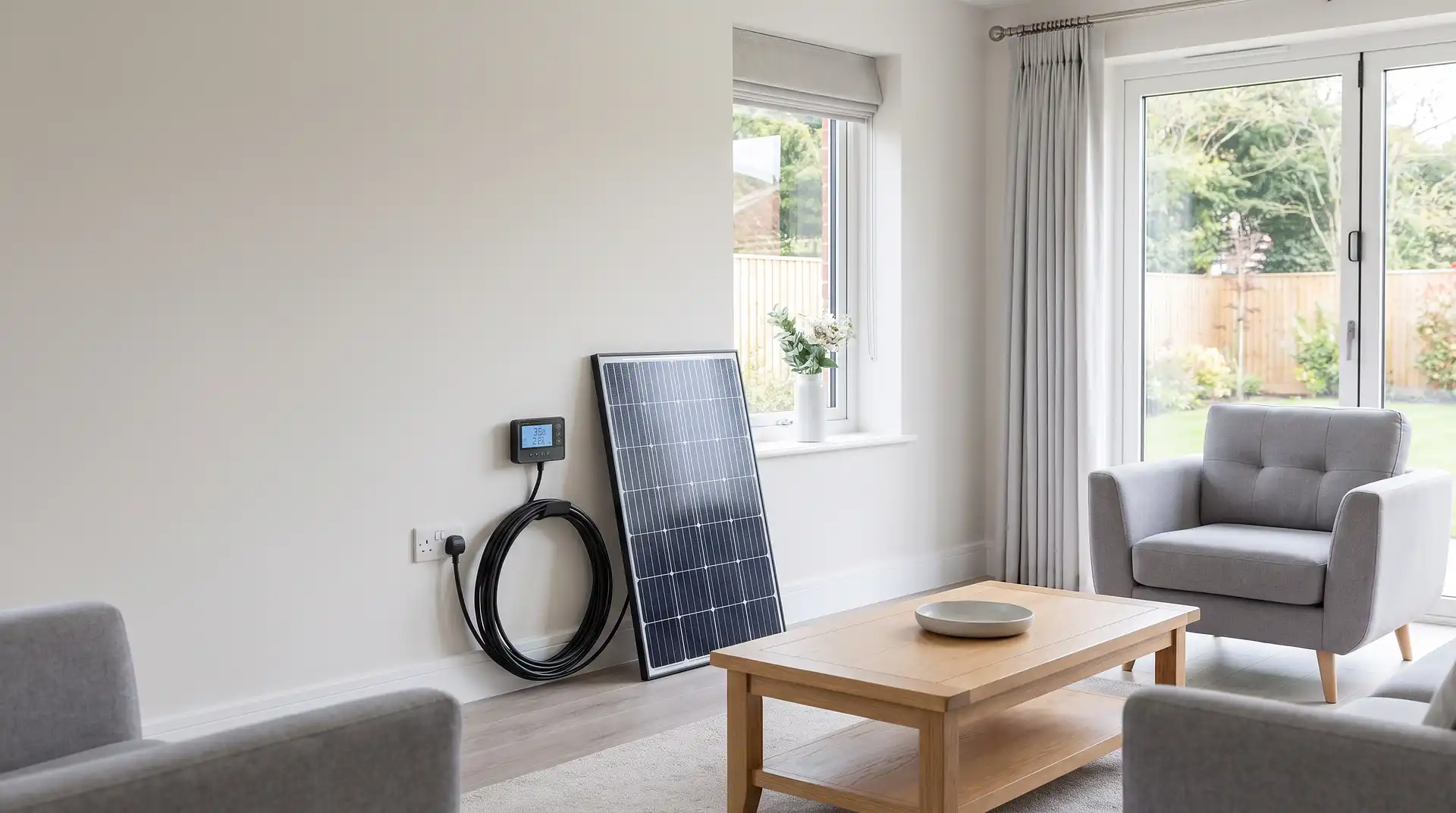
Plug-in solar panels generate electricity from sunlight and feed it directly into your home through a standard wall socket. A small inverter converts the DC output from the solar panel into AC electricity compatible with UK household circuits, and this power is consumed by whatever appliances happen to be running in the home at that moment.
The concept is simple and the appeal is obvious: no scaffolding, no planning permission, no installer required. You position the panel on a balcony, in a garden, or against a south-facing wall, plug the cable into a socket, and the system starts generating. The electricity meter reads the reduction in draw from the grid rather than measuring the solar output directly.
What a Plug-In Solar System Actually Consists Of
A plug-in solar kit, also called a balcony solar system or solar plug, typically contains one or two panels rated at 200 to 400 watts each, a micro-inverter that converts panel output to grid-compatible AC power, a cable that connects to a standard 13-amp socket, and mounting hardware for a balcony rail, wall, or flat surface.
The total system output is limited by the inverter and by UK regulations. Most plug-in solar kits sold in the UK are configured to output a maximum of 800 watts, which is the threshold below which the energy regulator's requirements become simpler to satisfy. Some older or budget kits are limited to 600 watts.
For context, a kettle uses around 2,000 to 3,000 watts, a washing machine on a full cycle averages around 1,000 watts, and a 50-inch television uses roughly 100 to 200 watts. An 800-watt plug-in solar system on a good sunny day in July would power the television and a laptop with capacity to spare, or contribute meaningfully toward a washing machine cycle.
How the Electricity Flows Through the House
When sunlight hits the panels, the micro-inverter converts the output to 230V AC electricity at 50Hz, which is the same as UK mains power. This electricity flows into the home's ring main circuit through the socket it is plugged into.
Any appliances running on that circuit draw from this solar-generated power first before pulling from the grid. The home's electricity meter records a lower import figure. If the home is consuming less electricity than the panels are generating at any given moment, the surplus flows back toward the meter.
This is where a technical and financial consideration arises for UK households. Standard single-rate electricity meters and older meters measure current flowing in both directions. If surplus solar power flows back through the meter, some older meters actually run backwards, effectively crediting the homeowner. Modern smart meters, which most UK homes now have or are being upgraded to, record export and import separately and do not run backwards. Surplus generation from a plug-in system on a smart meter is effectively wasted unless the homeowner is enrolled in the Smart Export Guarantee.
The UK Legal and Regulatory Position
This is the area that most plug-in solar guides published outside the UK get wrong, and it matters for any UK homeowner considering a purchase.
In the UK, any device that connects to and feeds electricity into the grid-connected domestic wiring is technically subject to the Distribution Network Operator notification requirements under Engineering Recommendation G98. G98 covers systems up to 16 amps per phase, which includes virtually all plug-in solar kits. G99 covers larger systems.
G98 requires the installer or owner to notify the DNO before connecting a generation device to the network. In practice, plug-in solar kits sold by reputable UK retailers come with G98-compliant micro-inverters that have an automatic 20-second delay on connection and built-in grid protection, and the notification process for systems under 3.68kW is a simple form submission rather than an approval process. Several UK-based plug-in solar retailers handle this notification as part of the purchase.
The position differs from continental Europe, where balcony solar has been explicitly legalised with simplified notification under specific wattage thresholds (800 watts in Germany, for example, with no notification required below this level). UK regulation has not yet created an equivalent simplified category, though the regulatory direction appears to be moving toward this.
A homeowner who plugs in a kit without notifying the DNO is technically in breach of the connection requirements, which could affect their electricity supply contract and their home insurance in the event of a related incident. Buying from a reputable UK-based retailer who handles G98 notification as part of the sale process is the straightforward way to stay on the right side of this.
How Much Electricity a Plug-In System Generates
A single 400-watt panel in the UK generates approximately 320 to 380 kWh per year under average UK conditions, accounting for seasonal variation, weather, and typical roof or wall orientation. A two-panel 800-watt system generates roughly 640 to 760 kWh per year when positioned on a south or south-west facing surface with good sun exposure.
UK households use an average of around 2,700 to 3,500 kWh per year, so an 800-watt plug-in system covers roughly 18 to 28 percent of a typical home's annual electricity consumption. This assumes the generation aligns with consumption, which is not always the case: the panels generate most strongly during summer days when occupants may be out, and generate least during winter evenings when home consumption peaks.
The financial saving at 2026 import rates of 27 pence per kWh works out to roughly £170 to £205 per year for an 800-watt system where most of the generation is consumed in the home. Where a significant portion is exported without payment, the saving is lower.
Plug-In Solar Versus Roof-Mounted Solar: The Key Differences
Feature | Plug-in solar | Roof-mounted solar |
|---|---|---|
Typical output | 400 to 800 watts | 3,000 to 6,000 watts |
Installation | DIY, no scaffolding | Registered installer, scaffolding |
Cost | £300 to £800 | £4,500 to £10,000 |
Planning permission | Not required for most positions | Permitted development for most roofs |
DNO notification | G98 notification required | G98/G99 depending on system size |
Annual saving | £100 to £200 | £550 to £1,100 |
Payback period | 2 to 5 years | 9 to 14 years |
Smart Export Guarantee | Eligible if registered | Eligible if registered |
Plug-in solar costs a fraction of a roof-mounted system and pays back considerably faster in percentage terms, but the absolute saving is much smaller. For a homeowner who cannot install roof panels because they rent, live in a flat, or have a north-facing or unsuitable roof, plug-in solar is the realistic solar option available. For a homeowner with a suitable roof, a full system generates five to eight times more electricity and makes better long-term financial sense.
Is Plug-In Solar Worth It in the UK?
Plug-in solar is worth considering in the UK for renters and flat owners who cannot install a roof system, for homeowners who want to test solar generation before committing to a full installation, and for any household where the payback period of two to five years is acceptable.
It is less compelling for homeowners with a suitable roof who can access full roof-mounted solar, where the output and savings are proportionally far larger. At 2026 prices, a 4kW roof system costing £5,500 to £7,500 saves £550 to £750 per year, while an 800-watt plug-in system costing £400 to £800 saves £100 to £200. Both have similar payback periods in percentage terms, but the roof system generates real, significant annual savings on a household bill.
For anyone comparing what a full roof-mounted solar system would cost and save before deciding between the two options, the InstantCost solar panel cost guide has a 2026 UK calculator you can filter by property type, system size, and region, with payback estimates based on current import and export rates, so you can see the full cost and saving picture for both options side by side before purchasing anything.
Understanding what happens inside a solar panel, and why plug-in systems behave differently from roof-mounted systems in terms of grid interaction and inverter function, is worth reading alongside this guide. Our related article on how solar panels work covers the photovoltaic cell mechanism, why panel orientation and shading affect output disproportionately, and how inverters condition the electrical output for household use.
Common Mistakes and What to Do Instead
Mistake: buying a kit without checking whether G98 notification is included. Some cheaper kits sold through marketplace sites require the buyer to handle DNO notification separately. Buy from a UK-based retailer who includes notification as part of the purchase.
Mistake: expecting plug-in solar to make a significant dent in a large electricity bill. An 800-watt system covers roughly a fifth of an average UK home's electricity use under good conditions. It reduces the bill meaningfully but does not transform it. Set realistic expectations before purchasing.
Mistake: positioning the panel on a north-facing surface. North-facing panels in the UK generate a fraction of what south or south-west facing panels produce. Position on the sunniest available surface, ideally at a 30 to 35 degree angle from horizontal.
Mistake: assuming a smart meter will credit surplus generation automatically. Smart meters record export separately from import and do not credit it automatically. To receive payment for exported electricity, register with a licensed Smart Export Guarantee supplier.
Mistake: plugging into an extension lead rather than a wall socket. The cable should connect directly to a 13-amp wall socket on a ring main circuit, not to a multi-socket extension lead, which may not handle sustained current injection reliably.
Mistake: not checking the home insurance policy. Some home insurance policies require notification of any new electrical equipment connected to the domestic wiring. Check the policy terms before installation.
What It Costs in the UK
Item | Typical UK cost (2026) |
|---|---|
Single 400-watt plug-in kit | £300 to £500 |
Dual-panel 800-watt plug-in kit | £500 to £800 |
Replacement micro-inverter | £80 to £150 |
Balcony or wall mounting kit | £30 to £80 |
Annual electricity saving (800W system) | £100 to £205 |
Payback period | 2 to 5 years |
Full 4kW roof-mounted system (for comparison) | £5,500 to £7,500 |
Annual saving, full 4kW system | £550 to £750 |
Savings calculated at 27p per kWh import rate, 2026. Actual savings depend on consumption patterns, sun exposure, and orientation.
Staying Safe
Plug-in solar kits connect to the home's mains wiring. Any device that injects electricity into a ring main should meet the relevant safety standards and carry a CE or UKCA mark. Buy from reputable UK retailers rather than unbranded marketplace listings, where the inverter may not meet UK grid connection safety specifications, specifically the automatic disconnection and anti-islanding requirements that protect both the homeowner and grid workers.
Anti-islanding protection is the safety function that automatically disconnects the inverter from the circuit if the grid power fails. Without it, a system could continue generating and feeding into what appears to be a dead circuit while grid engineers work on nearby lines, creating a live wire hazard where none is expected. All G98-compliant inverters include this protection.
Do not modify the cable or connector supplied with the kit, and do not use a damaged cable. The connector between the inverter and the wall socket carries generated electricity and should be treated with the same care as any mains electrical connection.
Keep the panels clear of shade from trees, buildings, and roof overhangs. Partial shading on a panel disproportionately reduces the output of the whole panel due to the series wiring of cells within a panel.
Keep children away from the panels and cable connections during installation and adjustment.
Plug-in solar systems connected to UK domestic wiring are subject to Engineering Recommendation G98. DNO notification is required before connection. Micro-inverters must include anti-islanding protection to UK grid standards. The Smart Export Guarantee is available to plug-in solar owners who register with a licensed SEG supplier, subject to meter compatibility. Regulations and tariff rates change: verify current requirements with your DNO and Ofgem before installation.
FAQ
How does plug-in solar work in the UK? A plug-in solar system connects one or two panels to a micro-inverter, which converts the solar output to 230V AC electricity and feeds it into the home through a standard wall socket. This electricity powers whatever appliances are running in the home, reducing the amount drawn from the grid and lowering the electricity bill.
Do plug-in solar panels need planning permission in the UK? No, for panels positioned on a garden, balcony, or wall in most residential settings. Planning permission is not required for plug-in solar equipment. DNO notification under G98 is required before connecting to the domestic wiring, which reputable UK retailers arrange as part of the purchase.
How much electricity does a plug-in solar system generate? An 800-watt dual-panel system in a south-facing position generates approximately 640 to 760 kWh per year under UK conditions. At 27p per kWh, this saves around £170 to £205 per year when the generation is consumed within the home.
Can renters install plug-in solar in the UK? Yes, provided the landlord permits it and the system does not require any fixed installation that alters the property. A free-standing or balcony-mounted plug-in system that connects to an existing socket is the most straightforward option for renters.
What is the payback period for plug-in solar in the UK? Two to five years depending on the system cost, positioning, and how much of the generation is consumed rather than exported. This is faster than a full roof-mounted system in percentage terms, though the absolute annual saving is much smaller.
Is a smart meter needed for plug-in solar? A smart meter is not required for plug-in solar to work, but it is needed to receive payment for any electricity exported to the grid through the Smart Export Guarantee. Without smart meter export readings, surplus generation that returns to the grid is not credited.