How Much to Install an EV Charger at Home UK
22 August 2026
How Much to Install an EV Charger at Home UK
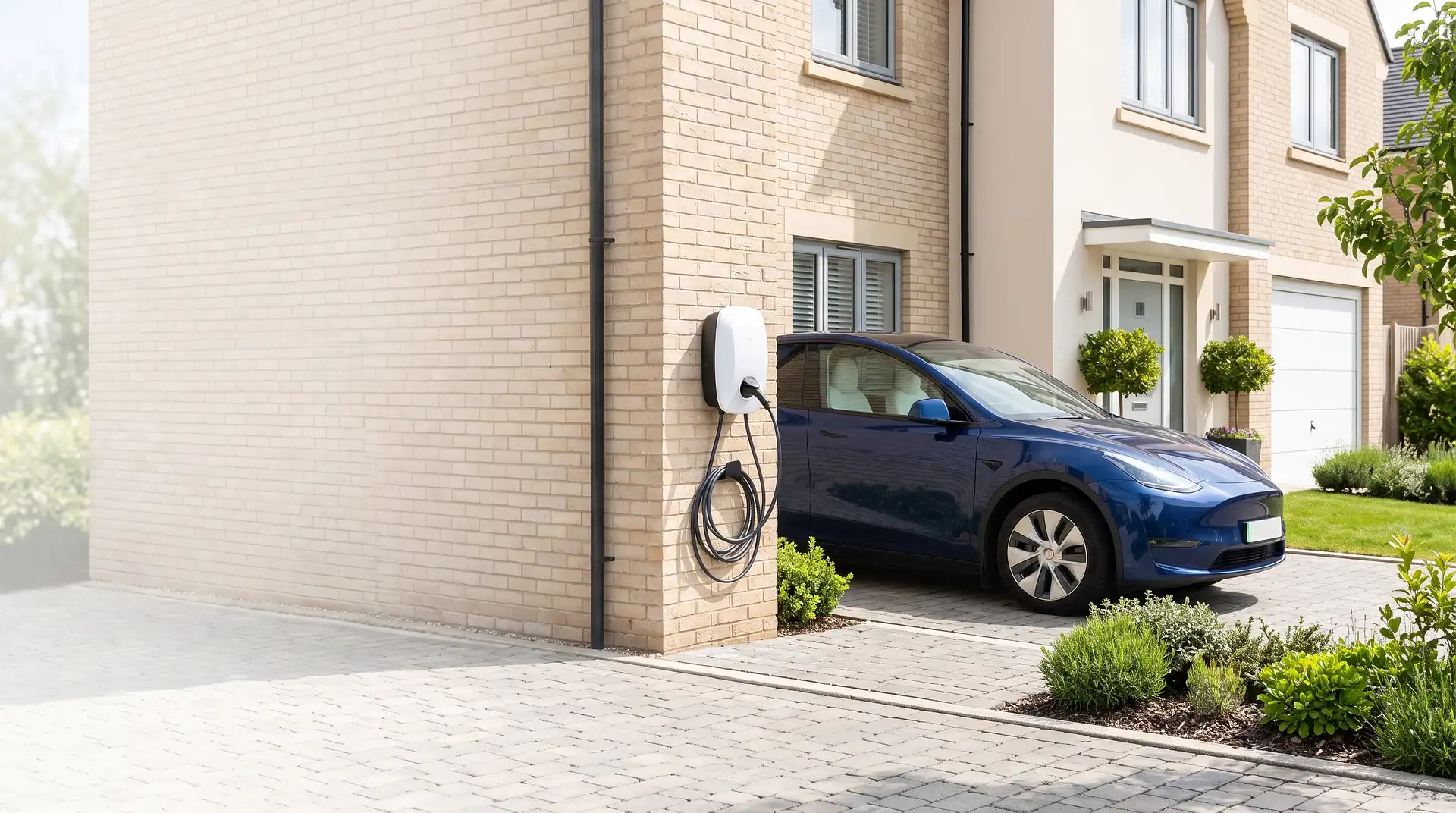
A 7kW home EV charger costs £900 to £1,400 supplied and fitted in the UK in 2026. That is the headline figure for a standard installation: a cable run of under 10 metres from the consumer unit to the parking position, no consumer unit work required, and straightforward wall mounting on a garage or house exterior.
The reason many buyers receive quotes significantly above that figure is that three variables routinely push the cost higher, and none of them is visible from a photograph of the parking position. Cable run distance, consumer unit condition, and whether the property has off-street parking at all are the three factors that account for almost all variation above the baseline.
What the Headline Price Covers and What It Does Not
A standard 7kW charger installation at the £900 to £1,400 price point covers the charger unit itself, up to roughly 10 metres of cable from the consumer unit to the charger mounting point, an isolator switch, and the Part P Building Regulations notification that the installer handles on your behalf.
It does not cover a cable run longer than 10 metres, any trenching to run cable underground to a detached garage or remote parking position, consumer unit work if the existing board cannot take the additional load, or the cost of a smart charger specification that became mandatory for new installations in the UK in June 2022 under the Electric Vehicles (Smart Charge Points) Regulations.
That last point catches buyers who have received informal quotes or are comparing against older published prices. All new home EV charger installations in the UK since June 2022 must use a smart charger with specific functionality including randomised delay capability and the ability to respond to time-of-use signals. Non-smart units that comply with earlier specifications can no longer be legally installed for new domestic installs, and any installation using a non-compliant unit is not certifiable under Part P.
The Variables That Actually Determine Your Bill
Cable run distance is the biggest single variable. At under 10 metres, a surface-clipped cable run is included in most standard quotes. At 15 to 25 metres, additional cable and labour add £150 to £400. A cable run over 25 metres, or one that requires trenching across a driveway or garden to reach a detached garage, adds £300 to £800 depending on the surface and run length. Get the distance measured before accepting any quote as final.
Consumer unit condition affects roughly one in four installations, according to UK installer data. An older consumer unit without a spare way for a dedicated EV circuit, or one that lacks adequate RCD protection, needs either a partial upgrade or full replacement before the charger can be certified. Consumer unit replacement costs £450 to £900. This is not optional: an installer who certifies an EV charger connected to an inadequate consumer unit is issuing a certificate that does not reflect the actual installation condition.
Tethered versus untethered is a minor cost difference but worth understanding before specifying. A tethered unit has the charging cable permanently attached, which is convenient for day-to-day use. An untethered unit is slightly cheaper, keeps the installation tidier, and works with any cable type the driver brings. The unit cost difference is typically £50 to £150.
7kW versus 22kW is a decision most buyers make correctly by default. A 7kW charger adds roughly 30 miles of range per hour of charge, which fills a typical EV overnight from any realistic daily mileage. A 22kW charger adds range three times faster but requires a three-phase electricity supply, which the overwhelming majority of UK homes do not have. Upgrading from single-phase to three-phase supply is a DNO (Distribution Network Operator) job costing £1,000 to £3,000 and is only worth considering for specific high-usage or fleet scenarios.
The Grant Situation in 2026
This is the most frequently misreported aspect of home EV charger installation, and getting it wrong affects the budget significantly.
The OZEV Electric Vehicle Chargepoint Grant for homeowners in houses ended in April 2022. It no longer exists for this group. A homeowner in a house installing a charger in 2026 receives no grant and pays full installation cost.
The grant that still exists in 2026 covers renters and flat owners, up to £350 off the cost of a charger and installation. The distinction is tenure and property type, not the charger itself. Landlords of residential properties can also apply for a grant covering up to £350 per parking space across up to 200 spaces per applicant.
There is a separate Workplace Charging Scheme for businesses, which covers up to £350 per socket up to a maximum of 40 sockets. This applies to business premises, not homes.
If any installer or website is still quoting a grant for a homeowner in a house, that information is out of date. Budget the full installation cost without a grant unless you are a renter, flat owner, or landlord applying under the current scheme.
What If There Is No Off-Street Parking?
Installing a home charger without a driveway or dedicated off-street parking space is possible in some UK locations but not a straightforward job. A cable channel across the public pavement requires permission from the local highway authority, and most councils have a specific process for this. Costs for no off-street parking installations run £1,500 to £2,500, reflecting the additional permissions, groundwork, and specialist installation involved.
Some local authorities run on-street charging schemes in partnership with charge point operators, where lamp post chargers or kerbside units are installed and managed by a third party rather than the homeowner. These are worth investigating before committing to a private installation in areas where the pavement channel option is refused or impractical.
Choosing an Installer
EV charger installation is notifiable work under Part P of the Building Regulations. The installer must be registered with an approved body (NICEIC, NAPIT, ELECSA, or similar) and must issue a certificate for the completed work. An uncertified installation is a problem at remortgage and at sale, and it also invalidates any warranty on the charger unit itself.
OZEV-approved installers are specifically registered to carry out EV charger installation work. The OZEV installer finder at gov.uk/plug-in-car-van-grants is the correct starting point for finding a registered installer. Using an OZEV-approved installer is also the condition of eligibility for the grants that still apply.
Check that any quote confirms who will issue the Part P certificate, whether the unit specified meets the Smart Charge Points Regulations 2021 requirements, and what the cable run assumption is. A quote that arrives without stating the cable run distance assumption is not comparable to one that does.
What a Quote Should Itemise
A properly itemised quote for an EV charger installation should state: the charger unit model and specification, the cable run distance and method (surface-clipped, trunking, or trenched), whether consumer unit work is included or excluded, the Part P certificate, and whether the installation qualifies for any applicable grant. Any quote that arrives as a single total figure rather than an itemised breakdown is not comparable to competitors and cannot be assessed for what is included.
Get three quotes. The spread between the cheapest and most expensive quotes for an identical specification tells you more about the market in your area than any average figure, and the cheapest quote is frequently the one that has excluded the cable run cost or the consumer unit assessment.
If you want to check a quote you have received against 2026 UK market rates by cable run distance, charger speed, and region before calling any installer, the InstantCost EV charger installation cost guide has a calculator built on 2026 UK pricing data that breaks the cost down by charger unit, cabling, labour, and consumer unit work so you can see exactly where a quote sits relative to the expected range for your specific situation.
The installation side of home EV charging is the one-time cost. The ongoing cost, including how much it actually costs per mile to charge at home on different tariff types, is covered in our related guide on how to charge an electric car at home , which covers why a smart charger connected to an off-peak time-of-use tariff can cut charging cost by 60 to 70% compared with charging on a standard flat-rate tariff during peak hours.
Common Mistakes and What to Do Instead
Mistake: assuming the grant still applies to homeowners in houses. The OZEV homeowner grant ended in April 2022. Budget the full cost without a grant unless you are a renter, flat owner, or landlord under the current scheme.
Mistake: accepting a quote without confirming the cable run assumption. A quote valid for a 10-metre cable run is not valid for a 25-metre run to a detached garage. Confirm the measured distance before accepting any figure.
Mistake: choosing a 22kW charger without confirming three-phase supply. Most UK homes have single-phase supply. A 22kW charger on a single-phase supply does not deliver 22kW. A 7kW charger is the correct specification for single-phase homes.
Mistake: not budgeting for consumer unit work. Around one in four UK installations requires consumer unit work. If the installer's survey flags this, it is not an upsell: it is a certification requirement. Factor £450 to £900 as a contingency until the survey confirms the board is adequate.
Mistake: using an unregistered installer to save money. An uncertified installation cannot be legally demonstrated to be safe, invalidates the charger warranty, and creates a problem at remortgage and sale. The Part P certificate is not paperwork, it is the legal record that the installation meets the safety standard.
Mistake: specifying a non-smart charger. All new home EV charger installations in the UK since June 2022 must use a smart charger complying with the Smart Charge Points Regulations 2021. A non-compliant unit cannot be certified for a new installation.
What It Costs in the UK
Item or scenario | Typical UK cost (2026) |
|---|---|
7kW charger, standard install (under 10m cable) | £900 to £1,400 |
7kW charger, long cable run (15 to 25m) | £1,200 to £1,800 |
7kW charger, trenched cable to detached garage | £1,500 to £2,200 |
22kW charger (three-phase supply required) | £1,400 to £2,200 |
Consumer unit upgrade (where required) | £450 to £900 |
No off-street parking installation | £1,500 to £2,500 |
Tethered vs untethered unit cost difference | £50 to £150 |
EV chargepoint grant (renters and flat owners) | Up to £350 off |
EV chargepoint grant (homeowners in houses) | Not available |
Figures based on InstantCost.co.uk's 2026 UK EV charger installation pricing data and vary by region, cable run, and installer. London and South East typically run 15 to 25% above the national average.
Staying Safe
EV charger installation is a high-current electrical job. A 7kW charger draws 32 amps continuously, which is comparable to a full electric cooker circuit. This is not a job for a competent DIYer who is comfortable with basic electrical work: it is notifiable work under Part P that requires registration with an approved body and the issue of a certificate that confirms the installation meets British Standard BS 7671.
Do not use a standard 3-pin plug and a Mode 2 cable as a long-term home charging solution. These cables are designed for occasional emergency use, not daily sustained charging at home. A Mode 2 cable draws 10 amps continuously through a domestic socket that was not designed for sustained high-current load, which is a real fire risk over the months and years of daily use. A dedicated Mode 3 charger on its own circuit is the correct long-term solution.
If the installer identifies any defect in the existing consumer unit or wiring during the survey, it must be addressed before the charger is installed. An installer who offers to proceed without addressing flagged defects is not one to use.
Keep children and pets clear of the installation area during work. Open cable runs, tools, and temporary live connections during installation are hazards that require the working area to be treated as a site.
Under the Electric Vehicles (Smart Charge Points) Regulations 2021, all new home charge points installed in the UK from June 2022 must have smart functionality including demand-side response capability. Installers are responsible for compliance. If a quote specifies a unit without confirming smart compliance, ask for confirmation in writing before proceeding. Regulations are enforced by the Office for Product Safety and Standards (OPSS). Check current requirements at gov.uk before installation.
FAQ
How much does it cost to install a home EV charger in the UK in 2026? A 7kW home EV charger costs £900 to £1,400 supplied and fitted for a standard installation with a cable run under 10 metres and no consumer unit work required. Long cable runs, consumer unit upgrades, and no off-street parking each add significant cost beyond that baseline.
Is there a grant for home EV charger installation in 2026? Not for homeowners in houses. The OZEV homeowner grant ended in April 2022. The EV chargepoint grant still covers renters and flat owners, up to £350 off. Landlords of residential properties can also apply for up to £350 per parking space.
Do I need a consumer unit upgrade for an EV charger? Around one in four UK installations requires consumer unit work. An older board without a spare way for a dedicated 32-amp circuit, or one lacking adequate RCD protection, needs upgrading before the charger can be certified. This adds £450 to £900 and is a certification requirement, not optional.
Can I install a home EV charger without a driveway? Sometimes. A cable channel across the public pavement is possible in some local authority areas with permission, but costs £1,500 to £2,500 and involves a permissions process. Some councils also run kerbside charging schemes worth investigating first.
Is a 7kW or 22kW home charger better? 7kW for almost all UK homes, which have single-phase electricity supply. A 7kW charger adds around 30 miles of range per hour and fills a typical EV overnight. A 22kW charger needs a three-phase supply that most UK homes do not have.
Do EV charger installers need to be registered? Yes. EV charger installation is notifiable work under Part P of the Building Regulations. The installer must be registered with NICEIC, NAPIT, ELECSA, or another approved body and must issue a Part P certificate for the completed work. OZEV-approved registration is also required for grant-eligible installations.