How to Clean Solar Panels
22 August 2026
How to Clean Solar Panels
Cleaning solar panels in the UK improves output in specific circumstances and makes almost no measurable difference in others. The distinction is worth understanding before climbing onto a roof or paying for a professional clean, because the majority of general surface soiling on a UK roof is removed by rainfall and cleaning it manually produces a marginal and short-lived improvement.
The contamination types that do require intervention are different: bird fouling, which blocks cells entirely rather than reducing efficiency slightly; industrial fallout and traffic film in urban areas near main roads; and pollen accumulation during spring, which builds into a sticky film that rain does not fully clear. These cause real, measurable output reduction. A light layer of dust does not.
Does Cleaning Actually Improve Output?
A clean panel outperforms a soiled one, but by how much depends entirely on what is on the panel and where the installation is. Research from the UK's real operating conditions consistently shows that general dust and light soiling on panels at the typical UK roof pitch reduces output by 2 to 5% across a year. On a 4kW system generating around 3,400 kWh annually, that is a loss of 68 to 170 kWh, worth roughly £18 to £46 at 2026 import rates of 27p per kWh.
That figure is smaller than most solar panel owners expect, and it is the reason reputable installers in the UK typically say annual cleaning is sufficient rather than quarterly. The UK's rainfall pattern is actually an asset here: panels pitched at 15 degrees or more shed light dust in moderate rainfall without intervention.
What changes the equation are localised contamination sources. A panel that is partially shaded by a bird dropping performs disproportionately worse than one with an even dust layer, because solar panels contain strings of cells wired in series, and one blocked cell affects the output of the whole string, not just that cell. A dropping covering 5% of a panel's surface can reduce string output by 20 to 30% until it is cleared. That is the case for targeted cleaning even when general cleaning is not.
When to Clean, and When Not To
Clean when: A section of the panel is visibly covered by bird fouling that has dried and crusted. A sticky film from spring pollen or tree sap is visible across the surface. The installation is in an urban area near heavy traffic where exhaust particulates build into a film that rain does not clear. Your monitoring data shows output consistently tracking 10 to 15% below the expected generation for the time of year and weather conditions, and visible soiling is the likely cause.
Do not bother when: The panels are lightly dusty but otherwise clear. It has not rained in two weeks and you are tempted to clean on the basis that they look dusty. You are planning to clean more than twice a year on a standard UK roof installation. You cannot access the panels safely without specialist equipment.
The last point is the most important one. The output improvement from cleaning is never worth a fall from a roof.
Ground-Level Cleaning: The Safe Default
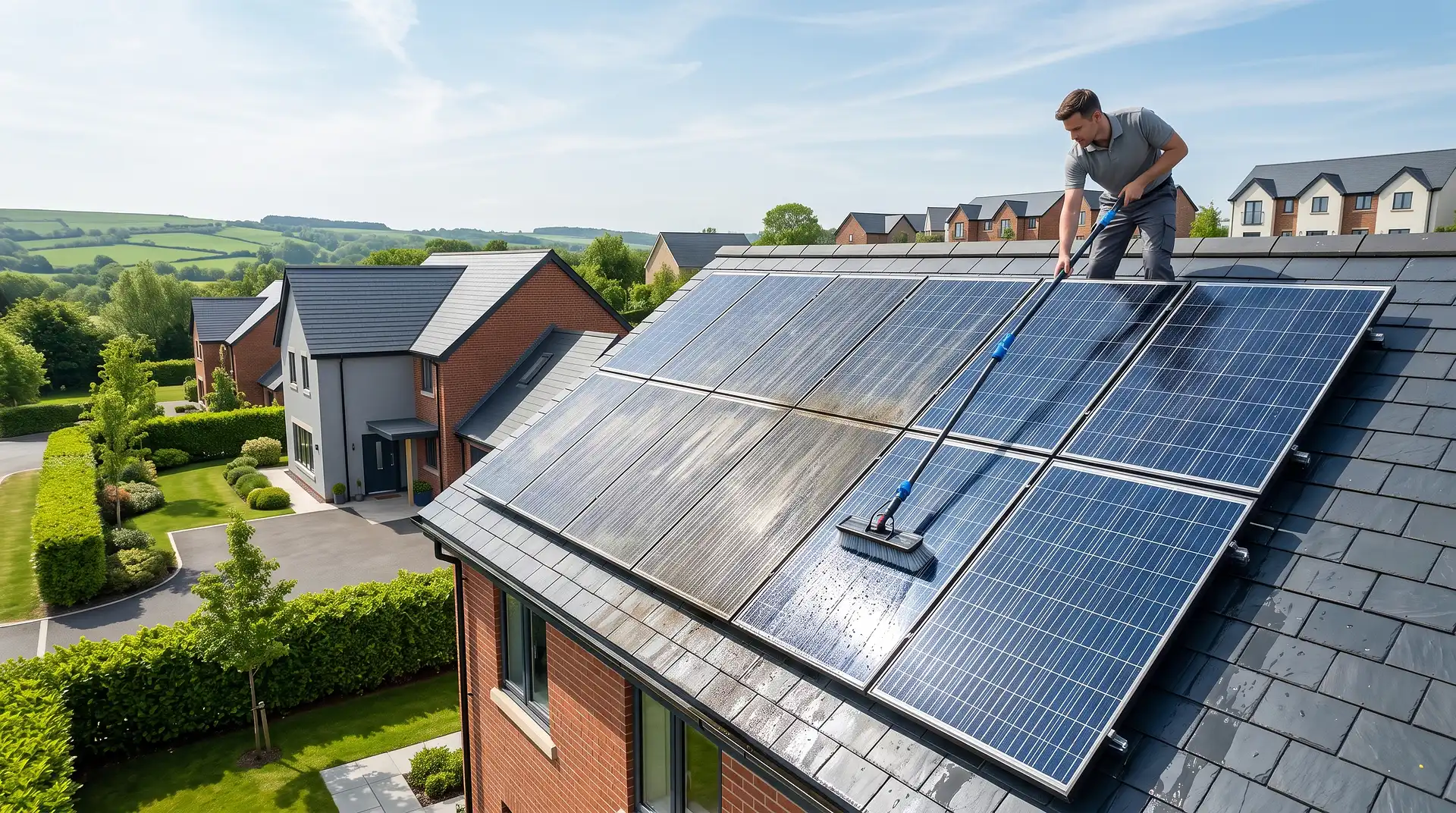
The safest method for most UK domestic installations is ground-level cleaning using a soft-bristle brush head on an extendable pole with a hose feed, which wets the panel surface and agitates soiling without requiring any roof access. These are widely sold as window cleaning poles and cost £30 to £80 for a set that reaches a standard two-storey roof.
Use cold or lukewarm water only. Hot water on a cold panel surface in winter creates thermal shock risk, and the tempered glass on most solar panels is designed for temperature cycling, not sudden extreme differentials. Detergent is not required and most panel manufacturers advise against it: residue left by soap products attracts airborne particulates faster than a clean water rinse does, which accelerates resoiling.
The method is simple. Wet the panel surface to loosen dried soiling. Brush gently from the top of the panel downward. Rinse from the top again with clean water. That is the complete process for anything short of hardened bird fouling.
For hardened bird fouling, soak the affected area with water and allow it to soften for five to ten minutes before attempting to remove it. Do not scrape with anything hard. A soft cloth or the brush head, rewetted several times, removes most fouling once it has been properly softened. Scraping tempered glass risks microfractures that, while not immediately visible, create stress points that fail under subsequent thermal cycling.
Step 1: Check Your Monitoring Data First
Before cleaning anything, look at your inverter monitoring app or the generation log on your system. Most modern inverters, including Solaredge, SolarEdge, Huawei, and Growatt systems, log daily generation against expected generation for the location and date.
A system consistently generating within 5% of expected output in good conditions does not need cleaning. A system running 15% or more below expected output in good conditions, where shade is not the explanation, is worth investigating, and visible soiling is the first thing to check.
If the monitoring data shows one string performing significantly below another on the same roof, that specific string has either a fault or a soiling problem concentrated on it. That targeted information is more useful than cleaning the whole array on a schedule.
Step 2: Choose the Right Time of Day
Clean panels in the early morning or evening, not midday. Panels in direct summer sun reach surface temperatures of 50 to 70 degrees Celsius. Cold water applied to a very hot panel surface causes localised thermal stress, and the water evaporates almost immediately before it has time to loosen soiling. Early morning dew also pre-softens surface deposits, making the cleaning more effective with less effort.
Do not clean in freezing conditions. Ice forming from cleaning water in the cell gaps and around the frame can cause expansion damage.
Step 3: Water Quality Matters More Than Most Guides Note
Hard water, which covers most of England and parts of Wales, leaves calcium and magnesium mineral deposits when it dries on a panel surface. These deposits are not removed by the next rainfall and accumulate over years, producing a white film that reduces transmittance gradually. Cleaning with hard mains water and allowing it to air-dry produces a result that is worse than the dusty panel you started with once the water spots dry.
Use deionised or demineralised water for the final rinse, or a squeegee to remove water before it dries. Deionised water is available in 25-litre containers from motor factors and cleaning suppliers for £4 to £8. Professional solar panel cleaners use deionised water as standard for this reason.
Step 4: Check the Frame and Drainage Channels
While the panel surface is wet and accessible, check the aluminium frame around each panel for debris accumulation. Leaves, moss, and lichen build up in the channel between the frame and the glass, which creates a damp reservoir that promotes frame corrosion and provides a growing medium for moss that spreads onto the panel surface.
Clear this channel with the brush head or a gloved hand. Moss on panel frames is worth treating with a diluted sodium hypochlorite solution (no stronger than 5%), applied to the frame only, not to the glass surface. Leave it for 10 minutes and rinse. This kills the root system rather than just removing surface growth, which delays recolonisation considerably.
When to Call a Professional
Call a professional solar panel cleaning service if the installation is on a two-storey or higher roof where ground-level pole cleaning cannot reach effectively, if there is significant moss or lichen colonisation across the panel surface rather than just the frames, or if the panels have not been cleaned in several years and there is visible mineral scale across the surface that requires deionised water equipment to address properly.
A professional clean also makes sense as part of the periodic inspection recommended by most manufacturers: every three to five years, a qualified solar panel installer should inspect the panel condition, connector integrity, inverter performance, and mounting system fixings. Combining a clean with that inspection visit saves a separate call-out.
Professional solar panel cleaning costs £80 to £200 for a standard domestic installation of 8 to 12 panels, depending on roof height and access difficulty. That cost needs to be weighed against the output improvement it produces: on a UK system without significant bird fouling or hard water scaling, the annual generation improvement from a professional clean over a ground-level clean is often minimal. The inspection value is the better justification.
Understanding how panel condition connects to long-term system performance is worth doing before a clean rather than after one. A system that is consistently underperforming despite clean panels may have an inverter fault, a shading problem, or a degraded panel rather than a soiling problem, and cleaning does not address any of those. For a full 2026 UK breakdown of what solar systems cost by size, the savings they generate, and what payback looks like with and without battery storage, the InstantCost solar panel cost guide has a calculator you can use to check whether your system is performing in line with its original specification.
For the context on how panels actually generate electricity and why shading and soiling affect output the way they do, our related guide on how solar energy works covers the cell-string relationship that explains why a single bird dropping has a disproportionate effect on whole-string output -- the mechanism that makes targeted cleaning genuinely worthwhile even when general cleaning is not.
Common Mistakes and What to Do Instead
Mistake: cleaning on a schedule rather than on need. Cleaning twice a year on fixed dates regardless of what the panels actually look like or what the monitoring data shows wastes time and risks unnecessary roof access. Check the data first.
Mistake: using mains hard water and leaving it to air-dry. Hard water deposits worsen panel performance over time. Use deionised water for the final rinse or remove water with a squeegee before it dries.
Mistake: using detergent. Soap residue attracts particulates and accelerates resoiling. Cold or lukewarm clean water with a soft brush is sufficient for all standard soiling.
Mistake: cleaning at midday in summer. Panel surface temperatures of 50 to 70 degrees Celsius make cleaning less effective and create thermal stress risk. Clean in early morning or evening.
Mistake: scraping dried bird fouling. Scraping tempered glass risks microfractures. Soak the fouling until soft, then remove with a soft brush or cloth. Multiple wet passes are more effective than mechanical force.
Mistake: ignoring the frame drainage channels. Debris and moss build up in the frame channel out of sight and create the conditions for frame corrosion and surface moss spread. Clear and treat annually.
Mistake: cleaning instead of investigating a genuine fault. A system consistently generating 15% below expected output may have a panel fault, an inverter issue, or a new shading problem. Cleaning does not address any of these. Check the monitoring data by string before assuming soiling is the cause.
What It Costs in the UK
Item or service | Typical UK cost (2026) |
|---|---|
Extendable soft-brush pole with hose feed | £30 to £80 |
Deionised water, 25 litres | £4 to £8 |
Squeegee attachment for pole | £10 to £25 |
Professional clean, 8 to 12 panels | £80 to £150 |
Professional clean, 12 to 16 panels | £120 to £200 |
Combined clean and system inspection | £150 to £300 |
Annual output loss from general UK soiling | £18 to £46 (2 to 5% of generation) |
Annual output loss from significant bird fouling | £50 to £150+ (10 to 30% of string output) |
Output loss figures based on a 4kW system generating 3,400 kWh annually at 27p per kWh import rate. Professional cleaning costs vary by roof height, access difficulty, and region.
Staying Safe
The most important safety point for solar panel cleaning is the one most guides state and then underweight: roof access is the leading cause of serious DIY injury in UK home maintenance, and the output improvement from cleaning never justifies a fall.
If your installation requires ladder access or walking on the roof to reach the panels, use a professional. The ground-level pole method reaches the panels on most standard UK two-storey roofs without any roof contact, and where it does not, the professional cleaning cost of £80 to £200 is straightforwardly the right option.
Solar panels on a wet roof are slippery surfaces with no grip. Moss, which grows preferentially on roof surfaces with north-facing aspect or persistent shade, is particularly hazardous underfoot. Never walk on a solar panel surface. The tempered glass is not designed to take point loads from footsteps and will crack, voiding the panel warranty and creating a glass and live electrical hazard simultaneously.
Solar panels generate DC voltage whenever they are exposed to light, including overcast UK daylight. This means the panel and its cables are live whenever visible light reaches the surface, regardless of whether the inverter is switched on. Do not touch panel frames, connectors, or cables. The cleaning method described above involves no contact with electrical components, but awareness of the live circuit is important context for anyone working near roof-mounted systems.
Keep children and pets away from the working area during cleaning. Runoff water from panel cleaning may contain bird fouling, moss treatment chemicals, or mineral deposits and should not be directed to a water butt or a watercourse. Direct it to a foul drain where possible.
Solar panels in the UK are live DC circuits during daylight hours. Panel connectors and cables carry potentially dangerous voltages even when the AC inverter is isolated. Never attempt to disconnect, move, or repair panel wiring yourself. Any work involving panel wiring, connector replacement, or inverter connections must be carried out by a qualified MCS-accredited solar installer.
FAQ
How often should solar panels be cleaned in the UK? Once or twice a year is sufficient for most UK installations. Check your inverter monitoring data rather than cleaning on a fixed schedule. Panels with significant bird fouling should be cleaned as soon as the fouling is noticed, since a single dropping on one cell can reduce whole-string output by 20 to 30%.
Does rain clean solar panels? For general dust and light soiling on panels pitched at 15 degrees or more, yes. UK rainfall is sufficient to remove most surface dust. Rain does not remove hardened bird fouling, dried pollen film, or hard water mineral deposits. These require intervention.
Can I use a pressure washer on solar panels? No. High-pressure water forces water into the gap between the frame and the glass, risks connector damage, and the impact pressure can cause microfractures in tempered glass. Use a soft brush with a low-pressure hose feed only.
What should I use to clean solar panels? Cold or lukewarm deionised water with a soft-bristle brush on an extendable pole. No detergent, no abrasive pads, no pressure washing. Deionised water prevents the mineral deposits that mains hard water leaves when it dries on the panel surface.
How much does professional solar panel cleaning cost? £80 to £150 for a standard 8 to 12 panel domestic installation, rising to £120 to £200 for larger arrays or difficult roof access. Combining a clean with a system inspection every three to five years makes better use of the visit.
Can dirty solar panels cause permanent damage? Bird fouling left for extended periods causes hotspot damage where the blocked cell overheats relative to the surrounding cells, creating localised thermal stress that can degrade that cell permanently. This is the main argument for addressing concentrated fouling promptly rather than waiting for a scheduled clean.