How to Connect a Double Light Switch
10 October 2026
How to Connect a Double Light Switch
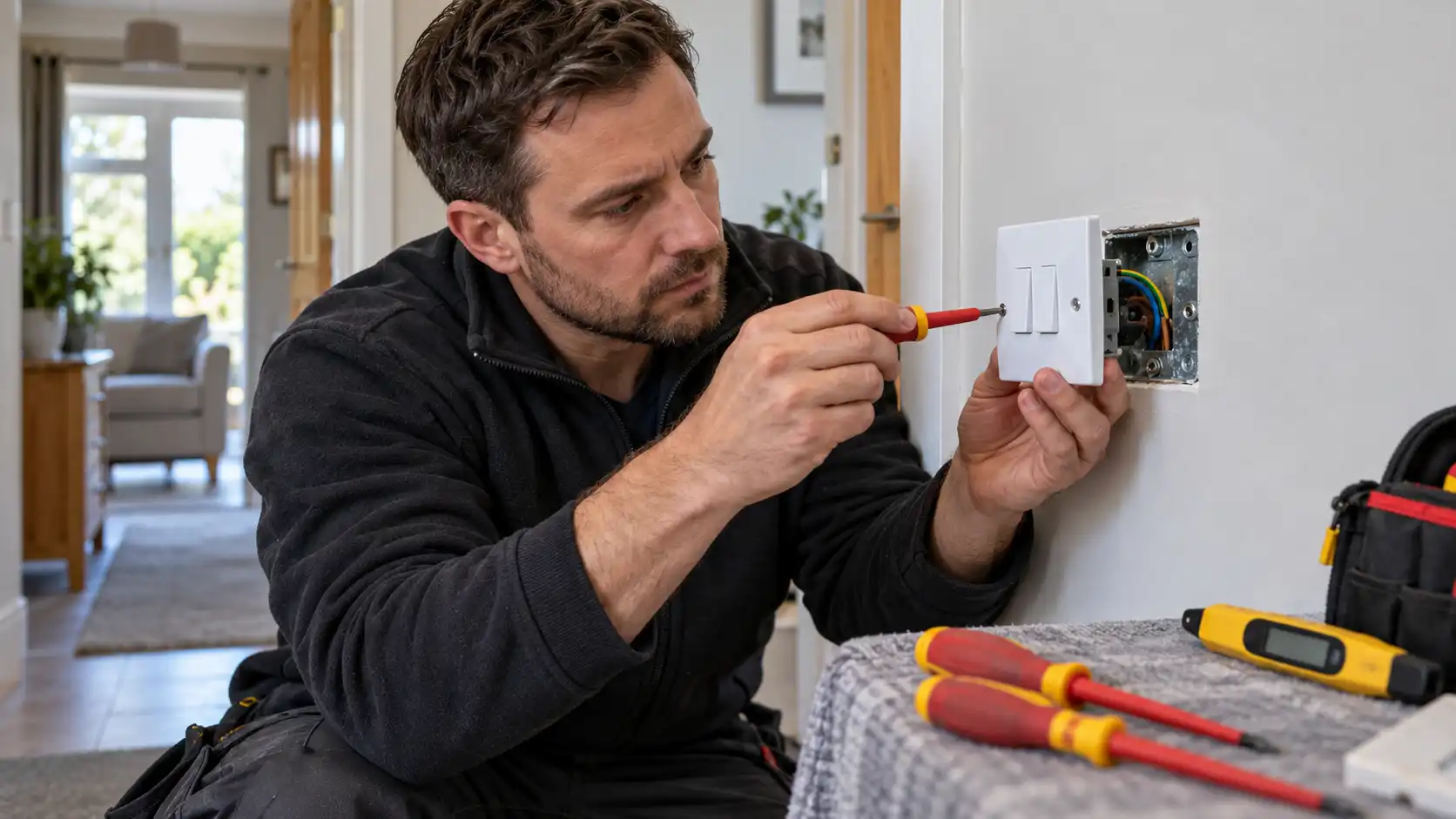
A double light switch, also called a two-gang switch, controls two separate lights or two lighting circuits from one wall plate. The safe way to replace one is to isolate the correct circuit, prove it is dead, record the existing terminals and transfer each conductor to the matching terminal on the new switch.
This guide is for understanding a like-for-like replacement. New wiring, changes to the circuit, bathroom work, outdoor lighting and uncertain wiring should be completed and tested by a qualified electrician.
Quick answer: A two-gang switch normally has two separate switch mechanisms. Label the existing conductors before removing them, identify the common and switched terminals on both gangs, and reproduce the same arrangement on the new switch. Never rely on wire colour alone.
What Does “Double Switch” Mean?
Term | Meaning |
|---|---|
Two-gang switch | Two switches mounted on one plate, usually controlling two separate lights |
Two-way switch | A switch that can control one light from two locations |
Double two-way switch | Two switch mechanisms, each capable of two-way control |
Intermediate switch | Used in a circuit controlled from three or more locations |
Many people use “double switch” to mean a two-gang switch, while “two-way” describes how the light is controlled. Check the markings and the existing circuit before buying a replacement.
Before You Start
Buy a replacement with the same gang and switching arrangement.
Check whether the plate fits the existing back box.
Read the new switch instructions.
Take a clear photograph before disconnecting anything.
Label each conductor with masking tape.
Use a proper two-pole voltage tester and proving unit.
Make sure the work area is dry and well lit.
A non-contact voltage pen is useful as an additional check but should not be your only method of proving the circuit dead.
How to Connect a Double Light Switch Step by Step
1. Turn off the correct circuit
Switch off the lighting circuit at the consumer unit. If the circuit is not clearly identified, turn off the main switch or arrange an electrician to identify it safely.
2. Prevent accidental reconnection
Keep the consumer unit cover closed, attach a warning note and tell everyone in the property that electrical work is in progress. Do not allow anyone to switch the circuit back on.
3. Prove your tester works
Test the two-pole tester on a known live source or proving unit. This confirms the tester is functioning before you rely on it.
4. Remove the switch plate carefully
Remove the screws and ease the switch forward without pulling the conductors tight. Older boxes can contain brittle insulation or crowded wiring.
5. Prove the conductors are dead
Test every conductor at the switch, including any black or blue conductor that may be used as a switched live. Then test the proving unit or known live source again to confirm the tester has not failed.
6. Photograph and label the terminals
Take a close photograph showing the terminal markings. Label conductors according to the terminal they came from, such as common, L1 or L2. Do not label them only by colour.
7. Identify each switch gang
A two-gang switch has two independent mechanisms. One gang may control the ceiling light and the other may control a porch light, wall light or second room. Keep the conductors for each circuit with the correct gang.
8. Transfer the conductors one at a time
Move each conductor from the old switch to the matching terminal on the new switch. Tighten terminals securely, but do not crush the copper or leave exposed strands outside the terminal.
9. Check the earth conductor
If an earth conductor is present, it must remain connected to the earth terminal or earth connection in the back box as required. Do not leave an earth conductor loose or cover it in a way that hides its purpose.
10. Check the neutral arrangement
Many traditional wall switches do not contain a neutral conductor. Do not connect a blue or black conductor to a neutral terminal simply because of its colour. Confirm its function from the original arrangement or ask an electrician.
11. Secure the switch
Fold the conductors carefully into the box without trapping insulation under the accessory. Secure the switch plate evenly and make sure no cable is being pinched.
12. Restore power and test
Switch the circuit back on and test each gang separately. Check that each light responds to the correct switch and that there is no buzzing, heat, flickering or smell of burning.
How to Connect a Double Two-Way Switch
A double two-way switch contains two separate common, L1 and L2 arrangements. Each light circuit has its own set of conductors, although the exact terminal layout varies by manufacturer.
Do not copy a diagram from another switch unless the terminal markings, circuit arrangement and conductor functions match your installation. If the old switch has several linked conductors or the lights can be controlled from multiple locations, use an electrician unless you are experienced with two-way circuits.
Common Wiring Mistakes
Turning off the wrong circuit
Testing only one conductor
Relying on a non-contact tester alone
Assuming blue or black always means neutral
Mixing conductors from the two gangs
Leaving exposed copper outside a terminal
Forgetting the earth connection
Using a one-way switch in a two-way circuit
Forcing too many conductors into a shallow back box
Ignoring buzzing, heat or flickering after testing
When Should You Call an Electrician?
Arrange professional help if the wiring does not match the replacement switch, the back box is damaged, the circuit includes a bathroom or outdoor light, the installation is old and brittle, or you need to add a new switch position or cable.
Use a registered electrician for new wiring, circuit alterations and work where you cannot confidently isolate and prove the circuit dead.
Not sure about the wiring?
Compare current UK electrician prices for switch replacement, fault finding and lighting work.
UK Electrical Safety Requirements
Electrical work in a dwelling must be designed and installed to protect people from electric shock and fire. Some work may need notification or certification under Part P, especially where new circuits or special locations are involved.
Read the GOV.UK Approved Document P guidance and use a qualified electrician when the work is outside a straightforward like-for-like replacement.
How Much Does It Cost to Replace a Double Light Switch?
InstantCost’s current UK electrician data places standard electrician labour at approximately £40 to £75 per hour. A straightforward existing-switch replacement may be charged as a small fixed job, while fault finding, new wiring, access problems or a consumer unit issue will cost more.
Indicative UK electrical prices in 2026 | |
Job | Typical guide |
|---|---|
Electrician hourly rate | £40 to £75 per hour |
Like-for-like switch replacement | Often a small fixed job or minimum charge |
Lighting fault finding | Quoted according to time and fault complexity |
New switch position or wiring | Higher cost after a site inspection |
Ask whether the quote includes the switch, call-out, testing, certification and VAT.
Safety Checklist
Correct circuit isolated at the consumer unit
Tester proved before and after testing
Every conductor tested dead
Original arrangement photographed and labelled
Earth connection retained
No exposed copper visible outside terminals
Switch plate secure and cables not trapped
Lights tested without buzzing, heat or flickering
Frequently Asked Questions
Can I replace a double light switch myself?
A competent person may replace an existing switch on an existing circuit if the wiring is understood, the circuit is safely isolated and the installation is tested. New wiring, special locations and uncertain arrangements should be handled by an electrician.
What is the difference between a two-gang and two-way switch?
Two-gang means two switches on one plate. Two-way means one light can be controlled from two locations. A switch can be both two-gang and two-way.
Why are there blue wires in my light switch?
A blue conductor may be used as a switched live in some lighting circuits. Wire colour does not prove its function, so test and label every conductor.
Do I need a neutral wire for a normal double light switch?
Many traditional mechanical switches work without a neutral at the switch. Smart switches often need a neutral, so check compatibility before buying.
Why is one light working but the other not?
A conductor may be in the wrong gang, a terminal may be loose, the lamp may have failed or the circuit may have a fault. Isolate the circuit and arrange testing if the cause is not obvious.
Why does my light switch buzz after replacement?
Buzzing can indicate a loose connection, incompatible dimmer or faulty accessory. Turn off the circuit and arrange an electrician rather than continuing to use it.
Need a safe lighting installation?
Request a written quote from a local electrician for your double-switch replacement or lighting alteration.