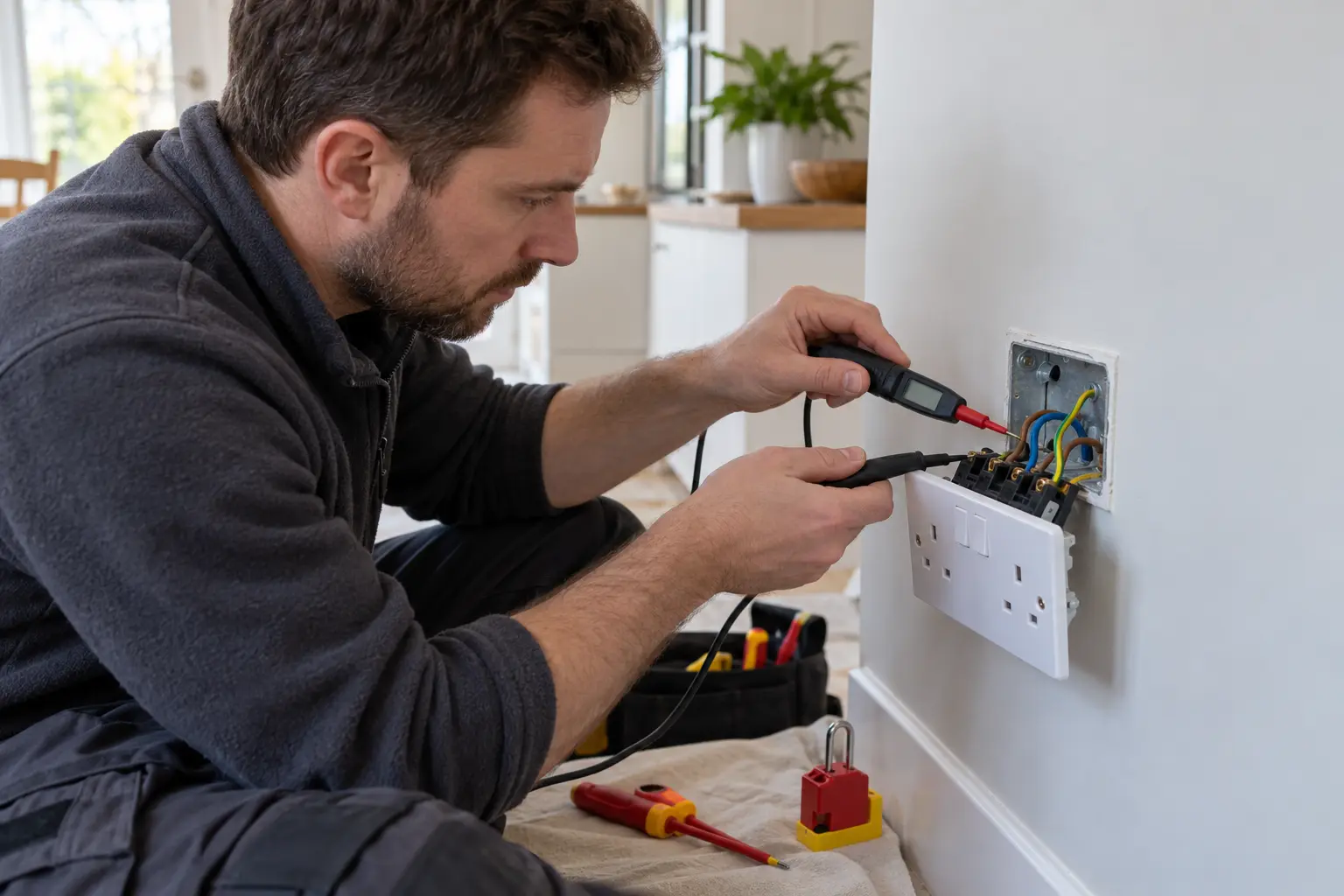
How to Wire a Plug Socket
23 October 2026
How to Wire a Plug Socket Safely in the UK
A UK wall socket normally has terminals marked L for live, N for neutral and an earth symbol for the protective conductor. On modern wiring, brown connects to L, blue connects to N and green-and-yellow connects to earth. However, the function of every conductor must be verified. Wire colour and a generic online diagram are not enough to prove that an existing circuit is safe.
This guide explains a like-for-like replacement of an existing socket whose wiring is sound and understood. Adding a new socket, extending a circuit, converting a circuit arrangement or working with damaged or unidentified wiring requires proper design, inspection and testing.
Quick answer: Isolate the socket circuit at the consumer unit, prevent it from being switched back on and prove every conductor dead with a suitable two-pole tester. Photograph and label the existing connections. Transfer the verified live conductors to L, neutral conductors to N and protective conductors to the earth terminal on the matching replacement socket. Secure the cables without exposed copper, then inspect and test the completed work before use.
Does “plug socket” mean a plug or a wall socket?
In everyday UK language, a plug socket usually means the fixed outlet on the wall. A plug is the fused three-pin connector attached to an appliance cable.
The two jobs are different. Rewiring an appliance plug involves flexible cable, a fuse and a cable grip. Replacing a wall socket involves the fixed 230-volt electrical installation. This article covers the wall socket.
Can you replace a plug socket yourself?
A competent person may be able to replace an existing socket with an equivalent model when:
The circuit can be identified, isolated and proved dead
The existing wiring is undamaged and clearly understood
No new cable or socket position is being added
The replacement fits the existing back box
The circuit arrangement is not being changed
The completed work can be inspected and tested properly
Being able to switch off a circuit breaker is not the same as being competent to complete electrical work. You also need to recognise damaged wiring, terminate conductors correctly and determine whether the finished socket is safe.
Use an electrician if you cannot confidently isolate and prove the circuit dead, if the wiring arrangement is unclear or if you do not have the equipment needed to test the completed work.
What do the terminals on a UK socket mean?
Terminal | Function | Current UK colour | Older UK colour |
|---|---|---|---|
L | Live or line | Brown | Red |
N | Neutral | Blue | Black |
Earth symbol | Circuit protective conductor | Green and yellow, or bare copper with green-and-yellow sleeving | Green, or bare copper that should be correctly sleeved |
The terminal positions are not identical on every socket. On one product, live may be on the left when viewed from the back. On another, it may be elsewhere. Follow the L, N and earth markings on the actual replacement and read its instructions.
Mixed old and new colours can indicate that a circuit has been altered. Stop and arrange testing if the conductor functions or history of the installation are uncertain.
What does a basic UK socket wiring diagram look like?
The following is a conceptual terminal guide. It does not identify the circuit type or prove what any conductor in your wall does.
Rear of a typical UK socket

        ┌────────────────────────────┐
        │                            │
        │   N                    L   │
        │ Neutral               Live │
        │   ○                    ○   │
        │ Blue                  Brown│
        │                            │
        │          Earth             │
        │            ○               │
        │ Green/yellow sleeving      │
        │                            │
        └────────────────────────────┘

Terminal positions vary. Follow the markings on the actual socket.
A socket may contain one, two or three cables. The number of cables alone does not confirm whether it is part of a ring final circuit, a radial circuit or a spur. Proper electrical testing is needed to establish the circuit arrangement.
What tools are needed for a like-for-like replacement?
A suitable replacement socket that complies with the relevant UK product standard
A two-pole voltage tester
A proving unit or suitable known live source
A consumer-unit lockout device and warning tag
Insulated screwdrivers suitable for the terminals
Wire labels or masking tape
A camera for recording the original connections
A torch or battery-powered work light
A non-contact voltage pen can provide an initial warning, but it must not be the only tool used to prove conductors dead. A simple plug-in socket tester also has limits and cannot prove every requirement of a completed installation.
How do you wire a replacement plug socket?
1. Confirm that the job is like for like
Check whether you are replacing a single or double socket and whether it is switched, unswitched, fitted with USB outlets or made from metal.
A socket containing USB charging equipment may be deeper than a standard socket. Check that the back box has enough room without crushing cables or forcing the faceplate against the wall.
Changing from plastic to metal also affects the earthing requirements. Do not fit a metal faceplate unless the protective conductor and required earth connections are present and sound.
2. Switch off the correct circuit
Turn off the socket circuit at the consumer unit. Do not rely on the socket’s front switch because live conductors remain behind the faceplate.
Lock the circuit breaker in the off position where possible, attach a warning tag and tell everyone in the property not to restore the supply.
3. Prove the voltage tester works
Test the two-pole voltage tester on a proving unit or suitable known live source. This confirms that the tester is working before you depend on it.
4. Check the socket is dead
Test the socket and every relevant conductor using the correct procedure for the tester. Check between live and neutral, live and earth, and neutral and earth as appropriate.
After proving the conductors dead, test the voltage tester again on the proving unit. This live-dead-live process confirms that the tester did not fail during the check.
If any voltage is detected, stop. Do not remove or touch the conductors until the correct supply has been isolated.
5. Remove the faceplate carefully
Undo the fixing screws and ease the socket forward without pulling sharply. The cables may be short, stiff or crowded inside the box.
Support the faceplate so its weight is not hanging from the conductors. Check for damaged insulation, loose terminals, corrosion, scorch marks, melted plastic or signs of previous overheating.
6. Photograph and label every connection
Take clear photographs showing the terminal markings and every conductor before disconnecting anything. Label the groups according to the old socket terminals, such as L, N and earth.
Do not label conductors by colour alone. Record the verified terminal function they came from.
7. Compare the old and new sockets
Place the sockets side by side and find the L, N and earth markings on each. The new terminal positions may be different from the old ones.
Check the manufacturer’s instructions, terminal capacity and required conductor preparation. Do not put more conductors into a terminal than the socket is designed to accept.
8. Transfer the verified conductors
For a verified like-for-like replacement:
Conductors removed from the old L terminal go to the new L terminal
Conductors removed from the old N terminal go to the new N terminal
Protective conductors go to the socket’s earth terminal
The protective conductors should have green-and-yellow sleeving where required. No bare protective conductor should be able to touch a live or neutral terminal.
If the back box is metal, its earthing arrangement must also remain effective. Follow the socket manufacturer’s instructions and the requirements for the existing installation. Do not assume that one earth connection is suitable for every metal box and faceplate arrangement.
9. Check each terminal
Make sure each conductor is fully inserted and securely clamped. There should be no exposed live or neutral copper outside the terminal.
Give each conductor a gentle individual pull to check that it is held. A bundle can appear secure even when one conductor has missed the terminal clamp.
Do not overtighten terminal screws. Excessive force can damage the conductor or terminal, while insufficient tightening can create resistance and overheating.
10. Refit the socket without trapping cables
Fold the conductors into the back box with smooth bends. Do not sharply crease them, trap insulation behind a fixing screw or force a deep socket into a shallow box.
Fit the faceplate squarely and tighten the fixing screws evenly. Do not overtighten them, especially on decorative or brittle faceplates.
11. Inspect and test the completed work
Before restoring power, check that:
The faceplate is secure
No cable insulation is trapped
No copper is visible outside the terminals
The earth arrangement is intact
The socket switches move normally
The completed work should then be tested appropriately. A plug-in tester can identify some basic polarity and earth problems, but it cannot confirm all the tests needed to demonstrate circuit safety.
If you cannot carry out or arrange the correct testing, use a qualified electrician rather than treating a light or reading on a basic tester as full proof that the work is safe.
What if there are two or three wires in each terminal?
Two conductors of each function are common where the circuit continues through the socket. However, this does not prove that the socket is part of a ring circuit. A radial circuit can also enter and leave a socket.
A third cable might supply a spur, but it could have another purpose. Do not separate the cables or change their arrangement unless the circuit has been identified and tested.
All conductors that were correctly grouped in one terminal must remain properly grouped in the equivalent terminal of the replacement. If the new socket cannot safely accept them, stop and use an electrician. Do not cut strands or force an oversized group into the terminal.
When should you call an electrician?
Do not continue with a DIY replacement if:
You cannot identify or isolate the correct circuit
You cannot prove every conductor dead
The socket contains damaged, brittle or scorched wiring
The insulation colours or conductor functions are unclear
The socket or wall feels warm
You hear buzzing or crackling
The circuit breaker or RCD trips
The earth conductor is missing or damaged
The metal back box or faceplate cannot be earthed correctly
The cables are too short to terminate without strain
You are adding, moving or extending a socket circuit
The work is in a bathroom, outdoors or another special location
You cannot complete the required inspection and testing
Safe isolation is also essential when working on light switches and other accessories. The InstantCost guide to installing a light switch safely explains why the circuit must be isolated and proved dead rather than simply switched off at the accessory.
Need a socket replaced or professionally tested? Use the InstantCost calculator to check a regional guide price for socket and electrical work.
Calculate socket replacement costs
How much does it cost to replace a plug socket?
InstantCost’s electrician calculator currently lists adding or replacing a socket at approximately £90 to £150 as a UK guide range. The calculator was checked in October 2026.
This is an estimate rather than a fixed quote. The final cost can change with your region, minimum call-out, socket type, back-box condition, access, fault finding, testing and whether new wiring is required.
A straightforward faceplate replacement is different from adding a completely new socket. A new point may require cable routing, wall chasing, circuit design, RCD protection, testing, certification and repairs to the wall finish.
UK electrical-safety and Building Regulations
A socket circuit can remain dangerous even when the socket’s front switch is off. Always isolate the circuit at the consumer unit and prove the conductors dead before touching them.
In England, GOV.UK’s Approved Document P explains the electrical-safety requirements for dwellings and when work needs notification. A straightforward replacement is different from installing a new circuit, but all completed work must still be safe.
Building-control and certification arrangements differ across England, Wales, Scotland and Northern Ireland. Ask a registered electrician or the relevant local authority when the work involves a new circuit, a special location or uncertainty about notification.
Common plug-socket wiring mistakes
Relying on the socket switch
The switch controls the socket outlet, not necessarily every live part behind the faceplate. Isolate the circuit at the consumer unit.
Using a non-contact voltage pen alone
A voltage pen can miss dangerous conditions or respond to nearby cables. Use suitable test equipment and a proper safe-isolation procedure.
Copying terminal positions
Terminal positions vary between manufacturers. Match verified conductor functions to the L, N and earth markings rather than copying left, right or physical position.
Assuming the wire colours prove everything
Colours can help, but they do not prove circuit function or condition. Older installations, alterations and incorrect previous work can produce unexpected arrangements.
Leaving one conductor loose
Where several conductors share a terminal, one can miss the clamp. Check each conductor individually after tightening.
Forcing a USB socket into a shallow box
USB sockets are often deeper than standard faceplates. Crushing or sharply bending conductors to make one fit can damage the insulation or loosen a terminal.
Failing to test the finished circuit
A socket working with a lamp or phone charger does not prove that its polarity, earth path, protective devices and connections are safe.
Frequently asked questions
Which wire goes where in a UK plug socket?
On current UK wiring, a verified brown live conductor connects to L, a verified blue neutral connects to N and the green-and-yellow protective conductor connects to the earth terminal. Follow the terminal markings and verify every conductor’s function.
Why does my socket have two brown and two blue wires?
The circuit may enter the socket and continue to another point. This can occur on ring and radial circuits, so the number of conductors alone does not identify the circuit type.
Why are the wires red and black?
Red and black are older UK fixed-wiring colours. Red was normally live and black normally neutral. Do not rely only on those colours, especially where an installation contains later alterations or mixed cable colours.
Can I replace a single socket with a double socket?
It depends on the back box, cable space and the condition of the circuit. A conversion socket may fit an existing single box, while a standard double socket normally needs a suitable double back box and wall alterations. Use an electrician if the box or circuit must be changed.
Does a plastic socket need an earth connection?
Yes. The circuit protective conductors must remain correctly connected even when the faceplate is plastic. They provide protection for the circuit and may also earth a metal back box.
Can I install a USB plug socket?
A compatible USB socket can sometimes replace an existing socket, but it may need a deeper back box and more space for its electronics. Check its instructions, terminal capacity and installation depth before disconnecting anything.
Why does the new socket trip the circuit breaker?
An incorrect connection, trapped conductor, damaged cable, faulty socket or earth fault may be present. Leave the circuit switched off and arrange professional testing. Do not repeatedly reset the breaker.
Is replacing a socket notifiable work?
A straightforward like-for-like replacement is generally treated differently from installing a new circuit. The exact requirements depend on the work and UK nation. All electrical work must still be completed and tested safely.
Is a plug-in socket tester enough?
No. It can identify certain basic faults but cannot prove every safety requirement or replace the complete tests carried out with professional equipment.
Prefer to have the socket replaced and tested professionally? Compare local electrician quotes for the actual socket type and condition of your circuit.