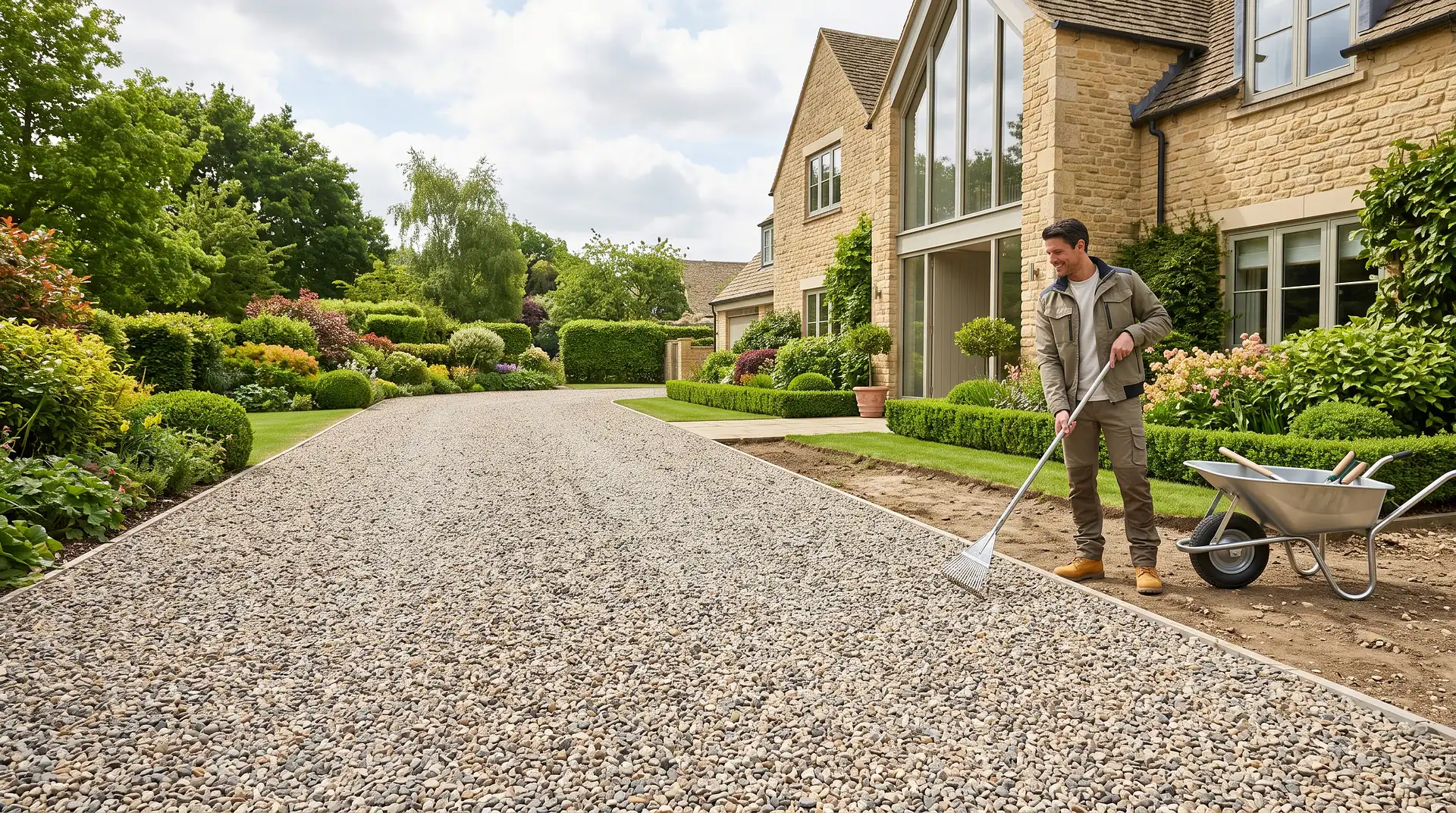
How to Gravel a Driveway
22 August 2026
How to Gravel a Driveway
A gravel driveway costs from £55 per square metre supplied and fitted in the UK in 2026, making it the cheapest driveway surface available and the only common material that qualifies as permeable under current UK planning rules without any additional work. For a standard double driveway of around 36 square metres, that puts the professional installed cost at roughly £1,980 to £2,500, and the DIY material cost considerably lower.
What determines whether a gravel driveway lasts 10 to 15 years or needs remedial work within two seasons is almost entirely the sub-base. The gravel itself is maintenance, not structure. Skimping on the depth or quality of the compacted base beneath it is the single most common reason gravel driveways fail: the surface moves, channels develop where vehicle tyres run, and the whole thing needs raking and topping up constantly rather than occasionally.
Does a Gravel Driveway Need Planning Permission?
No, in almost all cases. Gravel is a permeable surface, and since the UK planning rules changed in 2008, permeable driveway materials do not require planning permission for a new driveway fronting a public highway, regardless of size.
This is one of the main practical advantages of gravel over tarmac, concrete, or sealed block paving, all of which require either drainage to a soakaway or planning permission from the local authority if they cover more than 5 square metres and drain to the public highway.
The exception worth knowing is a listed building or a property in a conservation area, where permitted development rights may be restricted regardless of material. Check with the local planning authority before starting if either applies to your property.
Which Type of Gravel to Choose
This decision matters more than most guides suggest, because different gravel types behave very differently under vehicle traffic and foot traffic.
Angular gravel (MOT Type 1 or crusher run) locks together when compacted because the irregular edges bind against each other. This is the correct material for the sub-base layer and can also be used as a surface layer on working driveways. It does not look decorative but it stays where it is put and rarely migrates under tyre pressure. This is the gravel that actually solves the scattering problem.
Pea shingle (rounded pea gravel) is the most commonly chosen decorative surface and the one most likely to scatter. Rounded stones roll rather than lock, which means vehicle tyres push them forward and foot traffic displaces them sideways. On a flat driveway with good edging it is manageable. On any gradient steeper than roughly 1:20, it migrates continuously toward the bottom of the slope. If your driveway has any slope, choose angular gravel or a self-binding gravel instead.
Self-binding gravel is a compressed mixture of gravel, sand, and fine particles that, when compacted and wet, sets into a semi-solid surface. It is harder underfoot than loose gravel, does not scatter in the same way, and has a cleaner appearance than angular gravel. It costs slightly more per tonne than standard gravel but the reduced migration makes it worth the difference on most residential driveways.
Slate chippings and decorative aggregates are surface-only materials, purely for appearance. They behave similarly to pea shingle in terms of migration and are not suitable as a sub-base layer under any circumstances. Use them where vehicle traffic is light and appearance is the priority.
Gravel type | Best use | Migration risk | Approx. cost per tonne |
|---|---|---|---|
MOT Type 1 / crusher run | Sub-base, working driveways | Low | £30 to £50 |
Pea shingle | Flat decorative surfaces | High | £40 to £65 |
Self-binding gravel | Residential driveways, paths | Low to medium | £55 to £80 |
Slate chippings | Light traffic, decorative | High | £60 to £90 |
Step 1: Mark Out and Excavate
Mark the driveway boundary with pegs and string before digging. Check for underground services, particularly if the driveway is adjacent to the house: gas pipes, electrical cables, water supply pipes, and drainage runs all commonly sit within the first 600 mm of depth near a property boundary. Call 0800 96 73 60 (Dial Before You Dig) to check for service locations if you are uncertain.
Excavate to a minimum depth of 150 mm for a pedestrian-use area or 200 mm for vehicle use. That total depth breaks down as 100 to 150 mm of compacted sub-base, topped with 50 mm of gravel surface. On soft or clay-heavy soil, increase the sub-base depth to 150 mm minimum, because soft ground compresses under vehicle weight and a thin sub-base produces ruts quickly.
Excavated soil needs somewhere to go. A standard double driveway excavation at 200 mm depth produces roughly 7 to 8 cubic metres of spoil, which fills approximately one and a half standard skips. Factor skip hire into the budget if you are doing this yourself: a 6-yard skip costs £200 to £350 in most UK regions.
Step 2: Lay a Weed Membrane
A weed membrane is the cheapest long-term investment in a gravel driveway. Without it, weeds grow through from below within one to two seasons and require either chemical treatment, which kills surrounding plants and contaminates drainage, or regular hand weeding through gravel, which is one of the more tedious gardening jobs available.
Use a commercial-grade permeable membrane rated for vehicle traffic, not garden fleece, which degrades under UV and compression within a season. Pin it to the edges with galvanised staples or landscape pins and overlap joins by at least 200 mm. The membrane must be permeable to maintain the drainage characteristic that exempts gravel from planning requirements.
Step 3: Lay and Compact the Sub-Base
Fill the excavated area with MOT Type 1 crushed stone to a compacted depth of 100 to 150 mm. Lay it in two passes of 75 mm each if using a plate compactor, since a single deep layer does not compact evenly. A hired plate compactor costs £50 to £80 per day and is not optional on any driveway that will take vehicle traffic. Hand tamping does not produce sufficient density.
After compacting, the sub-base should feel solid underfoot with no give. A surface that deflects slightly under foot pressure will deflect considerably more under vehicle weight and the gravel above it will rut accordingly.
Check the fall across the surface with a spirit level at this stage. The sub-base should fall at a minimum of 1:60 away from the house and toward a permeable area or a drainage channel. Getting the fall right at the sub-base stage is considerably easier than trying to correct drainage problems in the finished gravel surface.
Step 4: Install Edging
Edging is what keeps gravel in the driveway and off the lawn, beds, and public pavement. Without it, the boundary migrates outward within one season and the driveway develops ragged edges that require constant raking back.
Timber edging (pressure-treated sleepers or gravel boards) is the cheapest option at £3 to £8 per linear metre. Metal landscape edging sits lower and is less visible. Concrete kerbs are the most permanent option and the least likely to need replacing, at £8 to £15 per linear metre fitted.
Fix edging before the gravel goes down, not after. Edging pushed in alongside existing gravel never achieves the same stability as edging set into the sub-base.
Step 5: Spread and Rake the Gravel Surface
Tip gravel in loads across the sub-base and rake to an even depth of 50 mm. Depth matters: less than 40 mm and the sub-base shows through in wheel ruts quickly; more than 75 mm and the surface becomes difficult to walk on and gravel migrates more freely.
Rake systematically from one end of the driveway to the other rather than from the tip points outward, which produces uneven thickness and high spots that show once the gravel settles. After raking, walk the full surface to identify any soft spots in the sub-base that were missed during compaction, and compact those areas with the plate compactor before the gravel settles over them.
The Maintenance Cycle Most Guides Skip
A gravel driveway is not a set-and-forget surface. What determines whether it looks well-maintained or neglected within two or three years is how the maintenance is timed and done.
Annual top-up: Plan on adding 25 to 30 mm of fresh gravel every two to three years for a vehicle driveway. Gravel compresses over time and migrates toward edges and into the membrane surface. A tonne of pea gravel covers roughly 8 to 10 square metres at 50 mm depth, so a double driveway top-up runs to two to three tonnes of material per cycle.
Raking: Rake the surface back from edges toward the centre once or twice a year, particularly in autumn after fallen leaves have been removed. Wet leaves on gravel promote weed growth through the membrane gaps and accelerate the breakdown of sub-grade membranes.
Weed management: Even with a membrane, annual weeds that seed on top of the gravel surface in accumulated debris will establish if left. Remove them before they root through the membrane. A flame weeder is effective on gravel surfaces and avoids chemical runoff, which should not be directed to a surface water drain from a permeable driveway.
Edging: Check edging fixings annually and re-pin or re-fix any sections that have lifted or shifted. A gap in the edging produces a gravel migration route that widens quickly.
When to Call a Professional Instead
The groundwork side of a gravel driveway, particularly excavation and sub-base compaction on a vehicle driveway, is where DIY most commonly underdelivers. An undercompacted sub-base is not fixable without lifting the gravel and membrane and starting again, which costs more in total than getting it done correctly first time.
If the driveway area is on a gradient steeper than roughly 1:10, if there are underground services that need diverting, or if the area is over around 50 square metres, a professional groundwork contractor produces a more reliable result. According to InstantCost.co.uk's 2026 UK driveway pricing data, gravel driveway installation runs £55 per square metre professionally supplied and fitted, which for a standard double driveway of 36 square metres works out to approximately £1,980. That includes excavation, sub-base, membrane, and gravel surface. Optional extras include drainage or soakaway (£850), decorative edging or kerbs (£380), and a protective sealant layer (£320). For a full breakdown by driveway size, material comparison, and regional pricing, the InstantCost driveway cost guide has a 2026 UK calculator you can filter by material and area before approaching any contractor.
Gravel is also the starting point for understanding how other driveway surfaces compare on cost, lifespan, and planning permission requirements. Once a gravel driveway has been in place for a season or two, oil drips from parked vehicles become one of the more common maintenance issues. Our related guide covers how to remove oil drips from a driveway , which covers why drips are a different problem from a one-off spill and why each cleaning attempt fights a source that is still active if the vehicle leak is not fixed.
Common Mistakes and What to Do Instead
Mistake: skimping on sub-base depth. A 50 mm sub-base under vehicle traffic produces ruts within months. Minimum 100 mm compacted for pedestrian use, 150 mm for vehicles, more on soft or clay-heavy soil.
Mistake: choosing pea shingle on a sloped driveway. Rounded gravel rolls under tyre pressure and migrates toward the bottom of any gradient. Use self-binding gravel or angular gravel instead on any slope.
Mistake: using garden fleece instead of a commercial weed membrane. Garden fleece degrades within one season under UV and compression. Use a commercial-grade permeable membrane rated for vehicle traffic.
Mistake: skipping plate compactor hire. Hand tamping does not achieve the compaction density needed under vehicle loads. An undercompacted sub-base cannot be fixed without lifting the whole surface.
Mistake: omitting edging. Without edging, gravel migrates outward from the boundary within one season. Fit edging before the gravel goes down, not after.
Mistake: laying gravel too deep. More than 75 mm is difficult to walk on, migrates more freely, and provides no additional structural benefit beyond 50 mm on a compacted sub-base.
Mistake: not checking for underground services before excavating. Gas pipes, water mains, and electrical cables commonly run within 200 mm of the surface near property boundaries. Call Dial Before You Dig before breaking ground.
What It Costs in the UK
Item | Typical UK cost (2026) |
|---|---|
Gravel, professionally supplied and fitted | £55 per m² |
Standard double driveway (36m²), fitted | £1,980 to £2,500 |
MOT Type 1 sub-base material (per tonne) | £30 to £50 |
Self-binding gravel (per tonne) | £55 to £80 |
Pea shingle (per tonne) | £40 to £65 |
Commercial weed membrane (per roll) | £15 to £40 |
Plate compactor hire (per day) | £50 to £80 |
Skip hire, 6-yard (for excavated spoil) | £200 to £350 |
Timber edging (per linear metre) | £3 to £8 |
Concrete kerb edging, fitted (per linear metre) | £8 to £15 |
Drainage or soakaway (optional extra) | £850 |
Decorative edging or kerbs (optional extra) | £380 |
Top-up gravel per tonne (every 2 to 3 years) | £40 to £80 |
Figures based on InstantCost.co.uk's 2026 UK driveway pricing data and vary by region, soil conditions, and provider. London and South East typically run 15 to 25% above the national average.
Staying Safe
The main physical risk in a DIY gravel driveway is the excavation stage. Confirm the location of all underground services before digging at any depth beyond 300 mm near a building. Gas pipes and electrical cables are the highest consequence services to strike, but water and drainage runs add their own complications and cost to repair.
A plate compactor running on a compacted surface creates vibration that can travel through the ground to nearby foundations. On a new build or a property with older, shallow foundations, check that sustained vibration from compaction work is not affecting the structure. If in doubt, consult a structural engineer before compaction work on an area immediately adjacent to the building.
Gravel creates a genuine slip hazard when wet, and loose gravel under a vehicle that is reversing on a gradient produces reduced traction. These are manageable rather than serious risks, but worth knowing before choosing gravel over a fully bound surface on a steep driveway approach.
Keep children and pets off the driveway during excavation, compaction, and membrane laying. The tools and materials involved create trip and crush hazards that are disproportionately dangerous at low height.
Under the Sustainable Drainage Systems (SuDS) requirements, permeable driveways including gravel must drain to a permeable area such as a lawn, flower bed, or soakaway rather than to the public sewer or public highway. Directing surface runoff containing weedkiller or oil contamination to a surface water drain constitutes a water pollution offence. If significant oil contamination is present, use a hydrocarbon interceptor before any drainage discharge.
FAQ
Does gravel need planning permission in the UK? No, in almost all cases. Gravel is permeable and is exempt from the planning permission requirement that applies to impermeable surfaces over 5 square metres fronting a public highway. The exception is listed buildings and some conservation areas, where permitted development rights may be restricted regardless of material.
How deep should gravel be on a driveway? 50 mm of gravel surface on top of a compacted sub-base of 100 to 150 mm MOT Type 1 for vehicle use. Total excavation depth of 150 to 200 mm. Less sub-base depth than this produces ruts under vehicle loads within months.
What type of gravel is best for a driveway? Self-binding gravel for most residential driveways: it compacts into a semi-solid surface, does not scatter under tyre pressure, and is low-maintenance. Pea shingle is the most popular decorative choice but migrates on any gradient. Angular gravel (MOT Type 1) is the most stable but least decorative option.
How much does a gravel driveway cost in the UK? Professional supply and fit runs £55 per square metre in 2026. A standard double driveway of 36 square metres costs £1,980 to £2,500. DIY material costs are considerably lower: sub-base, membrane, and gravel for the same area runs roughly £400 to £700 excluding skip hire and plant hire.
How often does a gravel driveway need topping up? Plan on adding 25 to 30 mm of fresh gravel every two to three years for a vehicle driveway. A tonne covers roughly 8 to 10 square metres at 50 mm depth. Annual raking keeps the surface level between top-ups.
How long does a gravel driveway last? 10 to 15 years before the surface needs significant renovation, and longer if the sub-base was correctly installed and annual maintenance is kept up. The sub-base itself lasts indefinitely if correctly compacted. What wears out is the surface gravel through migration and compression, which is addressed by topping up rather than full replacement.