How to Remove Oil Drips From a Driveway
6 August 2026
How to Remove Oil Drips From a Driveway
Oil drips are a different problem from a one-off spill, and the difference matters. A spill is a single event you clean up once. Drips are ongoing, usually from a vehicle with a slow leak, which means every cleaning effort is fighting a source that's still actively producing more. Cleaning drips without dealing with what's causing them is genuinely just maintenance rather than a fix, and identifying the leak is usually the more valuable half of the job.
Start With the Source, Not the Stain
Before treating anything, work out where the drips are actually coming from. Park the car in the same spot and slide a large sheet of cardboard underneath overnight, the position of fresh drips on the cardboard the next morning tells you roughly which part of the vehicle is leaking. Engine oil is typically brown to black, transmission fluid is reddish, and coolant is usually green or orange, which gives a useful first indication of what's actually leaking before you take it to a garage.
Getting the leak fixed is what stops the problem recurring. Everything below deals with the staining that's already there, but without addressing the source, you'll be repeating this process indefinitely.
Fresh Drips: Act Within Hours
A drip caught while still wet or recent is considerably easier to deal with than one that's been sitting for weeks. Lay paper towels over it and press down firmly to absorb as much as possible, rather than wiping, which spreads the oil across a wider area and works it further into the surface. Follow with an absorbent material, cat litter, sawdust, or a commercial oil absorbent, left in place for a few hours or overnight to draw out what's soaked in below the surface.
Established Drip Stains: The Degreaser Route
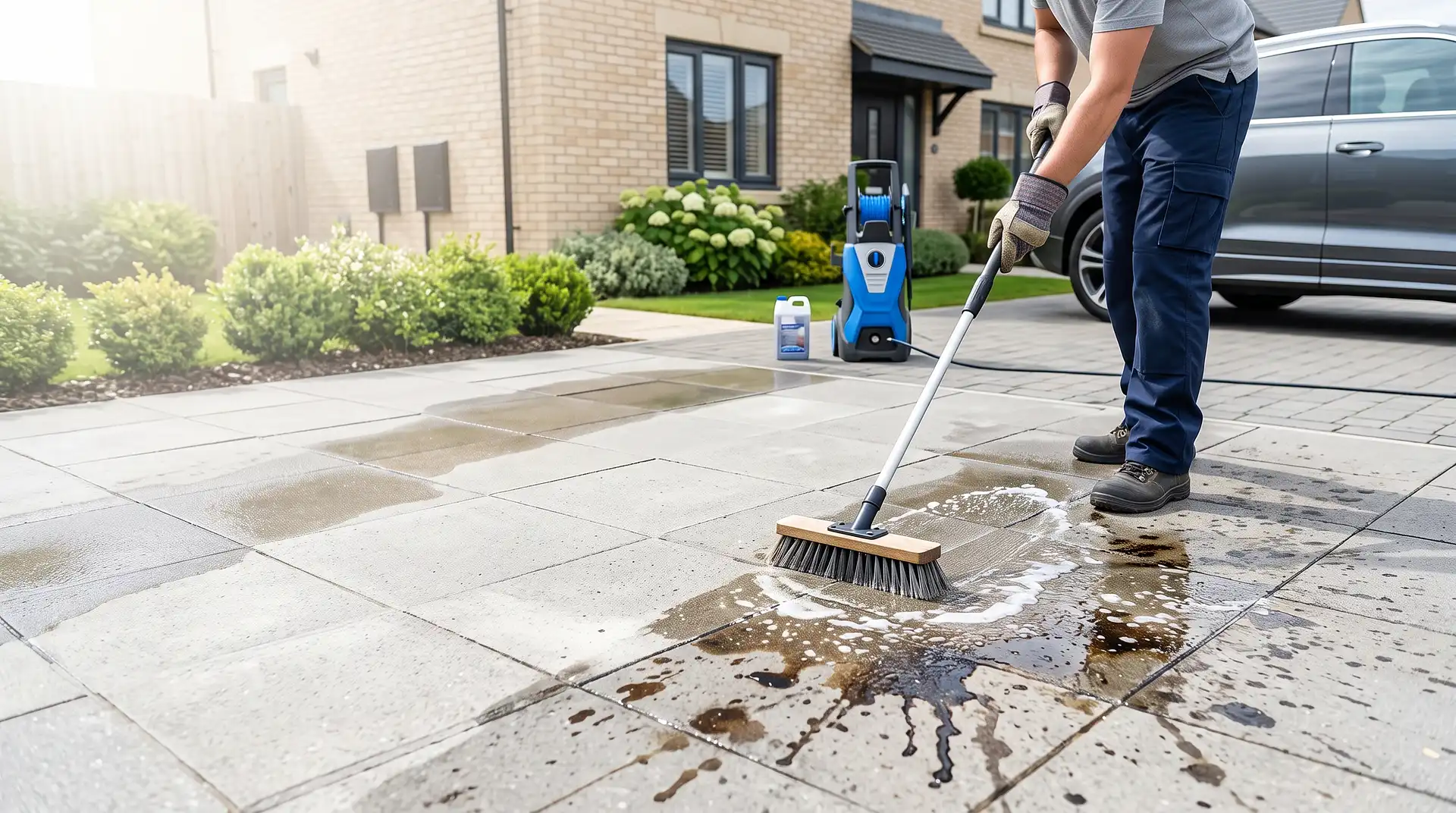
For drips that have been building up over weeks or months, absorption alone won't be enough. Apply a dedicated driveway degreaser directly to the stained area and work it in with a stiff, non-wire brush, then leave it to dwell for the time stated on the product, commonly 10 to 20 minutes, before scrubbing again and rinsing. Repeated drip staining in one spot often needs two or three treatment cycles rather than one, since the oil has been reapplied to the same area over an extended period rather than arriving all at once.
The Poultice Method for Deep-Set Drips
Where drips have accumulated in the same spot for months, a poultice works better than repeated surface treatment. Mix an absorbent powder, baking soda or a proprietary poultice product, with a degreasing liquid into a thick paste, spread it over the stain, cover with plastic sheeting to slow evaporation, and leave for 24 to 48 hours. This actively draws oil out of the surface pores rather than just treating what's visible, which is exactly what a long-accumulated drip stain needs.
Method by Driveway Surface
Concrete is porous and absorbs drip oil readily, which is why concrete driveways show drip staining most visibly. The upside is that the same porosity means degreasers and poultices work reasonably well at drawing oil back out.
Tarmac is more oil-resistant than concrete generally, but oil can soften tarmac over time with prolonged, repeated exposure in the same spot, which is a genuine argument for fixing a recurring drip rather than just cleaning around it. Avoid high-pressure washing on older or already-softened tarmac.
Block paving complicates things, since drips seep into the jointing sand between blocks as well as the block faces. Persistent drip staining sometimes needs the jointing sand removing and replacing, or individual affected blocks lifting, rather than continued surface treatment.
Resin bound is less porous than concrete and tends to hold oil closer to the surface, which can make it easier to clean promptly but harder to fully draw out once set. Prompt treatment matters more here than on more porous surfaces.
Gravel genuinely can't be cleaned in place in the way a solid surface can. The practical fix is removing and replacing the affected stones rather than attempting to treat them where they lie.
Preventing Recurring Drips
Once the leak itself is fixed, a few practical steps stop future drips becoming stains. A purpose-made drip tray or absorbent mat under the parked vehicle catches anything before it reaches the surface, worth using even after a repair if the vehicle is older and prone to occasional weeping. Sealing a concrete or block paved driveway makes it meaningfully less porous, so future drips sit on the surface where they're easier to wipe up rather than soaking straight in.
If your driveway is genuinely past the point where cleaning helps, badly stained across a large area, softened tarmac, or a surface at the end of its useful life, replacement becomes the practical conversation instead. Our related guide on the InstantCost blog covers how much a resin driveway costs , worth reading if you're weighing up whether a resurface makes more sense than continuing to treat staining, since resin's lower porosity handles future drips differently than an ageing concrete or tarmac surface would.
Common Mistakes and What to Do Instead
Mistake: treating the stain repeatedly without fixing the leak. This is the defining mistake with drips specifically. Cleaning a spot that's actively being re-dripped onto is maintenance, not a fix. Identify and repair the source first.
Mistake: wiping fresh drips rather than blotting them. Wiping spreads oil across a wider area and pushes it further into the surface. Press absorbent material down firmly instead.
Mistake: pressure washing before degreasing. High pressure alone doesn't break oil's bond with the surface and can drive it deeper into porous concrete. Degrease first, then use pressure washing only to rinse.
Mistake: expecting one treatment to clear months of accumulated drips. Repeated drip staining in the same spot typically needs multiple degreaser cycles or a full poultice treatment, not a single attempt.
Mistake: using the same approach on every surface. Block paving joints, resin's lower porosity, and gravel's inability to be cleaned in place all need genuinely different responses than a straightforward concrete treatment.
When It's Beyond Cleaning
Some drip staining genuinely won't come out, particularly where oil has been accumulating in one spot for years, or where tarmac has softened from prolonged exposure. At that point the realistic options are localised repair, resurfacing, or accepting a permanently marked area. If the driveway is also showing its age in other ways, cracking, sinking, or a surface past its expected lifespan, that's the moment to weigh a full replacement rather than continuing to spend on treatments that won't fully resolve it.
What It Costs in the UK
DIY treatment is inexpensive. A dedicated driveway degreaser typically costs £15 to £40, absorbent material costs a few pounds, and a stiff outdoor brush costs £10 to £20 if you don't already own one. A drip tray or absorbent mat to prevent future drips typically costs £10 to £30.
If staining is permanent and resurfacing becomes the answer, according to InstantCost.co.uk's 2026 UK driveway pricing data, replacement costs vary considerably by material: gravel at £55/m², tarmac at £75/m², concrete at £85/m², block paving at £110/m², resin bound at £130/m², and Indian sandstone at £160/m², all supplied and fitted including VAT and groundwork. On a typical 36m² double driveway, that ranges from roughly £1,980 for gravel to £5,760 for Indian sandstone. A protective sealant, worth considering specifically to reduce future oil absorption, is priced as a £320 optional extra.
Item or Service | Typical UK Cost (2026) |
|---|---|
Driveway degreaser | £15 to £40 |
Absorbent material | A few pounds |
Drip tray or absorbent mat | £10 to £30 |
Protective sealant (reduces future absorption) | £320 |
Replacement: gravel, per m² | £55 |
Replacement: tarmac, per m² | £75 |
Replacement: concrete, per m² | £85 |
Replacement: block paving, per m² | £110 |
Replacement: resin bound, per m² | £130 |
Replacement figures are based on InstantCost.co.uk's 2026 UK driveway pricing data, which includes VAT, excavation, sub-base preparation and removal of the existing surface. Always get two to three local quotes before booking replacement work.
Staying Safe
Driveway degreasers are stronger than household cleaning products, so wear gloves and avoid skin contact. Check the product label for guidance on run-off, since some degreasing chemicals shouldn't drain untreated into drains or onto nearby planting. If you're using a pressure washer for the rinse stage, keep it at a sensible distance from the surface, particularly on older tarmac that may already have softened from oil exposure.
Keep children and pets away from the area while degreaser or poultice treatment is applied and dwelling, and store products in their original labelled containers out of reach once you've finished.
Product-specific safety data varies by manufacturer, so check the label for dwell time and drainage guidance before use, particularly near planting or in a household with children or pets.
FAQ
Why do oil drips keep reappearing on my driveway? Because the source is still leaking. Drips differ from a one-off spill in that a vehicle is actively producing more, so cleaning without repairing the leak means the staining returns indefinitely.
How do I find out where the oil is dripping from? Slide a large sheet of cardboard under the parked vehicle overnight. The position of fresh drips shows roughly which part of the car is leaking, and the colour indicates the fluid type, brown to black for engine oil, reddish for transmission fluid.
What's the best way to remove old drip stains from concrete? A poultice, absorbent powder mixed with degreasing liquid, spread over the stain, covered, and left for 24 to 48 hours, works better on long-accumulated stains than repeated surface scrubbing.
Can oil drips damage a tarmac driveway? Yes, prolonged repeated exposure in the same spot can soften tarmac over time, which is a genuine reason to fix the leak rather than simply cleaning around it.
How do I stop future oil drips staining my driveway? Fix the vehicle leak first, then use a drip tray or absorbent mat under the parked car, and consider a protective sealant, priced at around £320, to reduce how readily the surface absorbs future drips.
When is drip staining bad enough to justify resurfacing? When staining is extensive and won't respond to repeated treatment, or when the surface shows other age-related issues alongside it. Replacement costs range from £55/m² for gravel to £160/m² for Indian sandstone in 2026.