Do I Cut a Kitchen Worktop
19 October 2026
How Do I Cut a Kitchen Worktop?
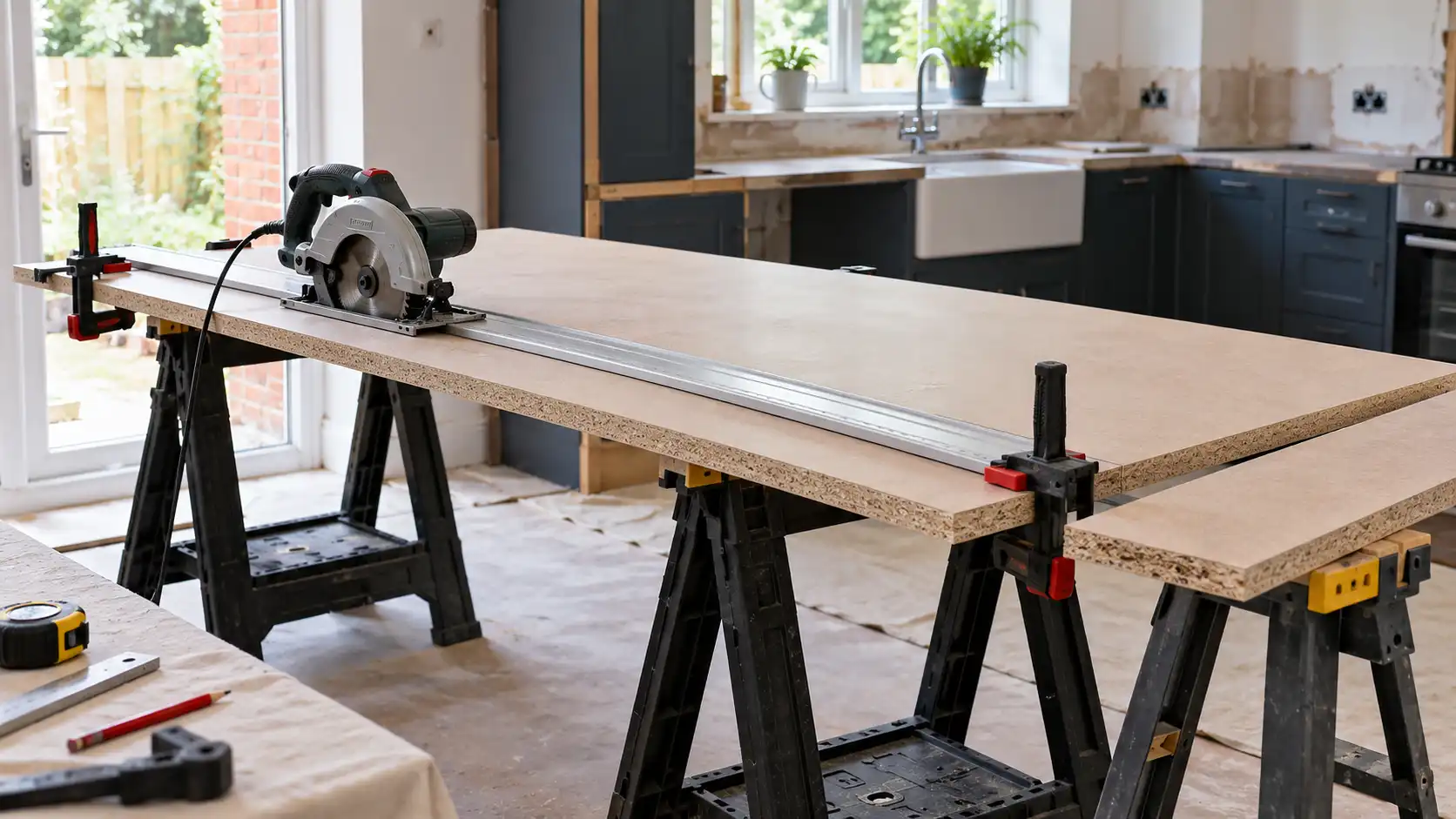
For a standard laminate worktop, measure against the fitted cabinets, support the worktop on trestles and use a sharp, fine-tooth circular saw with a clamped straight guide. With a conventional upward-cutting saw blade, place the decorative face down to reduce chipping. Use the sink or hob manufacturer's template for openings, then seal every exposed chipboard edge before fitting the appliance.
The right method depends on the material. A straight cut in laminate is a reasonable job for a confident DIYer. Stone, quartz and porcelain worktops need professional templating and fabrication.
What type of worktop are you cutting?
Worktop | Practical approach |
|---|---|
Chipboard-core laminate | A guided circular saw can make straight cuts. A suitable jigsaw can make inset sink and hob openings. Seal exposed core immediately. |
Solid wood | Use woodworking tools and the maker's fitting instructions. Allow for the specified movement and finish newly exposed timber. |
Compact laminate | Use the exact manufacturer's instructions and suitable cutters. Its dense construction, joint details and visible edges make it less forgiving than standard laminate. |
Quartz, granite or porcelain | Arrange professional measuring, cutting and fitting. Do not cut stone with ordinary DIY tools. |
If you are unsure what you have, inspect a supplied offcut or the underside. A standard laminate top normally has a chipboard core beneath a thin decorative surface. Compact laminate has a dense, consistent core instead.
What tools do you need to cut a laminate worktop?
Tape measure, pencil, square and masking tape
Two stable trestles or a properly supported cutting bench
Clamps and a straight guide or compatible saw rail
Circular saw with a sharp blade suitable for laminate
Drill and jigsaw with a blade suitable for the worktop
Scrap material to support the offcut
Eye protection, hearing protection and suitable dust protection
The worktop maker's fitting instructions and any sink or hob template
The specified product for sealing and finishing cut edges
Make a test cut on an offcut with your chosen blade and saw setting. It shows which face comes out cleaner before you touch the piece you need to install.
How do you measure the worktop before cutting?
Measure after the base cabinets are fitted, level and fixed. A drawing made before installation cannot show every uneven wall or small change in cabinet position. Put the worktop in its intended position and check the front overhang at several points.
Mark three things separately: the finished edge you want to keep, the line the saw will follow and the waste side. They are easy to confuse when you turn the worktop face down. Write “WASTE” on the offcut, and remember that the blade removes a strip of material. Position the guide so the blade cuts on the waste side of the finished measurement.
Before cutting, check that the new end will still have the intended overhang or space for an edging strip. Plan any joints over proper cabinet support and follow the worktop manufacturer's rules for the distance from sinks and hobs.
How do you make a straight cut in a laminate kitchen worktop?
Protect and support it. Put the decorative face down on clean, padded trestles if your saw and blade cut cleanly in that orientation. Support both the section you are keeping and the offcut so neither drops as the cut finishes.
Transfer the measurement. Mark the underside, checking that the mark corresponds to the correct end once the worktop has been turned over.
Set the guide. Measure the distance from your saw blade to the edge of its base plate. Clamp the straight guide at that offset from the cut line. Check it at both ends.
Check beneath the cut. Make sure the blade will clear trestles, clamps, cables and anything else below the worktop. Set the blade depth according to the saw instructions.
Make a test cut. Check for chipping and adjust the blade or setup if needed.
Cut at a steady pace. Keep the saw base flat against the worktop and against the guide. Do not force it or pull it backwards through a moving blade.
Finish the end. Remove rough fibres carefully, dry-fit the worktop and apply the specified edging or edge treatment.
A jigsaw is useful for openings, but its flexible blade can wander through a thick worktop. For a long, visible straight end, a guided circular saw generally gives better control.
How do you cut a kitchen worktop for a sink?
Use the template and instructions supplied with the actual sink. Its outside rim is usually larger than the hole you need to cut. If you simply draw around the sink and cut on that line, the rim may have nothing to rest on.
Dry-fit the worktop in its final position and mark the sink location from the finished front edge.
Look inside the cabinet below. Check the sink bowl, fixing clips, tap, waste pipe, cabinet sides and support rails will all fit.
Tape the worktop surface and mark the manufacturer's cut line. Check the front, rear and side clearances stated in the sink instructions.
Drill starter holes inside the waste area at the corners, keeping within the marked opening. Follow the worktop maker's corner-radius requirements.
Support or temporarily fix the centre piece so it cannot fall and break the last section of laminate.
Cut steadily between the starter holes with a suitable jigsaw blade. Follow the blade maker's instructions for the clean cutting face. If using a conventional upward-cutting blade, cutting from the underside generally protects the decorative surface.
Test-fit the sink before applying sealant. Make small adjustments only where needed.
Seal the entire exposed chipboard edge with the product specified by the worktop maker, including the corners. Fit the sink using its supplied seal and clips.
Useful final check: Before sealing, run your eyes around the full opening. The easily missed areas are the rear edge near the wall and the corners near tap holes. Water can reach those exposed sections even when the sink rim looks sealed from above.
How do you cut a worktop for a hob?
The marking and cutting method is similar to an inset sink, but the hob's installation instructions control the opening size, clearances and any heat protection. Check what sits underneath, including an oven, drawer, cabinet rail, cable route or gas pipe.
Do not guess a standard clearance from a general online guide. Hob models differ. Keep the required amount of worktop in front of and behind the opening, and follow the worktop and hob instructions for sealing and heat protection. Any gas connection must be handled by a Gas Safe registered engineer; electrical connection requirements depend on the appliance and installation.
When should you hire a kitchen fitter?
Ask a fitter to handle the cut if the worktop is already fixed in place near hidden services, the sink opening leaves a narrow strip of material, the joint needs a router and jig, or a mistake would mean replacing an expensive full length. Specialist materials and undermount sink openings also need the right equipment and experience.
If you are planning a wider replacement, InstantCost's kitchen fitting guide explains where the worktop sits in the installation sequence. For a fitter's quote, specify whether you need measuring, straight cuts, sink and hob openings, edging, sealing, joints and installation. Those tasks may be priced or included differently.
Considering professional worktop fitting? Use the kitchen calculator to describe your worktop and installation plans before comparing local quotes.
Check Kitchen Fitting Costs
What if the cut chips or does not fit?
If a test cut chips, stop before cutting the final piece. Check that the blade is sharp and intended for laminate, the worktop is firmly supported, the guide is secure and the decorative face is on the cleaner cutting side for your blade. Masking tape can protect a surface from the saw base and make marking easier, but it cannot correct a blunt blade or an unsupported offcut.
If a sink or hob opening is slightly tight, remove only the material needed, then test-fit again. If it is too large, do not rely on sealant to compensate. The rim and fixing clips still need proper support. Ask the supplier or a fitter to assess whether the worktop can be used safely.
If a straight end does not sit against an uneven wall, check whether the worktop needs scribing. Do not keep shortening the whole length to cure a gap at just one point.
How do you work safely?
Clamp the worktop, support the offcut, keep hands clear of the blade path and use the tool manufacturer's guards and instructions. Wear suitable eye, hearing and dust protection. Check for pipes and cables before cutting an installed worktop. Never hold a falling offcut while operating a saw.
Do not dry-cut stone worktops at home. The UK Health and Safety Executive's stone worktop guidance explains that dust from natural and engineered stone can cause serious lung disease and recommends carrying out as much cutting as possible in a suitably equipped workplace.
Frequently asked questions
Can you cut a kitchen worktop with a jigsaw?
Yes, a suitable jigsaw can cut an inset sink or hob opening in standard laminate. A guided circular saw is usually easier to control for a long, straight end cut. Test the blade on an offcut first.
Which side should face up when cutting laminate?
With a conventional handheld circular saw whose teeth cut upward through the worktop, the decorative face is generally placed down. Blade designs differ, so check your saw and blade instructions and confirm the result with an offcut.
Do you need to seal a cut laminate worktop?
Yes. The exposed chipboard core is vulnerable to moisture, especially around a sink, tap hole or joint. Use the edge treatment specified by the worktop manufacturer before fitting the sink or joining worktop sections.
Can you cut a worktop after it has been fitted?
Sometimes, but it is harder to support the material and check what is beneath the blade. If the cut is close to pipes, wiring, a hob or a cabinet rail, have a kitchen fitter inspect it first.
Need the cut-outs and fitting done for you? The InstantCost kitchen service page includes a quote request after the estimate. Describe the worktop material and the cuts you need so the scope is clear.