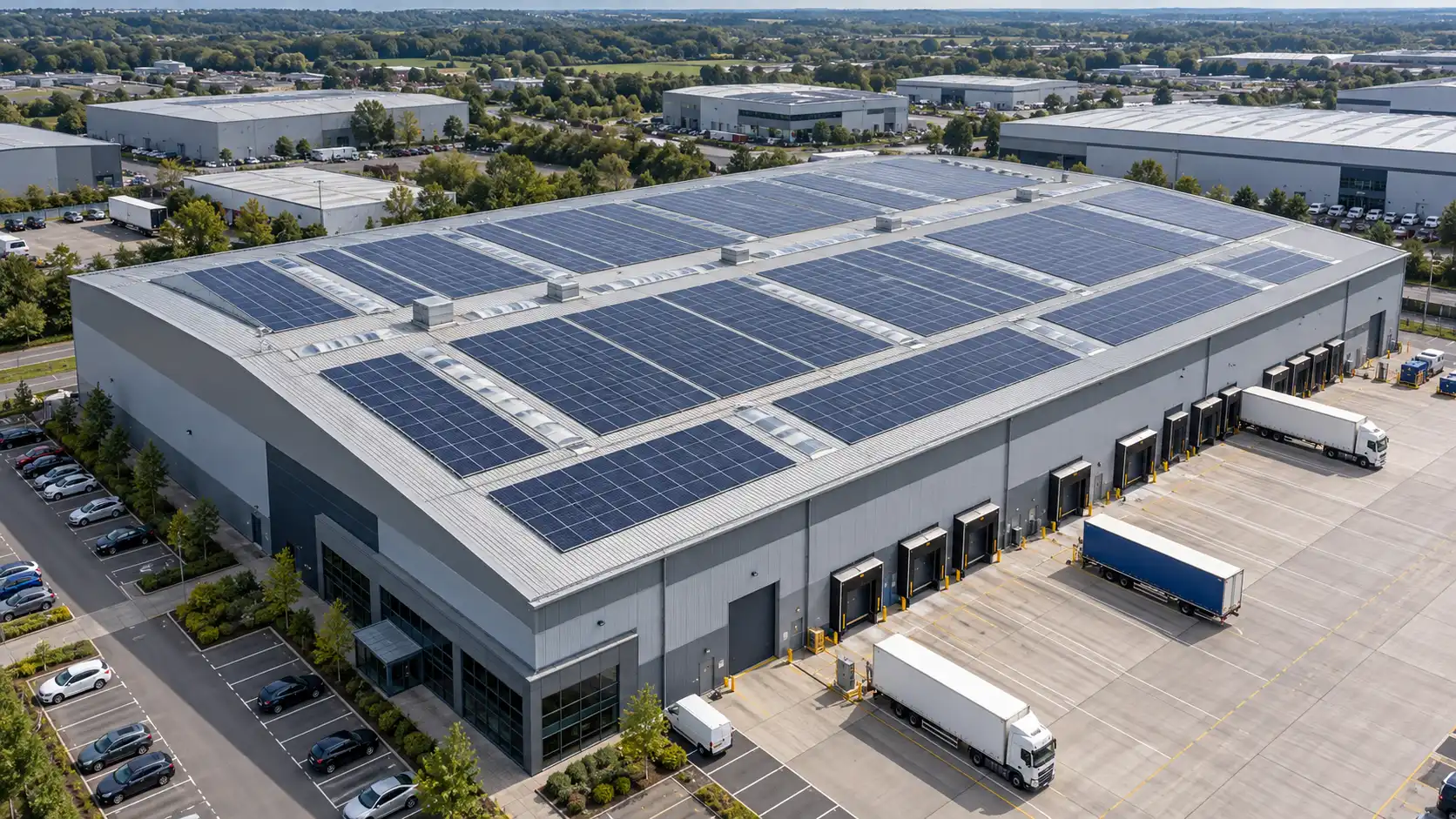
How Much Do Commercial Solar Panels Cost in the UK
16 October 2026
How Much Do Commercial Solar Panels Cost in the UK?
Commercial solar panel costs depend on the size of the system, the roof, the electricity connection and the amount of groundwork required. A small office, warehouse, farm building and industrial unit can all need very different designs and installation methods.
Quick answer: A commercial solar quote should include the panels, inverters, mounting system, labour, access equipment, electrical connection, monitoring, design, testing and grid paperwork. Batteries, roof repairs, structural work and export-limiting equipment are usually separate decisions.
What determines commercial solar panel cost?
The main cost drivers are:
Total system capacity and number of panels
Panel efficiency, warranty and mounting design
Roof structure, height, pitch and access
Scaffolding, powered access or lifting equipment
Inverter type and the number of electrical circuits
Distance between the roof array and the main switchboard
Grid connection requirements and export limits
Battery storage and energy-management controls
Roof repairs, asbestos management or structural reinforcement
Monitoring, maintenance and inspection arrangements
The lowest equipment price is not always the lowest project cost. A quote that excludes access equipment, grid studies or roof work may look cheaper until those items are added later.
What should a commercial solar quote include?
Quote section | What to check |
|---|---|
Survey and design | Roof inspection, shading assessment, structural review and system layout. |
Solar modules | Brand, model, power rating, product warranty and performance warranty. |
Mounting system | Compatibility with the roof covering, wind loading and corrosion protection. |
Inverters | Capacity, number of MPPT inputs, warranty, location and monitoring features. |
Electrical work | DC cabling, AC connection, protection equipment, switchgear and testing. |
Access and installation | Scaffolding, lifting, roof protection and working-at-height arrangements. |
Grid and compliance | DNO application, export limitation, commissioning documents and certification. |
Aftercare | Monitoring, maintenance, fault response and warranty support. |
How does system size affect the quote?
Commercial systems are normally described by their kilowatt-peak capacity, written as kWp. More panels increase equipment and installation requirements, but larger projects may spread fixed design, access and mobilisation costs across more generation capacity.
The correct size should be based on the business’s electricity demand, operating hours and available roof area. A business that uses most of its electricity during daylight may benefit from a different system size from a business that operates mainly overnight.
Ask the installer to show:
Annual generation estimate
Expected on-site consumption
Exported electricity estimate
Assumed electricity tariff
Degradation allowance
Maintenance and replacement assumptions
How does the building affect commercial solar cost?
Roof condition
Solar panels can last for decades, so installing them on a roof near the end of its service life can create a major future cost. Repair or replace the roof first if it is leaking, fragile or due for renewal.
Roof type
Flat roofs, standing-seam roofs, corrugated sheets and tiled roofs need different mounting systems. Ballasted systems may add weight, while penetrative systems need careful waterproofing.
Height and access
A low warehouse with easy vehicle access is generally simpler to work on than a high building surrounded by restricted access. Scaffolding, cranes, hoists and traffic management may all affect the final quote.
Structural capacity
The roof must support the panels, mounting system, ballast, snow and wind loads. A structural engineer may need to provide calculations before installation.
Asbestos and older materials
Older commercial buildings may contain asbestos cement roofing or fragile sheets. Do not allow drilling or roof access until the material has been identified and managed safely.
Do commercial solar installations need batteries?
No. A battery is not automatically required. It becomes more relevant when the business generates more solar power than it can use during the day, has high evening demand or wants to reduce reliance on expensive peak-period electricity.
A battery adds equipment, installation, control and future replacement considerations. Ask the installer to compare a solar-only design with a solar-and-storage design using the same electricity-demand data.
Check the battery’s usable capacity, round-trip efficiency, warranty, cycle limit, fire-protection arrangements and monitoring platform. A larger battery is not automatically better if the business rarely has surplus solar energy.
What is the difference between commercial and domestic solar?
Area | Domestic installation | Commercial installation |
|---|---|---|
System size | Usually designed around household demand and roof space. | Often larger, with multiple roof areas and electrical sections. |
Electricity use | Household demand changes throughout the day. | May include machinery, refrigeration, offices or shift patterns. |
Grid connection | Usually simpler for smaller systems. | May require DNO applications, export limits or network studies. |
Design responsibility | Residential survey and installation. | May include structural engineers, principal contractors and site controls. |
Maintenance | Often handled through a domestic installer warranty. | May need planned inspections, monitoring and service-level agreements. |
How do businesses measure the return on solar?
The return depends on how much electricity the business uses directly, the price paid for imported electricity, the value of exported electricity and the system’s operating life.
A useful business case should include:
Annual solar generation
Daytime electricity consumption
Export assumptions
Import and export tariffs
Maintenance and monitoring costs
Inverter and battery replacement assumptions
Financing or lease charges
Changes to the business premises or operating hours
Do not rely only on a headline payback period. Ask for the assumptions behind the calculation and test the result against lower generation, lower electricity prices and reduced site occupancy.
What planning and compliance issues apply?
Commercial solar projects may need planning advice, building-control input, structural calculations and a grid-connection application. The requirements depend on the building, system size, location and proposed export.
The installer should explain whether the project needs:
Planning permission or a permitted-development assessment
Building-control notification
Structural calculations
DNO approval or export limitation
Fire-safety and emergency-shutdown arrangements
Electrical inspection and certification
Roof-access and working-at-height controls
Use an installer with appropriate commercial experience and relevant certification. Ask who is responsible for applications, inspections and handover documents.
How should you compare commercial solar quotes?
Give each installer the same electricity bills and operating information.
Ask for the same system capacity assumptions where possible.
Request a separate breakdown for panels, inverters, mounting and labour.
Check whether scaffolding, cranes and traffic management are included.
Confirm whether roof repairs and structural work are excluded.
Compare warranties for panels, inverters, workmanship and batteries.
Ask who will submit grid applications and provide certificates.
Request generation estimates based on the actual roof orientation and shading.
Check payment stages and the process for variations.
Be careful with “free solar” offers. A lease, power-purchase agreement or finance arrangement may remove the upfront payment but still create long-term obligations. Read the ownership, maintenance, roof-access and removal terms carefully.
Planning a solar project?
Use the InstantCost solar calculator for domestic project benchmarks, then request a commercial survey for a business premises.
What commercial solar mistakes should businesses avoid?
Choosing a system size without checking the business’s daytime electricity demand
Installing panels on a roof that needs replacement soon
Ignoring structural capacity and wind loading
Assuming the grid will accept unlimited export
Comparing quotes with different inclusions
Leaving access, scaffolding or lifting costs out of the budget
Failing to plan inverter replacement and monitoring
Choosing a domestic installer without commercial site experience
Ignoring fire access and emergency isolation requirements
Relying on savings estimates without checking the assumptions
What information should you give a commercial solar installer?
Provide at least twelve months of electricity bills, half-hourly usage data if available, details of operating hours and information about future changes to the premises. Include roof plans, access restrictions, asbestos records and any planned roof works.
Tell the installer about large loads such as refrigeration, machinery, electric vehicle charging, heat pumps and process equipment. These loads can change both the system size and the value of using solar power on site.
Frequently asked questions
How much do commercial solar panels cost in the UK?
There is no single commercial price because system size, roof condition, access, grid requirements and electrical design vary widely. Request an itemised survey-based quote rather than relying on a domestic per-panel figure.
Is commercial solar cheaper per panel than domestic solar?
Larger projects can spread fixed design and installation costs across more panels, but commercial roofs may require additional engineering, access equipment, switchgear and grid work. The total project should be compared on a cost-per-kWp basis with the full scope included.
Do businesses need planning permission for solar panels?
Some installations may fall within permitted development, while others need planning permission or additional assessment. The building type, location, roof design and system size affect the answer. Ask the installer to confirm the route in writing.
Do commercial solar panels need a battery?
No. A battery is useful when a business has significant surplus solar generation or high electricity demand outside daylight hours. Compare solar-only and storage designs using real usage data.
Can solar panels be installed on a warehouse roof?
Yes, provided the roof is structurally suitable, safe to access and capable of supporting the proposed system. Older, fragile or asbestos-containing roofs need specialist assessment.
How long does a commercial solar installation take?
The physical installation may be completed quickly once design, roof checks, equipment and grid approvals are ready. Larger projects can take longer because of structural work, DNO requirements, access planning and commissioning.
What happens to unused commercial solar electricity?
It can be exported to the grid if the connection permits, stored in a battery or curtailed by an export-control system. The value depends on the business tariff and export arrangement.
What warranties should commercial solar panels have?
Check the panel product and performance warranties, inverter warranty, mounting-system warranty, workmanship cover and battery warranty. Confirm who handles claims if the installer stops trading.
Ready to compare your solar options?
Review UK solar guidance before requesting a site survey and commercial proposal.